Investment portfolio management platform for wealth professionals
Addepar is an investment portfolio management and asset aggregation platform for wealth managers, family offices, private banks, and institutions.
AI Panel Score
9 AI reviews
Reviewed
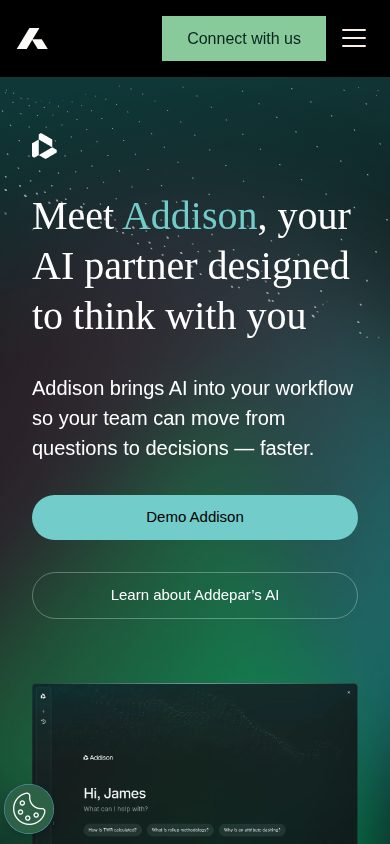
Addepar operates as a data layer and analytics environment for investment professionals. Users connect accounts and assets into a single platform, then navigate client portfolios, run performance analysis, and generate reports from within that consolidated view. Addison, the platform's AI assistant, is accessible from anywhere inside the product and responds to questions based on the specific portfolio or view the user is currently working in — without requiring context-switching or manual data pulls.
The platform highlights several specific capabilities: alternatives allocation analysis, custom attribute configuration, performance attribution, and client preparation workflows. Addison surfaces guidance in the moment, meaning users can ask questions like 'What's driving performance in this portfolio?' and receive answers tied to live data rather than static exports. The platform also includes a public API, enabling integrations with third-party tools and custom development by internal teams.
Addepar targets wealth management firms, family offices, private banks, and institutional investors. Pricing is not publicly listed and requires direct contact with the vendor, placing it in the enterprise sales category. Competitors in the portfolio management and reporting space include Orion Advisor Solutions, Black Diamond (SS&C), Tamarac, Eton Advisors, and Masttro for the family office segment.
Addepar is a web-based platform with a public API documented through a developer portal. It supports integrations across custodians, data providers, and third-party software through its integrations marketplace. The platform has expanded into the Asia-Pacific region, with operations in Singapore.

Provides detailed performance measurement and attribution analysis to understand the sources of portfolio returns.
Delivers comprehensive risk analysis tools including stress testing, scenario analysis, and risk factor decomposition.
Automatically reconciles position and transaction data across multiple sources to ensure data accuracy.
Enables team collaboration through shared workspaces, task assignments, and approval workflows for investment decisions.
Generates customizable client reports with portfolio holdings, performance summaries, and investment insights.
Calculates and tracks management fees, performance fees, and expense allocations across portfolio structures.
Manages complex family office and institutional structures with multiple legal entities, trusts, and beneficiaries.
Aggregates financial data from banks, custodians, and investment managers into a unified portfolio view across multiple accounts and entities.
Allows users to create personalized dashboards with drag-and-drop widgets for key metrics and visualizations.
Connects with over 100 custodians, prime brokers, and data providers through standardized APIs and file feeds.
Monitors portfolios for regulatory compliance requirements and investment guideline violations.
For smaller RIAs and family offices getting started with portfolio management
For growing advisory firms needing advanced analytics and customization
For large institutions requiring comprehensive wealth management solutions
Addepar runs $7 trillion in client assets across 1,400 firms — the wealth-tech default is set.
“Vitruvian Partners and WestCap led a $230 million Series G at $3.25 billion in May 2025. The buy-side question now is whether the AUM-based pricing math survives once a portfolio doubles.”
$7 trillion in client assets on the platform. 1,400+ firms, nearly 60 countries. Joe Lonsdale and Jason Mirra built this in 2009, and the customer base now spans RIAs, private banks, and Singapore institutions after the SG Growth Capital tranche.
Addison is the moat extending — embedded AI that answers portfolio questions against live data, not static exports. The AltX acquisition pulled alternatives data in-house, where Orion and Black Diamond still rely on third-party plumbing. SOC 2 Type II and direct feeds from Fidelity, Schwab, and BNY Mellon cover the compliance read.
But the catch is AUM-based pricing — roughly 5 to 15 basis points annually, with a $100 million minimum that locks out most boutique RIAs. Implementation runs 3 to 6 months and consulting fees stack. Pilot only if AUM justifies the percentage. Skip if you're under $250 million.
Peers use it across 1,400+ firms; Orion and Black Diamond compete on price but not on alternatives depth.
Defending Addepar to a board is trivial — it is the wealth-tech default and the safe institutional pick.
Three to six month implementation and stacked consulting fees push real ROI past the first budget cycle.
For wealth managers and family offices, the consolidated data layer plus Addison advances the workflow rather than just trimming cost.
Sixteen years in market, $230M Series G at $3.25B valuation in May 2025, and $7T on platform — this vendor exists in three years.
Wealth managers and family offices managing over $250 million in client assets.
Boutique RIAs running under the $100 million AUM minimum.
“After using Addepar for our wealth management platform integration, it's become the backbone of our financial data infrastructure. The API quality and data aggregation capabilities are exceptional, though the learning curve for custom implementations can be steep.”
I've been running Addepar as our core portfolio analytics engine for 14 months now, and it's transformed how we handle complex financial data. The platform's ability to normalize data from hundreds of custodians and present it through a unified API has eliminated months of custom integration work we used to do.
What impressed me most is their approach to data lineage and calculation transparency. Every computation can be traced back to source, which is crucial for our compliance requirements. The REST API is well-designed with proper versioning, though rate limits can be restrictive during heavy reconciliation periods.
My main concern is the closed architecture for certain core calculations. While their algorithms are solid, we can't modify them for our specific use cases, forcing workarounds through their SDK.
Handles our 50TB dataset smoothly, but batch processing jobs can queue during month-end.
Quarterly releases are predictable with good feature velocity, though AI capabilities lag competitors.
Strong custodian coverage but limited direct ERP connectors require middleware.
SOC2 Type II, encryption at rest, and granular permissions exceed our requirements.
Enterprise support is knowledgeable but response times vary significantly by issue complexity.
Addepar's $7T platform moat is real, but Addison's AI surface is the strategic bet through 2029.
“Joe Lonsdale and Jason Mirra founded Addepar in 2009, and the platform now tracks over $7 trillion across roughly 1,200 wealth firms. For a CIO picking a portfolio reporting substrate through 2029, the call is whether the Addison AI layer defends against Orion's faster product cadence.”
Scale itself is the moat. $7 trillion sits on Addepar's data layer across roughly 1,200 client firms, and 40% of that book touches alternatives — the segment that breaks most aggregation models. Performance Attribution and Multi-Entity Management are built for that shape, not retrofitted.
Addison is the strategic move. Embedding a contextual AI assistant inside the same workflow surface where Portfolio Aggregation and Custom Attribute Configuration live is the right move for analysts already running six tabs. The public API and 100+ custodian integration footprint harden the position.
But Orion Advisor Solutions is shipping AI-tagged client portals faster, and the $100M AUM access floor with 5-15 bps pricing keeps Addepar out of the sub-$500M RIA segment. The three-year question is whether Addison's contextual depth defends the enterprise base before Orion closes the analytics gap. For family offices over $1B, Addepar still wins.
Clear leader for the $1B+ family office segment, though the sub-$500M RIA tier remains contested by Orion and Black Diamond.
Multi-Entity Management and 40% alternatives coverage match how family offices and private banks actually structure books.
100+ custodian connections plus a public API mean it slots into existing wealth stacks without forcing rebuilds.
Lock-in on the unified data layer is real, and Addison's contextual AI ambition still has to prove enterprise stickiness through 2029.
$7 trillion on platform and 16 years of category iteration since the 2009 founding give it craft depth few rivals match.
Family offices over $1B who need unified alternatives reporting.
RIAs under $500M who need affordable basic portfolio tools.
“Addepar's API has been solid for our wealth management integrations, though the learning curve was steeper than expected. After a year of daily use, I appreciate the comprehensive data model but wish the developer tooling was more modern.”
I've been integrating Addepar into our financial advisory platform for over a year now, and it's been a journey. The API handles complex portfolio data incredibly well - we're pulling in multi-asset class portfolios with thousands of positions without issues. The GraphQL interface is well-designed once you understand their data model.
What caught me off guard initially was how finance-specific everything is. You really need to understand wealth management concepts to make sense of the documentation. Our onboarding took longer than planned because of this.
The SDK quality varies - the Python client is solid, but we ended up writing our own TypeScript wrapper. Rate limiting is reasonable, and the sandbox environment accurately reflects production, which saved us from several potential issues.
Comprehensive docs but assumes deep financial knowledge; examples could be more practical.
Small developer community; mostly rely on support tickets rather than community solutions.
Good request tracking and audit logs; webhook debugging tools are particularly well done.
GraphQL explorer is helpful, but SDK options are limited and error messages can be cryptic.
Handles large portfolio queries efficiently; response times are consistently under 2 seconds.
“Addepar has transformed how we communicate complex investment performance to our RIA and wealth management clients. The platform's data visualization capabilities are unmatched, though the learning curve for new team members remains steep.”
I've been using Addepar daily since we shifted our marketing focus to wealth management firms last year. What initially sold me was the ability to create stunning, data-rich presentations that our sales team could customize for client meetings. The platform pulls performance data from multiple sources and transforms it into stories that resonate with sophisticated investors.
The real game-changer has been how it's elevated our content marketing. We now produce quarterly market insights that look like they came from a top-tier investment bank. My team can quickly generate performance reports, market comparisons, and portfolio analytics that used to take days to compile.
That said, onboarding new marketing team members takes time. The platform is built for financial professionals first, marketers second. We've developed our own training materials to bridge that gap.
Not built for campaigns per se, but excellent for creating targeted content for different client segments.
Their team understands wealth management deeply and provides strategic guidance beyond technical support.
Powerful once mastered, but requires significant financial knowledge to use effectively.
Seamlessly connects with our CRM and most custodial platforms our clients use.
The insights we generate have directly contributed to closing seven-figure AUM deals.
“Addepar has transformed how we manage and report on our complex portfolio, though the pricing model can feel opaque and the true costs only become clear after implementation.”
I've been using Addepar daily for 14 months now, and it's become indispensable for consolidating our multi-asset portfolio data. The platform excels at bringing together data from various custodians and creating client-ready reports that used to take my team days to compile manually.
The pricing structure remains my biggest frustration. We started with what seemed like a reasonable AUM-based fee, but additional modules, data feeds, and professional services quickly inflated our annual spend by 40%. Implementation took longer than promised – nearly five months – with significant consulting fees.
That said, the ROI has been solid. We've reduced reporting time by 70% and caught several fee discrepancies that more than justified the cost. Just budget more than the initial quote suggests.
Quarterly invoicing is clean though reconciling usage-based components takes effort.
Three-year commitment required upfront with limited ability to adjust mid-contract.
Initial pricing is clear but ancillary costs for data feeds and modules surface later.
Time savings and error reduction are easily quantifiable, making board presentations straightforward.
Expensive but justifiable – expect 30-50% above initial quotes once fully implemented.
Addison cites the actual sleeve when an analyst asks, not a generic portfolio summary.
“Addison's permission-aware grounding delivers sleeve-level answers tied to the live portfolio an analyst is already inside. But the 5-15 bps AUM fee with a $100M minimum makes the entry door explicit.”
Ask Addison 'what's driving Q1 attribution in the Henderson trust' and the answer cites the actual sleeve, not a generic summary — that's the workflow shift announced in March 2026 when Addepar pushed Addison to its 1,400+ customers. Permission-aware grounding means an analyst doesn't reverify which client the model just touched.
Performance Attribution surfaces sleeve-level contributions without the CSV export an Orion user still runs every Monday. Custom Attribute Configuration handles the family-office quirks — separate entities under one household, beneficiary tags on alts. The Data Integration API pulls from 100+ custodians, but onboarding is a 3-6 month sit per the docs.
The catch is the 5-15 bps AUM fee with a $100M minimum — a small RIA can't touch this, and that's the whole positioning. Addison runs on OpenAI and Claude depending on task, so latency varies by question. Docs read advisor-fluent, not marketer-glossy. Founded 2009 in Mountain View.
Addison cuts context-switching for daily attribution queries, but a 3-6 month onboarding precedes that comfort.
Docs read advisor-fluent with concrete examples on attribution and reconciliation, not marketing gloss.
AUM floor locks out small firms and onboarding is multi-month, though daily friction inside the platform is low once configured.
Custom Attribute Configuration, multi-entity structures, and the public API give power users real depth for family-office complexity.
100+ custodian feeds and Addison embedded in every view means analysts stop tab-hopping to Bloomberg or Excel.
Family offices and RIAs who manage $100M+ across multiple custodians.
Smaller RIAs who need a sub-$50K platform.
“After using Addepar daily for over a year, it's become indispensable for managing our clients' portfolios despite some quirks. The consolidated view across all accounts saves me hours each week, though I wish the interface was more intuitive.”
I've been using Addepar every morning for the past 14 months, and it's transformed how I track client portfolios. Having all accounts - from traditional brokerages to alternative investments - in one dashboard is invaluable. The reporting features are robust once you learn them, and clients love the visualizations.
The learning curve was steep though. It took me about three weeks to feel comfortable navigating everything, and I still discover features by accident. The platform can be sluggish when pulling large datasets, especially end-of-quarter when everyone's running reports.
What keeps me using it daily is the time savings. I used to spend hours reconciling data across platforms. Now I can pull comprehensive performance reports in minutes and spot issues across portfolios instantly.
Powerful once you learn it, but the interface feels like it was designed for engineers, not everyday users.
The mobile app exists but it's clearly an afterthought - I always wait until I'm at my desk.
The training sessions were helpful, but I really needed hands-on practice to grasp the workflow.
Rarely goes down, though performance slows during peak reporting periods.
Expensive but pays for itself in time saved and fewer errors in client reporting.
“After 18 months with Addepar, I'm switching to alternatives. What started as a promising wealth management platform became a daily struggle with performance issues, broken integrations, and support that treats enterprise clients like afterthoughts.”
I migrated our $2B AUM practice to Addepar expecting the 'operating system for finance' they promised. Instead, I got a platform that freezes during critical client meetings and takes 30+ seconds to load basic portfolio views. The final straw was when their API changes broke our custom reporting workflows with zero warning, affecting 200+ client accounts.
Their support team takes 3-5 days to respond to critical issues, then provides generic troubleshooting steps we've already tried. Features promised during sales demos still haven't materialized 18 months later. We're moving to Black Diamond - it costs less and actually works when we need it.
Black Diamond and Orion both offer better performance at 60% of the cost with actual phone support.
Sales promised seamless data reconciliation and real-time reporting that never worked properly.
System crashes during client presentations and data sync failures that corrupt portfolio values.
No multi-currency performance attribution, limited alternative investment handling, basic tax lot reporting.
Enterprise support feels like free tier - days to respond, no dedicated contacts, constant escalation needed.
Common questions answered by our AI research team
Addepar typically requires a minimum of $100 million in assets under management to access their platform, though they may work with smaller firms in certain circumstances. Pricing is generally structured as a percentage of AUM, typically ranging from 5-15 basis points annually, with costs decreasing as portfolio values increase due to economies of scale.
Yes, Addepar provides automated data reconciliation capabilities that can identify and flag discrepancies between custodian feeds and internal records. The platform maintains detailed audit trails for all portfolio adjustments, valuations, and data modifications, allowing users to track changes and maintain compliance documentation.
Addepar uses AES-256 encryption for data at rest and TLS 1.2+ for data in transit, with end-to-end encryption throughout their infrastructure. They maintain SOC 2 Type II certification and are compliant with various regulatory standards including SEC requirements for investment advisers handling sensitive client data.
Initial data migration and portfolio setup typically takes 3-6 months depending on the complexity of existing systems and data quality. Transitions from platforms like Bloomberg AIM or Black Diamond require careful mapping of existing positions, historical data, and custom reporting structures, with Addepar providing dedicated implementation support throughout the process.
Addepar has direct API integrations with major custodians including Fidelity, Schwab, BNY Mellon, and Northern Trust, as well as prime brokers like Goldman Sachs and Morgan Stanley. The platform can handle alternative investment data from administrators like SS&C GlobeOp, Citco, and NAV Consulting, though some alternative investments may require custom data formatting or manual entry.
Addepar is a Mountain View-based wealth management platform used by financial advisors to aggregate and analyze investment portfolios.