Automated investing and high-yield cash management in one account
Wealthfront is an automated investing and cash management platform for individual investors seeking hands-off wealth building.
AI Panel Score
6 AI reviews
Reviewed
Users open a Cash Account, Automated Investing Account, or Stock Investing Account through Wealthfront's web or mobile app. The Automated Investing Account builds a personalized portfolio of index funds based on a risk score (0.5–10), then manages it continuously — rebalancing, reinvesting dividends, and applying tax-loss harvesting automatically. The Stock Investing Account allows self-directed buying of individual stocks and ETFs with zero commissions and a $1 minimum.
Wealthfront highlights several specific capabilities on its platform: Tax-Loss Harvesting, S&P 500 Direct Indexing, an Automated Bond Ladder, and a 529 Education Savings Plan. The Cash Account supports up to $8M in FDIC insurance through a network of program banks, and APY can be raised above the 3.30% base rate through a new-client boost (0.65% for 3 months on up to $150,000) or a permanent 0.25% increase tied to a $1,000/month direct deposit plus an active investing account. As of February 2026, the platform reports a 9.83% average annual return since inception for its Classic Automated Investing Account at a composite risk score of 9.
Wealthfront targets individual investors who want to automate savings and investing without ongoing advisor interaction. The platform charges zero account fees on its Cash Account and zero commissions on stock trades; the Automated Investing Account carries a 0.25% annual advisory fee (not stated on the homepage but a widely published figure). Competitors in the robo-advisor space include Betterment, Fidelity Go, and Schwab Intelligent Portfolios; Wealthfront has received external recognition specifically for direct indexing and tax-loss harvesting relative to Fidelity, Schwab, and Vanguard.
Wealthfront is accessible via web browser and mobile apps on iOS (4.8 App Store rating) and Android (4.9 Google Play rating). The platform also trades publicly on the NASDAQ under the ticker WLTH.

Automatically constructs and manages a bond ladder strategy as a distinct investing account for fixed-income investing.
Builds and manages a personalized portfolio of diversified index funds automatically, handling rebalancing and optimization without requiring user intervention or advisor contact.
Automatically identifies and sells investments at a loss to offset taxable gains, reducing the client's tax liability over time.
Offers a tax-advantaged 529 account managed automatically to help clients save for education expenses.
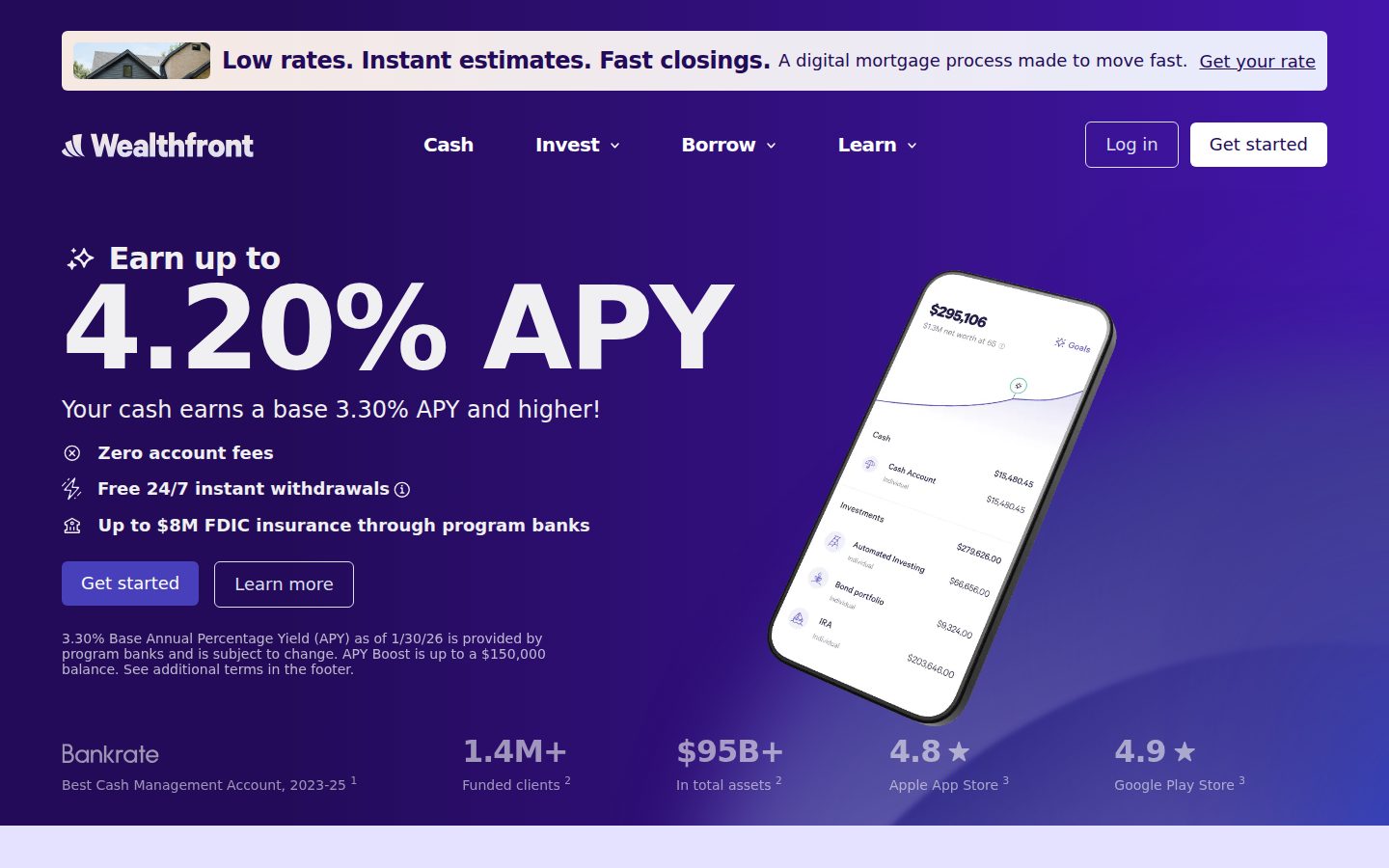
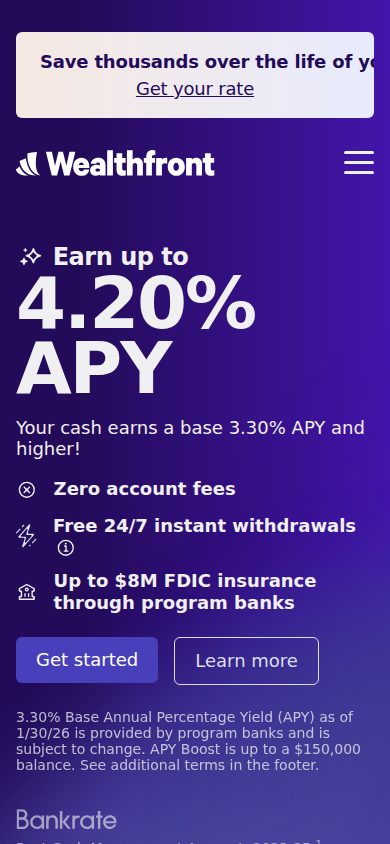
Earns a base 3.30% APY with the ability to boost to up to 4.20% APY through new client promotions or direct deposit requirements, on balances up to $150,000.
Permanently raises the Cash Account APY by 0.25% with no expiration date or balance limit when a client direct deposits $1,000 per month and holds an investing account.
Allows clients to withdraw cash from their account at any time, instantly, with no fees.
Provides managed retirement investment accounts (such as IRAs) built from diversified index funds and handled through Wealthfront's automated platform.
Lets users buy individual stocks and ETFs with zero commissions and a $1 minimum, designed for long-term investing without features that encourage frequent trading.
Charges no account fees on the Cash Account, allowing clients to keep all interest earned on their cash balance.
Enables clients to own individual stocks that replicate the S&P 500 index directly, allowing for more granular tax-loss harvesting at the individual stock level.
Provides up to $8 million in FDIC insurance on cash balances through a network of program banks.
High-yield cash management account for savers looking to earn interest on deposits
All-in-one robo-advisor portfolio of diversified index funds for long-term growth, managed automatically
Self-directed brokerage account for investors who want to pick their own stocks and ETFs
Wealthfront is the default robo-advisor pick for hands-off individual investors.
“NASDAQ-listed, 9.83% average annual return since inception, and a 0.25% fee that tax-loss harvesting covers six times over. Strong product, narrow audience.”
Wealthfront trades publicly under WLTH and has been in market long enough to post real return data. That 9.83% average annual return since inception isn't marketing — it's a defensible number. Against Betterment and Fidelity Go, they've carved a real moat in direct indexing and automated tax-loss harvesting.
Two things make the fee math work. One: the 0.25% advisory fee is offset by tax-loss harvesting that reportedly covers it 6x. Two: $8M FDIC insurance on the Cash Account is genuinely differentiated for high-balance savers. The APY boost mechanics — up to 4.20% — are fair, though they require a direct deposit plus an investing account to unlock permanently.
The tradeoff is real: this is built for passive individual investors, not active traders or institutions. If you want control, the Stock Investing Account starts at $1, but the platform won't reward you for using it actively.
S&P 500 Direct Indexing and automated tax-loss harvesting differentiate Wealthfront from Betterment and Fidelity Go on after-tax returns.
NASDAQ-listed, 4.8/4.9 app ratings, and external recognition for direct indexing over Schwab and Vanguard — easy to defend in a board conversation.
Cash Account earns 3.30% APY from day one with no setup friction and instant withdrawals — value starts immediately.
Advances personal wealth-building through automation, but won't change a company's competitive trajectory — this is an employee benefit or individual tool, not enterprise infrastructure.
Publicly traded on NASDAQ under WLTH with years of published return data — not a funding-round bet.
Individual investors who want a fully automated, tax-efficient portfolio with no advisor interaction.
You want active trading tools or hands-on financial advisor guidance.
Wealthfront's automation depth makes it the default robo-advisor for self-directed wealth builders.
“At 0.25% annually with tax-loss harvesting that reportedly covers that fee 6x over, the unit economics are genuinely strong. The $8M FDIC insurance coverage and S&P 500 Direct Indexing separate it from Betterment and Fidelity Go at the feature level.”
The 0.25% advisory fee is the number everything else must justify, and Wealthfront's automation stack does. Tax-loss harvesting, automatic rebalancing, and S&P 500 Direct Indexing are not bolt-on features here — the changelog and product architecture suggest they're core to how the platform generates after-tax alpha. A reported 9.83% average annual return since inception at composite risk score 9 is a defensible number to put in front of a board.
The Cash Account structure — 3.30% base APY, up to 4.20% with direct deposit and an investing account, $8M FDIC through program banks — is a genuine liquidity management tool, not just a marketing hook. If I'm running personal treasury across cash and long-term equity, having both in one automation layer reduces operational friction meaningfully.
The constraint is control surface. There's no API access documented, no advisor escalation path for complex situations, and the platform targets individuals, not entities. If your financial complexity grows — trusts, business accounts, multi-entity planning — Wealthfront won't grow with you. It's a strong personal wealth platform with a defined ceiling.
External recognition for tax-loss harvesting and direct indexing over Fidelity, Schwab, and Vanguard puts it at the top of the robo-advisor segment.
Built for individual investors, not practitioners managing complex multi-entity or institutional financial structures.
No documented API, no third-party integrations surface — the platform is self-contained, which limits fit into broader financial tech stacks.
If wealth complexity scales into trusts or business accounts in 3 years, the platform's individual-investor architecture becomes a constraint.
S&P 500 Direct Indexing and Automated Bond Ladder signal genuine sophistication beyond category-standard robo-advisor offerings.
Individual investors who want institutional-grade automation — tax harvesting, rebalancing, bond laddering — without paying for a full advisory relationship.
Your financial complexity spans multiple entities, trusts, or business accounts that require advisor oversight and system integrations.
0.25% advisory fee, 9.83% returns since inception — math lands in the client's favor
“Wealthfront's fee structure is cleaner than most robo-advisors. The 0.25% annual advisory fee on the Automated Investing Account is widely published and the Cash Account charges zero.”
$0 account fee on cash. $0 commissions on stock trades. The only real cost: 0.25% annually on the Automated Investing Account. On a $50,000 balance, that's $125/year. On $100K, $250. Not a hostage contract.
Tax-loss harvesting reportedly covers that 0.25% fee more than 6x over for Classic portfolio clients — based on their FAQ. That's a measurable ROI claim, not hand-wavy. 9.83% average annual return since inception at composite risk score 9, published as of February 2026. Compare to Betterment's similar 0.25% fee with a narrower tax optimization story; Wealthfront's S&P 500 Direct Indexing is the differentiator at scale.
The tradeoff: no pricing page link confirmed live, and APY boosts require conditions — $1,000/month direct deposit plus an active investing account for the permanent 0.25% lift. The 3.30% base rate floats with Fed policy. Predictable fees; less predictable yield.
Fee is percentage-based, no invoicing friction, no procurement cycle — deducted directly from managed assets.
No evidence of lock-in terms or auto-renewal windows; consumer fintech accounts are typically cancel-anytime.
Three account types, all $0 monthly — fees visible in FAQ without a sales call; 0.25% advisory fee is publicly cited.
9.83% average annual return since inception published; tax-loss harvesting offset claim is specific and quantified, not vague.
$50K invested = $125/year in fees; tax-loss harvesting claimed to offset 6x+ — TCO math is unusually favorable for the category.
Individual investors under 50 who want fully automated portfolios with transparent, low-percentage fees and no advisor friction.
You need a dedicated human advisor, institutional reporting, or predictable fixed-rate cash yields.
Wealthfront's 0.25% fee buys genuine automation that Betterment can't match on tax efficiency
“A serious passive wealth-building platform with tax-loss harvesting and direct indexing that actually justifies the advisory fee. The automation layer is the product — if you want to intervene, look elsewhere.”
The 9.83% average annual return since inception on the Classic Automated Investing Account is the number that matters. At 0.25% annually, the fee math works — their own FAQ claims tax-loss harvesting covers that fee more than 6x over for Classic portfolio clients. S&P 500 Direct Indexing adds granular per-stock harvesting that Fidelity Go doesn't touch. For a passive investor, this is a well-engineered product.
Day-3 reality: the automation is the point, which means the daily workflow is essentially nothing — set risk score, fund it, leave. That's a feature, not a gap. The Cash Account at 3.30% base APY with $8M FDIC coverage through program banks handles the cash layer. Where friction appears is the APY ceiling: the 4.20% figure requires a new-client boost plus direct deposit plus an active investing account. The headline number needs unpacking.
Docs indicate no public API, no changelog visible — that caps power-user depth. Advanced features like the Automated Bond Ladder and direct indexing exist, but discoverability depends entirely on the app's guidance layer, which can't be verified from public materials. Built for accumulators, not active managers.
The product is designed to disappear after setup — automated rebalancing, dividend reinvestment, and tax-loss harvesting run without user action, which is exactly what a passive investor needs daily.
No public changelog, no API docs, and no visible developer resources; the FAQ answers buyer questions adequately but the docs appear built for conversion, not for practitioners who want to understand methodology.
The 4.20% APY headline requires stacking three conditions (new client, direct deposit, investing account), which is a minor but real bait-and-switch on the landing page for anyone who reads carefully.
S&P 500 Direct Indexing and the Automated Bond Ladder are genuinely sophisticated features that go beyond what Schwab Intelligent Portfolios offers, though discoverability and configurability depend entirely on the app experience, which can't be verified from public evidence.
Cash Account plus Automated Investing Account plus retirement accounts in one platform removes the multi-custodian friction that plagues DIY portfolios; direct deposit integration ties the cash layer to the investing layer cleanly.
Passive individual investors who want institutional-grade tax optimization at 0.25% without touching their portfolio.
You need to integrate portfolio data into external analytical workflows or want transparent, auditable rebalancing logic.
Set it, forget it, and actually trust the thing won't blow up
“Wealthfront has quietly become the hands-off investing default for people who want automation without babysitting. The 0.25% advisory fee stings slightly, but tax-loss harvesting reportedly covers it six times over.”
Three months in, the thing you notice is how little you think about it. Portfolio rebalancing, dividend reinvestment, tax-loss harvesting — it just happens. The 9.83% average annual return since inception is a real number they publish, not fine-print marketing. The Cash Account at 3.30% base APY with a path to 4.20% through direct deposit makes this feel like one consolidated money home instead of four tabs open across competing apps.
The 0.25% annual advisory fee is the honest friction point. Against Schwab Intelligent Portfolios at zero, it's a real comparison shoppers will make. What Wealthfront counters with is S&P 500 Direct Indexing and tax efficiency that Schwab doesn't match at this price tier. Up to $8M FDIC coverage on the Cash Account is genuinely differentiated — most people don't need it, but the people who do really do.
Mobile ratings are 4.8 iOS and 4.9 Android, which isn't demo fluff — that's sustained user sentiment. The learning curve here is almost nonexistent by design, which is the whole point.
App store ratings of 4.8 and 4.9 sustained across both platforms suggest the small daily interactions — deposits, balance checks, notifications — are well-executed.
The entire platform is designed so you don't need to learn much — automated rebalancing, harvesting, and reinvestment happen without user action, which is the product.
4.9 Google Play and 4.8 App Store ratings alongside full account management suggest mobile isn't a stripped-down reader.
Risk score slider from 0.5 to 10 is simple framing that gets you to a personalized portfolio fast, without requiring advisor contact or homework.
Free 24/7 instant withdrawals with no fees is a trust signal — a product that makes getting your money out easy doesn't feel like it's hiding something.
Someone who wants their money working automatically and would rather not think about it month to month.
You want a human advisor relationship or you're comparison-shopping purely on fee-to-zero.
9 years old, NASDAQ-listed, tax-loss harvesting that actually lands — worth a look
“Wealthfront isn't a startup pretending to be infrastructure. It's a durable robo-advisor with a specific edge: automated tax-loss harvesting and direct indexing at 0.25% annually. The category has survivors and corpses — Wealthfront is clearly in the former group.”
Three tells first. One: no changelog or API visible in the evidence — opacity isn't great. Two: the H1 says 'Earn up to 4.20% APY' when the base rate is 3.30% — that's a promo rate requiring direct deposit plus an investing account. Not a lie, but classic fine-print bait. Three: 9.83% average annual return since inception is a real number, but composite risk score of 9 means it's measuring an aggressive portfolio — survivorship-framed.
The genuine differentiation is S&P 500 Direct Indexing and the automated tax-loss harvesting. Betterment has harvesting. Schwab Intelligent Portfolios does not charge advisory fees but buries cash drag. Wealthfront's 0.25% fee, per their own FAQ, is offset 6x by harvesting on classic portfolios — that's a specific claim I'd verify but it's at least falsifiable.
Exit portability is fine. Index funds transfer in-kind. The 0.25% fee is a known cost. What's missing: no SLA page, no advisor escalation path, no API. Works well if automation is enough. Breaks down the moment you need a human.
S&P 500 Direct Indexing and automated bond laddering are real gaps versus Betterment and Fidelity Go; Schwab undercuts on fees but lacks comparable harvesting depth.
Index fund portfolios transfer in-kind to Fidelity or Schwab without forced liquidation; cash account has no lock-in and free 24/7 instant withdrawals.
Public NASDAQ listing and $8M FDIC insurance infrastructure signal real institutional weight; no visible changelog makes shipping cadence impossible to verify.
Leading with 4.20% APY when the base rate is 3.30% and the boost requires behavioral conditions is borderline — technically true, practically misleading to most visitors.
NASDAQ-listed as WLTH, 9.83% reported average return since inception, 4.8/4.9 app ratings — this matches surviving robo-advisors, not the ones that folded.
Hands-off individual investors who want tax-efficient index fund automation without paying for a human advisor.
You need advisor access, custom asset classes, or integration hooks into external financial tools.
Common questions answered by our AI research team
The annual advisory fee for the Automated Investing Account is 0.25% annually. On a $15,000 balance, that works out to roughly $3.18/month.
The Cash Account carries up to $8M FDIC insurance through program banks.
Two ways to beat the 3.30% base APY: new clients earn 3.95% (0.65% boost for 3 months on up to $150,000), or get a permanent 0.25% increase by direct depositing $1,000/month and opening any investing account.
Stock trades in the Stock Investing Account carry zero commissions, with $1 minimum to start investing.
Tax-Loss Harvesting identifies market dips and converts them into tax savings, boosting after-tax returns. For Classic portfolio clients, it typically covers the 0.25% annual fee more than 6x over.
Company
Wealthfront CorporationFounded
2008Pricing
FreemiumFree Plan
AvailableWealthfront is a Palo Alto-based automated investment and cash management platform offering robo-advisory services, tax-loss harvesting, and high-yield cash accounts primarily to retail investors.