Run Claude Code, Codex and six more agent harnesses through one API
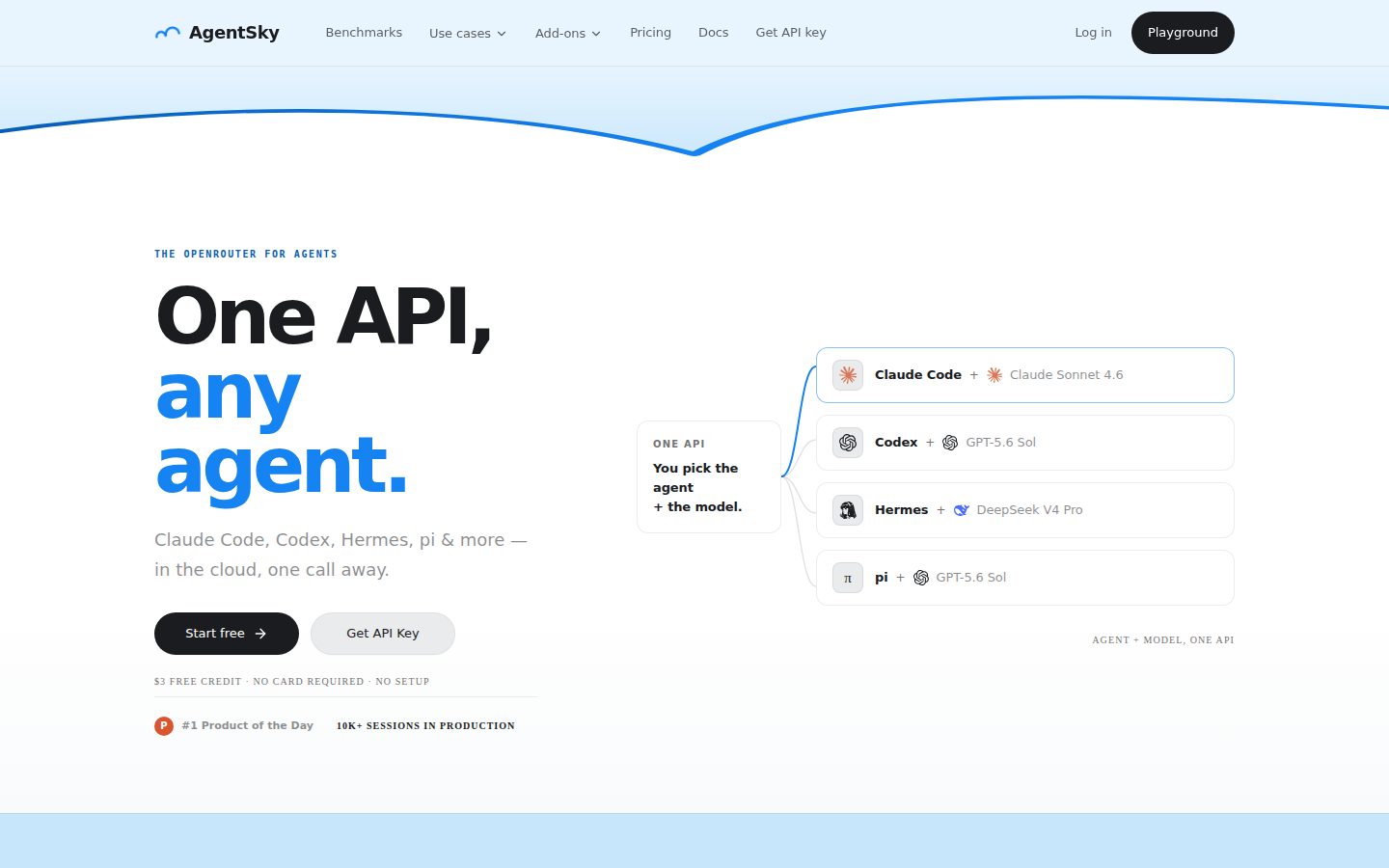
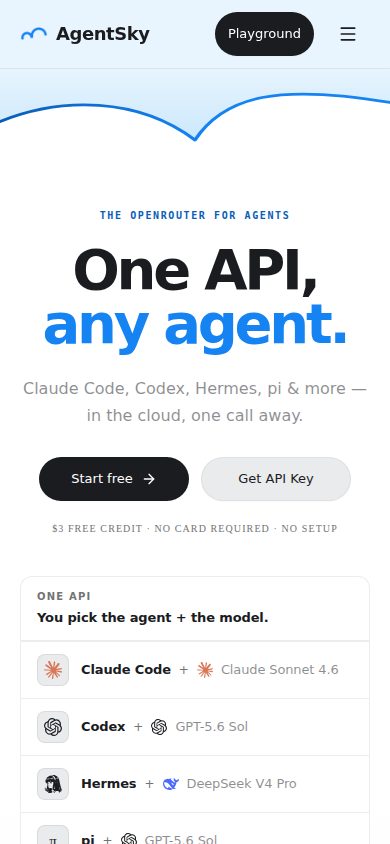
AgentSky is a cloud API that runs agent harnesses such as Claude Code and Codex against a choice of eleven models.
AI Panel Score
6 AI reviews
Reviewed
AgentSky is a cloud API that runs agent harnesses such as Claude Code, Codex and Hermes against a choice of eleven models through a single key. It suits teams that want agents inside their own product without operating the machines behind them, and developers who already run an agent locally and want it in the cloud. There is no subscription and no seats: prepaid credits are drawn on two meters, model tokens at provider list prices with no markup, from $0.44 to $10.00 per million input tokens, and compute from $0.021 to $0.071 per awake hour, with $3 of credit to start. Sessions persist between messages and suspend when idle, channels include Slack, Telegram, Discord and a plain web API, and one sky clone command lifts a local agent with its MCP servers into the cloud. TopReviewed's six-seat AI review panel scored it 8.1/10, praising the published rate card while noting the absence of a security or SLA page.
Getting started is three steps: create an account with no card, take the one API key that covers every agent and model, then name the agent and the model in your request. A playground lets you pick a harness and start working without writing the call yourself, and you can hand an agent real work - connect a GitHub repo, forward an email, upload files - rather than a toy prompt. Channels are parameters on the same call, so the agent can be reached from a web API, Slack, Telegram, Discord, WhatsApp, iMessage, a CLI, or the A2A protocol.
Eight harnesses are supported - Claude Code, Codex, Hermes, OpenClaw, pi, DeepSeek Harness, Kimi Code and opencode - against eleven models, and swapping either is a change to the request rather than a rebuild. Add-ons ride on the same call: search and web fetch, a browser, SEO and SERP data, image generation, background removal, video generation, image-to-video and transcription, plus connectors for Gmail, Notion, Slack and around 2,000 other apps. A "sky clone" command copies an agent you already run locally - instructions, model and MCP servers - into the cloud, and if you already pay for Claude Pro, Claude Max or ChatGPT you can connect that subscription so eligible agents run at $0 model usage. Agent Arena ranks harness-model pairs by Elo from head-to-head wins on 40,835 real tasks recorded between May and August 2026.
This is aimed at teams who want agents inside their product without running the machines: the site publishes three customer stories - Tycoon at 150,000 agents launched, HeyBoss AI at 250,000, WebJourney at 50,000-plus - each describing agents their own users interact with. The vendor positions itself as "the OpenRouter for agents". Pricing is prepaid credits with no subscription and no seats: model usage is itemised per turn at list price (from $0.15 per million input tokens on GLM-5.3-Flash up to $10.00 on Claude Fable 5.1), and compute runs $0.117 to $1.066 per awake hour by machine size, with the default 2 vCPU / 4 GB machine at $0.331. Suspended and parked agents cost nothing.
Enables search and web fetch, a browser, SEO and SERP data, image generation, background removal, video generation, image-to-video and transcription as parameters on the agent call.
Ranks harness and model pairs by Elo from head-to-head results on 40,835 real tasks recorded between May and August 2026.
Breaks billing down to the turn across two meters, model tokens and compute seconds, visible per agent.
Starts an agent from the browser by picking a harness and model, with GitHub repos, forwarded email or uploaded files as input.
Connects an existing Claude Pro, Claude Max or ChatGPT plan so eligible agents run at $0 model usage.
Runs Claude Code, Codex, Hermes, OpenClaw, pi, DeepSeek Harness, Kimi Code and opencode as cloud agents.
Pairs any supported harness with one of eleven models, including Claude Opus 5, GPT-5.6 Sol, DeepSeek V4 Pro and Kimi K3.
Keeps each agent on its own cloud machine so state survives between messages, with crashes and reconnects handled by the platform.
Suspends an idle agent so no compute is billed, then wakes it on the next message.
Exposes an agent through a web API, Slack, Telegram, Discord, WhatsApp, iMessage, a CLI or the A2A protocol.
Connects agents to Gmail, Notion, Slack and around 2,000 other applications.
Uses one key for every agent and model, with the choice named as parameters in the request.
Copies an agent already running locally into the cloud with its instructions, model and MCP servers in one command.
No subscription and no seats. Prepaid credits are drawn on two meters: model tokens at each provider's published rate, and compute per second while the agent machine is awake. Creating an account requires no card.
Connect an existing Claude Pro, Claude Max or ChatGPT plan once and eligible agents run at $0 model usage, leaving only the per-second compute meter.
One key, eight agent harnesses, and a rate card at list price. Easy pilot to approve.
“AgentSky rents the machine and the plumbing so your team stops maintaining either. The billing model is unusually legible for this category.”
Two meters, both published. Model tokens at provider list prices with zero markup, compute at $0.117 to $1.066 per awake hour, $0.331 on the default machine. No seats, no subscription, no minimum. That is a pilot finance can approve in a meeting.
What you're buying is optionality. Eight harnesses, eleven models, and switching either is an argument in a request rather than a rebuild. Three named customers describe agents their own users touch, at 150,000 and 250,000 agents launched. Vendor-stated, but specific enough to check.
The exposure is upstream. Every harness here is somebody else's open-source project and every model somebody else's API. If a provider reprices, so does your invoice. Run one production workload for a quarter and watch what the compute meter actually does before moving anything critical.
The vendor calls itself the OpenRouter for agents, and routing across eight harnesses rather than models is a genuinely different product.
No compliance page or SLA, and data handling is a single FAQ line promising zero retention only on enterprise plans, which matters if customer data passes through the agents.
Three steps to a running agent, no card at signup, and an existing local agent can be cloned up with one command.
Removes agent infrastructure from our roadmap entirely rather than shaving cost off something we already run.
Docs, a playground, a published benchmark over 40,835 tasks and three named case studies point to a shipping product, though the company itself is new.
Teams that want agents in production without running machines.
Regulated data has to pass through the agent.
Routing at the harness layer, not the model layer, is the bet worth understanding here.
“Most gateways abstract models. AgentSky abstracts the agent loop above them, which changes what your product depends on.”
The interesting decision is where the abstraction sits. A model gateway swaps weights behind one endpoint; this swaps the whole harness — Claude Code, Codex, Hermes, opencode — while keeping the session, the tools and the channel intact. If we build on it, our dependency becomes the request shape, not any single agent project.
Architecturally the state story carries the weight. Each agent gets a persistent machine that suspends when idle and wakes on the next message, so crash handling and reconnects sit on their side of the line. Add-ons ride the same call: browser, search, transcription, roughly 2,000 app connectors.
The three-year question is upstream drift. Harnesses evolve independently and a benchmark spanning May to August 2026 is a snapshot, not a trend.
Sits a layer above the model gateways it borrows its framing from, which is a defensible spot while harness choice keeps multiplying.
Persistent machines that suspend and wake match how agent workloads actually behave — long idle periods punctuated by bursts.
Web API, Slack, Telegram, Discord, WhatsApp, iMessage, CLI and A2A as call parameters, plus Gmail, Notion, Slack and around 2,000 connectors.
The dependency taken on is the request shape, but every harness underneath evolves on its own schedule and outside the vendor’s control.
Abstracting the harness rather than the model, with session, tools and channel preserved across a swap, is a deliberate and unusual architectural line.
Teams whose product embeds agents its users interact with.
You have already standardised on one harness and one model.
$0.331 an hour sounds small until the machine never sleeps and compute alone hits $238.46 a month.
“Two published meters, and compute is a fifth of the vendor's own monthly estimate. Suspend discipline, not the contract, is what holds the number down.”
Same machine, two very different invoices. The default 2 vCPU / 4 GB bills $0.331 an hour. At the vendor's estimate — 20 turns a day, two hours awake — that is $19.87 a month against $78.00 of model spend. Never suspend it and compute alone is $238.46.
That is $97.87 a month for one agent, $11,744 a year for ten. Model tokens run at each provider's list rate, $0.15 per million input on GLM-5.3-Flash up to $10.00 on GPT-6 Astra. Compute spans $0.117 to $1.066 an hour.
The estimator counts two meters. Capabilities are a third — browser at $0.03 a minute, connector calls at $0.029, image generation at $0.422 an asset. Bring Your Own Subscription zeroes the model meter on eligible agents. But top-ups still carry Stripe's 2.9% plus $0.30, and nothing here is contractual: the bill tracks your suspend discipline.
Self-serve prepaid credits start instantly but offer no invoicing or payment terms, which some procurement processes will not accept.
Prepaid credits with no subscription, seats, minimum or renewal window to negotiate out of.
Token rates, all fifteen machine rates, per-use capability prices and the card processing fee are published without a sales call.
Usage is itemised per turn, so cost per outcome is measurable, but no vendor ROI model or benchmark against self-hosting is published.
Both meters are computable per agent, but an always-on default machine is $238.46 a month before any model tokens.
Teams that can enforce a suspend policy on every agent.
Budget owners who need a fixed monthly cost per agent.
sky clone lifts a local agent into the cloud with its MCP servers intact
“The workflow is shaped like something the team actually uses. The gaps show up around what happens when a run goes wrong.”
One command clones the agent you already run locally — instructions, model, MCP servers — into the cloud. That's the tell. Whoever built it moves agents between machines often enough to hate doing it by hand.
Day-to-day the shape is good. Sessions persist between messages, suspend on idle and wake on the next one, so you're not writing reconnect logic. Usage is itemised to the turn across both meters, which is what you need at 2am when one agent's bill looks wrong. Channels are parameters, so putting the same agent in Slack and behind an HTTP endpoint isn't two integrations.
What's missing is failure detail. Restart behaviour is documented as managed recovery to the latest durable point, not zero-loss, but retry and timeout semantics are absent, and there is no changelog. You'll find those boundaries yourself.
Persistent sessions and automatic suspend remove the two chores — reconnects and idle cost — that usually land on the caller.
Docs, a playground and a published benchmark exist, but nothing published covers operational edges.
Failure semantics — retries, timeouts, what happens on restart — are not documented beyond a one-line FAQ on restart recovery, so early debugging is exploratory.
Eight harnesses, eleven models, built-in browser and transcription tools and A2A support leave room well past the first use case.
Cloning a local agent with its MCP servers in one command means the cloud version starts from the setup you already trust.
Engineers already running agent harnesses locally.
You need documented operational guarantees before shipping.
No card, no subscription, and a playground that starts an agent before you write any code.
“Trying it costs almost nothing and the first agent takes minutes. Where it gets murky is knowing what you have spent.”
No card is requested at signup, and the playground is enough to run something real rather than a hello-world. The playground lets you pick a harness and a model from a dropdown and start, and you can hand it a GitHub repo or a forwarded email instead of a toy prompt. That's a better first ten minutes than most developer tools manage.
The billing page does something I wish more products did: it tells you the card fee. $100 of credit costs $103.30. Nobody hides that well and this one just says it.
What nags is the two-meter model. Tokens and awake seconds are both perfectly reasonable and together they're two things to keep in your head. The estimator helps. It's still arithmetic you didn't have before.
The pricing page carries an estimator with model, machine size and turns per day as inputs, and discloses the card processing fee.
Starting is easy, but two billing meters and a choice between eight harnesses is more to hold than a single-model API.
No mobile app is described, though agents are reachable from WhatsApp, Telegram and iMessage, which covers the phone case differently.
No card at signup, a three-step flow and a playground that accepts a GitHub repo or forwarded email as the first task.
The platform states it handles crashes, reconnects and state, but no status page or uptime figure is published.
Curious people who want an agent running today.
You want one flat monthly number and no meters.
Rate card is honest to the cent. Everything about the vendor itself is thinner.
“The pricing page is the most credible thing here, and it is genuinely good. What is missing is any operational or security story.”
Credit where it's due. Zero markup on models, per-second compute, the Stripe fee disclosed. Vendors who plan to make money on opacity don't publish that.
What's absent is louder. No security page. No SLA. The data-handling answer is two sentences long — state kept to run and recover an agent, zero retention only on enterprise plans — and there is no security page or SLA behind it. The customer numbers — 150,000 agents launched, 250,000 — are vendor-stated with no way to check them, and 10K+ sessions in production is a phrase, not a metric.
Exit is fine, which surprised me. The harnesses are other people's open-source projects and the models are public APIs, so leaving means running what you already run somewhere else. That's real portability. The lock-in is convenience, not format.
Harness-level routing is a real gap in the market, but the vendor’s own OpenRouter framing invites a comparison it has not yet earned.
The harnesses are open-source projects and the models are public APIs, so leaving means self-hosting what you already use.
Docs, a playground and an active benchmark show maintenance, but there is no security page, SLA or status page anywhere on the site.
The pricing page publishes list-price token rates, per-second compute and the card fee, which is the opposite of the usual pattern.
Named harnesses and models are verifiable, but the customer volumes and the 10K+ sessions figure are vendor-stated with nothing behind them.
Teams comfortable running an early vendor in a non-critical path.
You need a security review before agents touch your data.
Common questions answered by our AI research team
There is no subscription and no seats. You prepay credits and are billed on two meters: model tokens at provider list prices, from $0.15 to $10.00 per million input tokens, and compute from $0.117 to $1.066 per awake hour ($0.331 on the default 2 vCPU / 4 GB machine).
Eight harnesses: Claude Code, Codex, Hermes, OpenClaw, pi, DeepSeek Harness, Kimi Code and opencode. Each pairs with any of eleven models, including Claude Opus 5 and GPT-5.6 Sol.
Yes. Connecting a Claude Pro, Claude Max or ChatGPT plan lets eligible agents run at $0 model usage, leaving only the per-second compute meter to pay for.
Yes. Each agent runs on its own persistent cloud machine that holds state across messages, suspends automatically when idle and wakes on the next message.
Yes. The sky clone command copies an agent you already run locally, with its instructions, model and MCP servers, into the cloud on the same API.
Channels are parameters on the agent call. AgentSky supports a web API, Slack, Telegram, Discord, WhatsApp, iMessage, a CLI and the A2A protocol.
You can create an account with no card required, but there is no permanently free tier: usage draws on prepaid credits.
AgentSky is a US-based cloud platform, operated by HeyMall, Inc., that runs eight AI agent harnesses and a dozen models through a single API with persistent sessions.