Deepgram logo

Deepgram Review

Visit

Speech-to-Text, Text-to-Speech, and Voice Agent APIs for developers

Deepgram is a Voice AI platform for developers building speech recognition, voice synthesis, and autonomous voice agent applications.

Deepgram·Founded 2015·Usage-basedFree TrialAI Voice & SpeechAI APIsAI Agents & Assistants

AI Panel Score

8.2/10

6 AI reviews

Reviewed

About Deepgram

Developers integrate Deepgram through REST and WebSocket APIs, SDKs, or an in-browser playground. The primary workflow involves sending audio streams or files to receive transcriptions, synthesized speech, or fully orchestrated voice agent responses. The Voice Agent API handles the full pipeline — speech recognition, LLM orchestration, and voice synthesis — without requiring developers to stitch together separate services.

Deepgram's STT offering includes two models: Nova-3, a general-purpose model with native streaming, and Flux, a conversational model with built-in end-of-turn detection and interruption handling. On the TTS side, Aura-2 provides over 40 voice personas with sub-200ms time-to-first-byte. Audio Intelligence features — summarization, sentiment analysis, topic detection, and intent recognition — run in real time alongside transcription. The platform also supports HIPAA-compliant medical transcription via Nova-3 Medical models trained on clinical terminology.

Deepgram targets developers and enterprise teams building contact center infrastructure, conversational AI, healthcare transcription, and quick-service restaurant automation. Pricing follows a usage-based model with Pay-As-You-Go, Growth, and Enterprise tiers. Competitors in the ASR and Voice AI category include OpenAI Whisper, Amazon Transcribe, Google Cloud Speech-to-Text, and Microsoft Azure Speech Services. Deepgram publishes benchmark comparisons against each of these, including an interactive ASR comparison tool on its website.

The platform supports self-hosted deployment via VPC or on-premise installation, in addition to its cloud offering. Native integrations exist for Five9 and Genesys in contact center contexts, and Deepgram is the exclusive voice partner for IBM watsonx Orchestrate. Official SDKs cover major programming languages, and full API reference documentation is available at developers.deepgram.com.

Features

AI

  • Flux Conversational STT Model

    A conversational-first speech-to-text model with built-in end-of-turn detection and natural interruption handling for dialogue-focused applications.

  • Voice Agent API

    A single WebSocket API that unifies STT, LLM orchestration, and TTS to deliver end-to-end voice interactions with sub-300ms latency.

Analytics

  • Audio Intelligence

    Real-time audio analysis features including summarization, sentiment analysis, topic detection, and intent recognition applied to transcribed audio.

Core

  • Aura-2 Text-to-Speech

    Enterprise-grade TTS engine offering 40+ voice personas with sub-200ms time-to-first-byte latency.

  • Nova-3 Speech-to-Text

    Deepgram's flagship STT model achieving a 5.26% Word Error Rate with native streaming support for real-time transcription.

Integration

  • Contact Center Infrastructure

    A scalable voice AI infrastructure capable of handling 140,000+ concurrent calls with native integrations for Five9 and Genesys platforms.

  • IBM watsonx Partnership Integration

    Deepgram serves as the exclusive voice AI partner for IBM watsonx Orchestrate, embedding its voice capabilities into IBM's enterprise AI platform.

  • Official SDKs

    Officially maintained SDKs for integrating Deepgram's speech-to-text, text-to-speech, and language understanding APIs into developer applications.

Security

  • Nova-3 Medical Model

    HIPAA-compliant STT models trained specifically on clinical terminology for use in medical and healthcare environments.

  • Self-Hosted Deployments

    Documented support for deploying Deepgram models within private VPC or on-premise infrastructure for data-sensitive environments.

Support

  • API Playground

    An in-browser testing environment within the Deepgram console that allows developers to test all Deepgram models without writing code.

  • ASR Comparison Tool

    An interactive browser-based tool that enables side-by-side accuracy testing of Deepgram against other ASR providers using custom audio input.

Preview

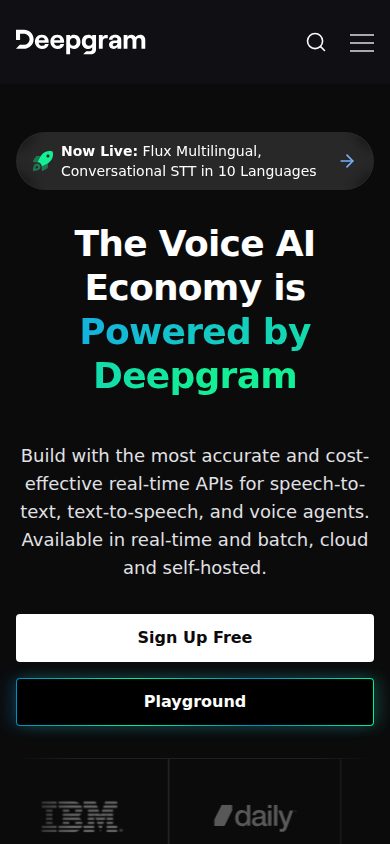
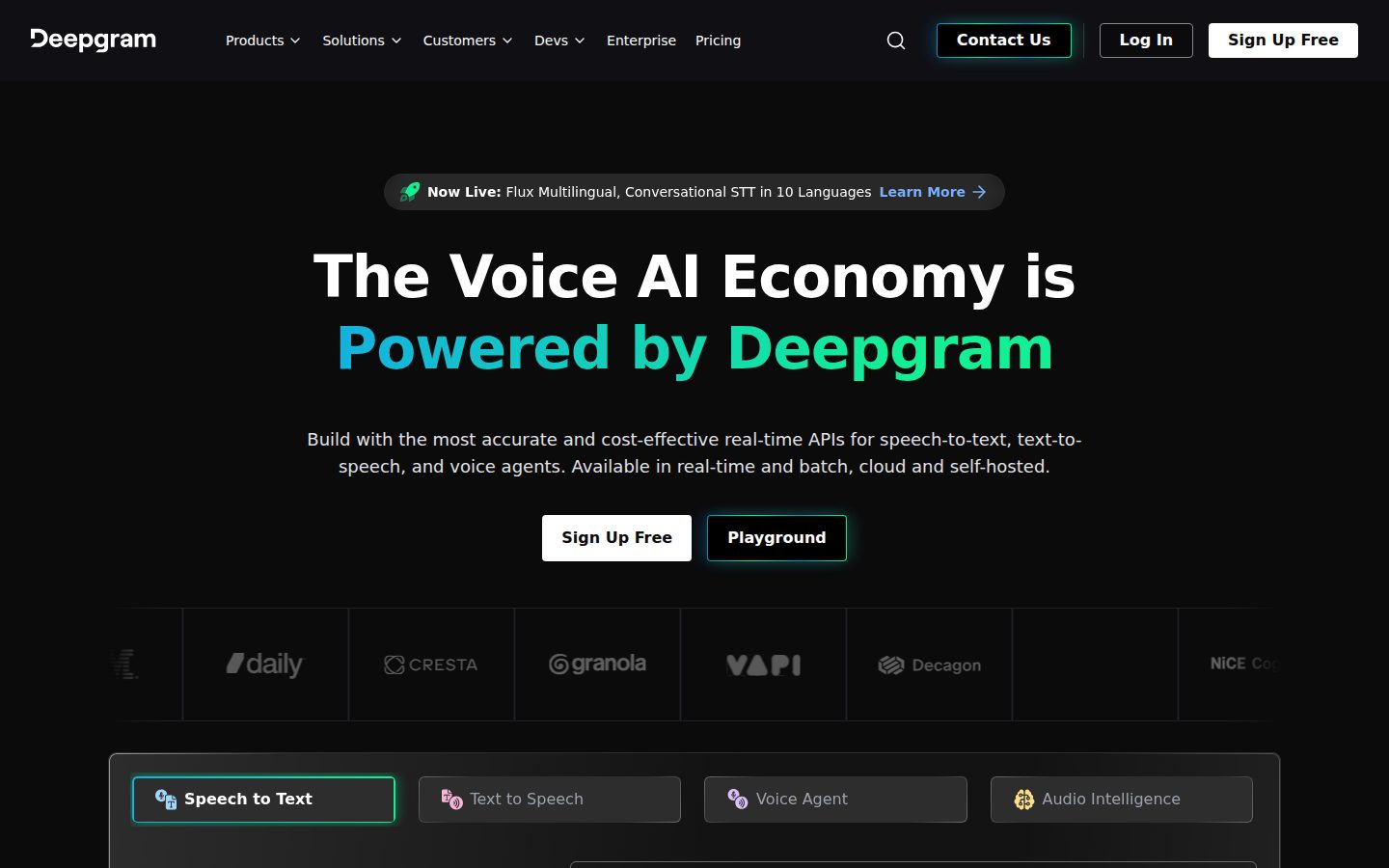
Deepgram desktop previewDeepgram mobile preview

Pricing Plans

Pay As You Go

Contact sales

Self-serve, usage-based access to Deepgram APIs with no upfront commitment. Pay only for what you use.

  • Speech-to-Text via Nova-3 and Flux models
  • Text-to-Speech via Aura-2 (40+ voices)
  • Audio Intelligence (summarization, sentiment, topics, intent)
  • Voice Agent API with sub-300ms latency
  • API Playground and full developer documentation access
Popular

Growth

Contact sales

For growing teams and businesses scaling voice AI usage, with additional support and higher throughput.

  • All Pay As You Go features
  • Higher concurrency and throughput limits
  • Access to all STT, TTS, and Voice Agent APIs
  • Audio Intelligence features included
  • Dedicated support resources

Enterprise

Contact sales

Custom pricing for large-scale deployments requiring dedicated infrastructure, SLAs, and compliance needs.

  • Custom volume pricing and committed use discounts
  • HIPAA-compliant Nova-3 Medical models
  • Self-hosted / VPC and on-premise deployment options
  • Handles 140,000+ concurrent calls
  • Native integrations with Five9, Genesys, and IBM watsonx Orchestrate
  • Dedicated enterprise support and SLAs

AI Panel Reviews

The Decision Maker

The Decision Maker

Strategic bet, vendor viability, timing, adoption approval
8.4/10

Deepgram owns the voice AI stack developers actually want to build on.

5.26% WER on Nova-3, sub-300ms Voice Agent latency, and a single WebSocket replacing three separate services. IBM's exclusive voice partner and scaling to 140,000 concurrent calls — this isn't a scrappy challenger.

The IBM watsonx Orchestrate exclusive tells you something. Enterprise partnerships at that level don't go to vendors who won't be around. The 140,000 concurrent call capacity and Five9/Genesys integrations confirm they're already embedded in production infrastructure, not pilots.

The unified Voice Agent API is the real differentiator. Google and Amazon Transcribe make you stitch STT, LLM, and TTS together yourself. Deepgram does it over a single WebSocket. That's developer hours, not just latency. The Nova-3 Medical HIPAA compliance opens healthcare deals competitors aren't positioned to close.

The tradeoff: pricing page is absent, starting price unknown. Pay-As-You-Go is listed as free-tier access, not a fixed rate — renewal math is invisible until you're already scaled. Pilot aggressively, but get the volume pricing in writing before you standardize.

Competitive Positioning8.3

Nova-3's 5.26% WER beats published benchmarks against Amazon Transcribe and Google Cloud Speech-to-Text; they publish the comparison tool, which is confident.

Reputation Risk8.2

IBM partnership plus Five9/Genesys integrations make this easy to defend; no pricing transparency is the only board-level awkward question.

Speed to Value8.6

In-browser API Playground and no-code testing mean developers can validate production viability in hours, not sprint cycles.

Strategic Fit8.8

The Voice Agent API collapses three-service architectures into one — that's architecture advancement, not just cost savings.

Vendor Viability8.5

IBM watsonx exclusive partnership and 140,000+ concurrent call infrastructure suggest a vendor with real enterprise traction and staying power.

Pros

  • Single WebSocket Voice Agent API replaces STT + LLM + TTS stitching
  • 5.26% WER on Nova-3 with published competitive benchmarks against Google and Amazon
  • HIPAA-compliant Nova-3 Medical model opens regulated healthcare verticals
  • IBM watsonx exclusive and Five9/Genesys integrations signal deep enterprise credibility

Cons

  • No public pricing page — volume costs are opaque until you're negotiating a contract
  • Flux Multilingual caps at 10 languages, a real gap for global deployments
  • No free plan; trial access only, which slows internal buy-in from skeptical stakeholders

Right for

Engineering teams building production voice agents who want one vendor instead of three.

Avoid if

You need multilingual support beyond 10 languages and can't afford pricing uncertainty at scale.

The Domain Strategist

The Domain Strategist

Craft and strategy in the product's domain — adapts identity per category, same lens
8.2/10

Deepgram is the voice infrastructure layer that serious voice products are built on.

Nova-3's 5.26% WER and sub-300ms Voice Agent latency aren't marketing numbers — they're architectural commitments. For teams building voice-forward products, this is the platform that removes the stitching work.

40+ voice personas in Aura-2, a unified WebSocket pipeline for the full STT-LLM-TTS stack, and HIPAA-compliant medical models — that's not a feature list, that's a platform decision. Someone here has shipped production voice infrastructure before. The ASR comparison tool is a confident move: you don't put competitors side-by-side unless you know you win.

The creative ceiling question is real, though. 40 voice personas sounds deep until your brand needs a voice that doesn't sound like anyone else's. Custom voice cloning isn't surfaced in the evidence — if it's absent, teams building distinctive audio identities will hit that wall within 18 months. ElevenLabs owns that creative tier right now.

If you adopt Deepgram as your voice infrastructure, in 3 years you have enterprise-grade reliability, IBM watsonx as a distribution moat, and 140,000+ concurrent call capacity. What you may not have is brand voice differentiation. Right infrastructure choice, potentially wrong creative choice.

Category Positioning8.3

Publishing benchmark comparisons against Amazon Transcribe, Google Cloud Speech, and Azure is a category-leader posture — few challengers do it this transparently.

Domain Fit7.8

Built for developer-led voice product teams, not brand creative workflows — the API Playground confirms the practitioner profile they're designing for.

Integration Surface8.4

Single WebSocket for the full voice pipeline, official multi-language SDKs, and self-hosted VPC options cover nearly every enterprise deployment pattern.

Long-term Implications8.0

IBM watsonx exclusivity and Five9/Genesys integrations create distribution depth, but custom voice identity capability isn't evidenced and that gap compounds over time.

Strategic Depth8.5

Nova-3 Medical, Flux's end-of-turn detection, and real-time Audio Intelligence show genuine model specialization beyond generic ASR.

Pros

  • 5.26% WER on Nova-3 with a published interactive comparison tool — rare transparency in a category full of vague accuracy claims
  • Single WebSocket Voice Agent API collapses what used to be a three-vendor integration problem
  • Self-hosted VPC deployment plus HIPAA-compliant medical models covers the compliance use cases that kill most voice platform deals
  • IBM watsonx exclusive partnership is a meaningful enterprise distribution moat

Cons

  • No evidence of custom voice cloning — teams needing proprietary brand voice will look at ElevenLabs instead
  • Pricing page isn't public, which makes budget planning conversations harder than they should be
  • Flux Multilingual supports only 10 languages — thin for global product teams

Right for

Developer-led teams building production voice products where accuracy, latency, and compliance requirements are non-negotiable.

Avoid if

Your primary need is distinctive brand voice creation rather than reliable voice infrastructure at scale.

The Finance Lead

The Finance Lead

Money, total cost of ownership, contracts, procurement math
7.8/10

5.26% WER, sub-300ms latency, zero published unit pricing — classic enterprise bait.

Deepgram's technical specs are credible and competitive. But no pricing page means every TCO model starts with a phone call.

Nova-3 at 5.26% WER and Aura-2 at sub-200ms TTFB are real numbers. 140,000 concurrent calls is a real ceiling. The Voice Agent API unifying STT, LLM, and TTS over one WebSocket connection cuts integration cost — fewer vendors, fewer invoices. Compare that to stitching Amazon Transcribe plus Polly plus Lambda plus your own orchestration. The consolidation math favors Deepgram at scale.

The pricing page doesn't exist. Three tiers listed — Pay As You Go, Growth, Enterprise — all marked 'Free' as a placeholder. No per-minute rate published. No overage rate published. That's the real risk: not the sticker, the invoice you can't model. Category norm for ASR is $0.006–$0.024 per minute. Deepgram's actual rate is unknown from public materials.

Enterprise tier adds HIPAA compliance and self-hosted VPC — meaningful for healthcare and contact center buyers. But 'custom pricing' plus no termination-for-convenience language visible means procurement will fight this. Growth tier has higher concurrency but no defined threshold. Budget conservatively: assume 20–30% volume growth annually, and your year-3 invoice could be 2× year-1 with no contractual ceiling in sight.

Billing & Procurement6.0

Pay-As-You-Go self-serve lowers SMB friction, but Enterprise tier requires a sales call and custom contract — standard procurement overhead.

Contract Flexibility5.5

No public auto-renewal terms, no published cancellation window, and 'custom pricing' Enterprise contracts suggest standard negotiation friction.

Pricing Transparency4.5

No unit pricing published anywhere; three tiers exist but all lack per-minute rates or overage caps per their pricing page.

ROI Clarity7.5

5.26% WER and sub-300ms latency are measurable; contact center and medical transcription use cases produce quantifiable throughput and accuracy gains.

Total Cost of Ownership6.5

Consolidated API reduces integration vendor count, but unpublished rates make 3-year TCO modeling impossible without a sales conversation.

Pros

  • Single WebSocket Voice Agent API eliminates multi-vendor stitching costs
  • Nova-3 Medical is HIPAA-compliant — rare to have compliance built into the model tier
  • ASR comparison tool lets procurement validate accuracy claims before committing
  • 140,000 concurrent call ceiling removes capacity risk for large contact center deployments

Cons

  • No published per-minute rate — TCO model requires a sales call before pencil hits paper
  • Growth tier concurrency limits undefined publicly — budget risk for scaling teams
  • No free plan; only a free trial, unlike Google Cloud Speech which offers monthly free tier
  • Contract terms, auto-renewal windows, and cancellation policy are not publicly documented

Right for

Enterprise contact center or healthcare teams with volume to negotiate custom rates and measurable accuracy requirements.

Avoid if

Your team needs a predictable monthly invoice without a sales relationship to set it.

The Domain Practitioner

The Domain Practitioner

Daily hands-on reality in the product's domain — adapts identity per category, same lens
8.4/10

Nova-3's 5.26% WER and sub-300ms latency make this a serious production stack.

Deepgram ships a unified Voice Agent API over a single WebSocket — STT, LLM orchestration, TTS in one connection. For audio producers building voice pipelines, that's less stitching, more shipping.

Nova-3 at 5.26% WER is a number worth respecting. Whisper and Amazon Transcribe both require workarounds for real-time streaming that Deepgram handles natively. Flux adds end-of-turn detection out of the box — that's not a minor feature, that's the difference between a conversation agent that works and one you spend weeks tuning. Aura-2's sub-200ms time-to-first-byte on TTS means the voice response doesn't feel like a chatbot with lag.

The Audio Intelligence layer — summarization, sentiment, topic detection, intent — runs alongside transcription in real time. That's a meaningful workflow win for post-production pipelines handling call center audio. The 140,000+ concurrent call capacity signals real infrastructure, not a demo-tier promise. Self-hosted VPC deployment is documented, which matters the moment a healthcare client asks about HIPAA.

Pricing page isn't public, which is a daily friction point when you're estimating project costs for a client. The API Playground helps day-one orientation, but the lack of transparent per-minute rates means budgeting requires a conversation, not a spreadsheet.

Day-3 Reality8.2

Single WebSocket for the full voice agent pipeline means fewer integration surfaces to babysit daily, but opaque pricing creates recurring friction when scoping new projects.

Documentation Practitioner-Fit8.3

developers.deepgram.com with changelog, API reference, and in-browser playground suggests the docs are maintained by people who actually integrate the API.

Friction Surface7.5

No public pricing page forces cost estimation offline; otherwise the API Playground and changelog-present docs reduce daily friction considerably.

Power-User Depth8.6

Nova-3 Medical for HIPAA-compliant clinical transcription, self-hosted VPC deployment, and 140,000+ concurrent call handling give power users real headroom beyond the starter tier.

Workflow Integration8.5

Native Five9 and Genesys integrations, official SDKs across major languages, and Flux's built-in interruption handling map directly onto contact center and conversational AI build workflows.

Pros

  • Nova-3 at 5.26% WER with native streaming beats Whisper's real-time workarounds
  • Flux handles end-of-turn detection and interruptions natively — no custom logic needed
  • Single WebSocket Voice Agent API eliminates multi-service stitching
  • Audio Intelligence runs in real time alongside transcription, not as a post-processing step

Cons

  • No public pricing page — budgeting a client project requires a sales conversation
  • No free plan; free trial only, which limits low-stakes experimentation
  • Flux Multilingual covers only 10 languages, thin for global deployment scenarios

Right for

Audio producers and dev teams building production voice agents or high-volume transcription pipelines who need sub-300ms latency and don't want to orchestrate three separate APIs.

Avoid if

You need transparent per-minute pricing upfront or are building a multilingual product requiring broad language coverage beyond 10 languages.

The Power User

The Power User

Daily human experience, onboarding, polish, learning curve, reliability
8.4/10

The API-first voice stack that makes AWS Transcribe look like it's trying too hard

Deepgram has the bones of a genuine category leader — 5.26% word error rate, sub-300ms Voice Agent latency, a single WebSocket that replaces three stitched-together services. This is infrastructure for builders, not a shiny dashboard for occasional users.

The Voice Agent API pulling STT, LLM orchestration, and TTS over one WebSocket is genuinely thoughtful. Anyone who's duct-taped together Whisper, an LLM, and a TTS service knows the latency compounding pain. Deepgram just skips that tax. Sub-300ms end-to-end isn't a marketing number — it's the difference between a voice product that feels alive and one that feels like a conference call with a bad connection.

The in-browser API Playground is the kind of thing that means someone on the team actually thought about the new-developer experience. Test Nova-3 without writing a line of code. That's day-one friction removed. The ASR comparison tool is a nice flex too — they're confident enough to let you upload your own audio and run it against Google and Amazon live.

The real tradeoff: there's no pricing page. Usage-based with no public rates means you're flying blind until you're already invested. For solo builders, that's annoying. The mobile story is also basically nonexistent — this is an API platform, so that's expected, but worth naming.

Daily Polish8.1

The API Playground and ASR comparison tool suggest real attention to developer-facing detail, though the missing public pricing page is a conspicuous rough edge.

Learning Curve8.0

Official SDKs across major languages plus full docs at developers.deepgram.com make the ramp reasonable, though the Flux versus Nova-3 model decision requires some homework.

Mobile Parity4.5

This is an API-first developer platform — mobile isn't the product — but the web console offers no meaningful mobile experience.

Onboarding Experience8.5

Free sign-up plus a no-code Playground means a developer can hear Nova-3 working before they've written a single line — that's a strong first ten minutes.

Reliability Feel8.3

The 140,000+ concurrent call capacity and dedicated enterprise SLAs at the top tier suggest the infrastructure is built to hold, not just demo well.

Pros

  • Single WebSocket Voice Agent API eliminates the multi-service stitching tax
  • 5.26% Word Error Rate on Nova-3 is a concrete, verifiable number — not vibes
  • Nova-3 Medical with HIPAA compliance opens healthcare without a custom build
  • In-browser Playground removes day-one friction for new developers

Cons

  • No public pricing page — usage-based rates are opaque until you're already in
  • Flux Multilingual caps at 10 languages, which will matter to some teams
  • Mobile console experience is essentially nonexistent
  • Contact center integrations (Five9, Genesys) are enterprise-tier only

Right for

Developer teams building production voice agents, contact center infrastructure, or healthcare transcription who want one platform instead of three.

Avoid if

You need transparent upfront pricing before you can get internal budget approval.

The Skeptic

The Skeptic

Contrarian. Watch-outs, deal-breakers, broken promises, category patterns
8.1/10

5.26% WER and 140k concurrent calls — the numbers do real work here

Deepgram has the benchmarks, the enterprise integrations, and the latency specs to be a credible default choice for developer-first voice AI. The missing pricing page and no free plan are small yellow flags in an otherwise solid evidence set.

Three tells upfront. One: 'The Voice AI Economy is Powered by Deepgram' is the kind of headline that ages poorly — but the actual feature claims are specific and testable. Two: no pricing page scraped, which means cost at scale is an unknown until you're already committed. Three: IBM watsonx as exclusive voice partner is a real anchor tenant, not a logo-wall vanity badge.

The differentiation is genuine. Nova-3 at 5.26% WER with a medical vertical variant, Flux with built-in end-of-turn detection, and a single-WebSocket Voice Agent API under 300ms — that's not Amazon Transcribe territory. Amazon and Google charge you to stitch those layers yourself. Deepgram bundles them. That matters for contact center buyers.

Exit portability is the quiet tradeoff. The Voice Agent API is a proprietary orchestration layer. If you build deep into it, migrating to OpenAI or Azure means re-architecting. STT-only usage exits cleanly. The bundled stack doesn't.

Competitive Differentiation8.4

Bundled STT+LLM+TTS under one WebSocket with an interactive ASR comparison tool is a concrete gap vs. Amazon Transcribe and Google Cloud Speech-to-Text.

Exit Portability6.5

STT-only exits are clean via standard APIs, but the Voice Agent WebSocket orchestration layer creates real re-architecture costs if you go deep.

Long-term Viability7.8

Changelog present, active SDK maintenance, IBM partnership, and 140k concurrent-call scale claims suggest real infrastructure investment — no public funding data visible though.

Marketing Honesty7.5

Specific numbers like 5.26% WER and sub-300ms latency are verifiable claims; the 'Voice AI Economy' framing is puffery but the product page stays mostly grounded.

Track Record Match8.2

IBM watsonx exclusivity, Five9/Genesys integrations, and Nova-3 Medical all suggest enterprise traction beyond typical API-startup-round-two fadeouts.

Pros

  • Nova-3 at 5.26% WER is a specific, auditable claim — not vibes
  • Single-WebSocket Voice Agent API under 300ms removes the stitching tax vs. competitors
  • HIPAA-compliant medical model is a real vertical moat, not a checkbox
  • IBM watsonx exclusive partnership is a durable enterprise anchor

Cons

  • No pricing page scraped — cost at scale is opaque until you're negotiating
  • Voice Agent API lock-in is real; deep adoption means expensive migration
  • No free plan; free trial only — raises friction for solo developers evaluating quickly
  • Flux Multilingual capped at 10 languages, which may cut off non-English enterprise deals

Right for

Developer teams building production contact center or healthcare voice applications who want a single vendor for the full STT-to-TTS pipeline.

Avoid if

You need transparent usage pricing before committing, or you're prototyping and want a no-credit-card sandbox.

Buyer Questions

Common questions answered by our AI research team

Features

What word error rate does Nova-3 achieve?

Nova-3 achieves a 5.26% Word Error Rate.

Features

How fast is the Voice Agent API response latency?

The Voice Agent API delivers end-to-end voice interactions with sub-300ms latency over a single WebSocket connection.

Setup

Can Deepgram be deployed on-premises?

Yes, Deepgram is available in both cloud and self-hosted (on-premises) deployments.

Features

How many languages does the Flux Multilingual model support?

The Flux Multilingual model supports 10 languages.

Setup

Does Deepgram offer a free way to test the API?

Yes, Deepgram offers a free sign-up and a Playground to test the API without writing code.

Also in AI Voice & Speech