Agnost AI logo

Agnost AI Review

Visit

Finds silent failures in production chat and voice agents

Agnost AI is an analytics platform for teams operating production chat and voice agents.

Agnost AI·From $49/moFree PlanAI AnalyticsAI Agents & AssistantsAI DevOps

AI Panel Score

7.5/10

6 AI reviews

Reviewed

Facts checked against agnost.ai

AI Editor Approved

About Agnost AI

Agnost AI works by connecting to a team's production chat or voice agent through an SDK or OpenTelemetry, ingesting conversation traces and events for analysis. Once connected, it processes real user interactions to detect where people get stuck, repeat themselves, rage-prompt, or abandon a conversation, and it groups recurring questions, objections, and unmet needs that might otherwise go unnoticed. The findings are organized into reviewed improvements to prompts, tools, or workflows, with teams retaining control over what actually gets shipped.

Beyond frustration detection, the platform identifies quality, policy, and compliance violations occurring in live interactions, and it supports natural-language queries so teams can ask questions about agent behavior directly rather than manually reviewing transcripts. It is built to work with any LLM or agent framework, and data handling includes encryption in transit and at rest, with customer data excluded from training third-party models and retention controlled by the selected plan.

Agnost AI is aimed at teams running chat or voice agents in production who need visibility into failure patterns at scale. It offers a Free tier with full product access for up to 1,000 events per month and 7-day retention, a Starter plan at $49/month with up to 10,000 events and 30-day retention plus onboarding help, and a Pro plan at $499/month with up to 1,000,000 events, 90-day retention, and a founders Slack channel. An Enterprise tier adds self-hostable VPC deployments, custom retention, audit logs, SLAs/SLOs, custom improvement workflows, and priority feature requests.

Integration options include the Agnost AI SDK, OpenTelemetry, a documented OpenAPI specification, and a hosted MCP server with OAuth support, giving engineering teams multiple paths to connect existing agent infrastructure to the platform.

Features

AI

  • Natural Language Conversation Querying

    Lets teams ask questions about agent conversation data in natural language instead of manually reading transcripts.

  • User Frustration Detection

    Analyzes production conversations to detect where users get stuck, repeat themselves, rage-prompt, or abandon a conversation.

Analytics

  • Hidden Demand Surfacing

    Groups recurring questions, feature requests, objections, and unmet needs across conversations before they lead to churn.

Automation

  • Agent Improvement Workflow

    Turns recurring failure patterns into reviewed prompt, tool, and workflow improvements that a team can approve before shipping.

Core

  • Chat and Voice Data Support

    Ingests and analyzes chat and voice-agent conversations, traces, and events.

  • Plan-Based Data Retention

    Controls how long conversation data is retained based on the subscription plan, from 7 to 90+ days.

Integration

  • Hosted MCP Server

    Provides a hosted Agnost AI MCP server with OAuth-based authorization for programmatic access to the platform.

  • SDK and OpenTelemetry Integration

    Connects to any LLM or agent framework by sending production traces via the Agnost AI SDK or OpenTelemetry.

Security

  • Audit Logs and SLAs

    Provides audit logs and SLAs/SLOs as part of enterprise-tier governance and reliability guarantees.

  • Encrypted Data Handling

    Encrypts customer data in transit and at rest and does not use it to train third-party models.

  • Self-Hostable VPC Deployment

    Offers self-hostable deployment within a customer's own VPC for enterprise customers.

  • Violation Detection

    Identifies quality, policy, and compliance failures occurring in real production chat and voice interactions.

Preview

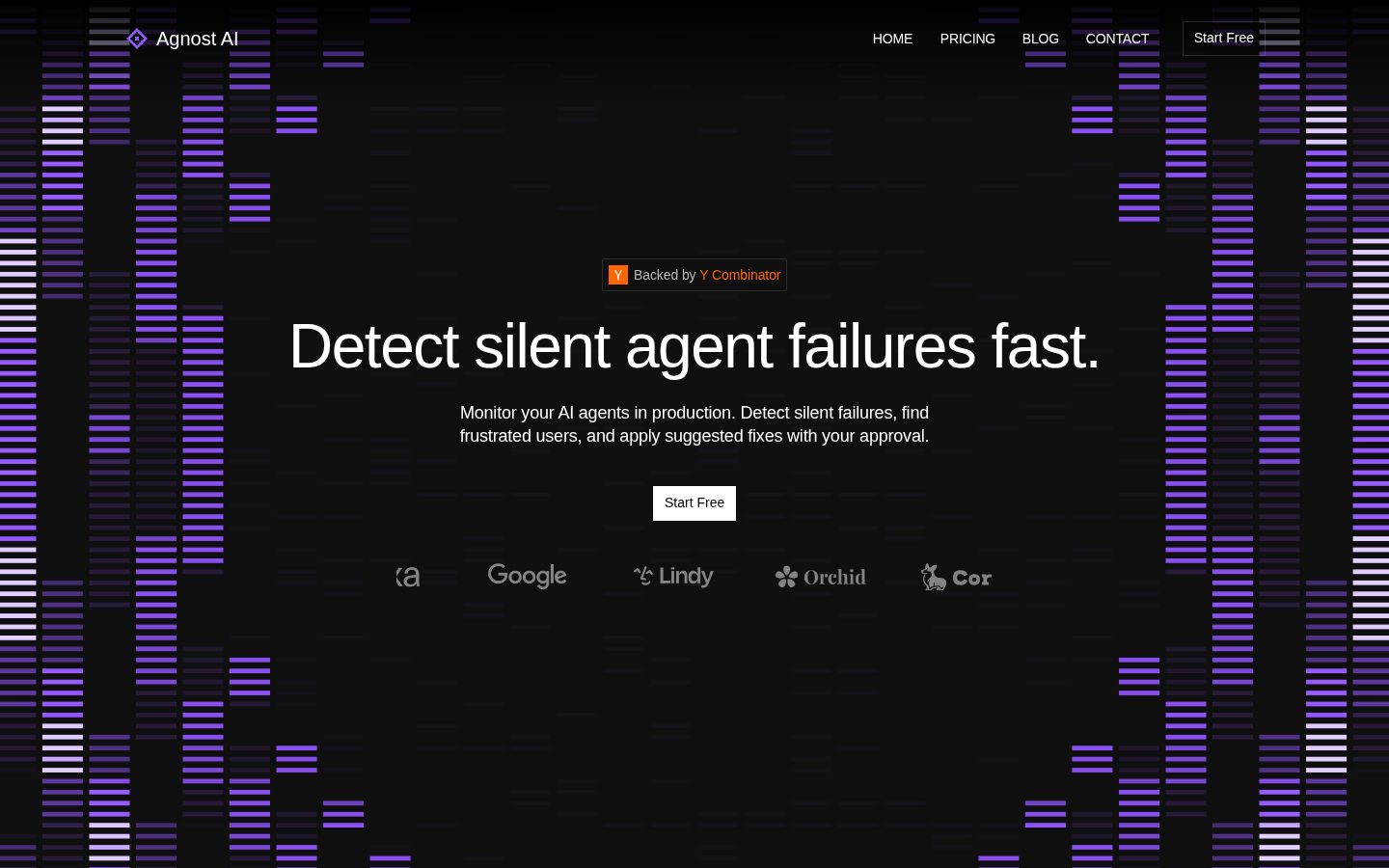
Agnost AI desktop previewAgnost AI mobile preview

Pricing Plans

Free

Free

For teams wanting to try full product access at small scale

  • Full product access
  • Up to 1,000 events/month
  • 7-day data retention

Starter

$49/monthly

For teams scaling up usage and needing onboarding support

  • Everything in Free
  • Up to 10,000 events/month
  • 30-day retention
  • Onboarding help
Popular

Pro

$499/monthly

For teams with high event volume needing deeper retention and direct support

  • Everything in Starter
  • Up to 1,000,000 events/month
  • 90-day retention
  • Founders Slack channel

Enterprise

Contact sales

For large organizations needing self-hosted deployment, custom retention, and compliance features; contact for pricing

  • Self-hostable VPC deployments
  • Custom retention
  • Audit logs
  • SLAs/SLOs
  • Custom improvement workflows
  • Priority feature requests

AI Panel Reviews

The Decision Maker

The Decision Maker

Strategic bet, vendor viability, timing, adoption approval
7.8/10

Finds the failures your dashboards can't see, but you're still trusting a new vendor with production data.

“Agnost AI turns raw chat and voice logs into reviewable fixes instead of another dashboard nobody reads. Pricing is transparent and the free tier is real, but this is a category still being invented.”

1,000,000 events for $499 a month is a real number, and the free tier at 1,000 events with 7-day retention is genuinely usable, not a trial wrapped in a paywall. The natural-language querying and the violation-detection angle are the differentiators here — most agent observability tools show you traces, not frustration patterns or compliance flags.

Two things stand out. One: they ingest via SDK or OpenTelemetry, which means no framework lock-in on the input side. Two: enterprise gets self-hosted VPC deployment, which tells me they expect regulated buyers.

The tradeoff: you're handing a new vendor your production conversation data, including the embarrassing parts, with encryption and no third-party training as the main assurances I could find. Fine for a pilot. I'd want the audit log details in writing before scaling past Pro.

Competitive Positioning8.0

Grouping rage-prompts, abandonment, and compliance violations into reviewable fixes goes beyond the trace-logging most observability tools stop at.

Reputation Risk6.8

Encryption in transit/at rest and no third-party training is stated, but audit logs and SLAs are enterprise-only, leaving mid-tier buyers thinner coverage.

Speed to Value7.8

Natural-language querying replaces manual transcript review on day one, and the Free tier lets a team validate fit before paying $49.

Strategic Fit8.0

This surfaces failures and hidden demand teams aren't currently catching manually — it advances capability, not just cuts cost.

Vendor Viability7.5

Four pricing tiers, documented OpenAPI spec, and a hosted MCP server with OAuth suggest active engineering, not a landing-page product.

Pros

  • 1,000,000 events for $499/month with 90-day retention on Pro
  • Works with any LLM or agent framework via SDK or OpenTelemetry
  • Natural-language querying cuts manual transcript review
  • Self-hostable VPC option for enterprise compliance needs

Cons

  • Audit logs and SLAs are locked to the Enterprise tier
  • Free tier retention is only 7 days, too short for real pattern analysis
  • Still an early, unproven category compared to established observability tools

Right for

Teams running production chat or voice agents who need to catch silent failures before churn or compliance complaints.

Avoid if

Skip it if your agent volume is low enough that manual transcript spot-checks already catch your problems.

The Domain Strategist

The Domain Strategist

Craft and strategy in the product's domain — adapts identity per category, same lens
7.6/10

A targeted lineage schema for agent failure data, not a general warehouse play.

“Agnost AI builds a conversation-level data model purpose-fit for chat and voice agent QA, with a credible ingestion path via SDK and OpenTelemetry. The open question for my team is whether that data stays queryable alongside everything else we already track.”

Event-based pricing tells me how this schema is built: 1,000,000 events at $499/month on Pro means they're metering conversational turns or traces, not seats. That's the right unit for agent telemetry, but it means our usage curve directly drives spend as agent traffic scales, not headcount — a cost model I'd need to forecast against actual conversation volume, not team size.

The OpenTelemetry and OpenAPI support matter more to me than the AI detection claims. If ingestion is standards-based, the data doesn't get stranded in a proprietary trace format I can't pipe elsewhere later. The hosted MCP server with OAuth is a forward-looking integration choice for agentic tooling access, though I'd want to see how that data reconciles with our existing warehouse.

My real concern is siloing: frustration and violation detection lives in Agnost's own analysis layer, and I don't yet see how those findings join with product or revenue data I already own elsewhere.

Category Positioning7.3

Sits adjacent to general observability tools but narrows specifically to chat/voice agent behavior, a newer and less contested lane.

Domain Fit7.8

Built around conversation traces and events, which matches how agent teams actually generate data, not retrofitted analytics.

Integration Surface8.0

SDK, OpenTelemetry, OpenAPI, and a hosted MCP server give multiple standards-based ingestion and query paths into existing infra.

Long-term Implications7.0

Event-based pricing scales with traffic, not team size, which means cost forecasting tracks agent usage curves directly.

Strategic Depth7.5

Frustration and violation detection on real traces is a genuine analytical layer, not just dashboarding over logs.

Pros

  • OpenTelemetry and OpenAPI support avoid proprietary trace lock-in
  • Event-metered pricing aligns cost with actual conversation volume
  • Hosted MCP server with OAuth supports programmatic, agentic access to findings

Cons

  • Analysis findings live in Agnost's own layer, with no stated path to join with other data systems
  • Event-volume pricing means cost scales directly with traffic spikes, not just team growth

Right for

Teams running production chat or voice agents who need a dedicated trace-analysis layer rather than general observability.

Avoid if

Avoid if you need agent failure findings to live natively inside an existing data warehouse rather than a separate analysis layer.

The Finance Lead

The Finance Lead

Money, total cost of ownership, contracts, procurement math
7.6/10

Four tiers, real numbers, no sales call until Enterprise. Procurement will like this one.

“Pricing runs Free to $499/month on stated event caps, with Enterprise the only quote-gated tier. The math is clean until you hit a traffic spike.”

$49/month gets 10,000 events, 30-day retention. $499/month gets 1,000,000 events, 90-day retention. That's a 100x event jump for 10x the price — generous ceiling, if you actually need it. Most teams won't; they'll overpay for headroom they don't use or get stuck mid-tier.

Three-year TCO is volume-driven, not seat-driven. 50-agent team running steady traffic might sit comfortably on Starter at $588/year. One viral spike and you're forced into Pro, $5,988/year, overnight. No published overage rate between tiers — budget for the jump, not the average.

No contract terms, auto-renewal language, or cancellation process published for Starter or Pro. Monthly billing suggests month-to-month, but I couldn't confirm it. Enterprise pricing requires a call, standard for audit logs and VPC self-hosting. Everything below that is self-serve, which procurement will appreciate.

Billing & Procurement7.8

Self-serve signup on two paid tiers with no sales call keeps onboarding friction low; only Enterprise adds a procurement cycle.

Contract Flexibility6.0

No term length, auto-renewal, or cancellation terms published for paid self-serve tiers; monthly billing implied but not confirmed.

Pricing Transparency8.2

Free, Starter, and Pro all list exact prices and event caps; only Enterprise is quote-gated, which is the normal line for audit logs and VPC hosting.

ROI Clarity7.0

Frustration and violation detection map to concrete event counts, but no benchmark ties detected issues to dollars saved or churn avoided.

Total Cost of Ownership6.8

Event-metered pricing is clean in theory but no stated overage rate means cost at year 3 depends on traffic you can't fully predict today.

Pros

  • Exact prices and event caps published for all three self-serve tiers
  • Onboarding help included starting at $49/month, no extra line item
  • OpenAPI and hosted MCP server give procurement multiple integration paths to vet

Cons

  • No overage rate published for exceeding a tier's event cap
  • No contract term or cancellation process stated outside Enterprise
  • Free tier's 7-day retention limits what finance can validate before committing spend

Right for

Teams with predictable, steady conversation volume who can forecast which tier they'll actually land in.

Avoid if

Avoid if your traffic is spiky and you can't afford surprise jumps between the $49 and $499 tiers.

The Domain Practitioner

The Domain Practitioner

Daily hands-on reality in the product's domain — adapts identity per category, same lens
7.6/10

Turns conversation logs into a queryable failure dataset, if your team trusts the groupings

“Agnost AI sits between observability and QA, clustering rage-prompts and abandoned flows into things you can act on. The real question for an analyst is whether its pattern grouping holds up against a quarter of messy production data.”

The core analytical move here is clustering: recurring objections, unmet needs, and policy violations get grouped instead of handed to you as a wall of transcripts. That's a different job than a dashboard tool does, and the natural-language query layer is the daily interface, not an afterthought bolted on top of charts. Whether that clustering stays coherent at 1,000,000 events a month on Pro, versus degrading into noisy buckets, isn't something I can validate from a pricing page.

The violation-detection angle is the more interesting analytical surface than the frustration-detection pitch. Policy and compliance flags inside live chat/voice data are the kind of finding compliance teams will want audit trails for, and those audit logs sit only at Enterprise, which is a real gap for a mid-tier team trying to build a defensible compliance narrative on a $499/month plan.

I couldn't find a changelog, so I can't speak to how fast the clustering model itself improves over time.

Day-3 Reality7.5

The frustration-detection and natural-language query loop sounds durable past the demo, but 7-day Free retention leaves little room to validate it before upgrading.

Documentation Practitioner-Fit7.0

Docs and an OpenAPI spec exist, but I couldn't find a changelog to judge how documentation keeps pace with feature changes.

Friction Surface7.0

No published overage rate for exceeding a tier's event cap means teams tracking spend against conversation volume are working partly blind.

Power-User Depth7.4

Audit logs, custom retention, and custom improvement workflows are gated to Enterprise, which caps how deep a self-serve Pro team can actually go.

Workflow Integration7.8

SDK, OpenTelemetry, and a hosted MCP server with OAuth give engineering multiple entry points without forcing a proprietary trace format.

Pros

  • Groups recurring objections and policy violations instead of leaving teams to read raw transcripts
  • Natural-language querying replaces manual transcript review as the primary analysis interface
  • Multiple integration paths (SDK, OpenTelemetry, hosted MCP with OAuth) reduce lock-in risk

Cons

  • Audit logs and SLAs are Enterprise-only, limiting compliance rigor for mid-tier Pro customers
  • No visible overage pricing for exceeding a plan's event cap complicates budget forecasting
  • Findings live in Agnost's own analytical layer with no stated path to join other data systems

Right for

Teams running production chat or voice agents who need compliance and frustration signals surfaced without hand-reading transcripts.

Avoid if

Avoid if your team needs audit-grade compliance logging without committing to an Enterprise contract.

The Power User

The Power User

Daily human experience, onboarding, polish, learning curve, reliability
7.3/10

A monitoring tool with no app to open and check on your phone

“Agnost AI is built for engineers plumbing traces through an SDK, not for anyone wanting a quick look on the go. That's fine for its job, but it means the whole product lives at a desk.”

This is a backend-facing tool and it reads that way everywhere, starting with the fact that there's no mention of a mobile app or responsive dashboard anywhere I could find. You're piping OpenTelemetry traces into it, reviewing prompt fixes before they ship, querying transcripts in natural language. That's a sit-down-at-your-laptop workflow, every time.

Where it gets interesting is onboarding. Starter at $49 a month includes actual onboarding help, which tells me someone on that team has watched a new customer get stuck and decided to fix it with a human instead of another tooltip. That's a good sign for the first week. Whether the Free tier at 1,000 events a month and 7-day retention is actually enough to feel the product work before you pay is a separate question I can't answer from the outside.

The natural-language query layer is the thing that'll make or break month three. If it actually answers real questions about rage-prompting and abandonment without you needing to learn a query syntax, this scales nicely. If it's a thin wrapper that only handles simple asks, you'll be back in raw transcripts by week four.

Daily Polish7.0

Onboarding help bundled at the $49 Starter tier suggests attention to the early experience, but no detail on day-to-day UI texture like loading states or empty views.

Learning Curve7.2

Natural-language querying over transcripts lowers the barrier versus manual review, but connecting via SDK or OpenTelemetry still asks real engineering lift upfront.

Mobile Parity4.5

I couldn't find any reference to a mobile app or mobile-optimized dashboard, and the integration model (SDK, OpenTelemetry, hosted MCP) points firmly at desk-bound engineering workflows.

Onboarding Experience7.6

Free tier with full product access plus paid onboarding help at Starter shows a real effort to get teams running, not just a signup form.

Reliability Feel7.4

Encryption in transit and at rest plus SLAs/SLOs at Enterprise signal reliability intent, though those guarantees don't extend to Pro or Starter customers.

Pros

  • Onboarding help included starting at the $49/month Starter tier
  • Natural-language querying lowers the skill floor for non-engineers digging into conversation data
  • Encrypted data handling with no use of customer data to train third-party models

Cons

  • No visible mobile app or mobile dashboard for checking on findings away from a desk
  • SLAs and audit logs reserved for Enterprise, leaving Pro customers without formal reliability guarantees

Right for

Engineering teams running production chat or voice agents who want someone at a desk reviewing flagged conversations regularly.

Avoid if

Avoid if you need to monitor agent health from your phone or away from a laptop.

The Skeptic

The Skeptic

Contrarian. Watch-outs, deal-breakers, broken promises, category patterns
6.9/10

Monitoring-for-agents is a 2026 land grab. Agnost's pitch is clean. The moat isn't.

“Detects frustration and compliance violations in production chat and voice traffic, priced by event volume. The hard question — what happens to the findings layer if you switch agent vendors — stays unanswered.”

No H1 on the landing page, just a meta line: 'Monitor AI agents in production.' Fine, grounded, not oversold — no 'industry-leading' anywhere I could find. That's a point in its favor.

The harder test is whether the category holds up. 'Silent failures' detection in agent observability is exactly the pitch I've watched get crowded fast — LangSmith, Helicone, a dozen smaller entrants all circling the same production-trace problem. Agnost's angle (violation detection, natural-language querying, reviewed-not-automatic fixes) is a reasonable wedge. Whether it's defensible against a bigger observability player bolting on frustration-detection next year — open question.

Enterprise tier hides its price, standard for VPC self-hosting deals. Pro at $499/month for a million events is a real number I can hold them to. What I can't verify: what you walk away with if you cancel. Findings and improvement history — exportable, or gone?

Competitive Differentiation6.5

Violation detection plus reviewed-fix workflow is a real combination, in a lane that established observability tools can replicate.

Exit Portability6.0

OpenTelemetry ingestion limits lock-in, but accumulated findings and improvement history have no stated export path.

Long-term Viability6.7

Docs and a blog exist; I couldn't find a changelog, which may just be my own crawl missing it.

Marketing Honesty7.5

Meta description ('monitor,' 'detect,' 'approve') stays functional, no superlatives I could find on the site.

Track Record Match6.8

Specific mechanics (rage-prompt detection, reviewed workflow fixes) back the claim, but no named case study to check it against.

Pros

  • Three self-serve tiers with exact event caps and prices, easy to budget against
  • Violation detection covers policy and compliance, not just UX frustration
  • Reviewed-fix workflow keeps a human in the loop before anything ships

Cons

  • No case study or named customer to validate the frustration-detection claims
  • Unclear what happens to accumulated findings if you cancel
  • Crowded adjacent space — bigger observability vendors could add this feature next

Right for

Teams running production chat or voice agents who want violation detection without building it in-house.

Avoid if

Avoid if you need certainty your findings history survives a vendor switch 18 months out.

Buyer Questions

Common questions answered by our AI research team

Features

What kind of data does Agnost AI analyze?

Agnost AI analyzes real conversations from production chat and voice agents to surface user frustration, hidden feature requests, and policy or compliance violations.

Security

Can Agnost AI detect compliance violations in chats?

Yes, it surfaces policy or compliance violations found within real conversations from production chat and voice agents.

Features

Does Agnost AI suggest specific prompt fixes?

Yes, it turns the highest-impact findings into specific prompt, tool, and workflow improvements for a team to review.

Features

Can I search conversations without reading transcripts?

Yes, you can query your conversation data in natural language instead of reading through transcripts manually.

Setup

Does a team review changes before they go live?

Yes, prompt, tool, and workflow improvements are generated for a team to review before shipping.

Product Information

  • Company

    Agnost AI
  • Pricing

    From $49/mo
  • Free Plan

    Available

Platforms

web

About Agnost AI

Agnost AI builds monitoring tools for AI agents in production, detecting silent failures and surfacing user frustration signals.

Resources

Documentation
Blog

Also in AI Analytics