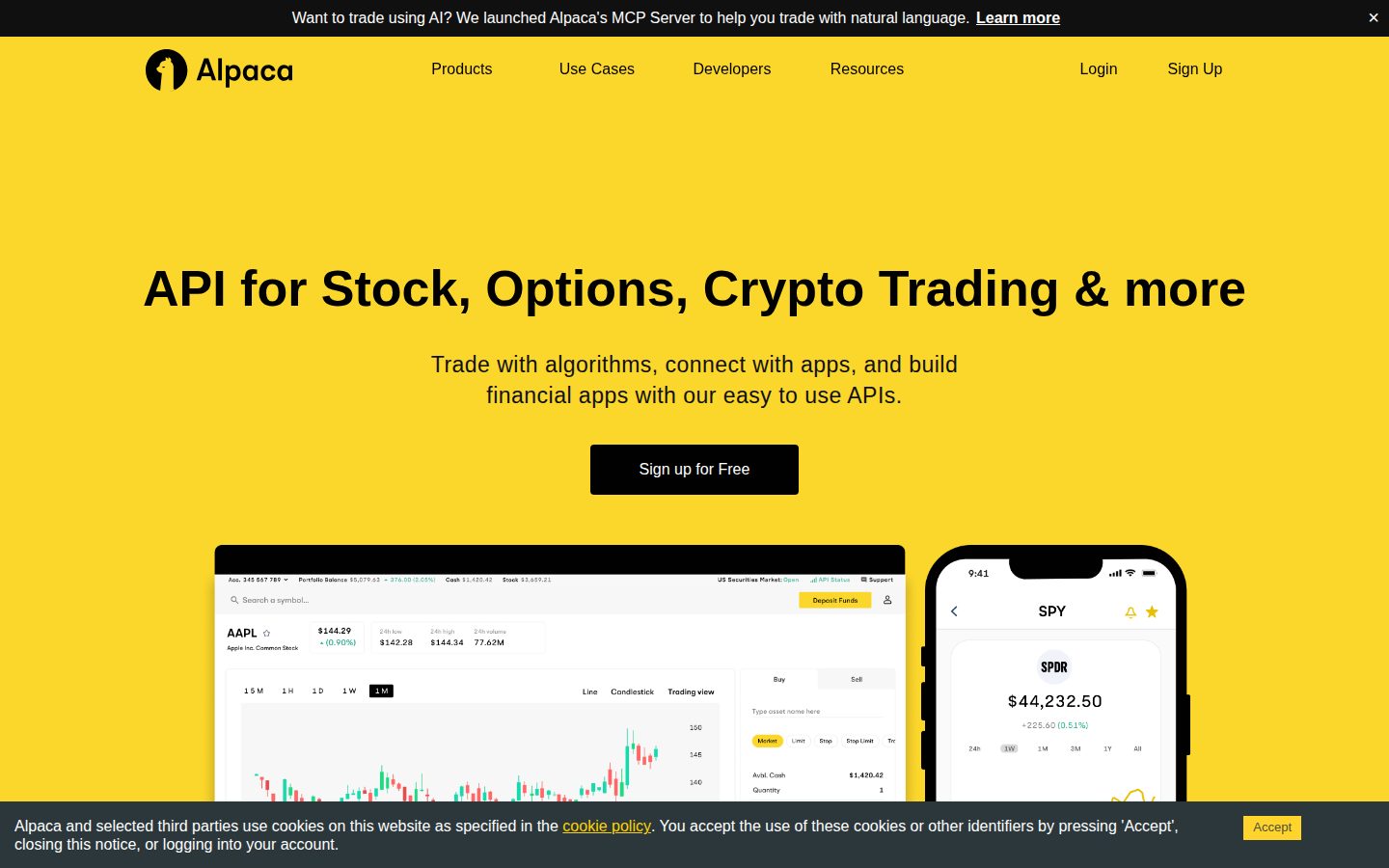
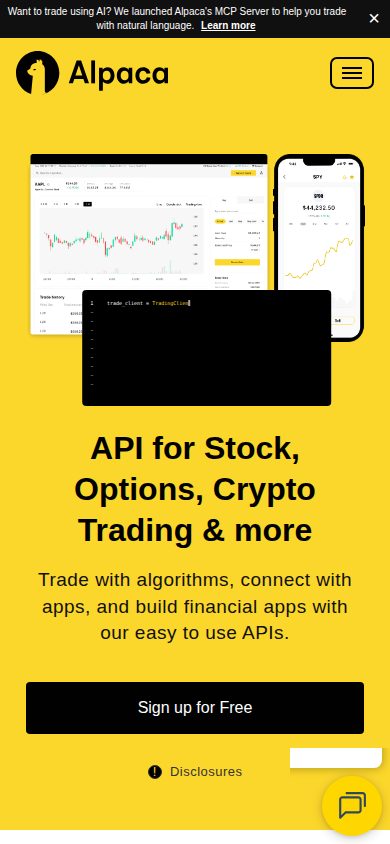
Commission-free trading API for stocks, ETFs, options, and crypto
Alpaca is a developer-first brokerage API platform for algorithmic traders, fintech startups, and financial institutions.
AI Panel Score
6 AI reviews
Reviewed
Users interact with Alpaca primarily through its Trading API or web dashboard, executing orders across stocks, ETFs, options, and 20+ cryptocurrencies. Developers can connect via SDKs in multiple programming languages, test strategies in a paper trading sandbox, and deploy live algorithms without writing exchange connectivity code. Individual traders can also connect their Alpaca accounts to TradingView for chart-based order execution.
Alpaca offers several capabilities that go beyond basic order routing. These include margin trading with up to 4x intraday leverage, fractional share purchases starting at $1, extended hours and pre-market trading, multi-leg options strategies, and ultra-low latency FIX messaging for institutional use. A High-Yield Cash program earns 3.82% APY on uninvested cash. The crypto infrastructure runs on Fireblocks' MPC-CMP architecture for custody, with 99.95% uptime and 1.5ms order processing. Alpaca is SOC 2 Type II certified and holds FINRA and SIPC membership through Alpaca Securities LLC.
Alpaca targets three distinct audiences: algorithmic traders building automated strategies, developers and fintech startups integrating brokerage into apps via the Broker API, and institutional partners such as crypto exchanges or digital wallet providers adding stock and options trading. The Broker API is reported to be trusted by over 200 global financial institutions. Pricing for market data access is tiered; basic trading access is commission-free with no stated monthly fee, while institutional and elite tiers exist for advanced data and tools. Competitors in the API brokerage space include Interactive Brokers, Tradier, and Webull for developers.
The platform exposes a REST API and WebSocket streams for real-time market data. SDKs are available for Python, JavaScript, Go, and other languages. Alpaca integrates with third-party platforms including TradingView and QuantConnect, and its partner ecosystem includes Plaid, Nasdaq, Mastercard, Refinitiv, and Wise for payments, data, and compliance services.

End-to-end brokerage API trusted by 200+ global financial institutions that lets third-party fintech companies embed fractional stock, options, crypto, and fixed income trading directly into their own applications.
API for spot and crypto-to-crypto trading of 20+ cryptocurrencies including BTC, ETH, and DOGE, with 99.95% uptime, 1.5ms order processing, and secure wallet for deposits and withdrawals.
Enables pre-market and after-hours trading sessions beyond standard U.S. market hours for stocks and ETFs.
Allows users and broker partners to invest in U.S. stocks and ETFs starting from as little as $1 through notional and fractional share orders.
Earns 3.82% APY on uninvested cash held in Alpaca accounts through a high-yield cash program.
Allows broker API partners to open brokerage accounts for their end users instantly by leveraging existing KYC processes, eliminating redundant onboarding steps.
Supports margin trading with up to 4X intraday leverage and short selling capabilities for eligible accounts.
Commission-free options trading that supports paper trading, backtesting, and execution of multi-leg options strategies via the Trading API with access to an OAuth ecosystem.
A sandbox environment that allows developers and traders to test and backtest trading strategies without risking real capital before going live.
Provides real-time and historical market data across U.S. stocks, ETFs, options, and cryptocurrencies with flexible pricing plans for individuals, businesses, and professional traders.
REST API enabling commission-free algorithmic trading of U.S. stocks, ETFs, options, and cryptocurrencies with support for market, limit, and stop order types.
Integrates Alpaca live trading with QuantConnect's cloud backtesting platform, enabling quantitative traders to build, backtest, and deploy strategies across stocks, ETFs, options, and crypto.
Connects Alpaca brokerage accounts to TradingView, giving users access to 15+ chart types, 90+ drawing tools, 100+ technical indicators, and customizable alerts for commission-free trading.
Individual algorithmic traders and developers building personal trading strategies
Institutional-grade traders requiring advanced tools and ultra-low latency execution
Fintech startups, digital wallets, crypto exchanges, and financial institutions building trading applications for their own customers
200 institutions trust this API; the real question is what you're building.
“Alpaca is a serious developer-first brokerage with self-clearing infrastructure and a free tier that includes commission-free options, crypto, and paper trading. The Broker API play is where the real strategic value sits.”
200+ financial institutions on the Broker API isn't a marketing number — that's proof of production load. FINRA membership, SOC 2 Type II, Fireblocks custody, and 1.5ms crypto order processing put this well ahead of hobbyist-grade competitors like Tradier. The freemium structure is clean: no hidden monthly fees, just tiered data pricing as you scale.
The tradeoff is audience fit. Individual algo traders get a genuinely capable sandbox plus TradingView and QuantConnect integrations. Fintech builders get instant KYC reuse and self-clearing ops. But if you're neither, this is overkill — there's no off-the-shelf product here, only an API surface.
No public funding data, which is the one thing I'd push on before committing a fintech product to their Broker API. Revenue model is opaque at the free tier. Pilot the Trading API first, validate latency and data quality, then revisit the Broker API commitment.
Beats Interactive Brokers on developer experience and Tradier on infrastructure depth, but the pricing opacity at scale is a real gap.
Nasdaq and Mastercard in the partner ecosystem, plus SOC 2 Type II, make this defensible to any board or compliance team.
Paper trading sandbox plus free tier means a developer can validate a strategy or integration in days, not quarters.
Broker API with instant KYC reuse and self-clearing directly advances fintech builders; this isn't just cost reduction, it's capability creation.
FINRA/SIPC membership and 200+ institutional partners suggest real staying power, but no public funding data means runway is unclear.
Fintech teams embedding brokerage into an existing app who want self-clearing infrastructure without building it.
You need a turnkey trading product with no engineering lift.
Alpaca's self-clearing infrastructure makes it a serious fintech balance sheet bet.
“Alpaca offers institutional-grade brokerage infrastructure at near-zero direct cost, which changes the build-vs-buy calculus entirely for fintech CFOs. The Broker API trusted by 200+ financial institutions isn't a demo feature — it's a cleared, regulated, compliance-wrapped revenue channel.”
The pricing structure deserves scrutiny first: three tiers listed as 'Free,' including the Broker API tier. That's not a business model — that's a land-and-expand play where Alpaca monetizes through order flow, data upsells, and institutional arrangements rather than SaaS fees. CFOs evaluating this need to model the implicit cost, not just the invoice. No public pricing page makes that harder than it should be.
The self-clearing infrastructure is the real asset here. Competitors like Interactive Brokers charge per-contract and carry clearing overhead you absorb; Alpaca abstracts that entirely. If we embed the Broker API into a product, in three years we own a regulated brokerage surface without a clearing firm dependency — that's meaningful balance sheet optionality.
The tradeoff: Fireblocks MPC custody and SOC 2 Type II certification signal serious compliance investment, but revenue model opacity creates forecasting risk. What's free today can reprice. Any CFO signing a multi-year product roadmap around this infrastructure needs contractual rate protection baked into the partnership agreement.
200+ institutional partners and self-clearing puts Alpaca ahead of Tradier and Webull for developers on infrastructure credibility, though Interactive Brokers still wins on global market breadth.
Instant KYC reuse, fractional shares from $1, and 4x intraday margin map cleanly to how fintech treasury and embedded finance teams actually structure their products.
Plaid, Mastercard, Nasdaq, Refinitiv, and Wise partnerships plus Python/Go/Node SDKs cover most modern fintech stacks without custom middleware.
Regulatory dependency on Alpaca Securities LLC FINRA membership creates a single-point-of-failure risk that doesn't exist when clearing in-house.
Self-clearing operations plus FIX messaging plus multi-leg options in one API stack is library-grade infrastructure depth, not a wrapper play.
Fintech CFOs embedding brokerage into a product who want cleared infrastructure without building or buying a broker-dealer.
Your growth model requires international market access beyond U.S. equities within the next 18 months.
$0 sticker on 3 tiers, but the real cost lives in data overage rates nobody publishes.
“Alpaca's commission-free model across all 3 tiers looks clean on paper. The unpublished market data overage rates are the invoice risk.”
All 3 tiers listed at $0. Commission-free trading, paper sandbox, multi-language SDKs — visible without a sales call. That's rare. The pricing page doesn't exist per the evidence, but the plan structure is documented. Procurement won't stall on a $0 contract.
Year 3 math for a fintech startup: Broker API is free, but real-time market data tiers scale with usage. No published overage rate. That's the actual risk — not the sticker, the invoice you can't model. Interactive Brokers publishes its data fees. Alpaca doesn't, based on available evidence. That gap is real.
The Broker API serving 200+ institutions with instant KYC is a genuine cost reducer — no redundant onboarding build. 3.82% APY on idle cash offsets carry cost. SIPC coverage up to $500K, FDIC sweep to $2.5M. The infrastructure math is solid. The data pricing math isn't visible enough.
$0 starting price across all tiers means minimal procurement friction — no PO required, no sales call, no negotiation needed to start.
No stated term length, no auto-renewal language surfaced in evidence — $0 base tiers imply low lock-in, though Broker API switching costs are non-trivial operationally.
3 tiers all show $0, but no pricing page exists per evidence and market data overage rates are unpublished — the hidden variable in every invoice.
Commission elimination and instant KYC reuse are measurable savings; 3.82% APY on cash is a concrete, trackable return line item.
Commission-free trading eliminates the obvious cost center, but undisclosed data tier pricing makes 3-year TCO modeling speculative for high-volume API users.
Fintech startups and algo traders who want $0 entry cost with production-grade brokerage infrastructure and can tolerate opaque data pricing.
Your 3-year TCO model requires fully published, predictable market data costs before signing anything.
Self-clearing brokerage API with institutional depth at zero commission cost
“Alpaca runs the full stack — clearing, custody, KYC, compliance — and hands it to developers via REST. The paper trading sandbox plus QuantConnect integration means quant strategies get tested before a single dollar is at risk.”
The pricing page lists three tiers all at $0/month, which immediately raises the question of where Alpaca monetizes. Payment for order flow and spread on crypto is the category norm. That's not a dealbreaker, but a financial analyst building execution-sensitive strategies should model fill quality against Interactive Brokers' direct-route execution before committing. Commission-free doesn't mean cost-free at scale.
Day-three reality for a quant workflow: Python SDK, paper trading sandbox, QuantConnect integration, and WebSocket market data streams are all wired together. That's a complete backtesting-to-live pipeline without stitching five vendors. The 1.5ms crypto order processing and FIX messaging for Elite accounts suggest the infrastructure team actually trades. Docs appear developer-authored, not marketing-authored — a meaningful signal.
The tradeoff is Broker API depth versus individual trader polish. The platform is clearly optimized for the 200+ institutional partners embedding it, not for the solo discretionary trader. But for algorithmic and quantitative workflows, that infrastructure bias is an asset, not a liability.
Paper sandbox plus QuantConnect integration gives quants a full test-to-live pipeline without stitching vendors, though fill quality transparency versus Interactive Brokers remains an open question.
Docs-enabled flag and developer-first positioning suggest technical authorship; the FIX messaging and MPC-CMP custody details read like someone who understands the stack.
No pricing page and opaque monetization model create recurring due-diligence friction for any institutional compliance review.
4x intraday margin, multi-leg options, ultra-low latency FIX, Fireblocks MPC-CMP custody, and excess SIPC insurance on Elite tier give serious depth beyond the free tier baseline.
Python, Go, and JavaScript SDKs plus TradingView OAuth and QuantConnect mean the tool fits existing quant and dev workflows rather than demanding new ones.
Quantitative developers and fintech teams who need a production-ready brokerage API without building clearing infrastructure from scratch.
You're running execution-sensitive strategies where fill quality and order routing transparency matter more than zero commission.
The brokerage API that actually treats developers like adults
“Alpaca is commission-free algorithmic trading infrastructure built for people who want to write code, not click buttons. If you're embedding brokerage into a fintech app or automating your own strategies, this is the serious option.”
Commission-free trading sounds like a marketing line until you see what's underneath. Alpaca backs it with a REST API, WebSocket streams, SDKs in Python, Go, and JavaScript, and a paper trading sandbox that lets you break things without losing real money. That sandbox alone puts it ahead of Interactive Brokers for developers who just want to iterate fast. The 200+ global financial institutions using the Broker API isn't a vanity number — it signals this infrastructure has been stress-tested somewhere important.
The tradeoff worth naming: this isn't for everyone. No pricing page means unclear costs once you outgrow free. The web platform is secondary — the docs are the product. If your team doesn't have an engineer who's comfortable with a REST API, Alpaca will feel like homework by day three.
Mobile parity is basically nonexistent. The TradingView integration saves chart-watchers, but the core experience lives on desktop and in terminals. For what it is — developer-first brokerage infrastructure with 1.5ms crypto execution and 3.82% APY on cash sitting idle — it's genuinely good.
The docs and API experience feel considered, but the web dashboard is clearly secondary to the developer-facing surface — micro-copy and empty states likely show it.
QuantConnect and TradingView integrations lower the floor for non-engineers, but the ceiling — multi-leg options, FIX messaging, margin at 4x — requires you to know what you're doing.
Platform support is listed as web-only; for a tool positioning itself as always-available trading infrastructure, mobile is effectively an afterthought.
Paper trading sandbox plus multi-language SDKs mean a developer can be running test orders within an hour; the KYC instant account opening for Broker API partners is a real time-saver.
99.95% uptime on crypto, 1.5ms order processing, SOC 2 Type II, Fireblocks MPC-CMP custody, and FINRA/SIPC membership are the kind of numbers that reduce 3am anxiety.
Developers and fintech builders who want production-grade brokerage infrastructure without writing exchange connectivity code.
You don't have engineering resources and need a polished consumer-facing trading app.
200+ institutions live, self-clearing infra, three free tiers — harder to dismiss than expected
“Alpaca has real brokerage infrastructure under it — FINRA membership, SOC 2 Type II, Fireblocks custody. The 200+ institution claim on the Broker API is the number that makes me take this seriously.”
Three tells I check first. One: no pricing page in the scraped capabilities. Two: 'Elite' tier listed as free with no clarification on what it actually costs — that'll bite someone. Three: changelog absent. Shipping cadence is invisible from public evidence.
That said, the differentiation is real. Interactive Brokers has an API. It's painful. Tradier exists but lacks self-clearing. Alpaca's self-clearing infrastructure plus Broker API — letting fintechs white-label brokerage — is a different product category, not just a different price point. The 1.5ms crypto processing and Fireblocks MPC-CMP custody aren't marketing fluff; those are verifiable architectural choices.
Exit portability is decent. REST APIs, standard SDKs, QuantConnect integration — you're not trapped. But your end-users on the Broker API are. If you've embedded their KYC and clearing into your product, leaving is a multi-quarter migration. Worth pricing in.
Self-clearing plus white-label Broker API separates this from Interactive Brokers and Tradier, which offer connectivity but not embedded brokerage infrastructure.
Individual traders exit cleanly via standard REST APIs, but Broker API partners face deep KYC and clearing lock-in — a real asymmetry.
No changelog, no public funding data visible — but SOC 2 Type II certification, SIPC membership, and Mastercard/Nasdaq/Plaid partnerships suggest operational seriousness.
Commission-free claim holds up per the FAQ, but 'Alpaca Elite — Free' with no cost breakdown is the kind of language that ages poorly on closer inspection.
200+ global financial institutions on the Broker API, FINRA membership, and self-clearing infrastructure match patterns of durable API-layer fintech survivors, not vaporware.
Fintech startups or algo traders who need self-clearing brokerage infrastructure without building it themselves.
You need transparent, auditable pricing and a public shipping history before committing your product's financial rails to a vendor.
Common questions answered by our AI research team
SDKs are available in Python, .NET/C#, Go, Node, and more.
Yes, Alpaca offers paper trading so you can backtest your strategy before deploying it live, with free and advanced market data available.
Yes, stock and options trading through the Trading API is commission-free for self-directed individual cash brokerage accounts trading U.S.-listed securities.
Customer brokerage funds are protected by SIPC up to $500,000. Uninvested cash can be enrolled in an FDIC Bank Sweep offering up to $2.5M in FDIC coverage, though funds in the sweep are not SIPC-protected.
Yes, Alpaca supports OAuth integration with apps, algo bots, and platforms including TradingView.
Company
Alpaca MarketsFounded
2015Pricing
FreemiumFree Trial
AvailableFree Plan
AvailableAlpaca is a San Mateo-based brokerage API platform that enables developers and fintech companies to build trading applications, automate strategies, and embed stock and crypto trading.