Amazon Product Ads logo

Amazon Product Ads Review

Visit

Self-service advertising across Amazon shopping, streaming, and display

Amazon Ads is a digital advertising platform for businesses looking to reach customers across Amazon's shopping, streaming, and content properties.

AI Panel Score

8.3/10

6 AI reviews

Reviewed

AI Editor Approved

About Amazon Product Ads

Advertisers use Amazon Ads by registering an account and building campaigns through a self-service console. The primary entry point is sponsored ads, which place products in search results and product pages on Amazon. From there, advertisers can expand into display, video, and streaming TV formats. Campaign setup requires no upfront fees for sponsored ads, and budgets are set by the advertiser on a cost-per-click basis.

The platform includes access to Amazon DSP (Demand-Side Platform), which enables programmatic ad buying across Amazon-owned sites and third-party inventory. Streaming TV ads run on Prime Video and Twitch, with interactive features that allow viewers to browse or shop directly from the ad. Reporting tools in the advertising console track sales attribution, keyword performance, and campaign-level metrics. Advertisers can also create free Brand Stores, which are custom multi-page storefronts hosted on Amazon.

Amazon Ads serves a wide range of advertisers, from individual sellers on the Amazon marketplace to large brands that do not sell on Amazon at all. Non-Amazon sellers can still use the platform to drive off-Amazon awareness using Amazon's audience data. Sponsored ads operate on a cost-per-click model with no minimum spend; managed-service campaigns with an Amazon Ads account executive typically require a minimum spend of $50,000. Competitors in the broader digital advertising space include Google Ads, Meta Ads, and The Trade Desk, though Amazon's differentiation is its direct connection to purchase behavior data.

The advertising console is web-based. Amazon also offers the Amazon Ads Academy, a free learning resource with courses and certifications, and a Partner Directory of vetted agencies for advertisers seeking managed support.

Features

Analytics

  • Campaign Reporting Console

    Advertising console that tracks sales, monitors campaign metrics, and provides performance breakdowns by campaign, keyword, or product to optimize ad spend.

Core

  • Amazon DSP

    Demand-side platform solution that enables advertisers to engage customers at scale across multiple channels programmatically.

  • Brand Stores

    Free self-service storefront solution that lets brands create a dedicated multi-page shopping destination within the Amazon store.

  • Display Ads

    Display advertising solution that helps advertisers engage customers at scale across multiple channels beyond search results.

  • First-Party Audience Targeting

    Audience targeting built from Amazon's real-time shopping, streaming, and browsing signals to connect advertisers with customers based on purchase intent and viewing behavior.

  • Interactive Shoppable Ads

    Interactive ad features embedded in streaming content that let viewers browse and shop products while they watch.

  • Non-Amazon Advertiser Access

    Registration pathway that allows businesses not selling on Amazon to still run ads and reach audiences using Amazon's shopping, streaming, and browsing signals.

  • Sponsored Ads

    Self-service cost-per-click ads that appear in high-visibility placements across Amazon with no up-front fees and can be set up in minutes.

  • Streaming TV Ads

    Full-funnel streaming TV ads served across Prime Video, Twitch, and beyond, using first-party shopping and streaming signals to reach targeted viewers.

  • Video Ads

    Video advertising format that allows brands to reach customers through video content across Amazon's properties.

Support

  • Amazon Ads Academy

    Free learning platform offering courses, certifications, and videos to help advertisers build skills and improve campaign performance.

  • Amazon Ads Partner Directory

    Directory of vetted third-party partners offering services in media planning, retail strategy, creative development, and performance management to help scale campaigns.

Preview

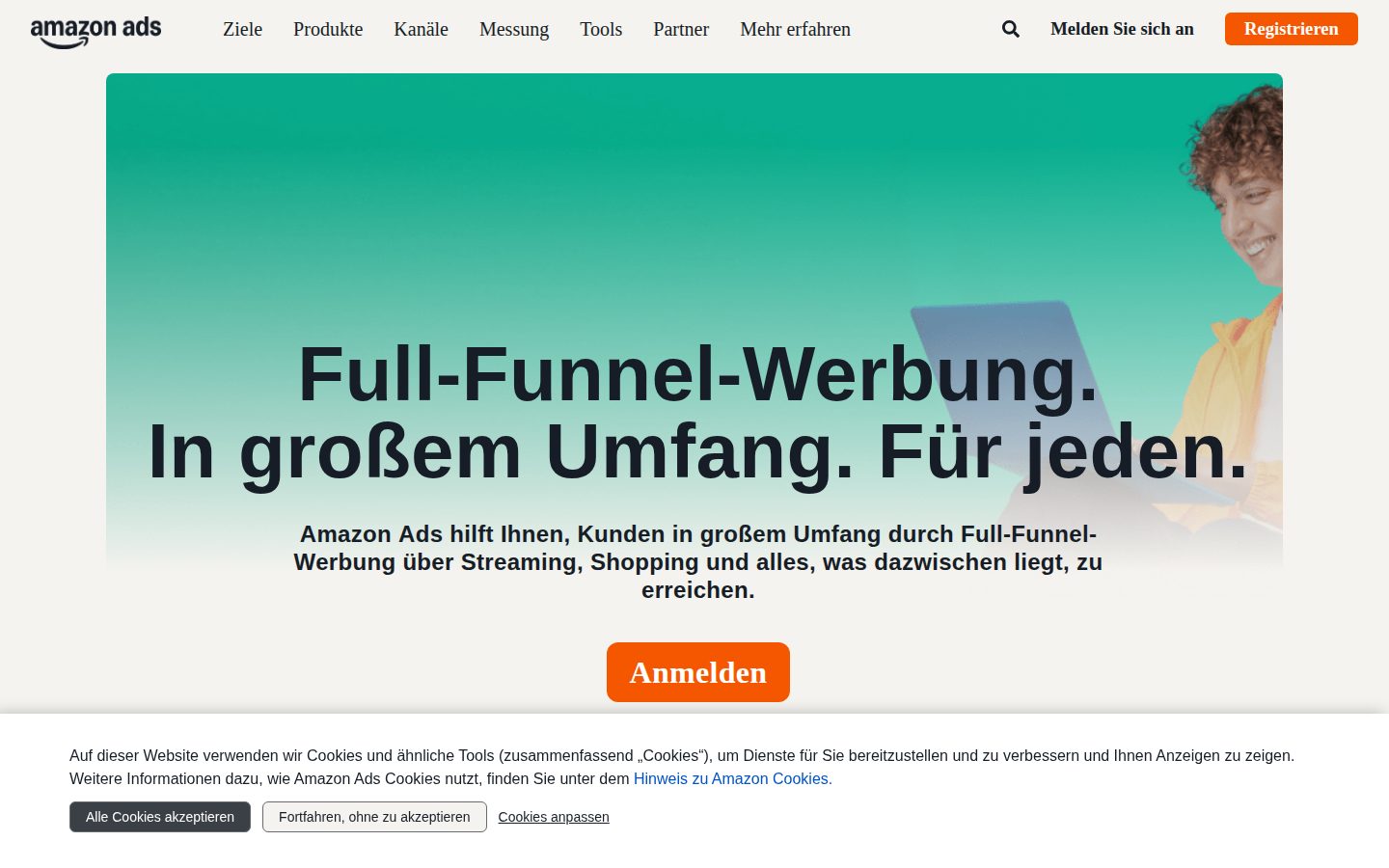
Amazon Product Ads desktop previewAmazon Product Ads mobile preview

Pricing Plans

Popular

Sponsored Products

Contact sales

Pay-per-click ads for individual product listings that appear in Amazon search results and product pages. No fixed plan price — costs are auction-based; advertisers set their own daily budget and maximum bid per click. Average CPC is $0.80–$1.30. Suitable for sellers of all sizes, especially beginners looking for the lowest-cost entry point into Amazon advertising.

  • Pay-per-click (PPC) auction model — no upfront flat fee
  • Average CPC of $0.80–$1.30 per click (2026 benchmarks)
  • Ads appear in search results and on product detail pages
  • No minimum daily budget required; beginners often start at $5–$20/day
  • Dynamic bidding — you pay one cent more than the next highest bidder
  • CPC varies by category: competitive niches (electronics, supplements) can reach $1.50–$3+
  • Lowest cost-per-click of all Amazon sponsored ad types

Sponsored Brands

Contact sales

Pay-per-click ads that display your brand logo, a custom headline, and multiple products at the top of search results. Auction-based pricing with no fixed plan fee. Average CPC is $1.25–$2.50. Best for established sellers and brands looking to increase brand awareness and differentiate from competitors.

  • Pay-per-click (PPC) auction model — no upfront flat fee
  • Average CPC of approximately $1.25–$2.50 per click
  • Prominent top-of-search placement with brand logo and headline
  • Promote multiple products simultaneously
  • Higher CPC than Sponsored Products due to premium placement
  • CPC can exceed $2.50 in competitive categories like Beauty and Electronics
  • Best for brand recognition and upper-funnel awareness

Sponsored Display

Contact sales

Display ads for retargeting and audience targeting, shown on Amazon product pages, review sections, and across third-party websites off Amazon. Supports both CPC and CPM (cost-per-thousand-impressions) billing. Average CPC is $0.80–$1.60; average CPM is $4–$12. Suitable for brands wanting to retarget shoppers or reach audiences beyond search.

  • Supports both CPC ($0.80–$1.60 avg) and CPM ($4–$12 avg) billing models
  • Reaches shoppers on Amazon and across third-party websites
  • Ideal for retargeting shoppers who viewed but did not purchase
  • No fixed minimum spend; flexible budget control
  • Creative assets (images, lifestyle photos) may add $300–$3,000 in production costs
  • CPC range varies widely based on targeting type and audience intent
  • Suitable for brand-building and retargeting campaigns

Amazon DSP (Demand-Side Platform)

Contact sales

Programmatic display and video advertising platform for reaching audiences at scale on and off Amazon. Operates on a CPM basis. Minimum spend thresholds typically apply and managed-service access generally requires contacting Amazon's sales team. Best for large brands with significant budgets seeking full-funnel reach and advanced attribution via Amazon Marketing Cloud (AMC).

  • Programmatic buying of display, video, and audio ad inventory
  • CPM-based pricing model (cost per 1,000 impressions)
  • Access to Amazon's first-party audience data for precise targeting
  • Retarget high-intent shoppers who viewed products but did not purchase
  • Amazon Marketing Cloud (AMC) integration for deeper attribution (recommended for $25,000+/month spenders)
  • Managed-service option available through Amazon's sales team
  • Best for established brands running full-funnel advertising strategies

Sponsored TV

Contact sales

Self-service streaming TV ad format with no minimum spend requirement. Runs on a CPM basis and is launched through the same console as Sponsored Products. Best for established brands looking to expand into upper-funnel, awareness-focused reach via streaming content.

  • CPM-based pricing — pay per 1,000 impressions
  • No minimum spend required
  • Self-service setup through Amazon Ads console
  • Targets streaming TV audiences on Amazon-owned properties
  • Upper-funnel awareness format
  • Best for brands ready to invest in video and streaming advertising

AI Panel Reviews

The Decision Maker

The Decision Maker

Strategic bet, vendor viability, timing, adoption approval
8.5/10

Amazon's purchase-intent data is the moat — nothing Google or Meta has matches it.

If your customers buy things, Amazon knows it before you do. That's the whole argument.

Three decades of transaction data, and they're feeding it into every ad format — Sponsored Products at $0.80–$1.30 CPC, streaming TV on Prime Video, programmatic DSP. No other platform connects ad exposure to actual purchase behavior this cleanly. Google and Meta are guessing at intent. Amazon's watching the cart.

The tradeoff is real. Managed-service DSP typically requires $50,000 minimum spend, and Amazon Marketing Cloud only makes sense at $25,000/month. Self-service sponsored ads have no floor, but you get what you pay for in support. Small budgets will feel the ceiling fast.

Non-Amazon sellers can still run here — the docs confirm a registration path for businesses not selling on Amazon. That changes the calculus. This isn't just a retail media play. It's a full-funnel platform with first-party audience data that Google Ads and The Trade Desk can't replicate.

Competitive Positioning8.5

Peers are already here — the question is whether they're using DSP and AMC, which is where the real edge lives.

Reputation Risk9.0

No board will question an Amazon Ads line item — it's the default call for commerce-adjacent brands.

Speed to Value8.0

Sponsored Products can be live in minutes with no upfront fee, but meaningful attribution data takes 30–60 days to stabilize.

Strategic Fit8.5

First-party purchase-intent targeting via Amazon DSP advances any brand running performance or awareness campaigns, not just Amazon sellers.

Vendor Viability10.0

Amazon is a $2T company — runway concerns don't apply here.

Pros

  • First-party purchase-intent data is unmatched — real shopping signals, not proxy behavioral data
  • Sponsored Products entry at $0.80–$1.30 CPC with no minimum spend means anyone can test it
  • Non-Amazon sellers can access the full audience stack — no marketplace account required
  • Free Brand Stores and Amazon Ads Academy lower the cost to get started

Cons

  • DSP and managed service require $50,000 minimum — smaller brands hit a hard wall
  • No pricing page published; CPC benchmarks from third parties, not Amazon directly
  • Creative production for Sponsored Display can run $300–$3,000 before you've spent a dollar on media

Right for

Any brand running performance marketing that wants to reach buyers at the moment of purchase intent.

Avoid if

Your budget won't sustain $25,000+/month once you outgrow self-service sponsored ads.

The Domain Strategist

The Domain Strategist

Craft and strategy in the product's domain — adapts identity per category, same lens
8.2/10

Amazon's purchase-intent data moat makes this the default full-funnel buy for product-led brands.

Amazon Ads is the only platform where targeting is built directly on real transaction behavior, not modeled proxies. For brands selling on Amazon, it's not optional — it's the channel where demand closes.

First-party purchase intent at scale is the strategic asset here. Google and Meta model intent; Amazon knows someone bought diapers last Tuesday. That signal difference compounds over time — the Campaign Reporting Console ties ad spend directly to sales attribution in a way Google Ads can't replicate without conversion API gymnastics. Sponsored Products at $0.80–$1.30 CPC with no minimums gives any brand a real entry point.

The ceiling depends entirely on budget architecture. Self-service works well through Sponsored Brands and Sponsored Display, but Amazon DSP and Amazon Marketing Cloud — where the real audience orchestration lives — become meaningful above $25,000/month and require managed-service access at $50,000 minimum. If we're a mid-market brand, that's a wall we'll hit faster than expected.

The tradeoff worth naming: Amazon Ads optimizes for Amazon. If our strategy is building owned audiences or driving DTC conversion, the platform works against us — shoppers stay in the Amazon ecosystem, and Brand Stores don't export customer data. Non-Amazon advertisers can run awareness campaigns, but attribution back to off-Amazon sales remains murky.

Category Positioning8.8

Against Google Ads, Meta Ads, and The Trade Desk, Amazon holds a defensible moat in purchase-intent data that competitors have spent years trying to approximate without success.

Domain Fit8.5

Full-funnel coverage from Sponsored Products through Streaming TV Ads matches how CMOs actually structure awareness-to-conversion campaigns, not just bottom-funnel activation.

Integration Surface7.0

The advertising console is web-only with no documented API access in the evidence, which limits integration with external CDPs or media mix modeling stacks without custom workarounds.

Long-term Implications7.5

Adopting Amazon Ads deepens dependency on Amazon's ecosystem — Brand Stores, attribution, and audience data don't port out, creating real strategic lock-in by year two.

Strategic Depth9.0

First-party shopping and streaming signals via Amazon DSP and AMC integration represent a targeting depth that no other platform can replicate from pure intent data.

Pros

  • Purchase-intent targeting built on real transaction data, not modeled behavior
  • Full-funnel format coverage: sponsored search, display, video, and streaming TV in one console
  • No minimum spend on self-service tiers — Sponsored Products starts at $5/day
  • Amazon Ads Academy and Partner Directory reduce onboarding friction for new teams

Cons

  • Managed-service DSP requires $50,000 minimum, locking serious audience orchestration behind a high budget threshold
  • Brand Stores and audience data stay inside Amazon's ecosystem — no owned-channel carryover
  • Attribution for non-Amazon advertisers driving off-platform sales remains structurally limited
  • No documented API access limits integration with external CDP or MMP stacks

Right for

Product-led brands selling on Amazon that need a direct line from ad spend to purchase attribution.

Avoid if

Your growth strategy depends on building owned audiences or converting customers on a DTC storefront outside Amazon.

The Finance Lead

The Finance Lead

Money, total cost of ownership, contracts, procurement math
8.2/10

No minimum spend entry, $50K managed floor — the range tells the whole story.

Amazon Ads runs CPC from $0.80 to $3+ depending on category, with zero upfront commitment on sponsored formats. Managed service requires $50K minimum — self-service and enterprise live on different planets.

Sponsored Products CPC averages $0.80–$1.30. Sponsored Brands runs $1.25–$2.50. No fixed minimums on either. A 50-seat marketing team can test at $10/day and scale without a contract. That's rare for a platform with this reach. Add creative production for Sponsored Display — $300–$3,000 per flight — and year-1 all-in for a mid-market brand might land at $60K–$120K depending on category competitiveness.

The DSP tier is where procurement gets complicated. Managed-service access requires $50K minimum spend and a sales call. No self-serve path at that scale. Amazon Marketing Cloud integration is recommended at $25K+/month — that's $300K/year before creative, agency fees, or AMC analytics tooling. Compare to Google Ads or The Trade Desk: both offer programmatic self-serve without a managed-service gate.

No pricing page exists — confirmed by the evidence. CPCs are benchmarks, not published rates. Category volatility is real: electronics and supplements hit $1.50–$3+. No published overage model. First-party purchase-intent data is the moat; no competitor touches it. The math works at entry level. Enterprise TCO needs a spreadsheet and a sales call.

Billing & Procurement7.5

Self-service billing is clean and usage-based; DSP managed service introduces sales-team dependency and a $50K floor that slows procurement.

Contract Flexibility8.5

Sponsored formats have no contracts, no minimums, and no auto-renewal risk — self-service budgets are fully advertiser-controlled.

Pricing Transparency6.5

No published pricing page; CPC benchmarks are available publicly but auction variability and DSP minimums require a sales conversation.

ROI Clarity8.8

Campaign Reporting Console tracks sales attribution, keyword performance, and campaign metrics; first-party purchase data makes attribution stronger than most competitors.

Total Cost of Ownership7.0

Entry TCO is genuinely low; DSP at $25K+/month and creative production costs make year-3 enterprise TCO unpredictable without a detailed model.

Pros

  • Sponsored Products: zero upfront, CPC averaging $0.80–$1.30
  • No minimum daily budget on self-service formats
  • First-party Amazon purchase-intent data — no competitor matches it
  • Free Brand Stores and Amazon Ads Academy reduce onboarding cost

Cons

  • No public pricing page — rates require external benchmarks or testing
  • DSP managed service gates at $50K minimum spend
  • Creative production adds $300–$3,000 per Sponsored Display flight
  • Category CPCs in electronics and supplements can exceed $3.00

Right for

Brands selling on Amazon who want measurable purchase-intent targeting from entry-level budgets to full-funnel scale.

Avoid if

Your managed-service budget is under $50K and you need programmatic DSP access without a sales relationship.

The Domain Practitioner

The Domain Practitioner

Daily hands-on reality in the product's domain — adapts identity per category, same lens
8.2/10

Amazon's purchase-intent data is real. The console will humble you first.

No ad platform has cleaner signal on buyer intent than Amazon. The $0.80–$1.30 CPC entry point for Sponsored Products is genuinely low for what you're reaching. But the console is dense, the learning curve is real, and the $50,000 managed-service floor means you're either self-sufficient or spending big.

Sponsored Products get you live fast — no minimum spend, auction-based, self-service console. For a marketer running e-commerce campaigns, that's a legitimate day-one win. The first-party audience data isn't scraped behavior or modeled lookalikes. It's checkout signals. That's the differentiator Google Ads and Meta Ads can't match for bottom-funnel intent.

Day three looks different. The console isn't Linear. Campaign structures, match types, bid strategies, and attribution windows all demand attention simultaneously. Sponsored Brands CPCs average $1.25–$2.50, and competitive categories blow past that fast. Budget pacing feels manual in ways that Meta's automated rules have long since solved.

The real ceiling is DSP. Amazon Marketing Cloud integration — recommended at $25,000+/month — unlocks the attribution depth that makes full-funnel reporting honest. Below that threshold, you're optimizing on incomplete signal. Amazon Ads Academy exists, but practitioner-written it isn't. The tradeoff is stark: unmatched audience quality, genuinely frustrating operational overhead.

Day-3 Reality7.0

Sponsored Products launch fast, but managing match types, bidding strategies, and attribution windows across multiple campaign types becomes a daily operational grind without agency support.

Documentation Practitioner-Fit6.5

Amazon Ads Academy offers free certifications, but the docs=N flag in evidence and no visible practitioner changelog suggest documentation written for onboarding, not for daily optimization decisions.

Friction Surface6.8

CPC variance by category, split billing models (CPC for Sponsored Display, CPM for DSP and Sponsored TV), and a $50,000 managed-service floor create compounding friction for mid-market teams.

Power-User Depth8.5

Amazon Marketing Cloud integration, DSP programmatic buying, and interactive shoppable ad formats on Prime Video give serious advertisers genuine full-funnel depth unavailable on most competing platforms.

Workflow Integration7.5

Web-console-only access means no native integration with campaign management tools marketers already live in; no public API evidence means automation requires workarounds or third-party platforms.

Pros

  • First-party purchase-intent targeting is the strongest signal in digital advertising — not modeled, not inferred
  • Sponsored Products entry point requires zero upfront spend, with CPCs averaging $0.80–$1.30
  • Full-funnel coverage from search (Sponsored Products) to streaming (Prime Video, Twitch) in one console
  • Non-Amazon sellers can still access Amazon's audience data for off-platform awareness campaigns

Cons

  • Managed-service access requires $50,000 minimum — a hard wall for growing brands who need expert support
  • Amazon Marketing Cloud's full attribution depth is realistically gated behind $25,000+/month in DSP spend
  • Console complexity compounds fast — bid types, match types, and attribution settings aren't self-explanatory
  • No API evidence in public materials means campaign automation likely requires paid third-party tools

Right for

E-commerce brands and Amazon sellers who want bottom-funnel intent targeting that Google and Meta simply can't replicate.

Avoid if

Your budget is under $10,000/month and you don't have the bandwidth to manage campaign complexity without a dedicated specialist or agency.

The Power User

The Power User

Daily human experience, onboarding, polish, learning curve, reliability
8.2/10

Amazon's ad data moat is real — if you can handle the console

The first-party purchase intent targeting is genuinely different from Google Ads or Meta. Getting good at it takes patience, but the floor is free and the ceiling is massive.

No minimum spend on Sponsored Products, average CPC around $0.80–$1.30, and you're inside the most purchase-ready audience on the internet. That's a real on-ramp. The setup is self-service through a web console, and the Amazon Ads Academy exists specifically because this platform isn't intuitive on its own. That's honest self-awareness, and I respect it.

The console has the feel of something built by many teams who don't talk to each other. Campaign Reporting, DSP, Sponsored TV — they're all technically in the same place but each one has its own logic. Day three you will feel this. Day thirty you'll have built muscle memory and stopped noticing, mostly.

The real tradeoff: this is a web-only platform. No mention of mobile parity anywhere. For a platform managing live ad spend, checking a campaign on your phone shouldn't be a prayer. DSP managed service also requires $50,000 minimum — a hard wall for smaller buyers who want programmatic reach without the spend.

Daily Polish6.5

Multiple ad formats with inconsistent console logic suggests different teams shipped different corners — functional but rough in the daily repetition.

Learning Curve6.8

Sponsored Products are genuinely quick to start, but DSP, Amazon Marketing Cloud, and Sponsored TV each add separate complexity layers that reward months of investment.

Mobile Parity4.5

Web-only platform with no mobile app evidence — live budget management from a phone appears to be an afterthought.

Onboarding Experience7.5

Free entry, no minimum spend, and Amazon Ads Academy with courses and certifications soften the learning curve at the door.

Reliability Feel8.0

Amazon-scale infrastructure; the changelog exists and the console tracks sales attribution in real time — platform reliability isn't the concern here.

Pros

  • First-party purchase intent data that Google Ads and Meta simply can't replicate
  • No minimum spend on Sponsored Products — beginners can test at $5/day
  • Free Brand Stores give smaller sellers a real storefront without a dev budget
  • Non-Amazon sellers can still access Amazon's audience data for off-platform awareness

Cons

  • Web-only; mobile experience appears nonexistent for active campaign management
  • DSP managed service requires $50,000 minimum — walls off programmatic reach for most small buyers
  • Console feels like several products stitched together rather than one coherent tool
  • Competitive niches like electronics can push CPC to $3+ fast

Right for

Amazon sellers or established brands who want to reach high-intent shoppers and can invest time learning a complex but powerful console.

Avoid if

Your budget won't clear $50,000 and you need programmatic reach, or you require a mobile-capable dashboard to manage spend on the go.

The Skeptic

The Skeptic

Contrarian. Watch-outs, deal-breakers, broken promises, category patterns
8.2/10

Amazon's first-party purchase data is the moat. Everything else is table stakes.

Mature platform with real differentiation — buying intent data nobody else has. The $50,000 managed-service floor keeps serious DSP access away from smaller players.

Three tells before I dig in. One: 'Full-funnel advertising. At scale. For everyone.' — that's three superlatives in five words. Two: no pricing page flagged in the scrape. Three: 'for everyone' is doing heavy lifting when managed-service requires $50K minimum. The headline doesn't match the access tiers.

But here's what's real: the First-Party Audience Targeting feature isn't marketing copy — it's structural. Google and Meta infer purchase intent. Amazon has the actual cart data. That gap is meaningful and durable. Sponsored Products entry point at $0.80–$1.30 CPC with no minimum is a legitimate low-risk ramp. Sponsored TV adding no-minimum CPM streaming is newer and worth watching.

The exit story is ugly. Campaigns, attribution data, audience lists — none of it ports cleanly to Google Ads or The Trade Desk. You're building inside Amazon's walls. If your business shifts off-Amazon, you start over. That's the tradeoff most advertisers underweight.

Competitive Differentiation8.8

First-party purchase-intent targeting is a genuine moat over Meta Ads and Google Ads, which infer rather than observe buying behavior directly.

Exit Portability3.5

Campaign data, attribution models, and audience segments built in the console don't migrate to Google Ads or The Trade Desk — lock-in is real and structural.

Long-term Viability9.5

Amazon is one of three dominant digital ad players globally — viable doesn't even capture it; the changelog shows active shipping and Academy certifications signal ongoing investment.

Marketing Honesty6.2

'For everyone' on the H1 conflicts with a $50,000 managed-service floor; no public pricing page makes comparison-shopping harder than it needs to be.

Track Record Match9.0

Amazon Ads has been a top-three digital ad platform for years — this isn't a startup pattern, it's an incumbent with compounding first-party data advantages.

Pros

  • First-party purchase behavior data no competitor can replicate
  • Sponsored Products entry at $0.80–$1.30 CPC with zero minimum spend
  • Non-Amazon sellers can still access Amazon's audience data
  • Streaming TV ads on Prime Video with no minimum — self-service access to a premium format

Cons

  • Exit portability is poor — audience and attribution data stays inside Amazon
  • $50,000 managed-service floor locks smaller brands out of full DSP access
  • No public pricing page; CPM and DSP costs require contacting sales
  • 'For everyone' headline undersells the real complexity and cost tiers

Right for

Brands selling on Amazon or targeting high-intent shoppers who want purchase-signal-based targeting unavailable elsewhere.

Avoid if

Your customer acquisition strategy needs portable data and clean migration paths across ad platforms.

Buyer Questions

Common questions answered by our AI research team

Pricing

What is the minimum spend for Amazon Ads managed service?

Managed-service advertising with an Amazon Ads account executive typically requires a minimum spend of $50,000.

Setup

Can I advertise on Amazon without selling products there?

Yes. During registration, select "Products and services not sold on Amazon" to access solutions that drive awareness and sales using Amazon's shopping, streaming, and browsing signals.

Features

What ad formats does Amazon Ads support?

Amazon Ads supports sponsored ads, Brand Stores, display ads, video ads, streaming TV ads, and Amazon DSP. These run across Amazon's store, Prime Video, Twitch, and beyond.

Integration

How do I find expert help to manage my Amazon Ads campaigns?

Browse the Amazon Ads Partner Directory to find vetted experts offering media planning, retail strategy, creative development, and performance management services.

Features

What reporting tools does the Amazon Ads console provide?

The advertising console tracks sales, monitors campaign metrics, and identifies optimization opportunities. You can view performance broken down by campaign, keyword, or product.

Also in AI Marketing Tools