Customer.io logo

Customer.io Review

Visit

Automated messaging platform for data-driven customer engagement

Customer.io is a marketing automation platform for sending targeted email, push, SMS, and in-app messages based on user behavior and data.

AI Panel Score

8.0/10

6 AI reviews

Reviewed

AI Editor Approved

About Customer.io

In practice, users connect Customer.io to their app or data sources via API, SDK, or integrations, then define audiences using real-time and historical event data. From there, they build journeys in a drag-and-drop visual editor—setting entry conditions, branching logic based on user attributes or actions, time delays, and exit rules—before sending messages across email, SMS, push, in-app, and webhooks.

The platform includes a built-in email editor alongside a code-based editor for custom HTML, liquid templating for dynamic content personalization, A/B testing for messages and branches, and frequency capping to control message volume per user. Customer.io also offers a Data Pipelines product that functions as a customer data platform (CDP), routing event data between sources and destinations independently of the messaging layer. Reporting includes delivery metrics, conversion tracking, and funnel analysis tied to campaign goals.

Customer.io targets product-led SaaS companies, mobile apps, and growth and lifecycle marketing teams that need programmatic control over messaging logic. Pricing starts around $100/month on its Essentials plan and scales by the number of profiles and message volume; a free trial is available. It competes with Braze, Iterable, Klaviyo, ActiveCampaign, and Segment Engage in the lifecycle marketing and CDP space.

The platform offers REST and batch APIs, native SDKs for iOS and Android (for push and in-app), and pre-built integrations with Segment, Twilio, Stripe, Salesforce, and other tools. Customer.io is a cloud-hosted SaaS product accessible via web browser, with no self-hosted deployment option.

Features

AI

  • AI Agent

    Conversational AI that goes from a single prompt to a fully configured campaign with triggers, content, timing, and logic, and can instantly analyze campaign performance with recommendations.

  • Brand Voice & Preferences Memory

    The AI Agent automatically retains and applies brand voice, goals, and preferences across every session without manual reconfiguration.

Analytics

  • Analytics

    Surface campaign performance insights and data-grounded recommendations to help deliver measurable business outcomes.

Automation

  • Behavioral Triggers

    Trigger messages and workflows automatically based on real-time user actions, engagement signals, or inactivity detected within the product.

  • Journeys

    Build automated campaigns with triggers, content, timing, and logic that improve with every send across multiple channels.

Core

  • Audiences

    Segment and reach the right customers using data-driven conditions based on real-time events, attributes, and behavioral signals.

  • Lifecycle Journey Solutions

    Supports distinct customer journey stages—Activation, Onboarding, Retention, and Cross-sell & Upsell—each with purpose-built campaign logic tied to product usage and behavioral data.

Customization

  • Design Studio

    Create and manage branded messages at scale without requiring complex tooling or design resources.

Integration

  • Data & Integrations

    Connect customer data, apps, and AI tools to a single platform to drive personalization and scale messaging workflows.

  • MCP / CLI / API / Webhook Integration

    Connects with any AI tool or external system using MCP, CLI, API, or webhooks for flexible data and workflow interoperability.

Security

  • Enterprise Security

    Protects customer data with enterprise-grade safeguards including GDPR compliance, HIPAA compliance, and AICPA SOC certification for both team and AI agent use.

Support

  • Implementation & Ongoing Support

    Provides email and chat support alongside hands-on implementation guidance and ongoing assistance for teams deploying the platform.

Preview

Customer.io desktop previewCustomer.io mobile preview

Pricing Plans

Essentials

$100/monthly

Entry plan for growing teams sending lifecycle messaging; scales with profiles and email volume.

  • 5,000 profiles (people + objects)
  • 1 million emails per month
  • 2 object types
  • Visual workflow builder
  • AI Agent with core execution skills
  • Email and community support

Premium

$83/monthly

For scaling teams needing custom volume and advanced data; priced $83.33/mo billed annually with negotiated volume.

  • Custom profile and email volume with negotiated pricing
  • 10 object types
  • Elevated Agent limits with custom skills
  • Daily Routines (scheduled tasks)
  • HIPAA Compliance available
  • 90-day onboarding support

Enterprise

Contact sales

Sales-led plan for large organizations; pricing requires contacting the vendor. Adds dedicated infrastructure and success management.

  • Dedicated hardware infrastructure
  • Dedicated Customer Success Manager
  • Custom Agent execution skills
  • Priority technical support
  • Audit logging and data governance
  • Migration support included

AI Panel Reviews

The Decision Maker

The Decision Maker

Strategic bet, vendor viability, timing, adoption approval
8.1/10

Mature lifecycle platform that developers and growth teams can actually own.

Customer.io has been doing this long enough to have real credibility against Braze and Iterable. At $100/month entry and a 14-day no-card trial, the risk to pilot is almost nothing.

The Journeys builder plus Behavioral Triggers is the core bet here. Multi-channel logic — email, SMS, push, in-app — in a single workflow canvas is exactly what product-led SaaS teams need, and the Liquid templating plus A/B branch testing means you're not duct-taping personalization on top. That's real infrastructure, not a feature list.

The AI Agent — prompt to configured campaign with triggers, timing, and content — is either a genuine accelerant or a demo feature. Based on the changelog gaps, I can't confirm shipping velocity. Brand Voice memory is the detail that makes me take the AI claim more seriously than most.

The tradeoff is real: Essentials caps at 5,000 profiles. Growth teams will hit Premium pricing fast, and Premium requires annual billing plus negotiated volume. That's a commitment jump, not a gentle ramp. Plan for it before the pilot ends.

Competitive Positioning7.8

Sits credibly between Klaviyo's e-commerce focus and Braze's enterprise pricing, which is exactly the right lane for mid-market SaaS and mobile-first teams.

Reputation Risk8.5

HIPAA, GDPR, and AICPA SOC certification plus named integrations with Stripe and Salesforce make this a defensible choice in any board conversation.

Speed to Value7.5

14-day free trial with no credit card and pre-built Segment and Twilio integrations compress time-to-first-campaign, but 5,000 profile cap limits early proof at scale.

Strategic Fit8.5

Lifecycle Journey Solutions covering Activation, Onboarding, Retention, and Upsell in one platform advances product-led growth strategy, not just cost reduction.

Vendor Viability8.0

Long-standing category presence competing directly with Braze and Iterable suggests durable business fundamentals, though no public funding data confirms runway.

Pros

  • Single workflow canvas for email, SMS, push, and in-app — no stitching platforms together
  • AI Agent with persistent Brand Voice memory goes beyond basic generation
  • HIPAA + SOC compliance available at Premium tier, not just Enterprise
  • 14-day free trial, no credit card — low-friction pilot

Cons

  • Essentials caps at 5,000 profiles; scaling teams will outgrow it quickly
  • Premium requires annual commitment and negotiated pricing — no self-serve ramp
  • No self-hosted option for teams with strict data residency requirements
  • No public changelog to verify AI Agent shipping velocity

Right for

Product-led SaaS or mobile app teams that need programmatic multi-channel lifecycle logic without enterprise-tier budget.

Avoid if

You need a self-hosted deployment or your profile volume will blow past Essentials before you've proven ROI.

The Domain Strategist

The Domain Strategist

Craft and strategy in the product's domain — adapts identity per category, same lens
8.2/10

Customer.io is the lifecycle automation platform for data-native growth teams who want programmatic control without enterprise bloat.

Strong behavioral trigger architecture and a visual journey builder that actually mirrors how lifecycle marketers think about funnel stages. The AI Agent adds real campaign-build velocity, not just a chatbot wrapper.

The Journeys builder covers all four lifecycle stages—Activation, Onboarding, Retention, Cross-sell—with distinct campaign logic per stage. That's not a cosmetic distinction; it means the data model and entry/exit conditions are purpose-built per motion, not jury-rigged from a generic automation canvas. Liquid templating plus A/B branch testing means personalization depth sits closer to Braze than to Klaviyo's commerce-first model.

The AI Agent going from single prompt to fully configured campaign—triggers, content, timing, logic—is the differentiator that compounds over time. Brand Voice Memory that persists across sessions without reconfiguration is the kind of detail that saves 20 minutes per campaign brief and actually changes how a team works. At $100/month entry, the Essentials tier is accessible; the jump to Premium's custom pricing is where mid-market teams need to pressure-test contract math.

If we adopt Customer.io, in 3 years we have a deep behavioral data layer that's genuinely hard to migrate off—the event schema and journey logic become institutional IP. The tradeoff: no self-hosted option and CDP functionality lives in a separate Data Pipelines product, so teams expecting a unified data+messaging layer need to architect that connection deliberately.

Category Positioning8.0

Sits credibly between Braze's enterprise power and Klaviyo's commerce focus—the right lane for product-led SaaS and mobile-first growth teams.

Domain Fit8.8

Behavioral triggers, frequency capping, and multi-channel delivery in a single workflow canvas maps directly to how lifecycle and growth marketers actually operate.

Integration Surface8.3

Native integrations with Segment, Stripe, Salesforce, plus MCP/API/webhook interoperability covers the standard growth stack without custom plumbing.

Long-term Implications7.8

Event schema and journey logic create durable institutional value but also meaningful migration friction; no self-hosted option concentrates vendor dependency.

Strategic Depth8.5

Lifecycle Journey Solutions with four distinct stage templates plus Liquid templating and A/B branch logic signals genuine craft depth, not surface-level automation.

Pros

  • AI Agent builds fully configured campaigns from a single prompt, not just content suggestions
  • Four purpose-built lifecycle stage templates with distinct campaign logic
  • HIPAA and SOC compliance available, reducing security review cycles
  • $100/month entry point with a 14-day no-credit-card trial lowers evaluation risk

Cons

  • CDP functionality lives in a separate Data Pipelines product, not natively unified
  • No self-hosted deployment option for teams with strict data residency requirements
  • Premium pricing is custom/negotiated, making budget forecasting opaque for scaling teams

Right for

Product-led SaaS or mobile app companies with engineering support who need programmatic behavioral messaging across the full customer lifecycle.

Avoid if

You need a natively unified CDP and messaging layer without managing a separate data pipeline product.

The Finance Lead

The Finance Lead

Money, total cost of ownership, contracts, procurement math
7.8/10

$100/month entry price is honest; year-3 cost with volume growth is not.

Customer.io publishes three tiers without a sales call required for two of them. Profile-based scaling makes year-3 TCO unpredictable unless you model seat and event growth carefully.

$100/month gets you 5,000 profiles and 1 million emails. Clean. But lifecycle tools have a compounding problem: profiles grow. A SaaS team at 5K profiles today hits 20K-30K in 24 months. Based on their pricing page, volume-based escalation is negotiated at Premium, not published. That's the number you can't model.

Premium lists $83.33/month billed annually, which is actually lower than Essentials monthly. That's a pricing page anomaly procurement will flag. Enterprise is sales-led with no sticker. Compare to Braze — also sales-led, routinely $60K-$120K annually for mid-market. Customer.io likely stays below that, but without published overage rates, year-3 math requires assumptions.

HIPAA compliance is Premium-only. Teams in health-adjacent SaaS need to budget for that tier minimum. A/B testing, behavioral triggers, and the AI Agent are differentiators. The 14-day trial with no credit card is procurement-friendly. Contract flexibility terms aren't published — that's the gap.

Billing & Procurement7.5

No credit card required for 14-day trial and three visible tiers reduce procurement friction versus fully sales-led competitors like Braze.

Contract Flexibility6.0

Annual billing implied at Premium but auto-renewal windows, termination terms, and cancellation process aren't publicly documented.

Pricing Transparency7.0

Essentials at $100/month is fully published; Premium and Enterprise require negotiation with no public overage rates.

ROI Clarity7.5

Conversion tracking and funnel analysis tied to campaign goals give measurable output; Lifecycle Journey Solutions map directly to activation and retention metrics.

Total Cost of Ownership6.5

Profile-based scaling without published tier breakpoints makes 3-year TCO modeling speculative above 5,000 profiles.

Pros

  • $100/month Essentials tier is fully published — no sales call required
  • 14-day free trial, no credit card, reduces procurement friction
  • HIPAA and SOC compliance available — rare at this price tier
  • Behavioral triggers plus AI Agent in one platform, not two invoices

Cons

  • No published overage rates — volume growth creates unpredictable invoices
  • HIPAA compliance locked to Premium; Essentials teams pay twice to upgrade
  • Premium pricing anomaly ($83.33 vs $100 Essentials) signals negotiated complexity
  • Contract flexibility terms not publicly documented

Right for

Product-led SaaS teams under 10K profiles that need multi-channel lifecycle automation without Braze-level spend.

Avoid if

You need predictable year-3 billing with no sales negotiation for volume overages.

The Domain Practitioner

The Domain Practitioner

Daily hands-on reality in the product's domain — adapts identity per category, same lens
8.1/10

Customer.io is where lifecycle marketers stop duct-taping Segment to Mailchimp

Behavioral triggers, multi-channel journeys, and a built-in AI Agent in one workflow layer. Starts at $100/month with real programmatic depth behind the visual editor.

The visual journey builder is the daily driver here. Branching logic, time delays, frequency capping, A/B testing on branches—not just messages—that's the kind of control that separates lifecycle tooling from batch-and-blast. Liquid templating for dynamic content means you're not writing 12 campaign variants manually. The AI Agent going from prompt to configured campaign with triggers and timing set is genuinely interesting, and Brand Voice Memory means you're not re-briefing it every session.

Day-3 reality: this tool rewards teams who've already done the data plumbing. If your event taxonomy is messy, the behavioral triggers expose that fast. Essentials tops out at 5,000 profiles and 1 million emails monthly—fine for early-stage, but scaling teams hit the Premium tier quickly, which flips to annual negotiated pricing. That pricing structure creates budget uncertainty.

Vs. Braze or Iterable, Customer.io is less enterprise-heavy and more hands-on-marketer-friendly. The CDP layer via Data Pipelines means fewer Segment round-trips. Teams running product-led growth with clean event data will live comfortably here.

Day-3 Reality7.8

Journey builder depth holds up daily, but messy event data will surface as a constant fight given how tightly behavioral triggers depend on clean inputs.

Documentation Practitioner-Fit8.0

Docs and API coverage confirmed; the REST and batch API documentation suggests engineers-as-authors, which helps technical lifecycle marketers but may leave pure campaign managers reaching for support.

Friction Surface7.5

Liquid templating and code-based email editor are powerful but add friction for non-technical marketers who expected drag-and-drop all the way down.

Power-User Depth8.5

A/B testing on branches, frequency capping, custom AI Agent skills on Premium, and Data Pipelines as a standalone CDP layer signal real ceiling height for advanced users.

Workflow Integration8.3

Native integrations with Segment, Stripe, Salesforce, and MCP/webhook support mean it plugs into existing stacks without forcing a full rearchitecture.

Pros

  • Behavioral triggers on real-time events, not just scheduled sends
  • Branch-level A/B testing, not just message-level
  • AI Agent with persistent Brand Voice Memory reduces campaign setup overhead
  • Data Pipelines CDP layer cuts reliance on a separate tool like Segment

Cons

  • 5,000 profile cap on Essentials tier hits fast for growth-stage teams
  • Liquid templating requires technical fluency most lifecycle marketers don't have daily
  • Premium pricing shifts to annual negotiated—hard to budget without a sales call
  • No self-hosted option; cloud-only for teams with strict data residency needs

Right for

Product-led SaaS or mobile app teams with clean event data who need programmatic lifecycle control without enterprise contract overhead.

Avoid if

Your marketing team doesn't have engineering support to maintain a clean event schema feeding the behavioral triggers.

The Power User

The Power User

Daily human experience, onboarding, polish, learning curve, reliability
8.2/10

Serious lifecycle automation that actually respects how engineers think

Customer.io is built for teams who want programmatic control over messaging without hiring a Braze consultant. At $100/month for 5,000 profiles, it punches well above its entry price.

The visual workflow builder is the whole product, really. Triggers, branches, time delays, multi-channel delivery — all in one logic layer instead of stitched across five tabs. That's not common. Iterable charges enterprise prices for similar depth, and Klaviyo leans hard into e-commerce. Customer.io sits in the middle: SaaS-native, data-forward, and built for people who actually read API docs.

The AI Agent feature — prompt to fully configured campaign — sounds like a demo trick, but the Brand Voice Memory piece is the part that might actually survive day thirty. Not re-entering your tone preferences every session is a small thing that compounds fast.

The tradeoff is real though: this isn't a point-and-click tool for a two-person marketing team. The learning curve is steep enough that the 90-day onboarding on Premium exists for a reason. Mobile is SDK-only for push and in-app, which is correct but means setup has friction before you see anything.

Daily Polish7.8

Liquid templating, A/B testing on branches, and frequency capping suggest a team that uses this daily — but the scraped site shows no changelog, which is a quiet tell.

Learning Curve7.2

Powerful branching logic and Liquid templating reward investment over time, but the 90-day onboarding tier on Premium signals this isn't discoverable by clicking around.

Mobile Parity6.5

Native iOS and Android SDKs exist for push and in-app, but the product is fundamentally a web-configured platform — mobile is a message destination, not a management surface.

Onboarding Experience7.0

14-day free trial with no credit card is a good start, but API/SDK connection required before any real workflows run means the first session is setup, not magic.

Reliability Feel8.0

SOC certification, HIPAA compliance, and dedicated infrastructure at Enterprise tier suggest serious operational discipline, not afterthought ops.

Pros

  • Single workflow layer for email, SMS, push, in-app, and webhooks — no tab-switching between channels
  • $100/month Essentials tier is genuinely competitive for 5,000 profiles and 1M emails
  • Real-time behavioral triggers connected to your data warehouse, not just form fills
  • HIPAA + SOC compliance available without moving to a custom enterprise contract

Cons

  • Steep setup cost — API or SDK connection required before the platform does anything useful
  • No self-hosted option, full stop
  • Mobile is a delivery target, not a management surface
  • No public changelog visible, which makes it harder to know if the product is moving

Right for

SaaS or mobile product teams who need event-driven lifecycle automation and have an engineer available to wire up the data layer.

Avoid if

You need a marketer-friendly tool that works on day one without a technical setup.

The Skeptic

The Skeptic

Contrarian. Watch-outs, deal-breakers, broken promises, category patterns
7.8/10

Solid lifecycle platform, 12 years in, but the AI story is fresh paint

Customer.io has earned its spot in the category. Real API depth, behavioral triggers that actually work, and pricing that doesn't punish you at entry. The AI Agent pitch is new and unproven.

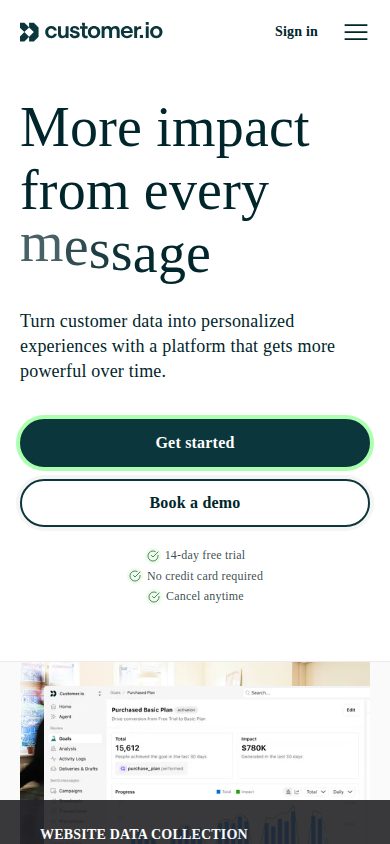
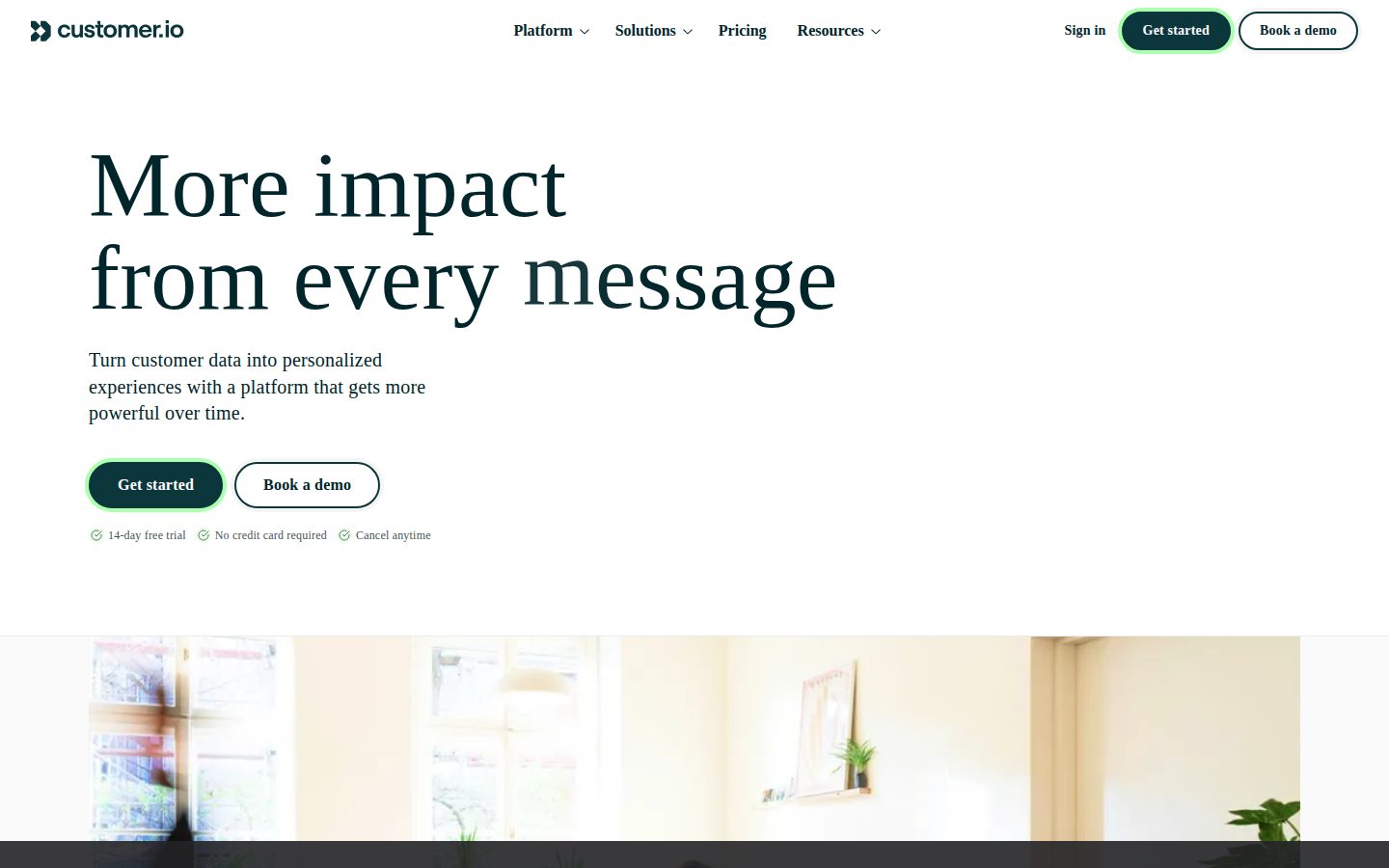
Three tells before I get cynical. One: the H1 is 'More impact from every message' — the kind of superlative that ages poorly. Two: no changelog visible in scraped evidence. Three: the AI Agent feature reads like a Q4 2024 add-on, not a core capability. None of these are fatal. Just flags.

What holds up: $100/month Essentials gets you 5,000 profiles, a million emails, and the full visual workflow builder. That's an honest entry point. Behavioral triggers, Liquid templating, A/B on branches — this isn't vaporware. It matches the playbook of products that survived: deep API, real SDK, named compliance certs. Braze and Iterable charge more for comparable logic depth.

Exit risk is real though. No self-hosted option. Journeys, audiences, and data pipelines live entirely in their cloud. Migration off means re-mapping behavioral logic somewhere like Iterable from scratch. That's 3-6 weeks minimum. Not a dealbreaker — category norm — but don't pretend it's clean.

Competitive Differentiation7.5

Visual workflow builder with data-warehouse-native triggers is a real gap vs. Klaviyo's ecommerce focus and ActiveCampaign's SMB positioning; less differentiated vs. Braze at scale.

Exit Portability5.5

Cloud-only, no self-hosted option, and behavioral journey logic is proprietary — migrating to Braze or Iterable means rebuilding workflows from scratch.

Long-term Viability7.8

HIPAA compliance, enterprise tier with dedicated infrastructure, and 90-day onboarding support on Premium suggest an operationally mature vendor — no public funding data visible though.

Marketing Honesty7.2

'More impact from every message' is vague, but the pricing page and feature descriptions are specific and grounded — no egregious oversell.

Track Record Match8.5

Patterns match survivors: REST + batch API, native iOS/Android SDKs, HIPAA/SOC compliance, and a named-competitor set that implies the product is playing in the real arena.

Pros

  • $100/month Essentials includes 1M emails and visual workflow builder — honest entry pricing
  • Real behavioral trigger depth: real-time events, data-warehouse sources, Liquid templating
  • HIPAA + SOC + GDPR certified — compliance story holds up
  • API, MCP, webhooks — integration surface is genuinely broad

Cons

  • AI Agent is new and unverified — 'single prompt to fully configured campaign' is a bold claim with no track record
  • No self-hosted option means full vendor lock-in on data infrastructure
  • Changelog not publicly visible — hard to assess shipping cadence
  • Premium pricing listed as $83.33/mo but requires negotiation — not a real self-serve tier

Right for

Product-led SaaS teams who need programmatic behavioral messaging with real API control and can live in a cloud-only stack.

Avoid if

You need data sovereignty, self-hosted deployment, or want to migrate workflows cleanly if the vendor relationship changes.

Buyer Questions

Common questions answered by our AI research team

Setup

Does Customer.io offer a free trial?

A 14-day free trial is available with no credit card required, and you can cancel anytime.

Security

Is Customer.io HIPAA compliant?

Customer.io is HIPAA compliant, along with being GDPR compliant and AICPA SOC certified.

Features

Can Customer.io trigger messages based on real-time behavior?

Yes, Customer.io triggers automated campaigns based on real-time events, attributes, and behavioral data from your product or data warehouse.

Integration

Does Customer.io integrate with AI tools?

Customer.io integrates with any AI tool using MCP, CLI, API, or webhooks, and includes a built-in AI Agent for campaign building and analysis.

Features

Can I build multi-channel campaigns in one workflow?

Yes, the visual workflow builder connects data conditions, time delays, and multi-channel message delivery into a single campaign logic layer.

Product Information

Platforms

webiosandroid

About Customer.io Platform: Automation, Data, Content Creation

Customer.io is a Portland-based marketing automation platform that enables businesses to send targeted emails, push notifications, and SMS messages based on user behavior and first-party data.

Resources

Documentation
API

Also in AI Marketing Tools