AI-powered search that answers questions without ads or tracking
Andi is a conversational AI search engine for users who want direct answers instead of a list of links.
AI Panel Score
6 AI reviews
Reviewed
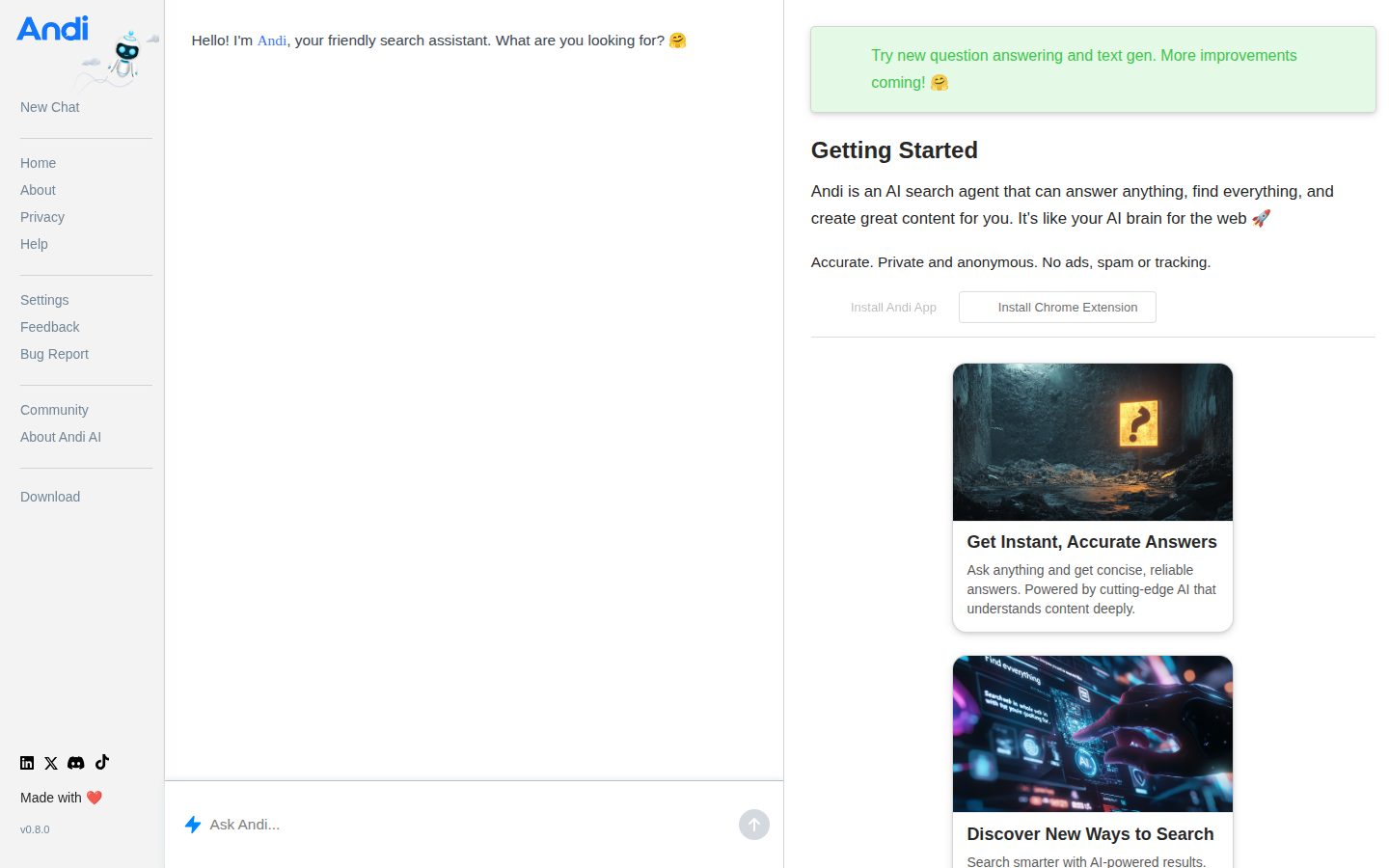
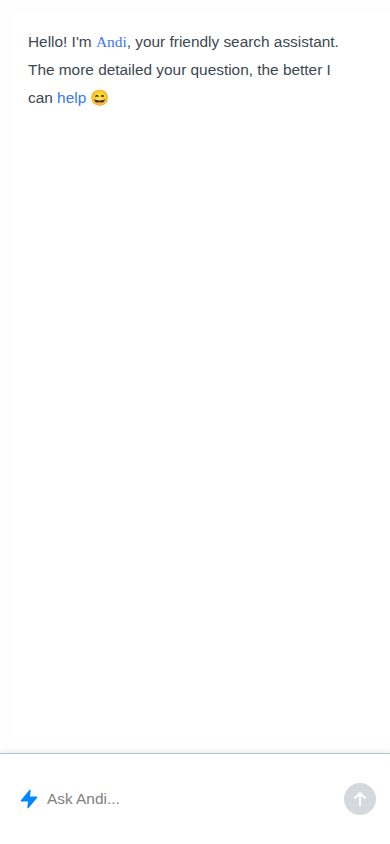
When a user types a question into Andi, the system queries the web in real time and feeds those results into a language model to generate a direct answer. The interface displays the synthesized response on the left and a panel of source links on the right, so users can verify claims or read further. Queries are typed in plain language rather than keyword strings.
Andi highlights several specific capabilities on its site: a built-in ad blocker and tracker blocker that activates when users follow source links, a summarization tool that condenses full web pages on demand, and a visual search mode that surfaces image results alongside text. The product also includes a "read" mode that strips clutter from articles opened through the interface.
Andi is aimed at general consumers who find traditional search result pages noisy or ad-heavy, as well as users with privacy concerns about query tracking. The core product is free to use with no stated paid tier as of the available information, making its pricing model free. It competes in the AI search category alongside Perplexity AI, You.com, and Microsoft Copilot (Bing), as well as traditional search engines like Google.
Andi runs as a web application and requires no account or login to use. No dedicated desktop or mobile apps are listed on the site, though the web interface is accessible via mobile browsers.
Allows users to create factually grounded written content—such as tutorials, overviews, and reports—directly from search results using the Generate Text function.
Uses an ensemble of large language models combined with live web data to synthesize direct, factually grounded answers to queries instead of returning a list of links.
Andi's own backend index of 15 billion web pages that scores 450+ data points per page, analyzing full-page meaning and credibility rather than relying on keywords or third-party search APIs.
Andi operates entirely without advertisements, and spam content is filtered at index ingestion so users receive clean, uncluttered results free from paid placements.
A Chrome extension turns the browser address bar into an AI search assistant that can answer questions, summarize and explain content, and generate written content with web research.
An Explain button on each result card breaks down complex topics into simple, clear language, making dense or technical content accessible to any user.
A Summarize button on every search result card generates a concise ~200-word summary of the full page content, allowing users to quickly digest articles without leaving the search interface.
Search results are displayed in a visually engaging card-based layout with support for multiple view format modes, presenting information more intuitively than traditional text-link pages.
Every API response is structured with an LLM-optimized output format, making it ready for use in AI agents and Retrieval-Augmented Generation (RAG) pipelines.
A developer-facing Search API provides access to Andi's 15-billion-page index in two modes—Fast (sub-second) and Deep (with AI summaries)—compatible with Google Custom Search and OpenSearch standards.
Andi is available as an installable Progressive Web App (PWA) on mobile devices, enabling the full AI search experience on smartphones and tablets without a native app download.
Andi does not store cookies, IP addresses, or search history, and does not sell user data to third parties, making all searches anonymous by design.
For all users — Andi Search is currently entirely free with full access to all search features, no account or credit card required.
Clean privacy-first search, but zero business case and no funding signal.
“Andi is a genuinely well-built consumer search alternative with real privacy credentials and a 15-billion-page proprietary index. There's no path to a B2B buying decision here.”
No pricing page, no API docs, no changelog, no known funding. That's four red flags before I even look at the product. Perplexity AI raised $165M and is shipping weekly. That's who you compare Andi against, and that comparison doesn't go well on viability.
The product itself is solid for what it is. Zero tracking, no cookies, ad-free by architecture, and per-result summarization without leaving the interface — those aren't marketing claims, they're structural. The Chrome extension and PWA suggest real shipping cadence. But it's a free consumer tool with no stated paid tier, which means no revenue model I can see.
I won't take this to the board as a vendor relationship. The tradeoff is real: strong product execution, completely unclear business sustainability. Useful for a privacy-conscious employee who wants a Google alternative. Not a procurement conversation.
Perplexity AI and Microsoft Copilot are better-resourced, better-distributed alternatives in the same AI search space.
Privacy-first positioning reads as neutral-to-positive, but recommending a zero-revenue free tool as a vendor looks thin in a board conversation.
No account, no credit card, works immediately — fastest possible time-to-use, but value ceiling is low for any business context.
Built for individual consumers avoiding ads, not for advancing enterprise workflows or company direction.
No public funding data, unknown team size, no pricing tier generating revenue — survival past 24 months is genuinely uncertain.
Privacy-conscious individuals who want ad-free AI search without creating an account.
You need a vendor with a sustainable business model and defensible 36-month runway.
Privacy-first consumer search with no enterprise knowledge architecture underneath.
“Andi's 15-billion-page proprietary index and zero-tracking privacy model are genuinely differentiated for consumer search. But as a knowledge management tool for organizational use, the architecture is missing the foundational layers that matter.”
The Trantora index scoring 450+ data points per page shows real investment in content quality signals — that's meaningful. Per-result summarization and the Explain feature address real friction in research workflows. For an individual knowledge worker doing open-web research, this is a cleaner experience than Google's ad-cluttered results pages.
The gap is structural. No API access for internal knowledge bases, no user-level search history, no glossary or taxonomy controls, no connector layer to enterprise repositories. Perplexity AI ships team plans with shared spaces and source pinning — Andi has none of that. The zero-tracking architecture that's a privacy strength actively prevents the query-pattern analysis that makes enterprise knowledge systems improve over time.
If we adopt this for an organizational knowledge program, in 3 years we have a tool that's still optimized for anonymous consumer queries with no institutional memory built on top. Free pricing with no paid tier means no roadmap leverage and unclear sustainability.
Strong privacy differentiation versus Perplexity AI and Microsoft Copilot, but positioned squarely in consumer search rather than the enterprise knowledge segment where buying decisions happen.
Built for anonymous consumer research; no shared workspaces, no knowledge base connectors, and no contributor-level access controls that knowledge management programs require.
No documented API for internal use, no SSO, no connector to SharePoint, Confluence, or comparable enterprise repositories the docs indicate exist.
Zero-tracking architecture prevents institutional query-pattern learning, and a single free tier with no published roadmap offers no leverage for evolving organizational requirements.
Per-result summarization and the proprietary 15B-page index show craft, but no taxonomy controls, no ontology layer, and no organizational context management caps the ceiling.
Individual knowledge workers who need private, ad-free open-web research without organizational integration requirements.
Your knowledge management program requires enterprise connectors, shared search workspaces, or institutional query analytics.
$0 all-in, 15-billion-page index, zero tracking — but sustainability math is unresolved.
“Andi is fully free with no tiers, no ads, no account required. The business model question is real, and procurement teams should note it.”
$0/seat × 50 users × 36 months = $0 TCO. Hard to beat on paper. No SSO tax, no overage rate, no per-seat negotiation. Andi's pricing page doesn't exist because there's nothing to price. That's either a gift or a warning.
The 15-billion-page proprietary index with 450+ credibility signals per page is a real architectural differentiator versus Perplexity AI, which leans on third-party APIs. Zero-cookie, no-IP-storage privacy architecture adds procurement value for privacy-sensitive orgs. Chrome extension and PWA cover the deployment surface adequately.
The tradeoff: no paid tier means no SLA, no support contract, no vendor accountability. Year 3 TCO is $0 — until it isn't. Free products pivot. Procurement can't negotiate what has no price. For teams needing contractual guarantees, Perplexity's $20/seat business tier buys you an actual agreement. Andi buys you nothing to sign, which cuts both ways.
No invoice, no PO process, no vendor onboarding — procurement teams may struggle to formally approve a $0 tool with no legal entity agreement.
No contract exists — zero flexibility and zero obligation, which eliminates renewal risk but also eliminates any vendor commitment.
Single free tier, fully visible, no sales call required — pricing page doesn't exist because the price is $0.
ROI is time-saved on ad-laden searches; no analytics, no usage reporting, no measurable productivity output documented.
$0 direct cost at any seat count; indirect risk is platform discontinuity, not hidden fees.
Privacy-conscious teams or individuals who need clean AI search at zero cost and can tolerate no formal vendor relationship.
Your procurement process requires a signed agreement, SLA, or invoiced vendor relationship.
Clean, private, source-cited search — but Perplexity still wins for serious research depth.
“Andi delivers ad-free, zero-tracking AI answers with per-result summarization and a 15-billion-page proprietary index. For casual queries it's genuinely clean; for deep literature synthesis, it doesn't yet match Perplexity's research workflow.”
The zero-cookie, no-IP-logging architecture is real — not a privacy policy promise but a structural design choice. For researchers who worry about institutional queries leaking through Google's ad targeting, that matters. The per-result Summarize button generating ~200-word digests is actually useful for triage: scan ten sources without ten tabs. The Explain feature on dense results is a quiet win for interdisciplinary reading.
Day three is where the gaps show. No changelog, no docs, no API visibility for public users — the capability flags all read N. Perplexity gives you follow-up threading, citation confidence signals, and a focused Academic mode. Andi doesn't expose query refinement depth or session continuity. Researching across a week of related queries means rebuilding context every session.
The proprietary Trantora index scoring 450+ credibility signals per page is the most interesting architectural claim here. But without a public blog or transparency report, there's no way to audit index quality. For exploratory research where source credibility is the whole game, that's a real gap.
No session continuity or query history means rebuilding context every day — a real friction cost for ongoing research projects.
Docs flag reads N — no public documentation found, which is a significant gap for any researcher trying to understand index methodology or query behavior.
No account required and the card-based interface with per-result summarization keeps daily friction low for consumption tasks.
The Trantora index and RAG-ready API output suggest depth, but with no visible advanced query syntax or power-user controls, the ceiling is hard to find.
Chrome extension brings AI search to the address bar, but no API access for public users limits integration into reference managers or note-taking workflows.
Researchers who want fast, ad-free source triage on sensitive topics without leaving query fingerprints.
Your workflow depends on persistent research sessions, citation exports, or deep follow-up threading across a multi-day project.
Clean, honest search with zero ads and a 15-billion-page backbone
“Andi does one thing really well: it gives you an answer instead of a chore. No account, no ads, no tracking — just ask and read.”
The pitch is dead simple. Type a question in plain language, get an answer with sources on the right so you can verify. No blue-link wall, no sponsored garbage, no cookie banner. The per-result Summarize button and the Explain feature are the kind of small things that make you wonder why Google never bothered. The proprietary Trantora index at 15 billion pages means they're not just wrapping someone else's API and calling it a product.
That said, no changelog, no blog, no pricing page — the evidence trail is thin. Compared to Perplexity, which has a clear Pro tier and active public development, Andi feels quieter. Harder to know where it's going. Free-forever is great until it isn't, and there's no public funding data to reassure you.
The PWA covers mobile, which is better than nothing, but category norm says a real native app matters. Day three you'll have a strong opinion about whether the card layout actually helps you think faster. I suspect most people will.
Card-based visual layout, per-result Summarize and Explain buttons, and a clutter-stripping read mode show real daily-use thinking — someone actually used this empty.
First hour is frictionless; features like Generate Text and the Chrome extension give you somewhere to grow without needing a manual.
The PWA is installable but there's no native app, and for a tool billing itself as your default search, that's a real gap against Perplexity's mobile app.
No account, no credit card, no tutorial needed — you just type and it works, which is the best onboarding that exists.
No changelog and thin public evidence make it hard to assess error-state quality or uptime history; the Fast and Deep API modes suggest infrastructure care, but the surface signals are quiet.
Privacy-conscious users who want direct answers without ads and don't mind a quieter product ecosystem.
You need a proven, actively documented tool with a mobile app and a clear roadmap you can point to.
15 billion pages, zero funding signals, and Perplexity already won this category
“Andi does the privacy-first conversational search thing competently. The problem is Perplexity exists, has raised hundreds of millions, and ships weekly.”
Three flags before I go deeper. One: no company name visible, no funding data, no changelog. Two: the capabilities page shows API=N, blog=N, pricing-page=N — that's a thin public footprint for a product competing against Microsoft Copilot. Three: 'AI search for the next generation' is exactly the kind of tagline that ages poorly.
What's actually credible: the Trantora proprietary index — 15 billion pages, 450+ scored data points per page — is a real differentiator if it holds up. Per-result summarization, the ad blocker, zero-cookie architecture, and a Chrome extension are all legitimate features. The privacy story is coherent, not bolted-on marketing.
The exit story is fine. It's a web app, no account required, no data stored. You walk away clean. But long-term viability worries me. Entirely free, no paid tier, no public investors — someone's paying for those LLM calls. Perplexity charges $20/month and still burns cash. This math doesn't close without a funding story I can't find.
Proprietary 15B-page index is a real gap vs. Perplexity's reliance on third-party search APIs, but not enough to move the needle for most users.
No account, no stored history, no data lock-in — walking away costs literally nothing.
No public funding, no paid tier, no changelog, unknown company — fully free LLM-powered search is not a sustainable cost structure based on any visible signal.
The privacy and ad-free claims are specific and checkable; 'smart friend' framing is soft but not deceptive.
Matches DuckDuckGo-era privacy-search pitches more than Perplexity's execution pattern — and most of those stalled.
Privacy-conscious users who want ad-free conversational search and don't mind betting on a vendor with an uncertain funding story.
You need a search tool your team or workflow will depend on — the viability signals aren't there for a critical use case.
Common questions answered by our AI research team
Yes, Andi presents cited sources alongside its conversational responses.
Yes, Andi understands and responds to natural language queries rather than requiring keyword-style searches.
Yes, Andi displays relevant images alongside its search responses.
Andi uses live web search combined with a large language model, not a static index.
Yes, Andi provides reading list suggestions after a search.