Exa Search logo

Exa Search Review

Visit

Search, crawl, and research API built for AI agents

Exa is a search and web crawling API for developers building AI agents and LLM-powered applications.

Exa Labs·Founded 2021·From $1/moFree PlanFree TrialAI Search & KnowledgeAI APIsAI Agents & Assistants

AI Panel Score

8.1/10

6 AI reviews

Reviewed

AI Editor Approved

About Exa Search

Developers integrate Exa through a REST API to give AI agents access to real-time web data. A typical workflow involves sending a search query to the API, receiving ranked results, and optionally retrieving full page contents or extracted highlights. Latency modes range from under 180ms for instant results to roughly 10 seconds for deep research with structured outputs and grounded citations. Responses can be formatted as plain results, direct answers, or structured JSON objects.

Exa offers several search verticals beyond general web queries: company search, people search, code repositories, news, research papers, and financial data. The highlights feature uses a specialized model to extract the most relevant excerpts from retrieved pages, reducing the token load sent to downstream language models. Structured output mode returns enriched fields—such as CEO name, founding year, and company metadata—across its database of 70 million+ companies. The API also supports a Monitors product for ongoing web surveillance and a DeepAgent mode for multi-step research tasks.

Exa targets AI engineers, agent developers, and companies embedding search into LLM workflows. Named customers include Cognition (Devin), HubSpot, monday.com, CodeRabbit, OpenRouter, Databricks, and StackAI. Competitors in the AI search API space include Perplexity and Brave Search. Pricing is usage-based with a free trial available via the API playground; enterprise plans with zero data retention, SOC 2 Type II compliance, and SSO are available through direct sales.

The product is accessed entirely through a web-based API and API playground. There is no native desktop or mobile application. Integration is API-first, making it platform-agnostic for any backend or agent framework.

Features

AI

  • Highlights

    A specialized model that extracts the most relevant excerpts from web pages, reducing tokens passed to AI models by up to 90%.

Automation

  • DeepAgent

    An automated deep research agent mode that performs multi-step research with grounded citations, configurable from fast to deep research.

  • Monitors

    A monitoring capability listed in the product navigation that tracks web content or events over time for agents.

Core

  • API Playground

    An interactive playground where developers can test Search, Answer, and Structured output modes directly against the Exa API.

  • Contents Retrieval

    Crawls and retrieves full page content from URLs, delivering web content in a format optimized for AI agent consumption.

  • Exa Instant (Low-Latency Search)

    Returns search results in under 180ms, described as faster than any other search provider for time-sensitive agent use cases.

  • Search API

    Provides web search across multiple verticals including Full Web, News, Companies, Research, People, and Financials via a single API endpoint.

  • Structured Outputs

    Returns enriched, structured data (e.g., company name, CEO, founding year) extracted across 70M+ companies.

Customization

  • Configurable Research Depth

    Allows users to configure search latency and depth—from fast (~450ms Auto) to deep research (~10s)—depending on the use case.

Security

  • SOC 2 Type II Certification

    Maintains SOC 2 Type II compliance for secure information processing and access control.

  • Single Sign-On (SSO)

    Provides team-wide authentication and authorization management through a built-in SSO integration.

  • Zero Data Retention (ZDR)

    Automatically purges all queries and data based on customized retention requirements to ensure privacy and compliance.

Preview

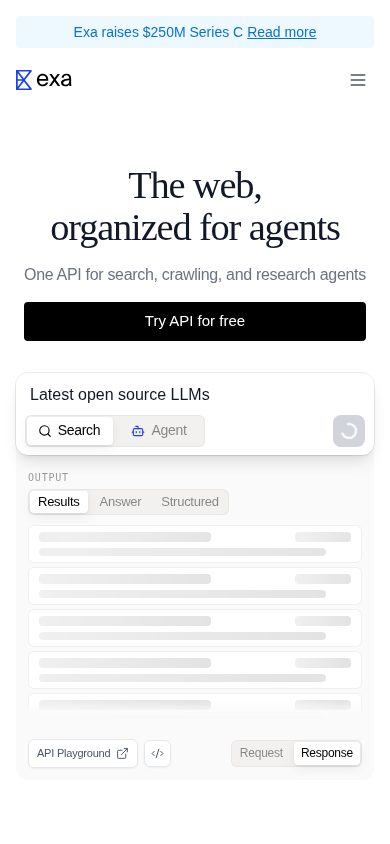
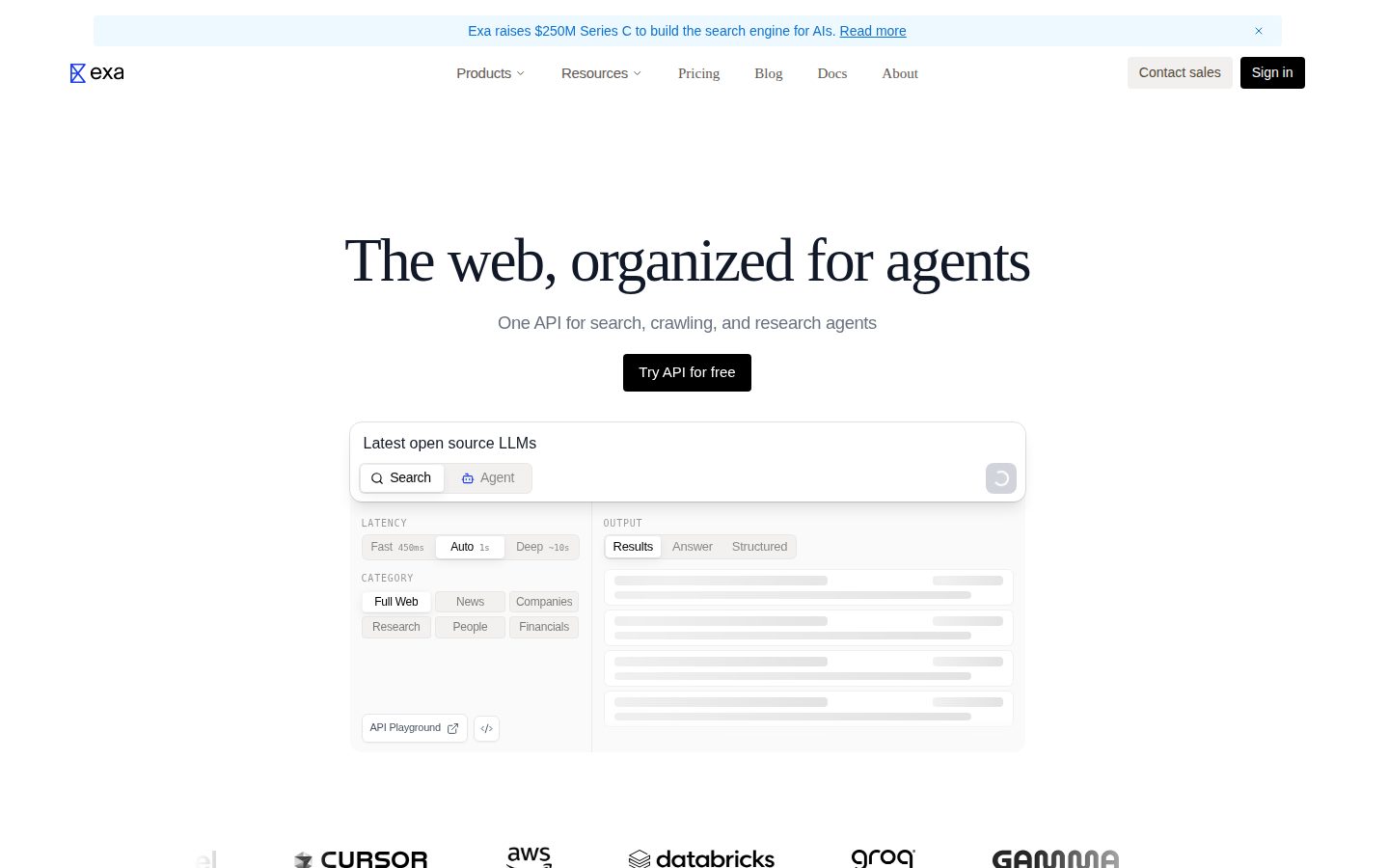
Exa Search desktop previewExa Search mobile preview

Pricing Plans

Free Tier

Free

Entry tier for developers trying Exa, capped at 1,000 requests per month.

  • 1,000 requests per month
  • Web search tool calls for agents
  • Webpage text and highlights
  • Configurable latency: 180ms to 1s

Search

$7/usage

Core real-time web search for agents, billed at $7 per 1,000 requests.

  • $7 per 1,000 requests
  • Real-time search with token-efficient page contents
  • Web search tool calls for agents
  • Configurable latency: 180ms to 1s

Deep Search

$12/usage

Research-grade search with structured outputs for complex queries, $12-$15 per 1,000 requests.

  • $12-$15 per 1,000 requests
  • Structured outputs optimized for complex queries
  • Multi-step agent workflows
  • Web-grounded citations

Contents

$1/usage

Full-page web content extraction optimized for LLM context, $1 per 1,000 pages per content type.

  • $1 per 1,000 pages per content type
  • Full-page contents for LLM context
  • Token-efficient highlights
  • Configurable livecrawl policies

Monitors

$15/usage

Scheduled searches that track new web events, $15 per 1,000 requests.

  • $15 per 1,000 requests
  • Track new events and updates across the web
  • Runs searches at a specified cadence
  • Receive updates with webhooks

Agent

Contact sales

Asynchronous deep research runs billed per Agent Compute Unit ($0.0001/ACU; ~$0.025-$2.00 per run).

  • Usage-based: $0.0001 per Agent Compute Unit
  • Asynchronous deep research runs
  • Structured outputs with citations
  • Fixed effort modes from Low to X-high

Enterprise

Contact sales

Sales-led tier for high-volume customers; pricing requires contacting the vendor.

  • Up to 1,000 results per search
  • Custom rate limits and moderation
  • Enterprise-grade support with SLAs
  • Zero data retention and custom pricing

AI Panel Reviews

The Decision Maker

The Decision Maker

Strategic bet, vendor viability, timing, adoption approval
8.2/10

Serious API infrastructure for agent builders; not a consumer play.

Exa is purpose-built search infrastructure for AI agent developers. Cognition, HubSpot, and Databricks on the customer list means this isn't a toy.

54.4% on FRAMES versus Perplexity's 44.5% is a real number, not a marketing claim. The Highlights feature cutting token load by up to 90% is the kind of efficiency that compounds fast when you're running thousands of agent calls. $7 per 1,000 requests for core search keeps the math clean at scale.

The tradeoff: this is a pure developer API. No desktop app, no GUI workflow, no hand-holding. Your team needs engineers who'll own the integration. If that's not you right now, wait until it is.

Vendor viability is the one question I can't fully close — no public funding data. Named enterprise customers and SOC 2 Type II give me confidence they're past the experimental phase. Pilot at low volume, watch the rate limit behavior, then commit.

Competitive Positioning8.0

Outperforms Perplexity by nearly 10 points on FRAMES and covers six search verticals including financials and research papers that Brave Search doesn't touch.

Reputation Risk8.0

Sharing a customer list with Databricks and HubSpot makes this a defensible board conversation, not an apology.

Speed to Value8.5

The API playground lets engineers test Search, Answer, and Structured Output modes before a single dollar is spent.

Strategic Fit8.5

If you're building AI agents, real-time web grounding via a single API endpoint with sub-180ms latency is foundational, not incremental.

Vendor Viability7.5

No public funding data, but Cognition, Databricks, and HubSpot as named customers plus SOC 2 Type II certification suggest real operational maturity.

Pros

  • 90% token reduction via Highlights directly cuts LLM inference costs
  • Six search verticals — companies, people, financials, research, news, code — from one endpoint
  • Sub-180ms Exa Instant for latency-sensitive agent loops
  • Enterprise tier includes zero data retention and custom rate limits

Cons

  • No public funding data — viability requires inference from customer signals
  • Pure API product; teams without engineering bandwidth won't ship quickly
  • Deep Search at $12-$15 per 1,000 requests adds up fast in high-volume agent workflows

Right for

Engineering teams actively building LLM-powered agents who need real-time web grounding at scale.

Avoid if

Your team doesn't have backend engineers ready to own the integration today.

The Domain Strategist

The Domain Strategist

Craft and strategy in the product's domain — adapts identity per category, same lens
8.2/10

Infrastructure-grade search API that gives AI agents the retrieval layer they've always lacked.

Exa is a developer-first search and crawling API purpose-built for AI agent workflows, not retrofitted from a consumer search product. The 70M+ company structured outputs and sub-180ms latency mode signal genuine investment in knowledge retrieval architecture, not just a wrapper.

The Highlights feature is the most KM-relevant capability here — extracting context-dense excerpts with up to 90% token reduction means knowledge retrieval actually scales without ballooning LLM costs. That's not a UX detail, that's corpus management discipline. The six search verticals (companies, people, news, research papers, financials, code) suggest someone thought hard about knowledge taxonomy, not just query throughput.

The tradeoff for a KM team is real: Exa is entirely API-first with no native knowledge-base UI, no taxonomy management layer, no contributor workflow. Adopting this means you're building the knowledge architecture yourself, on top of the API. Compared to Perplexity's more turnkey experience, Exa hands you the retrieval primitives and expects you to orchestrate them.

If we're embedding Exa into an agent-driven knowledge pipeline, the SOC 2 Type II certification and zero data retention option on enterprise plans make this defensible at the governance layer. Three years out, you're either deeply integrated and benefiting from structured output depth, or you've become dependent on their indexing decisions.

Category Positioning8.0

Sits above Brave Search on depth and above Perplexity on developer control; the DeepAgent and Monitors products push it toward knowledge infrastructure rather than search utility.

Domain Fit7.5

Excellent fit for AI-native knowledge pipelines; limited fit for knowledge managers who need curation, taxonomy control, or contributor-facing interfaces — it's infrastructure, not a KM platform.

Integration Surface8.8

API-first with configurable latency modes from 180ms to 10s, webhook support via Monitors, and structured JSON outputs makes this composable into virtually any agent framework or backend stack.

Long-term Implications7.8

Deep integration creates dependency on Exa's indexing and structured output schema decisions; the 70M+ company database is valuable but its maintenance and versioning aren't publicly documented.

Strategic Depth8.5

54.4% FRAMES benchmark accuracy versus Perplexity's 44.5%, plus a specialized highlights extraction model, indicates genuine R&D investment in retrieval quality rather than commodity search wrapping.

Pros

  • Up to 90% token reduction via Highlights — directly addresses LLM cost scaling in knowledge pipelines
  • Sub-180ms Exa Instant mode enables real-time retrieval in latency-sensitive agent workflows
  • SOC 2 Type II plus zero data retention option covers enterprise governance requirements
  • Six named search verticals show genuine knowledge taxonomy thinking beyond general web search

Cons

  • No native knowledge-base UI or taxonomy management — requires full architectural build on top of the API
  • Monitors at $15 per 1,000 requests adds up quickly for high-frequency knowledge surveillance use cases
  • Indexing quality and structured output schema versioning aren't publicly documented, creating long-term dependency risk

Right for

Engineering teams building AI agent pipelines that need a composable, high-accuracy retrieval layer with enterprise compliance.

Avoid if

Your team needs a managed knowledge base with contributor workflows, curation tools, or a non-developer interface.

The Finance Lead

The Finance Lead

Money, total cost of ownership, contracts, procurement math
8.1/10

$7 per 1,000 requests, all tiers public, no sales call required.

Usage-based pricing with every tier published. Enterprise is the only black box, and that's category norm.

Most pricing pages hide three tiers and a 'Contact Sales' wall. Exa shows six. Search at $7/1,000 requests, Deep Search at $12-$15, Contents at $1, Monitors at $15, Agent at $0.0001/ACU. Free tier caps at 1,000 requests/month for testing. Procurement won't fight this one.

TCO math for a mid-size AI team: 500,000 search requests/month × $7/1,000 = $3,500/month, $42K/year. Add Deep Search for research workflows — say 100K requests × $12.50 average = $1,250/month. Year-3 run rate lands around $57K before volume discounts. Compare to Perplexity API — Exa claims 54.4% vs 44.5% accuracy on FRAMES, so the premium may justify itself in fewer retry calls.

The tradeoff: Agent ACU pricing ($0.0001/ACU, ~$0.025–$2.00/run) has a wide range. $0.025 and $2.00 are not the same invoice. No published ACU-to-task conversion rate. That's the unpredictable line. SOC 2 Type II and ZDR are enterprise-tier only — costs opaque.

Billing & Procurement8.0

API playground enables pre-commit testing; usage-based model means no upfront commitment on standard tiers, low procurement friction.

Contract Flexibility8.2

Usage-based billing implies no annual lock-in on standard tiers; Enterprise term and auto-renewal terms are not publicly disclosed.

Pricing Transparency8.8

Six tiers with per-unit rates published; only Enterprise requires a sales call, which is standard.

ROI Clarity8.4

90% token reduction claim and FRAMES benchmark score (54.4% vs Perplexity's 44.5%) give measurable ROI hooks, not hand-waving.

Total Cost of Ownership7.5

Search and Contents costs are fully calculable; Agent ACU range ($0.025–$2.00/run) introduces meaningful variance at scale.

Pros

  • All standard tier pricing public — $7, $12-$15, $1, $15 per 1,000 visible without a call
  • 90% token reduction via Highlights directly lowers downstream LLM costs
  • Named enterprise customers (Cognition, HubSpot, Databricks) signal procurement-approved vendor status
  • Free tier at 1,000 requests/month enables real cost modeling before commitment

Cons

  • Agent ACU pricing range ($0.025–$2.00/run) makes budget forecasting unreliable for agent-heavy workflows
  • SOC 2 Type II, ZDR, and SSO gated to Enterprise — cost opaque
  • No published auto-renewal or cancellation terms for Enterprise tier

Right for

AI engineering teams running high-volume search in LLM pipelines who need transparent usage-based costs and measurable token savings.

Avoid if

Your primary workload is Agent-mode deep research at scale and you can't tolerate a 80x per-run cost variance.

The Domain Practitioner

The Domain Practitioner

Daily hands-on reality in the product's domain — adapts identity per category, same lens
8.2/10

The search API that actually thinks like a researcher, not a search engine

Exa's vertical search modes and 90% token-reduction highlights solve real LLM pipeline problems. Usage-based pricing at $7/1,000 requests keeps costs legible until research depth kicks in.

The FRAMES benchmark number stands out: 54.4% accuracy versus Perplexity's 44.5%. That's not a rounding difference — for a researcher building citation-grounded workflows, a 10-point accuracy gap matters every single query. The highlights feature is the daily workhorse here. Extracting relevant excerpts rather than dumping full page content cuts token bloat before it hits the model. For any pipeline running hundreds of searches, that's a real cost and latency win.

The friction shows at the pricing seam. Standard Search at $7/1,000 requests is clean. Once workflows drift into Deep Search territory — $12-$15/1,000 — the math gets harder to predict on variable research loads. The Monitors product at $15/1,000 is a separate budget line to justify. Research verticals beyond general web (papers, financials, people) are the real differentiator over Brave Search, but the docs would need to show query construction patterns for those verticals to be immediately useful.

No desktop app, no native interface — this is purely API-first. For researchers embedding this into agent pipelines, that's fine. For anyone expecting a Perplexity-style interface to explore alongside the API, it won't be there.

Day-3 Reality8.0

Under-180ms Exa Instant and configurable depth mean the API behaves predictably once latency modes are understood, but Deep Search at ~10s requires rethinking synchronous agent patterns.

Documentation Practitioner-Fit7.8

Changelog and API playground exist per the evidence, suggesting living docs, but no public signal on whether vertical-specific query patterns are documented for research papers or financials.

Friction Surface7.5

The pricing tier split between Search, Deep Search, and Monitors creates cost unpredictability when research queries escalate in complexity mid-workflow.

Power-User Depth8.3

DeepAgent multi-step mode, Monitors with webhooks, and configurable ACU-based compute ($0.0001/ACU) give advanced users real levers beyond basic search calls.

Workflow Integration8.5

Single endpoint covering news, research papers, financials, and people search maps cleanly onto multi-source research workflows without maintaining separate API credentials.

Pros

  • 54.4% FRAMES benchmark accuracy vs Perplexity's 44.5% — a meaningful gap for citation-heavy workflows
  • Highlights feature cuts token load by up to 90%, reducing both cost and model context pressure
  • 70M+ company structured outputs make company and people research a first-class use case, not an afterthought
  • SOC 2 Type II and zero data retention available at enterprise tier for sensitive research environments

Cons

  • Deep Search at $12-$15/1,000 requests compounds fast on open-ended research queries with unpredictable depth
  • Purely API-first — no exploratory interface for researchers who want to probe data before committing to pipeline integration
  • Monitors at $15/1,000 requests is a separate pricing line that requires its own ROI case

Right for

AI engineers and researchers building LLM pipelines that need grounded, multi-source search with citation quality and token efficiency.

Avoid if

You need a standalone research interface rather than an API layer, or your query volume is too low to justify usage-based pricing over a flat-rate alternative.

The Power User

The Power User

Daily human experience, onboarding, polish, learning curve, reliability
8.2/10

Exa is what you plug in when Perplexity's API isn't enough

A serious developer-grade search API with real benchmarks and a pricing model that stays honest as usage scales. Not for humans — entirely for agents and the engineers building them.

The numbers do the talking first. Under 180ms for Exa Instant, 54.4% on FRAMES versus Perplexity's 44.5%, 70 million+ companies in structured outputs, 90% token reduction from Highlights. That's not marketing fluff, that's a product that knows what its buyers care about — latency and cost per inference call. When Cognition and Databricks are on your customer list, you've cleared the serious-engineer filter.

Day three for a developer looks like: you've hit the 1,000-request free tier cap, you're staring at $7 per 1,000 for Search versus $12–$15 for Deep Search, and you're deciding which queries actually need grounded citations. That's a real architectural decision Exa forces you to make. Not a bad thing. The API Playground makes those tradeoffs visible before you commit.

The tradeoff worth naming: this is entirely API-first. No mobile app, no dashboard for non-engineers, no self-serve analytics for the product manager who wants to understand what their agent is searching. If you're not in the code, you're not in the product.

Daily Polish7.8

The changelog and API Playground show active iteration, but with no UI to speak of, polish lives entirely in API response consistency and docs quality — both appear solid based on the feature evidence.

Learning Curve7.5

Multiple verticals — News, People, Companies, Research, Financials — plus DeepAgent and Monitors mean real depth to discover, though the docs and playground structure make entry approachable.

Mobile Parity3.5

No mobile app exists — the product is entirely web API, so mobile parity is a non-concept here, which is fine for the target buyer but worth naming explicitly.

Onboarding Experience8.5

Free tier at 1,000 requests plus an interactive API Playground means a developer can test Search, Answer, and Structured Output modes without a credit card or a sales call.

Reliability Feel8.0

SOC 2 Type II certification, configurable latency tiers, and named enterprise customers like Databricks suggest infrastructure that's been stress-tested beyond early-stage indie use.

Pros

  • Under 180ms Exa Instant latency — genuinely faster than category alternatives
  • Highlights feature cuts token costs to downstream models by up to 90%
  • Free tier with API Playground lets engineers validate before spending anything
  • FRAMES benchmark shows measurable accuracy advantage over Perplexity

Cons

  • Zero UI for non-engineers — if you're not in code, you're locked out
  • Deep Search at $12–$15 per 1,000 requests adds up fast at agent scale
  • No native mobile experience, though that's by design not neglect
  • Enterprise pricing requires a sales conversation with no public number

Right for

AI engineers who need real-time web data inside agent workflows and want latency and token costs they can actually control.

Avoid if

Your team needs a search tool with a human-facing interface that non-developers can operate or monitor.

The Skeptic

The Skeptic

Contrarian. Watch-outs, deal-breakers, broken promises, category patterns
7.8/10

54.4% on FRAMES vs Perplexity's 44.5% — benchmark bragging that actually holds up

Exa has a real differentiation story: search verticals, 180ms latency, 90% token reduction via Highlights. Named customers like Cognition and Databricks aren't logo soup — these are teams that stress-test APIs hard.

Three tells before I dig in. One: 'faster than any other search provider' is the kind of claim that ages badly. Two: company ownership is listed as unknown — no named founding team publicly anchored. Three: SOC 2 Type II and enterprise ZDR suggest this isn't a weekend project, which partly offsets tell two.

The $7/1K search pricing and $1/1K contents tier are clean and auditable. Perplexity and Brave Search are the obvious comps, and the FRAMES benchmark gap is concrete enough to take seriously. The Highlights feature — extracting excerpts to cut 90% of tokens — is genuinely differentiated, not just a label.

Exit portability is fair. It's a REST API with no proprietary agent lock-in. If they go dark, you swap endpoints. The real risk: no public funding data, unknown company provenance, and Monitors at $15/1K could get expensive fast at scale.

Competitive Differentiation8.0

Vertical search lanes — company, people, code, financials — plus 180ms Instant mode and 70M+ structured company records are a real moat vs. Perplexity's general-web focus.

Exit Portability8.2

Standard REST API, no proprietary SDK lock-in, and structured JSON outputs make migration straightforward if needed.

Long-term Viability6.8

SOC 2 Type II and a changelog signal real infrastructure investment, but no public funding data and unknown company provenance create a 3-year question mark.

Marketing Honesty7.5

'Faster than any other search provider' is unprovable superlative, but the FRAMES benchmark (54.4% vs 44.5%) and 90% token reduction are specific, testable claims — net positive.

Track Record Match7.8

Cognition (Devin), Databricks, and HubSpot as named customers match patterns of developer-API products with durable adoption, not vaporware.

Pros

  • FRAMES benchmark vs. Perplexity is specific and independently verifiable
  • Highlights feature with 90% token reduction solves a real LLM cost problem
  • Clean tiered pricing — $7/1K search, $1/1K contents, readable at a glance
  • Vertical search (companies, people, code, financials) meaningfully differentiates from generic SERP APIs

Cons

  • No public funding data or named founders — unknown who's behind this long-term
  • Monitors at $15/1K requests scales expensively for high-cadence agent workflows
  • 'Faster than any other search provider' is unverifiable marketing
  • Entirely API-only — no dashboard analytics or observability tooling visible in the evidence

Right for

AI engineers embedding real-time web search into LLM agents who need token-efficient, structured data at sub-200ms latency.

Avoid if

Your team needs a named vendor with public ownership and auditable funding before signing an enterprise contract.

Buyer Questions

Common questions answered by our AI research team

Features

How fast does Exa Instant return search results?

Exa Instant returns results in under 180ms, faster than any other search provider.

Features

How does Exa reduce token usage when passing content to AI models?

The highlights feature extracts concise, relevant excerpts from web pages, reducing tokens passed to models by up to 90%.

Features

How does Exa's accuracy compare to Perplexity on FRAMES benchmark?

Exa scores 54.4% accuracy on FRAMES versus Perplexity's 44.5%, outperforming by nearly 10 percentage points.

Features

Does Exa support company and people search beyond general web queries?

Yes, Exa is best-in-class across company search, people search, and code—not just general web queries.

Features

How many companies are covered in Exa's structured data outputs?

Structured outputs return enriched data across 70 million+ companies.

Product Information

  • Company

    Exa Labs
  • Founded

    2021
  • Pricing

    From $1/mo
  • Free Trial

    Available
  • Free Plan

    Available

Platforms

web

About Exa Labs

Exa Labs is a San Francisco-based AI company building a web search engine and API designed for use by LLMs and AI applications, originally founded as Metaphor Systems.

Resources

Documentation
Blog
Changelog

Also in AI Search & Knowledge