Vector database for similarity search across billions of items in milliseconds
Pinecone is a managed vector database for building AI-powered search, recommendation, and retrieval-augmented generation (RAG) applications at scale.
AI Panel Score
6 AI reviews
Reviewed
AI Editor ApprovedApproved and published by our AI Editor-in-Chief after full panel analysis.Developers use Pinecone by converting data into vector embeddings using embedding models, then upserting those vectors into Pinecone indexes via API or SDK. Queries are performed by submitting a vector (or text that Pinecone converts to a vector), which returns the most semantically similar results from the index. The database supports hybrid search combining dense and sparse vectors, metadata filtering, and namespace-based data partitioning—all accessible through REST or gRPC APIs and official SDKs for Python, JavaScript, Java, and Go.
Pinecone's architecture separates storage from compute and reads from writes, enabling it to scale to billions of vectors and thousands of queries per second without manual capacity planning. The platform includes built-in inference capabilities—sparse and dense embedding models, and reranking models—so developers can handle embedding and retrieval within Pinecone rather than stitching together separate services. Updates to indexes are made searchable within seconds, which the company describes as "built-in freshness" for dynamic datasets. Pinecone Assistant is a separate product that wraps the vector database with a document Q&A interface and citation highlighting.
Pinecone targets machine learning engineers, backend developers, and AI application teams building semantic search, RAG systems, recommendation engines, and AI agents. A free Starter tier exists with limited index capacity; paid plans are usage-based (serverless) or provisioned, with enterprise options including dedicated read nodes and a Bring Your Own Cloud (BYOC) deployment model. Competing products in the vector database category include Weaviate, Qdrant, Milvus, Chroma, and PostgreSQL with pgvector.
Pinecone is available as a fully managed cloud service on AWS, GCP, and Azure. It integrates with frameworks and platforms including LangChain, LlamaIndex, n8n, Databricks, Vercel, and SageMaker. The Pinecone API is accessible over HTTP, and the BYOC option allows organizations to run Pinecone within their own cloud accounts to meet data residency or compliance requirements.
Combines dense vector semantic search with sparse keyword-based retrieval in a single query, enabling more accurate and relevant results than either method alone.
Hosts built-in embedding and reranking models (including Cohere Rerank 3.5) natively within the platform, so developers can generate vectors and reorder results without external inference services.
A built-in AI assistant feature that enables developers to create agents capable of answering complex questions over proprietary data stored in Pinecone indexes.
Supports a document schema index with BM25-ranked full-text search on string fields alongside dense and sparse vector fields under one unified schema.
Applies metadata filters inline during vector search in a single pass—no post-processing or added latency—allowing queries to combine semantic similarity with structured business rules.
Partitions records within a single index into isolated namespaces so each customer or agent gets its own context, enabling multitenancy without managing separate indexes.
New vectors are acknowledged in under 100ms and become searchable within seconds, with no re-indexing jobs or pipelines required to incorporate new data.
Uses advanced indexing algorithms (IVF + product quantization) and distributed parallel processing to handle billions of vectors with auto-sharding, high recall, and low-latency queries at any scale.
Fully managed, serverless architecture that automatically scales compute and storage independently based on workload demand, with no infrastructure provisioning or manual tuning required.
Provides official Python and Node.js SDKs with optional asyncio support for async frameworks and gRPC transport for improved upsert and query performance.
Offers native integrations with LangChain, LlamaIndex, Haystack, and agentic IDEs such as Claude Code, Gemini CLI, and Cursor for end-to-end AI pipeline development.
Provides role-based access controls, customer-managed encryption keys, single sign-on via SAML 2.0, private networking via AWS PrivateLink, plus SOC 2 Type II, HIPAA, GDPR, and ISO 27001 certifications.
For developers, students, and small projects exploring the platform or building proofs of concept with no financial commitment.
For production applications needing flexibility and pay-as-you-go scaling beyond a $50/month minimum commitment.
For larger organizations requiring compliance, private networking, encryption key management, and premium support.
For enterprises requiring Pinecone to run inside their own cloud account and VPC (Bring Your Own Cloud), with custom sizing and pricing.
Pinecone is the default vector database bet for teams shipping RAG in production.
“Category leader with real enterprise credentials and a $50/month on-ramp that's easy to defend. The tradeoff is cost at scale versus open-source alternatives like Qdrant or Weaviate.”
They've been shipping long enough to have SOC 2 Type II, HIPAA, GDPR, and ISO 27001 all checked. That's not a startup promise — that's a compliance posture that clears most enterprise procurement reviews without a fight. BYOC and AWS PrivateLink for the data-residency crowd seals it.
The integrated reranking — Cohere Rerank 3.5 baked in natively — means teams aren't stitching together three services to get a decent RAG pipeline. Hybrid search combining BM25 full-text with dense vectors in a single query is the architecture most teams eventually rebuild anyway. They've built it first.
Two things give me pause. One: read units at $24/million on Enterprise means high-QPS workloads get expensive fast — Qdrant self-hosted is a real conversation at that scale. Two: the Starter tier pauses indexes after 3 weeks of inactivity, which kills developer momentum. Still the category default. Pilot it at Standard.
Weaviate and Qdrant are credible alternatives, but Pinecone's managed serverless architecture and native reranking pull ahead for teams that don't want to run infrastructure.
LangChain, LlamaIndex, Databricks, and Cursor all integrate natively — this is what the peer group is already referencing in architecture reviews.
Free Starter tier, sub-100ms write acknowledgment, and real-time indexing mean a working prototype in hours, not sprint cycles.
If you're building RAG, agents, or semantic search, this is the infrastructure — not a cost-saving swap, a capability unlock.
Long enough in market to hold SOC 2 Type II, HIPAA, and ISO 27001 — that's a team that's been operating under scrutiny, not just shipping demos.
Engineering teams shipping RAG or semantic search in production who want managed infrastructure with enterprise compliance out of the box.
Your query volume is high enough that $24/million read units will dominate your bill and your team can run Kubernetes.
Purpose-built vector infrastructure that makes RAG pipelines a knowledge management problem, not an engineering one.
“Pinecone is the managed vector database that serious AI knowledge applications are built on. Hybrid search, real-time indexing, and enterprise-grade compliance make it the default choice when retrieval accuracy and data governance both matter.”
Hybrid dense-plus-sparse retrieval in a single query pass is the feature that separates Pinecone from most of the field. Weaviate and Qdrant both do vector search, but the built-in Cohere Rerank 3.5 integration plus BM25 full-text search under one unified schema means retrieval pipelines stay coherent rather than sprawling across three services. For knowledge management, that coherence is the whole game — fragmented retrieval architectures produce fragmented answers.
Namespace-based multitenancy and metadata filtering at query time, not post-retrieval, are exactly what enterprise knowledge bases require. SOC 2 Type II, HIPAA, ISO 27001, and the BYOC deployment option mean this can live inside your compliance perimeter, not adjacent to it. The $500/month Enterprise floor is real cost, but private networking and CMEK justify it for any regulated knowledge corpus.
The honest constraint: Pinecone is infrastructure, not a knowledge management platform. Pinecone Assistant is a wrapper, not a governance layer — there's no taxonomy management, no content lifecycle tooling, no contributor workflow. If your KM mandate includes curation and ownership, you're pairing this with something else.
Clear category leader in managed vector databases, ahead of self-hosted alternatives like Milvus and Chroma on operational maturity, with pgvector as the only real cost-competitive threat at smaller scale.
Excellent retrieval infrastructure fit, but no native knowledge governance, taxonomy, or lifecycle features — it's the engine, not the knowledge management system.
Native integrations with LangChain, LlamaIndex, Databricks, SageMaker, and agentic IDEs like Claude Code and Cursor cover the full modern AI development stack.
Adoption creates a durable, scalable retrieval foundation, but the embedding and index schemas you build today become migration debt if you ever need to move; BYOC mitigates vendor lock-in concerns.
IVF plus product quantization at billions of vectors, with storage-compute separation and sub-100ms write acknowledgment — someone has shipped production-scale retrieval systems before.
Engineering-led teams building RAG applications or semantic search over large, dynamic enterprise knowledge corpora with compliance requirements.
Your KM mandate is primarily content governance, taxonomy management, or contributor workflows rather than retrieval infrastructure.
$50 floor, usage-based above — but read-unit overages need a calculator
“Pinecone publishes four tiers without a sales call. Usage-based billing above the $50 minimum means year-3 costs depend entirely on query volume.”
Three tiers visible on the pricing page. Starter at $0, Standard at $50/month minimum, Enterprise at $500/month minimum. That's rare transparency for a category where Weaviate and Milvus often hide enterprise numbers. HIPAA is an add-on at Standard — included at Enterprise. That delta matters for healthcare buyers.
The TCO problem is read-unit pricing: $16/million at Standard, $24/million at Enterprise. A team running 50M reads/month hits $800/month at Standard before storage and write units. 50 users × $800 × 12 = $9.6K/year. Add 30% volume growth — year 3 is closer to $16K, just on reads. No published overage cap. That's the real number to pressure-test.
Contract flexibility is unclear from public materials — no published auto-renewal window or termination terms. Prepaid credits run $8K–$25K, which means cash commitment up front. BYOC is custom-priced with no public floor. Procurement will need a direct conversation there.
Serverless billing via read/write units is clean in theory; BYOC and HIPAA add-on require vendor contact, adding procurement friction.
No public auto-renewal window, termination terms, or cancellation process; prepaid credit tiers ($8K–$25K) add cash commitment risk.
Four tiers with unit prices published without a sales call — $16/million read units at Standard is specific and actionable.
Latency under 100ms and real-time indexing are measurable; retrieval quality improvements in RAG pipelines are harder to attribute directly to Pinecone vs. embedding model choice.
Usage-based overages with no published cap create unpredictable year-3 invoices; storage and write units stack on top of read-unit costs.
AI engineering teams building RAG or semantic search on AWS/GCP/Azure who need managed infrastructure and can predict query volume.
Your query volume is unpredictable and you can't absorb open-ended monthly overages without a cost ceiling.
Pinecone is the managed vector database RAG pipelines actually want to live in.
“Hybrid dense+sparse search plus built-in reranking means fewer stitched-together services in your retrieval pipeline. The $50/month Standard floor is honest: this is production infrastructure, not a toy.”
Real-time indexing — under 100ms acknowledgment, searchable within seconds — matters enormously for dynamic corpora. Literature databases, news feeds, document repositories with daily ingestion: no re-index jobs means your retrieval stays current without cron scaffolding. That's not a demo feature. That's a daily workflow requirement, and Pinecone satisfies it natively.
The integrated Cohere Rerank 3.5 and BM25 full-text search under one unified schema are the real differentiation against Weaviate or self-hosted Qdrant. Hybrid search without a sidecar keyword engine is genuinely fewer moving parts. Namespace-based multitenancy also means one index can partition across research projects or user groups without separate infrastructure. The Starter tier's index pause after 3 weeks of inactivity will sting researchers with irregular workflows.
Docs appear practitioner-authored — API-first, code-heavy, framework-specific examples for LangChain and LlamaIndex. The tradeoff: Standard's $16/million read units scales fine for moderate QPS, but high-query research workloads could see costs compound quickly without Dedicated Read Nodes, which live behind the $500/month Enterprise tier.
Serverless auto-scaling and real-time indexing remove most operational friction; the Starter tier's inactivity pause is the one daily annoyance for irregular research use.
Docs are API-first with framework-specific code examples, suggesting they were written by people who actually build retrieval pipelines.
Single-pass metadata filtering and built-in embedding models eliminate external service calls, but the 500 reranking requests/month on Starter will exhaust quickly in active retrieval testing.
IVF + product quantization internals, gRPC transport, BYOC deployment, and Dedicated Read Nodes give serious practitioners genuine depth to grow into.
Native LangChain, LlamaIndex, and Haystack integrations plus Python asyncio support means Pinecone drops into existing RAG and agent pipelines without new habits.
ML researchers and AI engineers building RAG systems or semantic search over large, frequently-updated corpora who want managed infrastructure with no vector DB ops burden.
You're running occasional, low-frequency retrieval experiments where self-hosted Qdrant or pgvector on an existing Postgres instance covers the need at zero marginal cost.
Best-in-class managed vector DB, but you'll need an engineer to feel at home
“Pinecone is the category default for teams building RAG and semantic search at scale. It's infrastructure, not an app — and it knows it.”
The $50 Standard plan is pay-as-you-go past the minimum, serverless, and honestly pretty generous for most production workloads. Real-time indexing under 100ms, hybrid dense-and-sparse search, built-in Cohere Rerank 3.5 — this is a lot of retrieval plumbing that you don't have to wire together yourself. Versus something like Qdrant or Weaviate, Pinecone's managed offering means zero infra babysitting. That's the pitch, and the pitch holds.
The daily experience, though, is API-first and proud of it. The console exists. It's functional. But if you're not comfortable in Python or Node, you'll feel it by day three. The free Starter tier pauses indexes after three weeks of inactivity — which will catch someone off guard at least once.
Mobile is basically nothing, which is fine because nobody's querying a vector database from their phone. Learning curve is real but the LangChain and LlamaIndex integrations mean most devs land in familiar territory fast. Not for no-code teams. Very much for teams who want to stop thinking about infrastructure.
Docs are solid and the SDK experience feels considered, but the console is functional-not-beautiful — two different levels of care depending on whether you're in code or the UI.
Native integrations with LangChain and LlamaIndex flatten the curve for developers, but namespaces, hybrid search tuning, and provisioned vs. serverless index decisions take real time to internalize.
Web-only platform with an API-first design; mobile is not a real consideration here and the product doesn't pretend otherwise.
Free Starter index with 2GB storage and 5M embedding tokens gets you running fast, but the index-pausing-after-3-weeks behavior is a quiet gotcha for new users.
SOC 2 Type II, HIPAA, ISO 27001, sub-100ms write acknowledgment — the reliability story is documented and credible for a managed service.
ML engineers and backend dev teams building RAG pipelines or semantic search who want managed infrastructure and don't want to think about scaling.
You're a no-code builder or small team without developer resources who expected a point-and-click search tool.
Three green flags, one expensive exit, and a crowded graveyard behind it
“Pinecone is the category's oldest managed play — real compliance stack, real scale story, real integrations. The risk isn't capability. It's what Qdrant and pgvector are doing for free.”
Five named compliance certs. BYOC. PrivateLink on three clouds. That's not startup marketing — that's a product that's been through enterprise procurement cycles and survived. The $50 Standard floor is honest: usage-based pricing with a visible rate card ($16/million read units) is grounded. No hidden tiers I can see in the docs.
The differentiation story is shakier. Hybrid search plus BM25 plus reranking in one platform is genuinely useful. But Weaviate ships that too. Qdrant is self-hostable and free. pgvector is already in the Postgres most teams already run. Pinecone's moat is managed convenience — real, but not permanent.
Exit portability is the soft spot. Vectors are portable. But Pinecone Assistant, namespace logic, and the proprietary embedding endpoints create enough coupling that migration isn't trivial. Based on the architecture, you'd lose inference convenience and need to rebuild pipelines. Plan for that day one.
Hybrid search plus reranking plus BM25 in one API is a real edge over bare pgvector, but Weaviate and Qdrant close that gap fast and cost less at low scale.
Raw vectors are portable, but Pinecone Assistant, built-in inference endpoints, and namespace-based multitenancy create real migration friction if you need to leave.
SOC 2 Type II, HIPAA, ISO 27001, BYOC, and enterprise-tier pricing suggest a company that's been through real deals — no public funding data visible, but the compliance investment signals staying power.
Tagline matches the actual product — no AI buzzword inflation, and the pricing page shows a real rate card rather than 'contact us' opacity.
Follows the Snowflake managed-infrastructure playbook: separate storage from compute, sell convenience to ops-averse teams — that pattern has worked durably in adjacent categories.
ML engineers and backend teams building RAG or semantic search who want zero infrastructure management and enterprise compliance without hiring a DBA.
Your team runs Postgres already and can tolerate pgvector's limitations — the cost delta won't justify the convenience.
Common questions answered by our AI research team
Yes, Pinecone is SOC 2 Type II, HIPAA, GDPR, and ISO 27001 certified.
Writes are acknowledged in under 100ms and become searchable within seconds — no re-index jobs or pipelines required.
Yes, you can create your first index for free, then pay as you go when ready to scale.
Yes, private networking is included as part of Pinecone's enterprise security features, alongside encryption, SSO, RBAC, and CMEK.
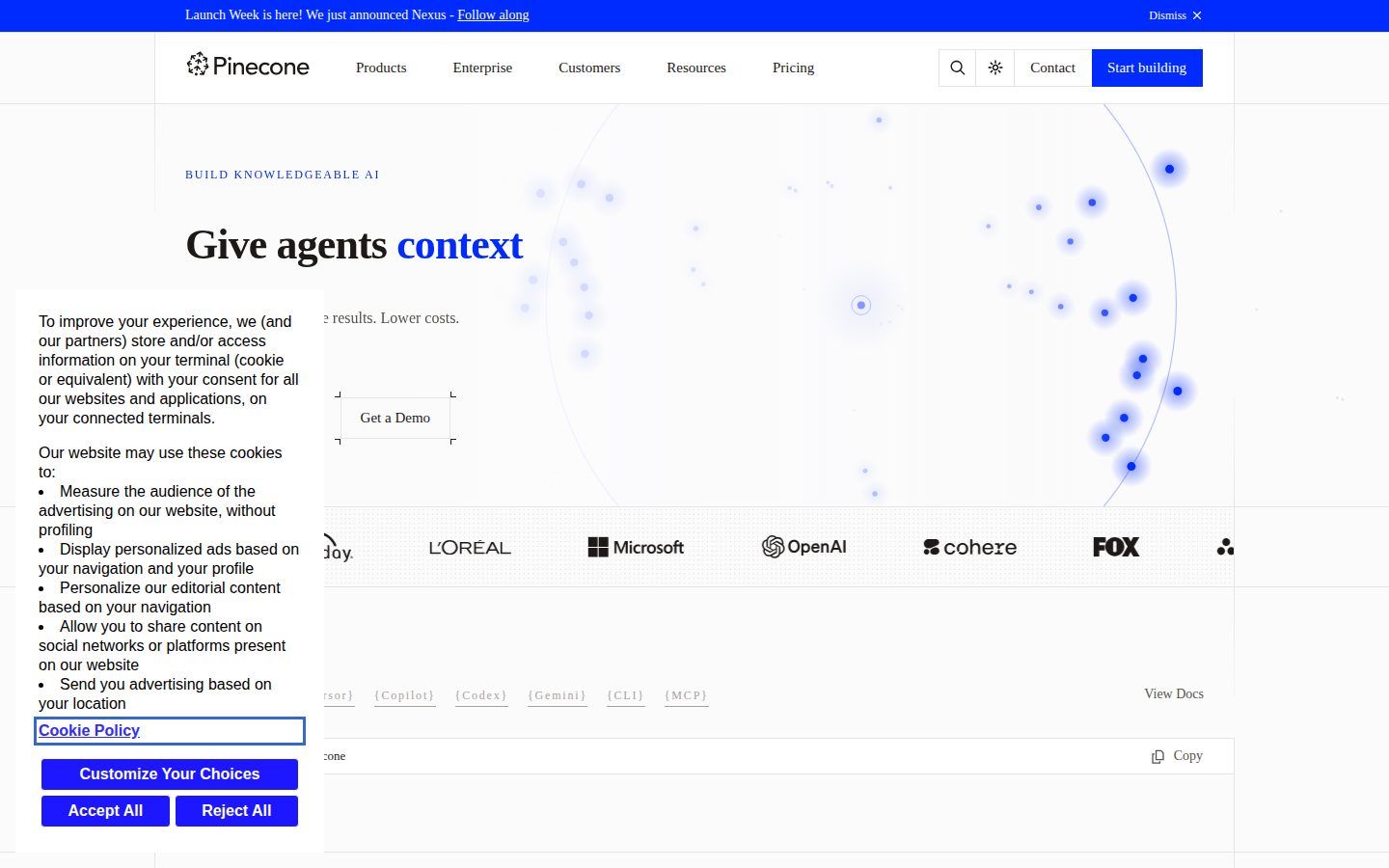
Yes, Claude and Cursor are both shown as supported integrations on the homepage, along with Copilot, Codex, Gemini, and CLI.
Company
Pinecone Systems Inc.Founded
2019Pricing
From $50/moFree Plan
AvailablePinecone is a fully managed, serverless vector database based in New York, designed for AI applications including semantic search, retrieval-augmented generation, and recommendation systems.