AI mock interviews built for the exact company and role you're applying to
AnswerDojo is an AI-powered mock interview platform for new graduates preparing for software, data, and product roles.
AI Panel Score
6 AI reviews
Reviewed
Facts checked against answerdojo.com
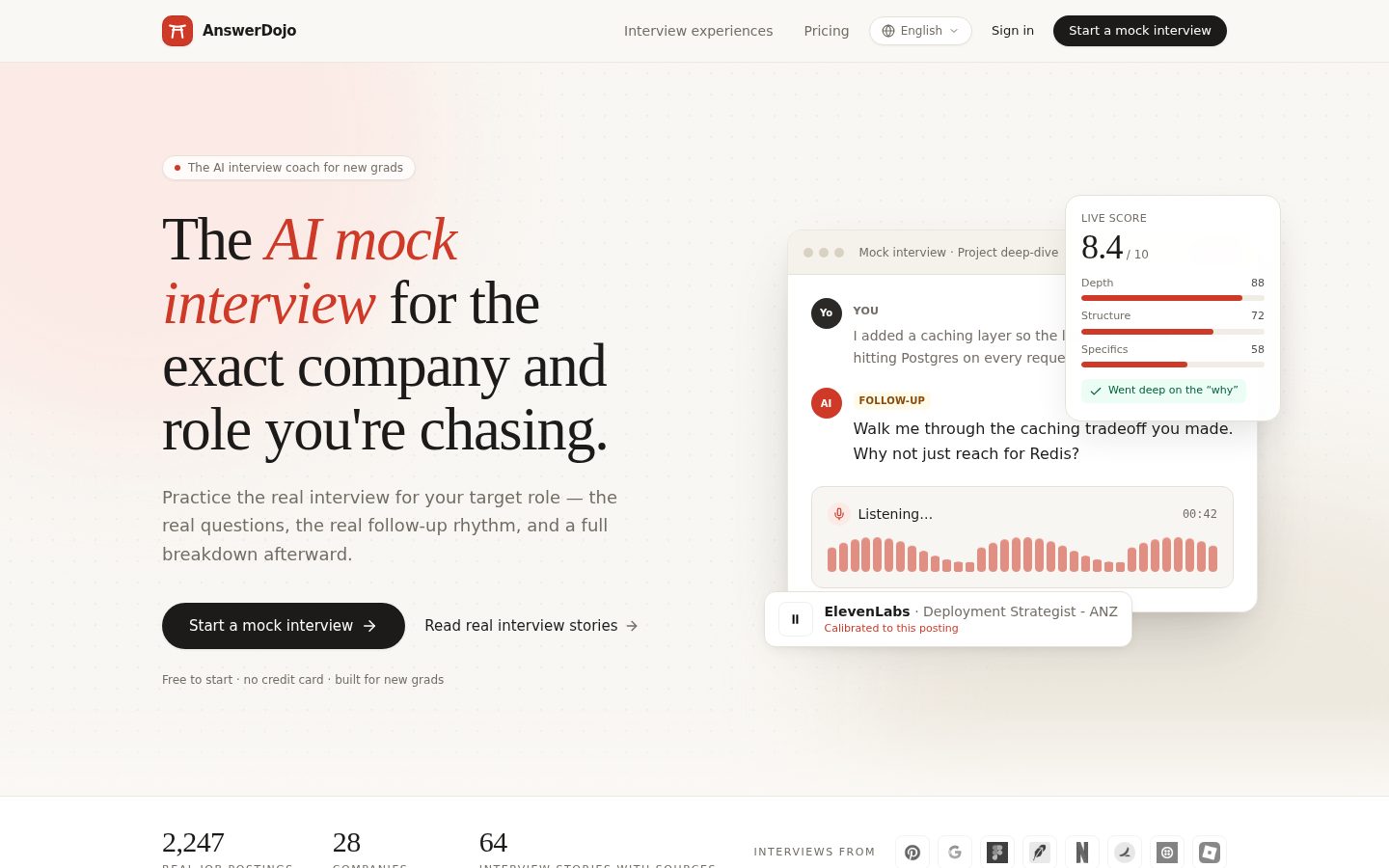
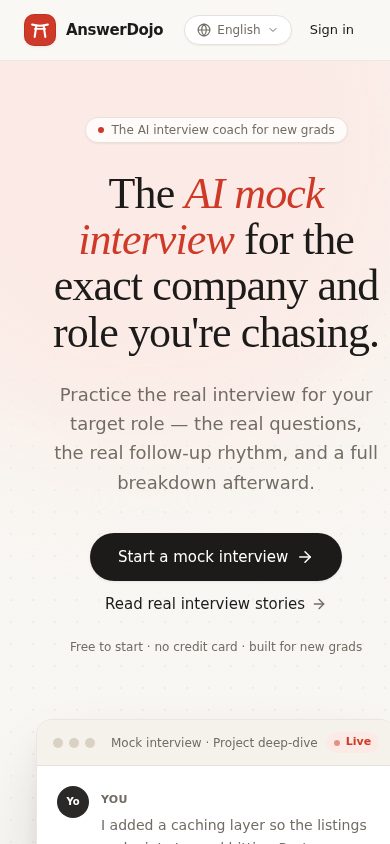
A candidate starts by uploading a resume or answering a few guided questions from scratch. AnswerDojo converts this into resume-based stories tied to likely interview questions, then opens a live voice mock interview: the candidate speaks their answers out loud, their speech is transcribed, and an AI interviewer responds with follow-up questions in the same rhythm a real interviewer would use, rather than following a fixed script. After the session, the candidate receives a live score (shown out of 10, broken into Depth, Structure, and Specifics sub-scores) along with feedback on what to strengthen before practicing again.
The platform's library includes mock interviews tied to real job postings from specific companies and roles — examples referenced include positions at ElevenLabs, Replit, Reddit, Databricks, and Brex, covering areas such as forward-deployed engineering, trust & safety, distributed systems, and solutions engineering. AnswerDojo also publishes real interview experiences submitted by candidates, detailing round-by-round structure and the actual questions asked at companies like Amazon and Google, which users can read and then practice against. The core differentiator the product emphasizes is interviewing candidates on their own projects and experience rather than generic question banks, targeting the second- and third-layer follow-up questions that new grads tend to struggle with.
Uses ElevenLabs voice technology to conduct spoken mock interviews that simulate a real interviewer's voice and follow-up rhythm.
Dynamically asks follow-up questions during the mock interview to mimic the real back-and-forth of an actual interview round.
Scores each mock interview attempt and provides a full breakdown of the candidate's performance afterward.
Generates a live voice mock interview built for a specific target company and role rather than generic questions.
Provides a searchable library of real, sourced interview stories detailing actual interview rounds and outcomes from companies like Amazon and Google.
Draws on a database of real job postings across dozens of companies to tailor mock interview content to actual open roles.
Builds interview questions from a candidate's uploaded resume or from answers provided about their project experience.
Offers a free tier with limited usage alongside a Pro subscription that unlocks unlimited mock interview practice.
Integrates third-party ElevenLabs voice technology to power the realistic spoken interview experience.
For new graduates who want to try limited AI-powered mock interview practice before upgrading.
For new graduates who want unlimited AI-powered mock interview practice. AnswerDojo's business model includes a free tier with limited usage and a Pro subscription for unlimited practice, but no verified numeric price for the Pro tier could be found in current public sources — contact AnswerDojo directly or check their site for current rates.
A sharp, narrow tool that drills the follow-up questions new grads actually fail on.
“AnswerDojo skips generic question banks for live voice mocks tied to real postings and real companies. The Pro tier price is missing, which matters for a new-grad budget.”
Two free voice mock interviews, no card required, built on 2,247 real postings across 28 companies. That's a specific, checkable claim, and it's the right wedge: new grads don't fail on 'tell me about yourself,' they fail on the third follow-up question. Scoring on Depth, Structure, and Specifics out of 10 gives candidates something concrete to fix.
The ElevenLabs voice integration is the real differentiator against flashcard-style prep tools — a spoken, adaptive interviewer beats a static question list for interview-day nerves. The real interview stories library from Amazon and Google candidates adds credibility a question bank can't fake.
Pro has no listed price, just 'contact AnswerDojo' — fine for enterprise, awkward for a cash-strapped grad who needs to compare cost before committing. Skip the open-ended pricing anxiety: try the two free sessions, then decide.
Company- and role-specific mocks built from real postings at firms like Databricks and Brex beat generic question-bank tools on relevance.
No credit card required for the free tier lowers adoption risk, but contract and cancellation terms for Pro aren't visible anywhere I could find.
Two free sessions mean a candidate gets a scored mock interview and feedback within one sitting, no setup required.
For a grad hiring or upskilling pipeline this directly advances interview readiness rather than just automating an existing prep workflow.
A working free tier, a built-out posting database of 2,247 jobs, and a published pricing page signal active building, though Pro pricing isn't listed.
New grads targeting specific tech companies who want realistic, spoken follow-up practice rather than flashcards.
Skip it if you need firm pricing upfront before trying a paid tier.
Strong remediation tool for interview readiness, but it trains for the gate, not the job.
“AnswerDojo drills new grads on company-specific interview follow-ups with real scoring. As a learning design, it's narrow by intent — which is both its strength and its ceiling.”
As a learning intervention, AnswerDojo is well-targeted: it isolates the specific failure mode new grads hit in interviews — collapsing under second- and third-layer follow-ups — and builds the entire session loop around remediating that one skill. The Depth/Structure/Specifics breakdown is a real competency rubric, not a vague 'good job' score, which matters if you're designing a learning path rather than a single practice session. That's deliberate scope, not laziness.
Where it thins out is transfer. Interview performance is a proxy skill for communication under pressure, and I don't see evidence of spaced practice, skill decay tracking, or a progression model across sessions — each mock reads as a standalone event rather than a curriculum. For a corporate L&D team building early-career pipelines, that's a gap: you'd want trend lines across cohorts, not just individual session scores.
Three years out, this is a point solution you bolt onto an early-career program, not a system of record. The real postings database (28 companies, 2,247 roles) keeps content fresh without vendor curriculum lock-in, which is the right dependency to have. But there's no visible API or LMS integration path, so reporting stays manual unless that changes.
The real job-posting database and sourced interview stories from companies like Amazon and Google position it closer to applied simulation than generic question-bank tools.
Matches how new grads actually fail interviews — follow-up questions — but doesn't model how L&D teams track skill progression over a cohort.
I couldn't find an API or LMS integration path, so it likely sits outside existing cohort tracking systems.
Useful as a pre-interview sprint tool, but I see no session-to-session progression model that compounds into a real curriculum.
The sub-score rubric (Depth, Structure, Specifics) shows real instructional design thinking beyond pass/fail scoring.
A university career center or bootcamp running a short pre-interview sprint for graduating cohorts.
You need a tracked, multi-week interview-readiness curriculum with cohort-level reporting built in.
Two free sessions. One tier. One number missing: the Pro price.
“Free tier works for a quick gut check. Everything past that runs into a contact-sales wall with no number attached.”
Two free voice mock interviews, no card. Fine for a sample size of one. Pro unlocks unlimited practice but the price isn't posted — 'contact AnswerDojo directly.' Can't build a TCO model on a number that doesn't exist.
For a new grad, the real cost comparison is time: weeks of interview prep against a flat subscription fee. Without that fee, the math stays theoretical. Category norm for consumer-priced ed-tech tools is posted monthly pricing, often under $30/seat. AnswerDojo breaks from that norm here.
No contract to speak of — this reads as an individual subscription, not an enterprise deal, so auto-renewal risk is low stakes. Billing friction is personal-card-level, not procurement-level. That's the one genuine point in its favor: no sales call for the free tier, no PO process, no vendor onboarding cost. Just an unpriced upgrade waiting at session three.
No-card free entry removes friction; a single candidate doesn't need a procurement process.
Individual subscription model, no visible term lock or auto-renewal clause to flag.
Free tier is clearly scoped, but Pro shows 'contact sales' with no number on the pricing page.
Depth/Structure/Specifics scoring gives a measurable proxy, but no link shown to actual offer outcomes.
Can't model 3-year cost without a Pro price; only the free tier's $0 is verifiable.
A single candidate who wants a free gut-check before deciding whether to pay for more.
You need a fixed price upfront to compare against other prep tools before committing.
Solid single-session drill, but there's no training plan behind it yet.
“AnswerDojo nails the live follow-up moment that trips up most new grads in a loop. What it doesn't do yet is teach you how to train for the next one.”
As a trainer, I care about what happens between sessions, not just inside one. AnswerDojo's adaptive follow-up questioning, built on ElevenLabs voice tech, replicates the exact moment most cohorts fall apart: the second-layer 'why' after a clean first answer. That's a real instructional target, not a demo trick.
Where it gets thinner is the week-over-week picture. A trainer wants to see drift across attempts — is Depth improving while Structure stalls? I couldn't find anything suggesting the scoring rubric persists across sessions into a trend line. Each run reads like a standalone drill rather than a curriculum building toward interview day.
For a solo candidate grinding nights before a Databricks or Brex loop, that's fine. For anyone trying to run this across a bootcamp or career-services cohort, the lack of a shared dashboard or instructor view is the daily fight. You'd be exporting scores by hand to track a group.
The follow-up questioning stays sharp past the first novelty session, per the adaptive rhythm the AI interviewer uses.
The buyer Q&A reads like it was written by people who've run the sessions, but I couldn't find deeper docs on the scoring methodology.
Resume upload straight into a voice mock removes setup friction most mock-interview tools force on you.
The Depth, Structure, Specifics breakdown gives a real rubric, but nothing visible scales it into a multi-session progression.
Fits an individual's prep routine but I found no path into a structured cohort or coaching workflow.
A new grad running solo prep on nights before a specific company's loop.
You're coordinating interview prep across a whole bootcamp cohort and need shared tracking.
A talking mock interview that works until you have to actually open it on your phone before a loop.
“AnswerDojo's voice interview format is the real hook, but the web-only build means you're tethered to a laptop to use it. Day one feels polished, month three is a question mark.”
First ten minutes here is genuinely low-friction: upload a resume, get stories back, talk to an AI interviewer that follows up on what you actually said instead of reading a script. That's a nice contrast to flashcard-style prep apps. The ElevenLabs voice tech makes the back-and-forth feel like a real round, not a quiz.
But it's a web product only, and voice-driven interview prep is exactly the kind of thing you'd want to squeeze in from a phone between classes or before walking into an office. Nothing in what I found suggests a mobile app or even a mobile-optimized voice flow, so the format that makes AnswerDojo distinct is stuck at a desk.
Reliability-wise I can't speak to uptime or error handling under a flaky mic connection, which matters a lot for a live-audio product. The scoring breakdown (Depth, Structure, Specifics) is a nice piece of micro-copy that actually teaches you something instead of just a number.
The Depth/Structure/Specifics breakdown is thoughtful, actionable feedback rather than a bare score.
Easy to pick up in one session, but with only two free interviews before Pro, there's not much room to see how it scales over weeks.
Platform is listed as web only, which is a real limitation for a voice-practice tool people want on the go.
No credit card needed and resume-to-mock-interview flow sounds quick to get into on day one.
A live voice interview depending on real-time transcription and third-party ElevenLabs tech is a lot of moving parts I can't vouch for under load.
A new grad with a laptop who wants to rehearse follow-up questions for a specific company before a loop.
You want to practice from your phone on the train or need guaranteed uptime for a high-stakes same-day prep session.
Interview coach for new grads leans entirely on a Pro tier with no number attached.
“AnswerDojo's pitch is specific and testable: two free voice mocks, a rubric scored on Depth, Structure, Specifics. The part that isn't testable is what Pro actually costs you.”
ElevenLabs voice tech, 2,247 real postings across 28 companies, a resume-to-mock pipeline — this is a concrete feature list, not vaporware language. 'Built for the exact company and role' is the kind of superlative that could mean a templated question swap. The postings database and real interview stories from Amazon and Google suggest it's closer to real than templated.
Here's what nags: Pro is marked POPULAR with no price next to it. Freemium products that hide the paid number usually do it because the number moves, or because they want you talking to sales before you've compared. Maybe it's just early pricing. Worth checking before you commit a job search budget to it.
Competitively, generic mock-interview tools have been around for years — this one's wedge is follow-up-question depth, not first-answer coaching. That's a real gap if the scoring holds up under scrutiny.
Targeting follow-up-question depth over generic question banks is a real, named wedge versus the standard mock-interview format.
It's a practice session, not a system of record — nothing suggests scores or history export anywhere.
I couldn't find a changelog or docs page, so active maintenance is unverified either way; a two-tier free/Pro structure at least suggests a running business model.
Claims are specific and checkable — resume parsing, live voice, named companies — rather than vague superlatives.
The Depth/Structure/Specifics scoring and 2,247-posting database back the headline claim, but the live voice pipeline's real-world reliability isn't something I can verify.
A new grad with upcoming interviews at a specific named company who wants targeted follow-up-question practice.
You need a fixed, budgetable price before committing to a job-search tool.
Common questions answered by our AI research team
AnswerDojo gives you two free voice mock interviews to start.
No credit card is required to try AnswerDojo's free mock interviews.
Yes, you can paste your own job description instead of picking from the preset postings to see what the role tests.
AnswerDojo includes real postings from 28 companies, including Amazon, Google, and Netflix, totaling 2,247 job postings.
Yes, the AI interviewer listens to your spoken answers and follows up as part of scoring the session.
AnswerDojo is an AI mock interview platform for new graduates, offering voice-based practice interviews tailored to specific companies and roles.