Anthropic Bedrock logo

Anthropic Bedrock Review

Visit

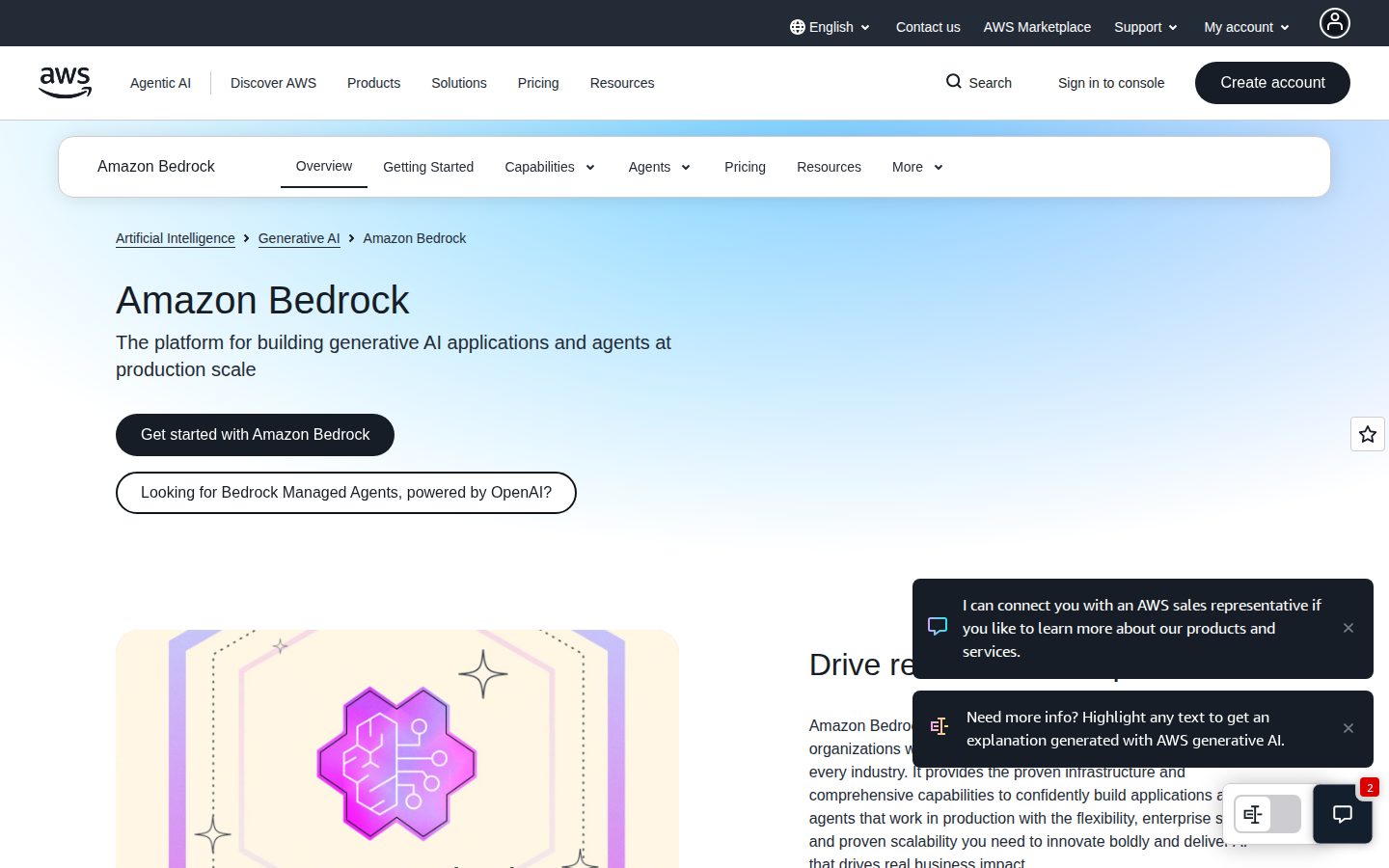
AWS managed service providing access to foundation models via APIs

Amazon Bedrock is a managed AWS service that provides API access to foundation models from multiple AI companies.

AI Panel Score

8.2/10

6 AI reviews

Reviewed

AI Editor Approved

About Anthropic Bedrock

Amazon Bedrock is a fully managed service on AWS that provides access to foundation models from leading AI companies through a single API. Users can choose from models developed by Anthropic (Claude), AI21 Labs (Jurassic), Cohere (Command and Embed), Meta (Llama), Mistral AI, and Stability AI (Stable Diffusion), among others.

The service is designed for developers and organizations looking to integrate generative AI capabilities into their applications without managing the underlying infrastructure. Bedrock handles model hosting, scaling, and availability, allowing users to focus on application development rather than operational concerns.

Key capabilities include text generation, conversational AI, text summarization, image generation, and code generation, depending on the selected model. The platform also offers fine-tuning options for certain models, allowing organizations to customize models with their own data while maintaining security and privacy controls.

Bedrock integrates with other AWS services and provides enterprise-grade security features, including data encryption and access controls. The service competes in the managed AI services market alongside offerings from Microsoft Azure OpenAI Service and Google Cloud's Vertex AI, positioning itself as AWS's primary generative AI platform for enterprise customers.

Features

AI

  • AgentCore Memory

    Enables intelligent context retention across sessions for agents, allowing continuity in multi-turn interactions.

  • Intelligent Prompt Routing

    Automatically routes prompts to reduce costs by up to 30% while maintaining response quality across AI applications.

  • Model Distillation

    Produces distilled models that run up to 500% faster and cost up to 75% less with minimal impact on accuracy compared to base models.

Analytics

  • AgentCore Observability

    Provides comprehensive monitoring and debugging capabilities to track agent performance and quality in production.

Automation

  • Amazon Bedrock AgentCore

    An agentic platform to build, deploy, and operate agents securely at scale using any framework and model without infrastructure management.

Core

  • Batch and Real-Time Processing

    Offers flexible options for both real-time and batch inference to balance cost, speed, and accuracy in AI applications.

  • Model Choice

    Provides access to hundreds of foundation models from leading AI companies with evaluation tools to select the best model based on performance and cost needs.

  • Prompt Caching

    Caches prompt data to reduce expenses and improve performance for AI application inference.

Customization

  • Bedrock Data Automation

    A data customization tool that enables organizations to tailor AI models to their specific business context and data.

  • Knowledge Bases

    Allows customization of AI models with proprietary business data to move from generic AI to domain-specific AI applications.

Security

  • Bedrock Guardrails

    Blocks up to 88% of harmful content and identifies correct model responses with up to 99% accuracy using Automated Reasoning checks to minimize hallucinations.

  • Compliance and Encryption

    Supports compliance standards including ISO, SOC, CSA STAR Level 2, GDPR, FedRAMP High, and HIPAA eligibility, with encryption of data in transit and at rest.

Preview

Anthropic Bedrock desktop previewAnthropic Bedrock mobile preview

Pricing Plans

Free Trial

Free

New AWS customers trying AWS AI services

  • Up to $200 in AWS credits for new customers
  • Access to Amazon Bedrock capabilities
  • Model choice from leading AI companies
  • Agent development tools
  • Security and compliance features

AI Panel Reviews

The Decision Maker

The Decision Maker

Strategic bet, vendor viability, timing, adoption approval
8.5/10

Amazon Bedrock is the safe enterprise AI bet, but it locks your roadmap deeper into AWS.

A fully managed AWS service that serves Claude and other foundation models behind one API. The catch is the deeper AWS commitment that comes with it.

No board member is going to question buying generative AI from AWS. That is the whole point. Bedrock has been generally available since September 2023, and the vendor is Amazon — runway is not a risk anyone needs to model.

The service does what enterprise buyers actually need. Bedrock Guardrails blocks up to 88% of harmful content, and Intelligent Prompt Routing trims inference cost by up to 30% without changing your application code. HIPAA eligibility and FedRAMP High clear the compliance review fast. Azure OpenAI Service and Google Vertex AI offer the same managed-model pitch, so the decision usually follows wherever your cloud contract already sits.

The catch is strategic, not financial. Standardizing on Bedrock pulls your AI roadmap further into AWS, and usage-based pricing at $6 per million input tokens scales with success. Run a scoped pilot on one product team for a quarter before you make it the org default.

Competitive Positioning7.8

Peers are split across Bedrock, Azure OpenAI Service, and Vertex AI, so this matches the field rather than moving ahead of it.

Reputation Risk9.0

Buying generative AI from AWS reads as a defensible, conservative choice to any board.

Speed to Value8.0

A unified API plus prebuilt Guardrails and Knowledge Bases gets a governed pilot live quickly.

Strategic Fit8.0

It advances AI capability for AWS-native shops but mainly consolidates spend rather than opening a new lane.

Vendor Viability9.5

The vendor is Amazon Web Services, so three-year survival is not a question worth modeling.

Pros

  • Backed by Amazon, so vendor longevity is effectively a non-issue.
  • One API serves Claude alongside models from Meta, Cohere, and Mistral, avoiding per-vendor integrations.
  • HIPAA, FedRAMP High, and SOC coverage clears enterprise compliance review with minimal friction.
  • Intelligent Prompt Routing and Model Distillation give real levers to manage inference cost.

Cons

  • Standardizing on Bedrock deepens AWS lock-in across your AI roadmap.
  • Usage-based pricing at $6 per million input tokens means costs rise as adoption grows.
  • No free plan, only up to $200 in trial credits for new AWS customers.

Right for

Enterprises already running on AWS who need governed access to foundation models.

Avoid if

Teams pursuing a deliberately multi-cloud or model-neutral AI strategy.

The Domain Strategist

The Domain Strategist

Craft and strategy in the product's domain — adapts identity per category, same lens
8.3/10

Amazon Bedrock is the right inference layer for AWS-native teams, but it welds your AI stack to AWS.

Bedrock puts foundation models from Anthropic, Meta, and Cohere behind one managed AWS API. For a CTO picking an inference layer through 2029, the call is multi-model flexibility against deep AWS gravity.

Standardizing on Amazon Bedrock is an architecture decision about where your inference layer lives, and AWS made the right structural choice: one API in front of foundation models from Anthropic, Meta, Mistral, and Cohere. Intelligent Prompt Routing lets you swap model tiers without rewriting application code, which is the lock-in escape hatch most single-vendor APIs lack.

The control plane is where the craft shows. Bedrock Guardrails enforces content and hallucination policy as configuration, and AgentCore runs agents in production without your team operating the infrastructure. Generally available since September 2023, with FedRAMP High and HIPAA eligibility, this is governance built for regulated org charts, not a hackathon.

But the catch is gravity. Adopt Bedrock and your AI layer is welded to IAM, VPCs, and AWS billing, so portability to Azure OpenAI Service or Vertex AI becomes a genuine migration. The tradeoff is sane if your stack already lives on AWS.

Category Positioning8.3

GA since September 2023, Bedrock is AWS's primary enterprise generative-AI platform against Azure and Google.

Domain Fit8.5

Bedrock matches how AWS-native platform teams already provision IAM, VPCs, and billing.

Integration Surface8.4

Native ties to AWS identity, networking, and observability give a frictionless integration story.

Long-term Implications7.6

Adoption welds the AI layer to AWS, making a later move to Azure OpenAI or Vertex AI costly.

Strategic Depth8.4

A unified multi-model API with Guardrails and AgentCore is best-in-class managed-AI infrastructure.

Pros

  • One API fronts foundation models from Anthropic, Meta, Mistral, and Cohere with no infrastructure to run.
  • Intelligent Prompt Routing swaps model tiers without application code changes, cutting cost up to 30%.
  • Bedrock Guardrails encodes content and hallucination policy as configuration for regulated teams.
  • FedRAMP High and HIPAA eligibility make it defensible for compliance-bound org charts.

Cons

  • Adoption welds your AI layer to AWS IAM, VPCs, and billing, raising real migration cost.
  • Usage-based pricing with no free plan makes long-run inference spend hard to forecast.

Right for

CTOs who run their stack on AWS and want one governed inference API.

Avoid if

Teams who need a cloud-portable AI layer across multiple providers.

The Finance Lead

The Finance Lead

Money, total cost of ownership, contracts, procurement math
8.2/10

Bedrock charges pure usage with no platform fee, so the invoice tracks token volume not headcount.

There is no seat license — you pay per token, with Claude Sonnet 4.6 at $3 and $15 per million. The catch is a usage bill that swings with traffic, not a flat number procurement can sign off once.

Amazon Bedrock has no platform fee. You pay per token. Claude Sonnet 4.6 runs $3.00 per 1M input tokens and $15.00 output; batch processing halves both to $1.50 and $7.50. No seat license, no minimum. New AWS accounts get up to $200 in credits — $100 at sign-up, $100 for activity.

TCO math. Token spend scales with traffic, so the year-3 number depends on adoption, not headcount. Intelligent Prompt Routing can trim up to 30% by sending easy prompts to cheaper models, and Prompt Caching cuts repeat-context cost. Compare Azure OpenAI Service, priced the same way. However, a usage meter is hard to forecast — model a volume range, not a single line.

Billing rides your existing AWS invoice, so procurement onboarding is near zero. No new vendor, no MSA. The yellow flag is cost ownership: nobody owns the meter until the bill arrives.

Billing & Procurement8.5

Charges land on the existing AWS invoice, so no new vendor or MSA is required.

Contract Flexibility8.5

No seat license, no minimum, and no term commitment — usage stops when you stop calling the API.

Pricing Transparency8.5

Per-token rates for every model are published on the Bedrock pricing page with no sales call.

ROI Clarity7.5

Token cost per request is measurable, but value depends on the application built on top.

Total Cost of Ownership7.5

Usage-based billing means the 3-year number swings with traffic and is hard to fix in advance.

Pros

  • No platform fee or seat license — you pay only for tokens consumed.
  • Per-token pricing for every model is published, with batch rates at half the on-demand cost.
  • Intelligent Prompt Routing can cut spend by up to 30% without quality loss.
  • Billing rides the existing AWS invoice, so procurement friction is near zero.

Cons

  • A pure usage meter is hard to forecast — there is no fixed annual number to sign.
  • Without active cost ownership, token spend can drift unnoticed until the monthly bill.

Right for

Teams already on AWS who want Claude access without a new vendor contract.

Avoid if

Buyers who need a fixed annual price locked before procurement signs.

The Domain Practitioner

The Domain Practitioner

Daily hands-on reality in the product's domain — adapts identity per category, same lens
8.0/10

Bedrock's Converse API lets you swap models without rewriting code, but the AWS tax follows you everywhere.

One API shape covers Claude, Llama, and Mistral, and Inference Profiles route around throttling for free. But token costs are steep and AWS plumbing becomes daily friction.

An engineer's day-three test isn't the console demo — it's whether the SDK call survives a model swap. The Converse API, GA since May 2024, gives one request shape across Claude, Llama, and Mistral, so you write the invocation once. That's the win Azure OpenAI Service can't match, because it only fronts OpenAI models.

The workflow glue is real. Cross-region Inference Profiles route around capacity throttling without you touching code, and Prompt Caching trims the cost of repeated context. Knowledge Bases wires retrieval to S3 and OpenSearch, so RAG stops being a side project. The docs are written by people who ship — every API has working SDK snippets.

The catch is the AWS tax. Tokens aren't cheap: Claude 3.5 Sonnet runs $6 per million input and $30 output, and IAM scoping, region availability, and quota tickets all become daily fights. However, if your stack already lives in AWS, that friction is what you pay everywhere.

Day-3 Reality8.0

The Converse API holds up past the demo: one request shape survives swapping Claude for Llama.

Documentation Practitioner-Fit8.0

API reference ships working SDK snippets per language, written by people who ship the service.

Friction Surface7.0

IAM scoping, per-region model availability, and quota-increase tickets add up over a working week.

Power-User Depth8.0

AgentCore, Model Distillation, and application inference profiles scale from a first call to production tenants.

Workflow Integration8.5

Inference Profiles, Prompt Caching, and Knowledge Bases tie into S3, OpenSearch, and IAM you already run.

Pros

  • Converse API gives one consistent request shape across Claude, Llama, Mistral, and Cohere models.
  • Cross-region Inference Profiles route around capacity throttling with no code change.
  • Knowledge Bases wires RAG directly into S3 and OpenSearch instead of a separate pipeline.
  • Docs ship working per-language SDK snippets for every API.

Cons

  • Token rates are steep — Claude 3.5 Sonnet is $6 per million input and $30 output.
  • IAM scoping, per-region model availability, and quota tickets add daily friction.
  • No free plan, only up to $200 in AWS credits for new accounts.

Right for

Engineers who already build on AWS and want one API across model vendors.

Avoid if

Solo developers who want the cheapest possible token rate.

The Power User

The Power User

Daily human experience, onboarding, polish, learning curve, reliability
7.9/10

Amazon Bedrock makes Claude easy to reach if you already live inside AWS.

One API gets you Claude alongside Llama and Nova, with no servers to babysit. The catch is the AWS console, which still feels like homework on day one.

The pull here is simple. You get Claude through the same console where your IAM roles, S3 buckets, and billing already live, so there is no new vendor to onboard. For a team already on AWS, that removes a real chore. New accounts get up to $200 in credits to poke around before committing.

What keeps it useful past day three is the cost tooling. Intelligent Prompt Routing quietly sends easy prompts to a cheaper model in the same family and trims spend up to 30%, and Prompt Caching shaves the repeated stuff. Azure OpenAI Service locks you to one model maker; Bedrock lets you swap Claude for Llama or Nova without rewriting your plumbing.

The catch is the front door. The Bedrock console is dense AWS-grade UI, region toggles and quota requests and JSON everywhere, so the first hour feels like homework. Generally available since 2023, it has settled down, but it never feels cozy.

Daily Polish7.5

The console is functional and dense AWS UI, with quota requests and JSON rather than sweated micro-copy.

Learning Curve7.8

Steep first hour, but cost tools like Intelligent Prompt Routing and Knowledge Bases reward teams who stay past month three.

Mobile Parity7.5

Bedrock is a developer API and console, so mobile is not a real use case here.

Onboarding Experience7.0

Region toggles, model access requests, and IAM setup make the first hour feel like homework.

Reliability Feel8.5

A fully managed AWS service generally available since 2023 handles hosting and scaling without you babysitting servers.

Pros

  • One API reaches Claude, Llama, Nova, and more without separate vendor contracts.
  • Lives inside existing AWS billing, IAM, and security, so there is no new account to manage.
  • Intelligent Prompt Routing and Prompt Caching cut inference costs up to 30%.
  • Fully managed hosting and scaling means no servers to babysit.

Cons

  • The dense AWS console makes the first hour feel like homework.
  • Model access requests and region toggles add friction before you write any code.
  • Usage-based pricing with no flat plan makes monthly costs hard to predict.

Right for

AWS teams who want Claude without a separate vendor.

Avoid if

Solo builders who want a friendly console on day one.

The Skeptic

The Skeptic

Contrarian. Watch-outs, deal-breakers, broken promises, category patterns
8.0/10

Bedrock is AWS infrastructure, not a startup bet, but the lock-in is the tell.

Generally available since September 2023 and backed by AWS, Bedrock is a durable platform with testable, specific claims. The catch is portability: agents and knowledge bases bind to AWS schemas, so leaving means rebuilding.

Managed AI platforms have a graveyard. Bedrock won't be in it — AWS owns the cloud underneath. Generally available since September 2023, with a changelog that moves weekly. The honest read: this is infrastructure, not a venture bet.

The marketing claims are specific, which I respect. Intelligent Prompt Routing claims up to 30% cost savings, and Bedrock Guardrails claims it blocks up to 88% of harmful content. Both are testable, not vapor. But the catch is lock-in. AgentCore Memory and Knowledge Bases bind your agents to AWS schemas — leaving means rebuilding, not exporting.

Pricing is real and public: Claude 3.5 Sonnet runs $6 per 1M input tokens. Azure OpenAI Service sells the same convenience pitch. Solid and durable, but priced and architected for shops already committed to AWS.

Competitive Differentiation7.5

Multi-model access is a real edge, though Azure OpenAI Service and Vertex AI sell the same convenience.

Exit Portability6.5

AgentCore Memory and Knowledge Bases bind agents to AWS schemas, so migration means rebuilding.

Long-term Viability9.0

AWS ownership and deep Anthropic investment make this a safe three-year bet.

Marketing Honesty8.0

Claims are specific and testable — 30% routing savings, 88% harmful-content blocking — not vague superlatives.

Track Record Match8.5

GA since September 2023 with weekly changelog cadence, backed by AWS rather than a fragile startup.

Pros

  • AWS ownership makes vendor shutdown a non-concern, unlike most managed AI startups.
  • Marketing claims are specific and verifiable rather than vague superlatives.
  • Single API gives access to models from Anthropic, Meta, Cohere, Mistral, and others.
  • Public token pricing and a $200 new-customer credit make cost modeling straightforward.

Cons

  • AgentCore and Knowledge Bases bind your stack to AWS schemas, making exit costly.
  • No free plan, and usage-based pricing assumes you are already an AWS customer.

Right for

Engineering teams who already run on AWS and want managed model access.

Avoid if

Teams who need cloud-portable AI infrastructure they can move later.

Buyer Questions

Common questions answered by our AI research team

Pricing

How much does Claude 3.5 Sonnet cost per million tokens?

Claude 3.5 Sonnet (Public Extended Access) costs $6.00 per 1M input tokens and $30.00 per 1M output tokens. Batch pricing is $3.00/$15.00 per 1M input/output tokens.

Security

Does Amazon Bedrock meet HIPAA compliance requirements?

Yes, Bedrock is HIPAA eligible, and also meets ISO, SOC, CSA STAR Level 2, GDPR, and FedRAMP High compliance standards.

Features

Can I fine-tune models with my own data on Bedrock?

Yes, fine-tuning is supported. Options include Knowledge Bases, Bedrock Data Automation, prompt engineering, and fine-tuning to customize models with your own data.

Security

Does Bedrock store my data to train its models?

Bedrock never stores or uses your data to train models. Data is encrypted in transit and at rest, with identity-based policies for managing data access.

Pricing

What cost savings does Intelligent Prompt Routing offer?

Intelligent Prompt Routing can cut costs by up to 30% while maintaining quality.

Also in LLM Platforms