Artisan logo

Artisan Review

Visit

The autonomous AI BDR that runs outbound for sales teams

Artisan is an AI sales agent platform for B2B outbound prospecting and meeting scheduling.

Artisan·Founded 2020·From $250/moFree PlanFree TrialAI Sales ToolsAI Agents & AssistantsAI Workflow Automation

AI Panel Score

7.3/10

6 AI reviews

Reviewed

Facts checked against artisan.co

AI Editor Approved

About Artisan

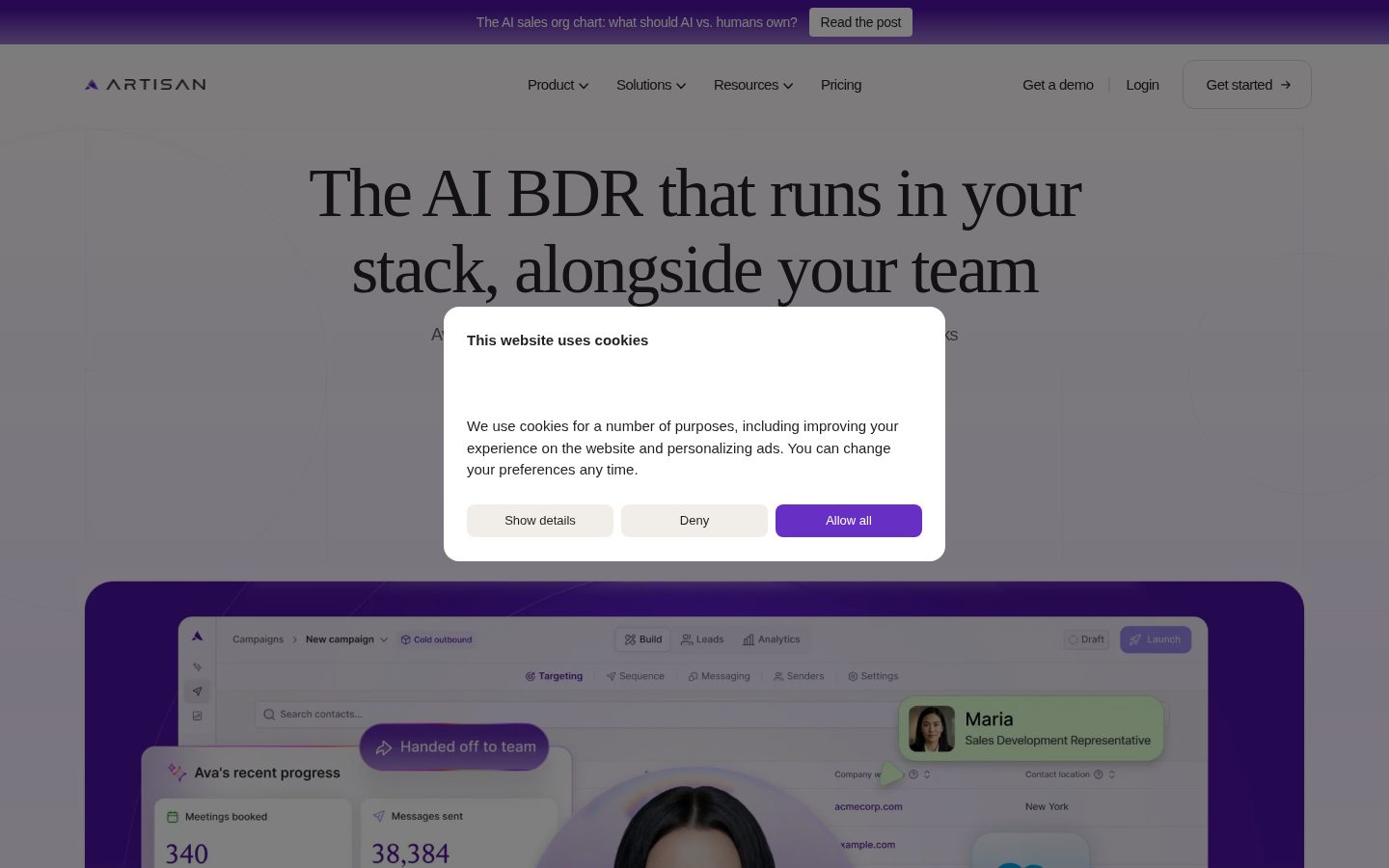
Artisan is built around Ava, an AI agent meant to operate as a BDR for outbound sales. In practice, teams use Artisan to find and enrich B2B leads, then have Ava run personalized outreach campaigns and book meetings from the resulting conversations, covering the prospecting-to-meeting workflow that a human BDR would otherwise handle manually.

Beyond core outbound, the site lists a set of adjacent capabilities built on the same platform: a B2B contact database and local business leads data for sourcing prospects, intent data for signal-based targeting, CRM reactivation for reviving stale pipeline, and upsell software for cross-sell motions within existing accounts. Artisan also publishes direct comparison pages against other AI sales tools, including Artisan vs 11x and Artisan vs AiSDR.

Artisan is aimed at startups, SMBs, and enterprise sales teams, based on dedicated solutions pages for each segment. Pricing is credit-based. For startups, the pricing page lists a Free plan with 300 credits a month, Intern at $250 a month billed annually ($280 month to month) for 10K credits, or about 500 leads contacted, and Employee at $600 a month billed annually ($660 month to month) for 25K credits, or about 1,250 leads. New accounts get a 30-day, 10K-credit free trial with no card required. For larger teams it lists Team (roughly 2,500 leads contacted a month), Scale (roughly 6,000) and a custom Enterprise plan, each sized to lead volume, mailboxes, and dialer seats and quoted through sales. These sales-led plans include Salesforce and HubSpot sync, access to 250M+ verified B2B contacts, and CSM-led onboarding.

Features

AI

  • AI Lead Generation

    Finds and enriches B2B leads to build target prospect lists.

  • AI Sales Agent (Ava)

    An autonomous AI BDR that handles prospecting, personalized outreach, and meeting booking for outbound sales.

  • Intent Data

    Uses intent signals to identify and target prospects more likely to convert.

Automation

  • AI Dialer

    Per-seat dialer add-on: reps call leads from Artisan with AI talking points, live transcripts and logged outcomes, plus a brief before and a follow-up after each call.

  • AI Outreach

    Runs personalized outbound email campaigns in your reps' names from your own sending domains, with Ava answering replies.

  • Approval Before Sending

    Optional review mode: every message Ava drafts waits on the Tasks page for approval, with a Regenerate option that takes rewrite instructions. Teams can also lock tone and CTAs, set banned phrases, and write escalation rules for when a person takes over a reply.

  • CRM Reactivation

    Revives stale pipeline and dormant leads sitting in a company's CRM.

  • Meeting Scheduling

    Books meetings with prospects directly from outbound campaigns.

  • Outbound Sales Automation

    Manages the end-to-end outbound sales motion from prospecting through meeting booking in one system.

  • Upsell Software

    Supports cross-sell and upsell motions to existing customers.

Core

  • B2B Contact Database

    Search 250M+ verified B2B contacts, with emails, direct dials and firmographics, using filters such as title, industry, geography and company attributes, or plain-language search.

  • Local Business Leads

    Search a database of 200M+ Google Maps businesses to build geographically targeted lead lists.

Integration

  • Artisan Connector in Claude (MCP)

    Connects an Artisan account to Claude through an MCP server, so you can search prospects, build lists, enrich contacts, draft campaigns and check remaining credits from a chat. Artisan labels it an early feature.

  • Salesforce and HubSpot Sync

    Bi-directional Salesforce and HubSpot sync; CRM lists can feed campaigns and CRM contact or account owners can be used as senders. Slack reply alerts and an inbound lead webhook cover other tools.

Preview

Artisan desktop previewArtisan mobile preview

Pricing Plans

Free

Free

For exploring the platform: look up individual leads and build and enrich lists, with 300 credits a month and no credit card needed. Campaigns, deliverability tools and integrations need a paid plan.

  • 300 credits per month
  • Find new leads
  • Lists and enrichment
  • Agent swarm research
  • CSV import/export

Intern

$250/monthly

For running outbound campaigns and booking first meetings. $250 a month billed annually with credits upfront, or $280 billed monthly; 10K credits a month, about 500 leads contacted. The paid self-serve plans start with a 30-day, 10K-credit free trial, no card required.

  • 10K credits per month
  • About 500 leads contacted per month
  • Everything in Free
  • CRM sync (HubSpot)
  • Autonomous campaigns and replies
  • Deliverability monitoring
  • Slack integration
  • Human power dialer ($67/seat/mo)

Employee

$600/monthly

For automating the full outbound motion with advanced campaigns and integrations. $600 a month billed annually with credits upfront, or $660 billed monthly; 25K credits a month, about 1,250 leads contacted. Marked recommended.

  • 25K credits per month
  • About 1,250 leads contacted per month
  • Everything in Intern
  • Advanced campaign types
  • Webhooks as data source
  • Priority support
  • Full self-driving Ava (coming soon)

Team

Contact sales

For teams running their first serious outbound motion, at about 2,500 leads contacted a month. Pricing is scoped to the plan through sales; no list price is published.

  • About 2,500 leads contacted per month
  • Every campaign type
  • Autonomous replies and meeting booking
  • 250M+ verified B2B contacts
  • Salesforce and HubSpot sync
  • CSM support and onboarding
  • AI dialer add-on, per seat
Popular

Scale

Contact sales

For teams scaling outbound across reps and segments, at about 6,000 leads contacted a month. Marked most popular; pricing is scoped to the plan through sales.

  • About 6,000 leads contacted per month
  • Everything in Team
  • Dedicated CSM
  • CRM setup included
  • Priority support

Enterprise

Contact sales

For custom volume, security, and rollout support. Flexible plans quoted through sales.

  • Custom volume
  • Everything in Scale
  • Forward-deployed strategist
  • Full onboarding buildout
  • Dedicated strategic support
  • Advanced security controls and audit logs
  • SSO / SAML

AI Panel Reviews

The Decision Maker

The Decision Maker

Strategic bet, vendor viability, timing, adoption approval
8.0/10

Piloting Ava against a BDR hire is cheap; the volume that would replace one is quoted by sales.

“A no-card 30-day trial and self-serve plans from $250 a month make an Ava pilot an easy yes. The Team and Scale tiers, where a hire actually gets replaced, are quoted by sales.”

Artisan's pricing page opens with a hiring pitch, not a feature list: pay a fraction of a human BDR. Ava finds the leads, writes the outreach, handles replies and books the meeting, the job a first BDR hire would do. So the real benchmark is a salary line, not 11x or AiSDR, the rivals Artisan's own comparison pages name.

The first step costs almost nothing. Every new account gets 30 days and 10K credits with no card, then Intern runs $250 a month billed annually and Employee $600, both self-serve. I'd approve that pilot without a meeting.

The catch is volume. Team, at about 2,500 leads contacted a month, and Scale, at about 6,000, are the volumes a headcount decision rests on, and both are quoted by sales. Pilot on Intern, then bring the meeting count to that call before touching the hiring plan.

Competitive Positioning8.0

Comparison pages against 11x and AiSDR plus a $250 self-serve entry plan pitch Artisan as a fraction of a BDR's cost, not just cheaper email.

Reputation Risk7.5

SOC 2 Type II and GDPR are confirmed, but one agent holding lead data, outreach history and booking makes this costly to unwind later.

Speed to Value8.0

A no-card 30-day trial lets a pilot start once a primary mailbox is connected, though secondary mailboxes need about two weeks of warm-up.

Strategic Fit8.0

Replaces a headcount-shaped workflow rather than just discounting an existing tool, which is a real shift in how outbound gets staffed.

Vendor Viability8.0

The pricing page lists self-serve plans, credit costs and a plan comparison, and the docs map setup step by step, though I couldn't find a changelog.

Pros

  • Ava covers the full prospecting-to-meeting workflow in one platform
  • A no-card 30-day trial and self-serve plans at $250 and $600 a month make a pilot cheap to approve
  • SOC 2 Type II and GDPR compliance both confirmed
  • CRM reactivation and intent data add use cases beyond pure outbound
  • Segmented solutions for startups, SMBs, and enterprise

Cons

  • Team (about 2,500 leads a month) and Scale (about 6,000), the volumes that replace a hire, are quoted by sales
  • Heavy reliance on one agent for outreach creates lock-in if you want to unwind it later

Right for

Sales leaders who want to pilot an AI BDR before approving another hire.

Avoid if

Skip it if you need a list price for 2,500+ leads a month before talking to sales.

The Domain Strategist

The Domain Strategist

Craft and strategy in the product's domain — adapts identity per category, same lens
7.6/10

A full BDR replacement pitch — great for pipeline math, risky for quota culture.

“Artisan wants to own the entire top-of-funnel motion under one agent, Ava. That's a compelling number to run past the board, but it changes what my reps actually do all day.”

I run pipeline coverage models for a living, and Artisan's pitch is a headcount argument first, a tool argument second. Ava handling prospecting, enrichment, outreach, and booking end to end means I'm not comparing seat prices — I'm comparing Ava's output against a BDR's fully-loaded cost and ramp time. That math works in a deck. It's less clear how it holds up when a named account needs a human touch mid-sequence.

What I actually want to know: how does Ava perform against quota-carrying reps on meeting show-rate, not just meetings booked? The CRM reactivation and intent-targeting features suggest this platform expects to run alongside a bigger revenue motion, which fits how enterprise sales orgs actually segment work today.

The SMB, startup, and enterprise solution pages tell me they've thought about org size. What they haven't shown me is how a VP re-trains a rep team once Ava owns the first three funnel stages. That's a leadership problem, not a features problem.

Category Positioning8.0

Direct comparison pages against other AI sales agents like 11x and AiSDR show Artisan is competing on the autonomous-BDR category itself, not just tooling.

Domain Fit7.5

The prospecting-to-meeting workflow maps to how BDR teams are actually structured, though the shape assumes leaders are ready to restructure headcount around an agent.

Integration Surface7.6

One system replacing prospecting and email tools cuts vendor sprawl, and Salesforce and HubSpot sync both ways, but I'd want to see how it plays with the comp plan, not just the tech stack.

Long-term Implications7.0

Three years in, this either becomes your outbound engine or a costly org redesign to unwind if Ava's output doesn't hold at scale.

Strategic Depth7.8

Consolidating lead data, enrichment, and outreach into one agent is a deeper bet than point-tool stacking, but the ceiling depends on Ava's judgment on non-templated accounts.

Pros

  • Ava covers the full outbound motion — prospecting, enrichment, outreach, and booking — without stitching tools together
  • Segmented solutions pages for startups, SMBs, and enterprise show they've built for different sales org shapes
  • CRM reactivation and intent data give reps upsell and win-back motions beyond pure cold outbound

Cons

  • No visible benchmark on meeting quality or show-rate versus a human BDR, which is the number I'd actually take to my CRO
  • Self-serve tiers publish credit costs (about 20 per person contacted), but Team and Scale, the volumes I'd need, are quoted through sales
  • Putting the entire top-of-funnel motion on one agent raises the stakes if Ava underperforms on a segment that needs nuance

Right for

Sales leaders who want to compress or reallocate BDR headcount and are comfortable measuring an agent against quota-carrying benchmarks.

Avoid if

Avoid if your outbound motion depends on rep-level judgment calls on tricky enterprise accounts that a script can't replicate yet.

The Finance Lead

The Finance Lead

Money, total cost of ownership, contracts, procurement math
6.7/10

Artisan's Intern plan works out near $0.50 per person contacted, and the pricing page shows the math.

“Published credit costs and self-serve prices turn Intern and Employee into a cost per lead you can compute. Annual credits load upfront with no rollover, and Team and Scale still run through a quote.”

Divide $250 by about 500 leads: Artisan's Intern plan lands near $0.50 per person contacted. That's roughly 20 credits a person against 10K credits a month. Employee is $600 for about 1,250 leads. $0.48 each. Month-to-month, they're $280 and $660.

Year one on Intern: $250 × 12 = $3,000 for 120K credits. One human power dialer seat at $67 a month adds $804 a year. Call it $3,804, before mailboxes and phone numbers, which bill separately. I couldn't find their rates. The Credits Estimator sizes the burn before you sign.

The catch is annual credits. They load upfront and don't roll over at term end. Monthly credits carry one extra period. So Intern's $360 annual saving only pays if the credits get spent. No overage, though: enrollments pause at zero. Team covers about 2,500 leads, twice Employee's. Priced by quote.

Billing & Procurement6.0

Self-serve plans bill monthly or annually and pause enrollments instead of charging overage; SOC 2 Type II eases security review, but I couldn't find payment terms for the sales-led plans.

Contract Flexibility6.0

Monthly billing exists, upgrades apply at once and downgrades at cycle end, but cancellation goes through a support ticket and I couldn't find Team or Scale term lengths.

Pricing Transparency4.5

Intern and Employee are public at $250 and $600 a month billed annually, with per-action credit costs, but Team, Scale and Enterprise are priced by quote.

ROI Clarity6.3

About 20 credits per person contacted puts Intern near $0.50 a lead; cost per meeting still depends on your own reply rates.

Total Cost of Ownership5.5

Intern's first year is $250 × 12 = $3,000 plus $804 per dialer seat, but mailboxes and phone numbers bill separately at rates I couldn't find.

Pros

  • Intern and Employee list public prices: $250 and $600 a month billed annually
  • Published credit costs, about 20 per person contacted, make cost per lead computable
  • Enrollments pause when credits run out, so there's no overage bill

Cons

  • Team, Scale and Enterprise are still priced by sales quote
  • Unused annual credits don't roll over at the end of the term
  • Mailboxes and phone numbers bill separately; the power dialer adds $67 a seat a month on annual billing

Right for

Startup sales teams who budget outbound per lead contacted.

Avoid if

You need a list price above 1,250 leads a month.

The Domain Practitioner

The Domain Practitioner

Daily hands-on reality in the product's domain — adapts identity per category, same lens
7.6/10

Ava emails prospects in my name, and I can make her wait for my approval first.

“Artisan runs sourcing, outreach and booking through one agent, and an optional approval step lets a rep sign off each draft before it sends. Sender rules follow CRM ownership, though I couldn't find a seat view built for the rep rather than the account.”

Every email Ava sends goes out in my name, from our own sending domains. The first setting I'd check: Require approval before sending. With it on, each draft waits in Tasks under Outbound to approve, and Regenerate takes rewrite notes when a line sounds wrong. The pricing FAQ adds tone and CTA locks plus banned phrases.

CRM fit holds up. Sender rules can follow the Contact owner or Account owner in Salesforce or HubSpot, so my accounts stay mine. The catch: forwarding replies to my primary mailbox doesn't work while Autopilot replies is on, so each campaign picks who works the thread.

What I couldn't find is a rep's own seat view. Analytics filter by sender and the Leads tab shows each lead's assigned sender, but both read as the team view, sliced by rep. Artisan pitches itself against 11x and AiSDR; my question for the 30-minute demo is simpler.

Day-3 Reality7.5

Require approval before sending parks each draft under Outbound to approve, and Regenerate takes rewrite notes, so a rep reads what goes out in their name.

Documentation Practitioner-Fit7.0

The help center walks through campaign settings and the Tasks approval flow step by step, written for the person running the campaign.

Friction Surface7.0

One system beats stitching tools together, but reply forwarding doesn't work while Autopilot replies is on, and new secondary mailboxes need about two weeks of warm-up before they send.

Power-User Depth7.2

Custom instructions set reply tone and escalation, up to five qualification conditions gate booking, and sender rules can be reordered.

Workflow Integration7.5

Sender rules can follow the CRM Contact or Account owner, Salesforce and HubSpot sync both ways, and positive or neutral replies can forward to the rep's primary mailbox.

Pros

  • One agent covers sourcing, enrichment, outreach, and booking without swapping tools mid-workflow
  • Require approval before sending holds every draft in Tasks for sign-off, with Regenerate for rewrites
  • CRM reactivation gives reps a second motion to run against pipeline they already own
  • SOC 2 Type II and GDPR compliance are already sorted for a security review

Cons

  • Reply forwarding to a rep's primary mailbox doesn't work while Autopilot replies is on
  • I couldn't find a rep's own seat view beyond account and campaign analytics filtered by sender

Right for

Reps who want AI outbound in their name without giving up sign-off.

Avoid if

You want Autopilot replies and inbox forwarding running on the same campaign.

The Power User

The Power User

Daily human experience, onboarding, polish, learning curve, reliability
7.3/10

Ava's first hour is mapped down to the Missing info warning, and that's rarer than it should be.

“Artisan's help center walks through a first campaign, from setup prerequisites to an optional review mode and bounce checks. Getting in is self-serve too: a 30-day, 10K-credit trial needs no card, though I couldn't find a mobile app.”

Somebody at Artisan wrote the boring setup homework down, and that matters. The Quickstart lists what Ava needs before she sends anything: a connected primary mailbox, a sender with a signature and booking link, and credits. Half-configured sender? A Missing info warning says so. After launch, message prep takes up to 10 minutes, then the campaign's Leads tab shows who's queued, contacted or excluded.

Nervous first week? Turn on Require approval before sending and every draft waits in Tasks under Outbound to approve, with a Regenerate button that takes rewrite notes. Add the optional bounce test, a daily prospect cap and the global DNC list, on by default, and a bad data day hits a few walls before a real inbox.

Getting in the door is easy: a 30-day free trial with 10K credits and no card, and the account drops to the Free plan, campaigns paused, if you don't add one. The catch is time, since secondary mailboxes need about two weeks of warm-up. I also couldn't find a mobile app, a status page, or what happens when enrichment fails for a lead. Fine for a desk tool. Worth knowing anyway.

Daily Polish7.0

The help center shows real daily detail: a Tasks page with Outbound to approve and Scheduled views, Regenerate with rewrite notes, and a Leads tab with each lead's sender and sequence step.

Learning Curve7.5

Default settings cover most campaigns, so a first launch means checking a handful of settings, and Top conversation drivers in campaign analytics give month three something to learn from.

Mobile Parity6.0

I couldn't find a mobile app or any mention of phone access, which matters less for outbound work run from a desk.

Onboarding Experience7.0

The Quickstart spells out the prerequisites and offers sequence templates, and a 30-day, 10K-credit trial needs no card, though secondary mailboxes take about two weeks to warm up.

Reliability Feel7.0

Missing info warnings, an optional bounce test, a daily prospect cap and a default DNC list guard against bad sends, but I couldn't find a status page or how enrichment failures are handled.

Pros

  • A public Quickstart, an optional review mode and Missing info warnings show a first campaign's setup before anything sends
  • Combines lead sourcing, enrichment, outreach, and booking under Ava in one platform
  • SOC 2 Type II and GDPR compliance give security teams a fast yes
  • Segmented offerings for startups, SMBs, and enterprise suggest the platform flexes with org size

Cons

  • Secondary mailboxes need about two weeks of warm-up before they can send
  • I couldn't find a mobile app, a status page, or what happens when enrichment fails for a lead

Right for

Outbound teams who want a documented launch path before letting Ava send on her own.

Avoid if

You need a new secondary mailbox sending in week one, since warm-up takes about two weeks.

The Skeptic

The Skeptic

Contrarian. Watch-outs, deal-breakers, broken promises, category patterns
6.8/10

The $250 plan is real, just one click past three Talk to sales buttons.

“Artisan does publish self-serve prices, $250 and $600 a month on annual billing, but only on the Startups tab behind a sales-led default. Credit costs are spelled out plainly; cancellation and contract terms get far less ink.”

Artisan's pricing page opens on Team, Scale and Enterprise. Three plans, three Talk to sales buttons. The self-serve prices sit one click over, on the Startups tab: Intern at $250 a month billed annually, Employee at $600. Published, yes. Front and center, no.

The credit math reads honest, but check the tilde. Intern's ~500 leads a month assumes about 20 credits per person contacted, and the FAQ says longer, ultra-personalized sequences cost more. Credit where due: the Credits Estimator is public, and new enrollments pause at zero. No surprise charges.

Exit is thinner. Cancelling means opening a support ticket, and I couldn't find a term length or notice period for Team or Scale. The Artisan vs 11x and Artisan vs AiSDR pages are still up — vendor-picked comparisons, not benchmarks. SOC 2 Type II I'd take at face value.

Competitive Differentiation6.5

Their own Artisan vs 11x and Artisan vs AiSDR pages confirm a crowded field selling a near-identical AI BDR pitch.

Exit Portability5.5

CSV import/export and two-way Salesforce and HubSpot sync help, but cancellation runs through a support ticket and I couldn't find Team or Scale terms.

Long-term Viability7.0

The help center and support docs are live, and SOC 2 Type II plus GDPR are concrete commitments, though I couldn't find a changelog.

Marketing Honesty6.5

Self-serve prices and per-action credit costs are published, but the pricing page leads with Talk to sales plans and puts them a tab away.

Track Record Match6.5

The claims come with stated limits: about 20 credits per person contacted, a maximum 30-day credit cost shown before launch, and optional Approval Before Sending.

Pros

  • SOC 2 Type II is a third-party attestation, not landing-page copy
  • The Startups tab lists real prices: Intern $250 a month billed annually ($280 monthly), Employee $600 ($660 monthly)
  • Per-action credit costs are published, and new enrollments pause at zero credits instead of running up charges

Cons

  • The pricing page opens on sales-led plans; the self-serve prices sit behind the Startups tab
  • The ~500 and ~1,250 leads-contacted figures assume about 20 credits per person; richer sequences cost more
  • Cancelling means opening a support ticket, and I couldn't find a term or notice period for Team or Scale

Right for

Startups who want to trial an AI BDR on published prices.

Avoid if

You need written cancellation terms before signing a sales-led plan.

Buyer Questions

Common questions answered by our AI research team

Features

What tasks does Ava the AI BDR handle?

Ava finds leads, enriches them, sends personalized outreach messages, and books meetings on behalf of sales reps, functioning as an autonomous BDR for outbound sales.

Security

Is Artisan SOC 2 certified?

Yes, Artisan holds SOC 2 Type II certification.

Security

Does Artisan comply with GDPR?

Yes, Artisan complies with GDPR.

Features

Does Artisan replace separate prospecting and email tools?

Yes, Artisan combines lead data, enrichment, and outreach automation into a single system rather than requiring separate prospecting and email tools.

Features

Can Ava help with CRM reactivation campaigns?

Yes, Ava supports CRM reactivation as one of its related use cases alongside intent-based targeting.

Product Information

  • Company

    Artisan
  • Founded

    2020
  • Pricing

    From $250/mo
  • Free Trial

    Available
  • Free Plan

    Available

Platforms

web

About Artisan

Artisan is a San Francisco-based company that builds AI-powered digital workers for sales teams, including an AI BDR called Ava that automates outbound prospecting and outreach.

Resources

Documentation
API
Blog

Also in AI Sales Tools