SaaS security posture management with owner-routed remediation
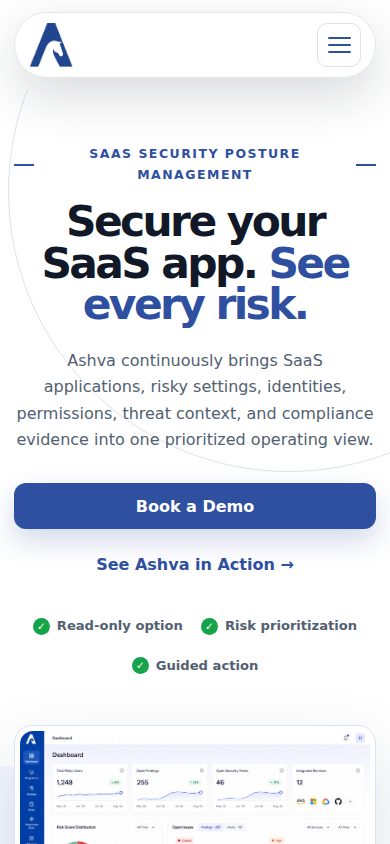
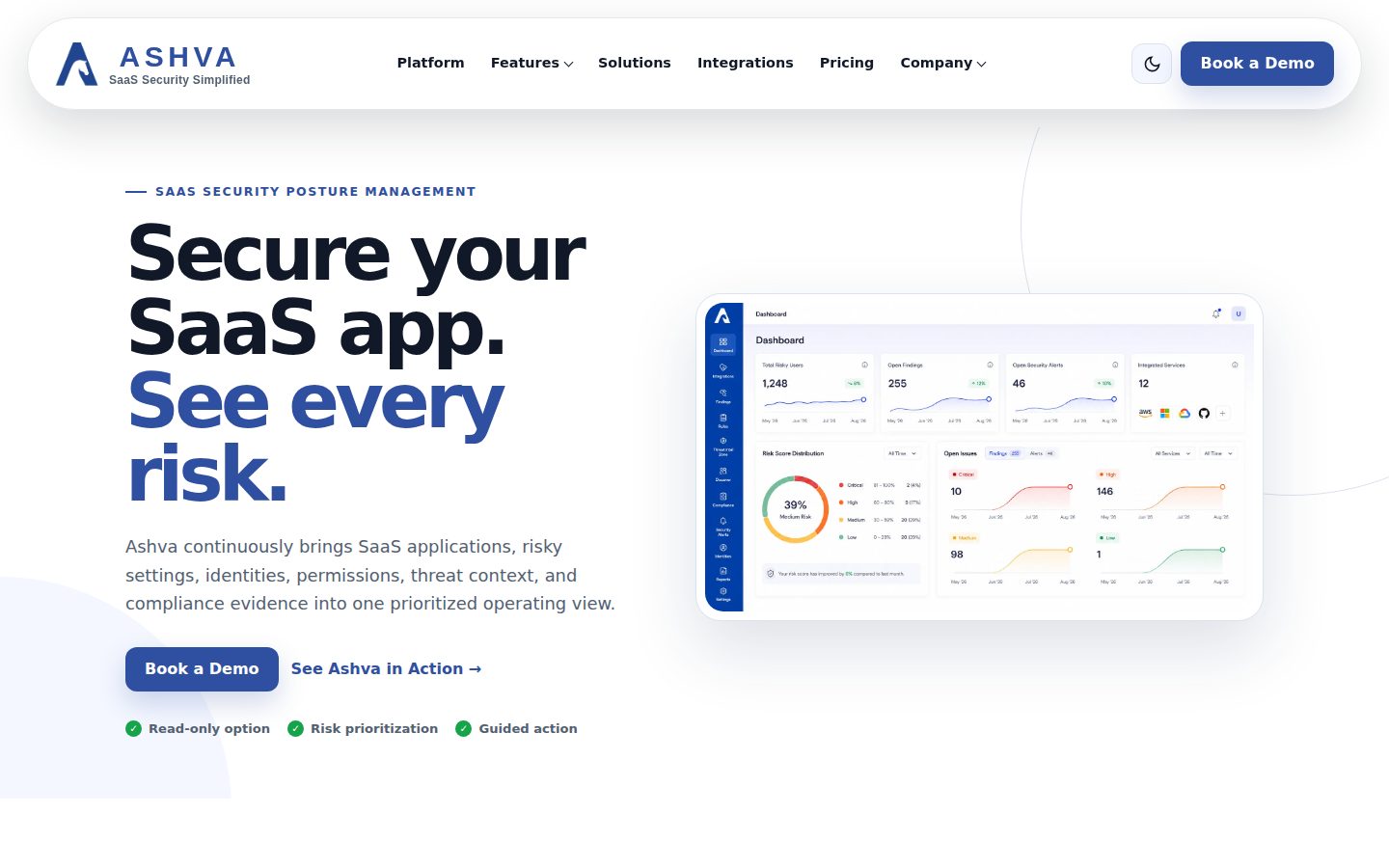
Ashva is a SaaS security posture management platform for security, IT and compliance teams.
AI Panel Score
6 AI reviews
Reviewed
AI Editor ApprovedApproved and published by our AI Editor-in-Chief after full panel analysis.Ashva is a SaaS security posture management (SSPM) platform that connects an organization's SaaS applications and identity providers, then normalizes configuration, identity, permission and activity signals into one prioritized findings queue. It is built for security teams, CISOs, IT and IAM administrators, GRC functions and managed service providers overseeing a growing SaaS estate. Pricing is quote-based: three annual plans, Starter, Business and Enterprise, are sized by connected integrations and monitored identities, each listed as Custom or Tailored rather than a published rate. Named capabilities include shadow SaaS discovery, misconfiguration management, an identity center spanning human and non-human accounts, excessive permission and dormant account detection, dark web exposure monitoring, threat intelligence enrichment, and workflows that route findings to owners and verify fixes. A compliance view maps findings and evidence to ISO 27001, SOC 2, GDPR, HIPAA, PCI DSS, NIST and CIS Controls. Best fit for organizations standardizing SaaS risk work across security, IT and compliance functions.
Ashva runs as a four-stage loop over the SaaS applications an organization chooses to connect. In the connect stage you add approved applications and discovery sources through identity providers and vendor APIs; the analyze stage normalizes configuration, identity, access, activity and control signals into a common shape; the prioritize stage ranks findings using asset, identity, exposure and business context; and the remediate stage assigns an owner, routes the work, collects evidence and verifies the change. The product page offers a read-only connection option, and deployment scope starts with the highest-risk applications and expands across the estate as the program matures.
Twelve named capabilities sit on that loop: Shadow SaaS Discovery, Misconfiguration Management, Security Alerts, Identity Center, Excessive Permission Detection, Dormant Account Identification, Compliance View, Threat Intelligence, Dark Web Exposure Monitoring, Continuous SaaS Risk Monitoring, SaaS Access & Permission Hygiene, and Workflows & Automation. The Identity Center covers human and non-human identities together, including administrators, guests and service accounts with their entitlements and activity. The connector catalog currently presents 40 applications across identity providers (Okta, Microsoft Entra ID, OneLogin, Ping Identity, Duo Premier), collaboration (Slack, Zoom, Google Workspace, Notion, Miro, Box, Dropbox), developer tools (GitHub, GitLab, Bitbucket Cloud), CRM (Salesforce), ticketing (Jira, Zendesk), data platforms (Snowflake, Databricks, Microsoft Power BI) and security tooling (Cisco, Datadog). It also carries an AI-applications category covering OpenAI, ChatGPT, Anthropic, Claude and Cursor — each with a per-application page naming five review areas, such as organization API keys without accountable owners, inactive members retaining console access, and connectors granted excessive permissions.
Ashva is aimed at CISOs, security analysts, IT and IAM administrators, GRC teams and managed service providers running SaaS risk as a shared program rather than a periodic spreadsheet review. Pricing is quote-based across three annual plans — Starter for up to 300 employees, Business for up to 1,000 and Enterprise for custom scope — each listed as Custom or Tailored and sized by connected integrations, monitored identities, workflow and reporting scope, and support level. The listed entry path is a 30-minute demo covering priority integrations, evaluation criteria and recommended rollout scope.
The product is delivered in the browser and depends on connector access: the vendor notes that available checks, supported data fields and remediation actions vary with vendor APIs, application licensing, granted permissions and the customer's own Ashva configuration. The Compliance View organizes findings, control status, remediation activity and evidence against ISO 27001, SOC 2, GDPR, HIPAA, PCI DSS, NIST and CIS Controls; Ashva positions this as compliance readiness support and states that it does not certify or guarantee compliance.

Routes findings to accountable owners through configurable approval, notification and verification steps triggered by events such as a new critical finding or an SLA threshold.
Organizes findings, control status, remediation activity and collected evidence against ISO 27001, SOC 2, GDPR, HIPAA, PCI DSS, NIST and CIS Controls for audit preparation.
Replaces periodic snapshots with ongoing posture checks that report configuration changes, new privileged users, sharing changes and integration drift as they happen.
Consolidates human and non-human identities, including administrators, guests and service accounts, with their entitlements, activity and risk in a single view.
Presents 40 connectors spanning identity providers, collaboration, developer tools, CRM, ticketing, cloud, data platforms and AI applications, each with a page listing five priority review areas.
Monitors for exposed credentials, leaked corporate email addresses and organization mentions so teams can validate affected identities and rotate secrets.
Combines sign-in history, account state, entitlement and ownership signals to flag inactive users, stale external guests and unused service accounts that still hold access.
Compares assigned privileges, group memberships and observed activity to identify users and applications holding more access than their role or usage requires.
Normalizes configuration signals across connected applications and flags weak access controls, unsafe sharing, missing safeguards and high-risk admin settings with prioritized remediation guidance.
Provides recurring contextual reviews of privileges, guest access, group membership, connected app grants and role consistency across SaaS environments.
Correlates security-relevant SaaS events such as privileged changes, suspicious access, policy drift and unusual sharing with identity and posture context to reduce alert noise.
Correlates approved discovery sources with identity and access signals to surface unmanaged SaaS applications, their owners and how they are being used.
Enriches SaaS posture findings with external indicators, credential exposure and campaign context so teams can separate routine posture work from urgent investigations.
Entry tier for teams starting with their highest-risk SaaS applications, covering up to 300 monitored identities; the published commercial model is a custom annual price requested from Ashva sales.
Highlighted tier for growing organizations coordinating SaaS security across teams, covering up to 1000 monitored identities; the published commercial model is a custom annual price requested from Ashva sales.
Tier for complex SaaS stacks, multiple business units or service providers; integration scope and identity count are set per environment and priced through a tailored proposal from Ashva sales.
Ashva puts your OpenAI and Okta accounts in one findings queue, then makes someone own the fix.
“Ashva inspects the settings, identities and permissions inside the SaaS apps you connect, then routes each finding to an owner and verifies the fix. Tier scoping is stated plainly at 300 and 1,000 identities, but every price comes by email and I couldn't find a trial.”
Your OpenAI and Claude org accounts are SaaS apps — admins, API keys, inactive members who still have console access. Ashva's connector catalog treats them exactly like Okta, GitHub and Snowflake, and Compliance View lines the findings up against seven frameworks without claiming to certify you against any of them.
The value sits after the finding, not in it. Identity Center pulls human and non-human identities — admins, guests, service accounts — into one view, and Workflows & Automation routes each finding to an accountable owner, collects evidence, then re-checks the fix. A dashboard that only ranks risk never closes anything.
The catch is the buying path. Three annual tiers — Starter to 300 monitored identities, Business to 1,000 — price by email to sales, and I couldn't find a trial to size it myself. Book the 30-minute demo, connect read-only, start with your three riskiest apps.
Owner-routed remediation with evidence collection and re-verification goes past the prioritized list where most posture tools stop.
Read-only connection keeps the blast radius small, but annual quote-only plans with no published cancellation terms mean you commit before you can compare.
Starting with the highest-risk apps and a 30-minute demo makes a first result reachable, but nothing on the site lets you trial it yourself first.
SaaS settings, identities and permissions are an ungoverned layer in most companies, and this turns them into a standing program instead of an annual spreadsheet review.
Twelve named capabilities and a page for each of the 40 presented connectors show steady build work, though I couldn't find docs, an API reference or a changelog.
Security and IT teams who run SaaS risk as a continuous program.
Teams who need a self-serve trial before a sales call.
Identity Center is the three-year asset; the Claude workspace checks are the reason to look now.
“Ashva runs SaaS posture as an ownership loop: findings routed to a named owner, evidence collected, drift re-checked. The unusual part is the commercial shape — no integration limits on any tier, with price scaling on monitored identities instead.”
The check list on their Claude integration page is the scope statement: organization API keys without accountable owners, inactive members retaining console access, connectors granted excessive permissions. That's an ownership problem wearing an AI label, and most programs haven't assigned it to anyone.
Identity Center is what makes that tractable. It holds human and non-human identities together — administrators, guests, service accounts — with entitlements and activity in one view. A gateway tool watches traffic between users and cloud services; this works inside the app, which is where API key ownership lives.
The packaging aims well: every tier carries no integration limits and prices on monitored identities instead — 300 on Starter, 1,000 on Business. The catch is that no rate appears anywhere, so the three-year curve gets set in a sales conversation rather than modeled. The ISO 27001 mapping in Compliance View is readiness work, not a certification Ashva holds.
It stakes a clear SSPM position and extends it to AI workspaces with dedicated pages for Anthropic, OpenAI and Cursor.
Owner-routed remediation with configurable approval and SLA-triggered steps matches how security teams actually close findings, not how dashboards display them.
The catalog presents 40 connectors across identity, collaboration, developer tools, data platforms and AI applications, and no tier caps how many you connect.
A consolidated identity graph across the estate becomes the sticky asset, while the absence of any published rate leaves the three-year cost curve to negotiation.
Twelve named capabilities sit on one connect-analyze-prioritize-remediate loop, and each connector page names five specific review areas rather than generic checks.
Security teams who run SaaS risk as a continuous program.
Buyers who need a published price before booking a sales call.
Ashva bands pricing at 300 and 1,000 monitored identities — the dollar figure comes only by email.
“Ashva publishes three annual tiers, banded at 300 and 1,000 monitored identities, with no integration limits on any of them. None carries a public price, so the first number takes a 30-minute call.”
The first cost here is calendar time. The pricing page carries no dollar figure. Starter and Business quote a custom annual price, Enterprise a tailored proposal. A 30-minute call is the only path to a number.
Sizing runs on bands: 300 identities on Starter, 1,000 on Business, custom above. No integration limits on any tier, which removes the per-app lever this category usually pulls. However, Identity Center counts guests and service accounts alongside staff — a 900-person org can cross 1,000 monitored identities without hiring anyone.
Annual billing means one invoice and no monthly exit. I couldn't find published renewal or cancellation terms, so ask in that first call. ROI is at least countable — findings closed, drift re-checked, evidence mapped for audit prep. Request Pricing is a mailto, not a form. Light process, zero benchmark.
A mailto quote request, a 30-minute demo and a read-only connection option keep entry light, but every path to a price runs through sales.
Both banded tiers state an annual commercial model, and I couldn't find published renewal or cancellation terms.
Three tiers, two identity bands and an annual commercial model are published, but no tier carries a dollar figure.
Owner-routed remediation with verification, plus Compliance View evidence mapping, gives countable outputs for audit prep.
No published rate makes a three-year model guesswork, though unlimited integrations remove the usual per-app overage.
Security teams who can commit to an annual contract priced by identity count.
Buyers who need a published price before booking a call.
Connector pages name the checks I'd actually triage; the capability pages repeat one sentence four times
“Each connector page names five app-specific review areas — unowned API keys, dormant console access, over-permissioned connectors — the level of detail a SaaS security queue runs on. The platform pages above them thin out fast, and I couldn't find a self-serve route past the demo booking.”
The catalog presents 40 connectors, each with its own list of five review areas. Claude's page names unowned organisation API keys, inactive members still holding console access, and connectors granted more permission than they need. Okta's names MFA gaps on privileged accounts. That's the shape of a real triage queue.
The capability pages don't hold that line. Identity Center lists four things security teams can do — spot privileged users, review service accounts, support access reviews, unify identity context — then explains all four with the same sentence. I couldn't find a docs site or an API reference either.
Owner-routed remediation is the right instinct; an unowned finding is just a dashboard row. But the vendor asks you to confirm connector availability and supported checks with its team, and every path to trying it ends at a 30-minute demo booking. All three tiers are quote-only.
The per-connector check lists read like a working triage queue, though I couldn't find a walkthrough of what a finding looks like in the console.
Connector pages are written by someone who knows the checks; the capability pages explain four different outcomes with one identical sentence.
Available checks vary with vendor APIs, licensing and granted permissions, so scoping is a per-connector conversation rather than a toggle.
Identity Center covers service accounts and external guests alongside staff, but I couldn't find an API or docs site for deeper wiring.
Findings route to a named owner with approval, evidence and verification steps, which is how access reviews already run.
Security and IAM teams who run recurring SaaS access reviews.
Buyers who need to self-serve a trial before booking a demo.
Strong SSPM bones, but the only door I could find is a 30-minute sales call.
“Identity Center and a 40-connector catalog make a real case for the daily queue. But I couldn't find a way to see any of it without booking a demo.”
The only way in is a 30-minute call. I couldn't find a working trial button anywhere, so your first ten minutes with Ashva are a calendar invite, not a screen. For a tool meant to live in a security team's morning, that's a real cost.
What I can see reads well. Identity Center puts humans and non-humans in one list — admins, guests, service accounts — with entitlements and activity beside them. Exactly the screen you want when somebody asks who still has admin on GitHub. The catalog presents 40 connectors, each with a page naming five things to review first.
But everything about how it feels stays behind that call. I couldn't find a docs site or a changelog, and pricing is banded by monitored identities — 300, then 1,000 — with no number attached. Month three, it's either the queue you work from or a tab you stopped opening.
Every connector gets a page naming five priority review areas, and the compliance copy says plainly that Ashva supports readiness without certifying it — though I couldn't see the console itself.
Twelve named capabilities sit on one connect, analyze, prioritize, remediate loop, which is a ramp you can actually follow from week one to month three.
Ashva is delivered in the browser and I couldn't find a mobile app, which matters less for a findings queue worked at a desk.
The published way in is a 30-minute demo booked on a calendar, and I couldn't find a working trial or self-serve signup anywhere on the site.
I couldn't get inside the product to judge how it behaves under load or failure, so this stays neutral rather than guessed.
Security teams who will book a demo before evaluating a tool.
Hands-on buyers who need to click around a product first.
Every 'Start Free Trial' button on Ashva's site is commented out of the markup.
“Ashva's only live conversion path is a demo booking, and every free-trial button on the site is commented out of the markup. The remediation loop underneath is more disciplined than that suggests, and the connector catalog is more hedged than its count implies.”
Every 'Start Free Trial' button on this site is wrapped in an HTML comment. In the markup, invisible on the page. The only live route is a demo booking. Their structured data declares a price of zero; the page says Request Pricing.
Underneath, it's better than that plumbing suggests. Identity Center covers service accounts and guests, not just employees, and each finding routes to an accountable owner and gets re-verified. More than a findings scanner does. Compliance View maps to ISO 27001 and SOC 2, and Ashva says twice it doesn't certify compliance.
But the catalog is hedged: 40 connectors are presented, and each connector page asks you to confirm availability and supported checks with their team. Tiers band at 300 and 1,000 monitored identities, no published number. I couldn't find docs or an API reference.
Owner-routed remediation with re-verification goes past a findings list, though SSPM is crowded and the catalog sits at 40 applications.
Unwinding is mostly disconnecting connectors, but I couldn't find an export path for the findings and evidence that accumulate.
The blog was publishing through August 2026, but I couldn't find a changelog, docs site or versioning trail.
The compliance and connector caveats are unusually candid, but the structured data on their pages advertises a price of zero while every tier says Request Pricing.
Twelve named capabilities and connector pages listing concrete checks, like dormant accounts retaining access, back the posture claim.
Security teams who run SaaS posture as a continuous program.
Teams who need a specific connector confirmed as available before committing.
Common questions answered by our AI research team
Ashva publishes three annual plans - Starter, Business and Enterprise - priced per environment rather than at a list rate. Starter covers up to 300 monitored identities and Business up to 1000, both with no integration limits.
Ashva presents 40 connectors spanning identity providers, collaboration, developer tools, CRM, ticketing, cloud, data and AI applications - Okta, Microsoft Entra ID, Google Workspace, Slack, Salesforce, GitHub, Jira, Snowflake, OpenAI and Claude among them.
Yes. Shadow SaaS Discovery correlates approved discovery sources with identity and access signals to surface applications that are not centrally managed, along with their owners and access patterns. The methods available scale with the data sources you connect.
Ashva's Compliance View maps SaaS findings, evidence, ownership and remediation to ISO 27001, SOC 2, GDPR, HIPAA, PCI DSS, NIST and CIS Controls. Ashva frames this as compliance readiness support and states that it does not certify or guarantee compliance.
Rollout time scales with the number of applications, access approvals and workflows in scope. A focused initial deployment covering the highest-risk applications can begin quickly, with further applications and teams onboarded in phases.
Ashva is a SaaS Security Posture Management platform that helps organizations discover SaaS usage, reduce misconfigurations, and protect identities.