Speech-to-text and voice AI models for developers
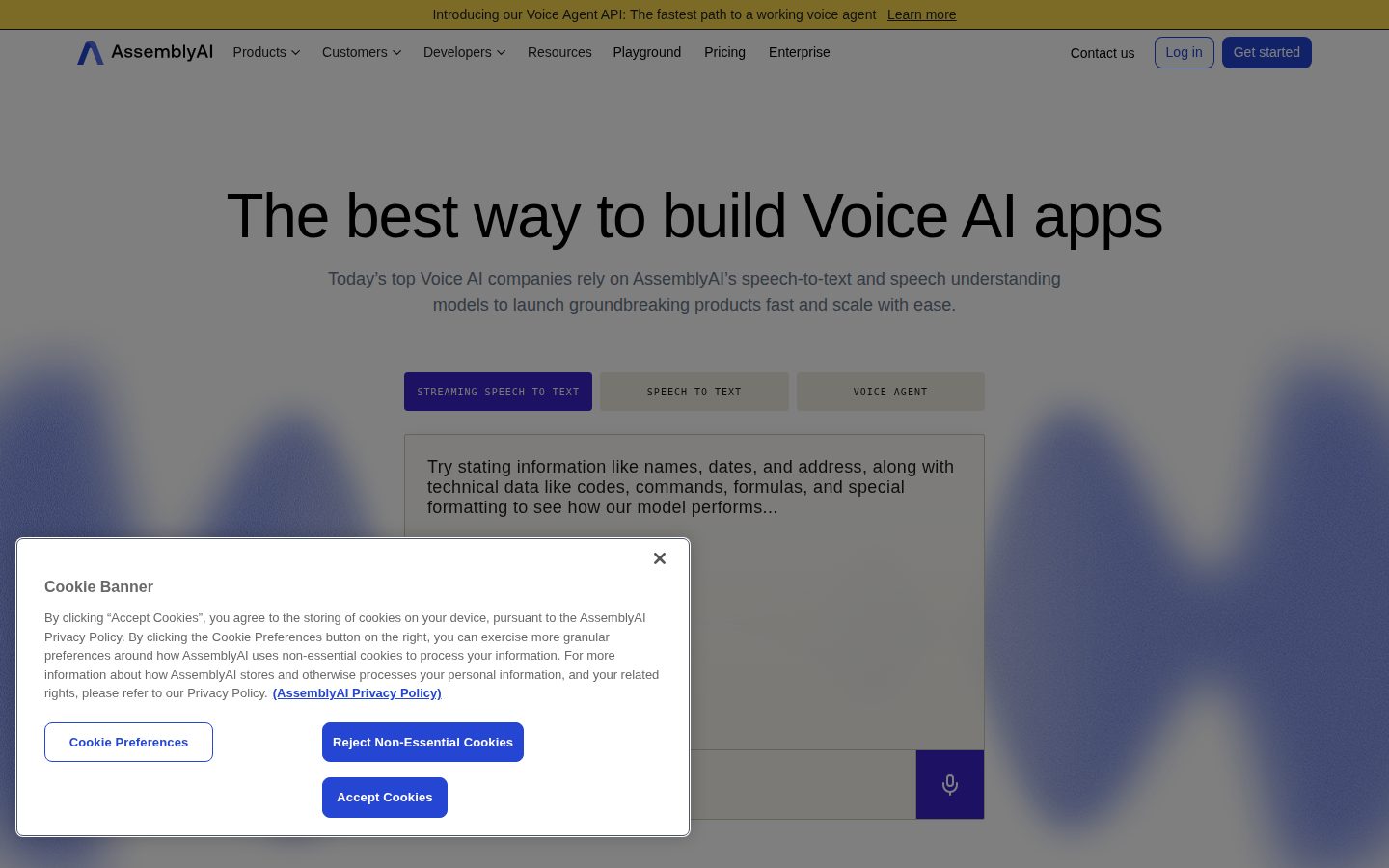
AssemblyAI is a speech AI API platform for developers building voice transcription and voice agent applications.
AI Panel Score
6 AI reviews
Reviewed
AI Editor ApprovedApproved and published by our AI Editor-in-Chief after full panel analysis.Developers integrate AssemblyAI through a REST API or SDKs to transcribe pre-recorded audio or stream real-time speech. The primary workflow involves sending audio data to AssemblyAI's models, which return timestamped transcripts along with optional enrichments such as speaker labels, sentiment, summaries, or detected audio events. A no-code playground is available for testing models before writing any code.
The platform's Universal-3 Pro model supports context-aware prompting, which allows developers to pass instructions that shape how the transcript is formatted — for example, preserving disfluencies like filler words and stutters for clinical or conversational analysis, tagging non-speech audio events such as beeps, capturing code-switching between languages, or correcting proper noun spelling using custom keyterms. Speaker role labeling goes beyond generic A/B diarization by allowing role names to be surfaced directly in the transcript output.
AssemblyAI targets software developers and product teams at voice AI companies, call analytics platforms, healthcare tech firms, and any application that processes spoken audio at scale. Pricing is usage-based with no contracts or throttles, and the company states it processes over 40 terabytes of audio daily and serves more than 840 million API calls per month. Competitors in the speech-to-text API category include Deepgram, Rev AI, Google Speech-to-Text, and OpenAI Whisper.
The platform exposes a public API with accompanying documentation, supports streaming via a LiveKit SDK integration for real-time voice agent use cases, and includes end-of-turn detection controls relevant to conversational AI workflows. Supported languages include multilingual audio with automatic language detection.

Detects and labels non-speech audio events within transcripts, such as inserting a [beep] tag when a tone is detected in a recording.
Detects the language being spoken in audio automatically, including support for multilingual and code-switching speech between languages such as English and Spanish.
Accepts natural language prompts to guide transcription output, enabling customized formatting, disfluency capture, role labeling, and domain-specific accuracy improvements.
Accurately transcribes speech disfluencies including fillers (um, uh), repetitions, restarts, stutters, and informal speech forms when instructed via prompt.
Identifies and labels individual speakers in audio, with advanced support for assigning contextual role labels such as Nurse or Patient rather than generic Speaker A/B labels.
A proprietary end-to-end Voice AI stack built specifically for speech, with every layer tuned for how people actually talk.
Provides a suite of audio-intelligence models that go beyond transcription to extract deep analysis and high-value insights from voice data.
Automatically formats text and alphanumerics in transcripts for clearer, more readable output.
Transcribes prerecorded audio to text with industry-leading accuracy, citing the lowest Word Error Rate and up to 30% fewer hallucinations than competing providers.
Provides real-time transcription with ultra-low latency, high accuracy, and precise end-of-turn controls for building voice agent workflows.
Allows users to supply specific terms such as proper nouns or technical vocabulary so the model spells and formats them correctly in the transcript.
A browser-based playground that lets developers test AssemblyAI's AI models without writing any code.
Get started for free with $50 in free credits, then pay per usage — no contracts, no minimums, no credit card required.
Custom rate limits, enhanced concurrency, and enterprise-grade flexibility tailored to AI workloads. Includes HIPAA BAAs, SOC 2 Type II audit reports, and dedicated data processing agreements.
40TB of audio daily — AssemblyAI has real scale behind the API pitch.
“Serious developer-first speech API with pricing transparency and accuracy claims that hold up against Deepgram and Whisper. The Voice Agent API and healthcare-grade diarization push it beyond commodity transcription.”
840 million API calls per month isn't a vanity metric. That's production scale with real customers, and the $0.21/hr Universal-3 Pro pricing is honest — no hidden minimums, no contracts. The $50 free credit with no credit card is a smart low-friction onboarding move developers actually appreciate.
Context-aware prompting and named speaker roles like [Speaker:NURSE] are genuinely differentiated. Deepgram won't give you that out of the box. The Medical Mode add-on at $0.15/hr signals real healthcare intent, and the HIPAA BAA with SOC 2 Type II makes it defensible in regulated verticals.
The tradeoff: no public funding data, so the 3-year viability question is real. Usage-based pricing is great until your volume spikes — enterprise custom tiers help, but you'll want that conversation early.
Named speaker role labeling and context-aware prompting are real differentiators versus Deepgram and OpenAI Whisper in healthcare and call analytics use cases.
SOC 2 Type II, HIPAA BAA, and published accuracy benchmarks make this a defensible vendor choice in front of any board or compliance team.
No-code playground plus SDKs and $50 free credits mean a developer can have a working prototype in hours, not weeks.
Voice Agent API, streaming transcription, and speech understanding go beyond cost-saving — they open new product capabilities teams can't easily build in-house.
No public funding stage available, but 840M monthly API calls and 40TB daily audio indicate a live, scaled business — not a slide deck.
Developer teams building voice agents or call analytics products who need accuracy, compliance, and fast integration.
You're a solo builder who only needs basic transcription — cheaper commodity options like Whisper will cover it.
The most architecturally serious speech API in a category full of commodity wrappers.
“AssemblyAI has built a speech platform with genuine craft depth — context-aware prompting, role-labeled diarization, and Medical Mode signal a team thinking about real editorial and production use cases, not just basic transcription. At $0.21/hr for Universal-3 Pro, the usage-based model lets product teams scale without contract drag.”
Universal-3 Pro's context-aware prompting is the most interesting design decision here. Passing natural language instructions to shape transcript output — preserving disfluencies, tagging audio events, correcting proper nouns via Keyterms — is closer to a content formatting system than a raw transcription API. Someone on this team understands that transcripts are editorial artifacts, not just data dumps.
The speaker role labeling goes beyond generic A/B diarization. Surfacing [Speaker:NURSE] and [Speaker:PATIENT] directly in output means downstream creative and clinical workflows don't need a post-processing layer to make content usable. That's a real production decision, not a demo feature. Deepgram and Whisper don't offer this at the model level.
The tradeoff: this is developer-first infrastructure, not a no-code creative tool. The playground helps, but production value extraction — summaries, sentiment, audio intelligence add-ons — requires engineering integration. Teams without dev capacity won't reach the ceiling here.
Lowest Word Error Rate claim plus 840 million API calls monthly positions AssemblyAI as the accuracy leader over Deepgram and Whisper in the developer API segment.
Built for voice AI developers and healthcare tech teams — the Medical Mode add-on at $0.15/hr and HIPAA BAA on enterprise plans confirm real vertical specificity.
LiveKit SDK support, LLM Gateway connecting to OpenAI/Anthropic/Google, and REST plus SDKs give this a wide connection surface across modern voice agent stacks.
Usage-based pricing with no contracts means cost structure stays honest as volume grows, but deep API integration creates switching friction if accuracy benchmarks shift.
Context-aware prompting on Universal-3 Pro plus role-labeled diarization shows library-grade thinking about how transcripts actually get used in production workflows.
Product and engineering teams building voice AI applications that need accuracy, role context, and scale built into the API layer.
Your team lacks developer resources to integrate and maintain an API-first speech pipeline.
$0.21/hr for Universal-3 Pro, no contract, no credit card — clean math.
“Usage-based pricing with full rate card published. $50 free credits to start, then you pay exactly what you consume.”
Pricing page shows everything: $0.21/hr for Universal-3 Pro pre-recorded, $0.45/hr streaming, Voice Agent API at $4.50/hr. Add-ons stack — Speaker Diarization at $0.02/hr, Keyterms Prompting at $0.05/hr, Medical Mode at $0.15/hr. No sales call required. Deepgram publishes comparable granularity; Google Speech-to-Text does not. AssemblyAI wins on procurement friction alone.
Model the math: 40 hours of audio monthly, Universal-3 Pro plus Diarization plus Summarization ($0.03/hr) = $0.26/hr × 40 × 12 = $124.80/year. Scale to 400 hours and you're at $1,248. Predictable. The real year-3 risk is add-on creep — teams underestimate how many enrichments production workflows eventually need.
No contract on pay-as-you-go. Enterprise tier requires a sales conversation, terms undisclosed. HIPAA BAA available — relevant for healthcare buyers. Tradeoff: no published overage rate or concurrency limit on standard tier. That's the one invoice surprise waiting.
$50 free credits with no credit card removes onboarding friction; SOC 2 Type II and HIPAA BAA available, reducing compliance procurement delays.
Pay-as-you-go has no contract, no minimum, no auto-renewal; enterprise terms are undisclosed but standard tier carries zero lock-in risk.
Full per-hour rate card published for all models and add-ons — no sales call needed, no bait-and-switch tiers.
Hourly unit economics are measurable; 840 million API calls/month and lowest Word Error Rate claim give procurement a concrete accuracy anchor to justify cost.
Usage-based model is predictable at low volume, but add-on stacking (Diarization + Keyterms + Medical Mode) can double effective per-hour cost.
Developer teams that need transparent usage-based speech API pricing with no contract commitment.
You need predictable enterprise concurrency guarantees without a sales negotiation.
AssemblyAI is the transcription API audio developers actually deploy, not just prototype.
“Granular control over disfluency capture, speaker role labeling, and keyterms prompting makes this a serious production tool for voice-heavy workflows. Usage-based pricing at $0.21/hr for Universal-3 Pro removes the contract friction that kills prototyping momentum.”
The no-code playground is the right first touch — drop in a session recording, see diarization and speaker role labels come back without writing a line. That's a fast signal. Universal-3 Pro's context-aware prompting is the differentiator worth noting: you can instruct the model to preserve disfluencies for clinical analysis, tag [beep] tones in call center audio, or surface [Speaker:NURSE] versus [Speaker:PATIENT] directly in the transcript. Deepgram doesn't go that deep on role labeling out of the box.
Streaming at $0.45/hr for Universal-3 Pro is double the pre-recorded rate. That's the real cost calculus for anyone building live monitoring workflows — budget accordingly. The LiveKit SDK integration for voice agent pipelines is well-scoped, and end-of-turn detection controls matter more than most buyers realize until they're debugging conversational latency at 2am.
The add-on pricing model — Speaker ID, Sentiment, Summarization each billed separately — keeps costs auditable but adds mental overhead when estimating job costs. Medical Mode at $0.15/hr add-on is genuinely useful for podcast producers working in healthcare content. Docs appear developer-authored: the changelog ships regularly and the pricing page is granular enough to quote before committing.
Usage-based with $50 free credits and no credit card means you're running real audio through production models before any procurement conversation.
Changelog is active, pricing page is granular with per-feature per-hour rates, and the playground exists specifically to reduce spec-before-test friction.
Add-on pricing across 8+ features requires careful cost modeling per job type — auditable, but not frictionless when scoping new projects.
Context-aware prompting, keyterms prompting, speaker role labeling, disfluency capture, and audio tagging give power users real handles that generic Whisper wrappers simply don't expose.
REST API plus SDKs, LiveKit integration, and no-code playground map cleanly onto the build-test-deploy loop most audio pipeline engineers already run.
Audio engineers building production pipelines for call analytics, clinical transcription, or voice agent apps who need model-level control over transcript formatting.
You need simple bulk transcription with flat monthly pricing and no tolerance for per-feature add-on math.
Deepgram has a real fight on its hands with Universal-3 Pro
“AssemblyAI is a developer-first speech API that's genuinely sweated the hard accuracy problems. $50 free credits, no credit card, and a no-code playground mean you're testing real models in minutes.”
The no-code playground is the right call. Most API products make you write glue code before you've seen a single result. AssemblyAI lets you test Universal-3 Pro — the context-aware prompting model at $0.21/hr — before you've touched a line. That's a team that's thought about the first ten minutes.
The feature depth is legitimately impressive for developers doing real work. Speaker role labeling that surfaces [Speaker:NURSE] instead of generic Speaker A/B, disfluency capture for clinical audio, keyterms prompting for proper nouns — this isn't checkbox AI. It's clearly built by people who've stared at bad transcripts. At 840 million API calls a month and 40 terabytes of audio daily, the scale story holds up.
The tradeoff: this is a developer product, full stop. If you're not writing code or managing API keys, there's no product here for you. Mobile is basically irrelevant to the use case. And the pricing adds up fast — streaming Universal-3 Pro at $0.45/hr plus add-ons can surprise a team that didn't model volume carefully.
No-code playground and context-aware prompting with named speaker roles shows the team sweated real daily developer pain, not just checkbox features.
REST API plus SDKs, a playground, and add-on pricing that's granular means the first hour is approachable but mastering prompt-driven formatting and the Voice Agent API takes real ramp time.
This is an API platform — mobile parity isn't really the product model, and the evidence shows web-only; not a gap so much as a category fact.
$50 free credits with no credit card required and a browser-based playground means first-run friction is genuinely low.
40 terabytes of audio daily and 840 million API calls per month is a scale number that earns some trust; docs and changelog are public, which signals maintenance discipline.
Developer teams building voice-first apps who need accurate, enriched transcription and don't want to fight a speech API to get real work done.
You need a no-code transcription workflow or you're a small team that hasn't modeled per-hour costs against expected audio volume.
40TB/day processed, real pricing, named models — this one's doing the work
“AssemblyAI has the receipts most speech API pitches skip: actual per-minute pricing, named model tiers, and HIPAA compliance signals. The 'industry-leading' claim is the kind of superlative that ages poorly, but the $0.21/hr for Universal-3 Pro and $50 no-card free trial are concrete and verifiable.”
Three tells. One: the H1 says 'best way to build Voice AI apps' — marketing throat-clearing. Two: no Series round visible publicly, though 840M API calls/month suggests real revenue. Three: changelog exists, which is more than most.
The differentiation is actually specific. Context-aware prompting, speaker role labeling beyond generic A/B, disfluency capture for clinical use — these aren't commodity features. Deepgram and Rev AI don't surface named roles like [Speaker:NURSE] out of the box. The Medical Mode add-on at $0.15/hr is a clear wedge into healthcare.
Exit portability is decent. REST API, standard SDKs, no proprietary lock-in beyond model-specific prompting syntax. Migrating to Deepgram or Whisper-based alternatives would hurt but wouldn't kill you. The tradeoff: Voice Agent API at $4.50/hr gets expensive fast at scale.
Speaker role labeling, disfluency capture, and Medical Mode at $0.15/hr add-on are specific gaps vs. Deepgram and Google Speech-to-Text, not feature-list padding.
Standard REST API and SDKs mean migration is painful but possible; the proprietary context-aware prompting syntax on Universal-3 Pro is the stickiest piece.
SOC 2 Type II, HIPAA BAAs, and changelog cadence are green signals; no public funding round visible, which could go either way on runway assumptions.
'Industry-leading Word Error Rate' and '30% fewer hallucinations' are specific claims — but unlinked benchmarks on a pricing page are unverified; the 'best way to' H1 is pure aspiration.
40TB daily and 840M monthly API calls suggest real production load — this isn't vaporware; matches patterns of Deepgram's trajectory before their Series C.
Developer teams building healthcare, call analytics, or voice agent applications who need accurate diarization and can absorb usage-based costs.
You're running high-volume streaming workloads where the $0.45/hr Universal-3 Pro streaming rate would materially impact unit economics.
Common questions answered by our AI research team
Universal-3 Pro costs $0.21/hr and Universal-2 costs $0.15/hr. Add-ons like Speaker Diarization (+$0.02/hr) and Keyterms Prompting (+$0.05/hr for Universal-3 Pro) are available.
Yes. Speaker Diarization detects multiple speakers and segments transcripts by speaker. The Prompting feature also enables speaker role labeling (e.g., [Speaker:NURSE], [Speaker:PATIENT]) with Universal-3 Pro.
Yes. New users receive $50 in free credits with no credit card required to get started.
Yes. Medical Mode optimizes transcription for medical terminology and healthcare conversations with significantly improved accuracy, available for $0.15/hr as an add-on for both Universal-3 Pro and Universal-2.
Yes. AssemblyAI offers Streaming Speech-to-Text with models including Universal-3 Pro Streaming ($0.45/hr), Universal-Streaming ($0.15/hr), and Whisper-Streaming ($0.30/hr), supporting real-time transcription at ultra-low latency.
Company
AssemblyAI, Inc.Founded
2017Pricing
Usage-basedFree Trial
AvailableFree Plan
AvailableAssemblyAI is a San Francisco-based company that provides speech-to-text transcription and audio intelligence APIs for developers and enterprises.