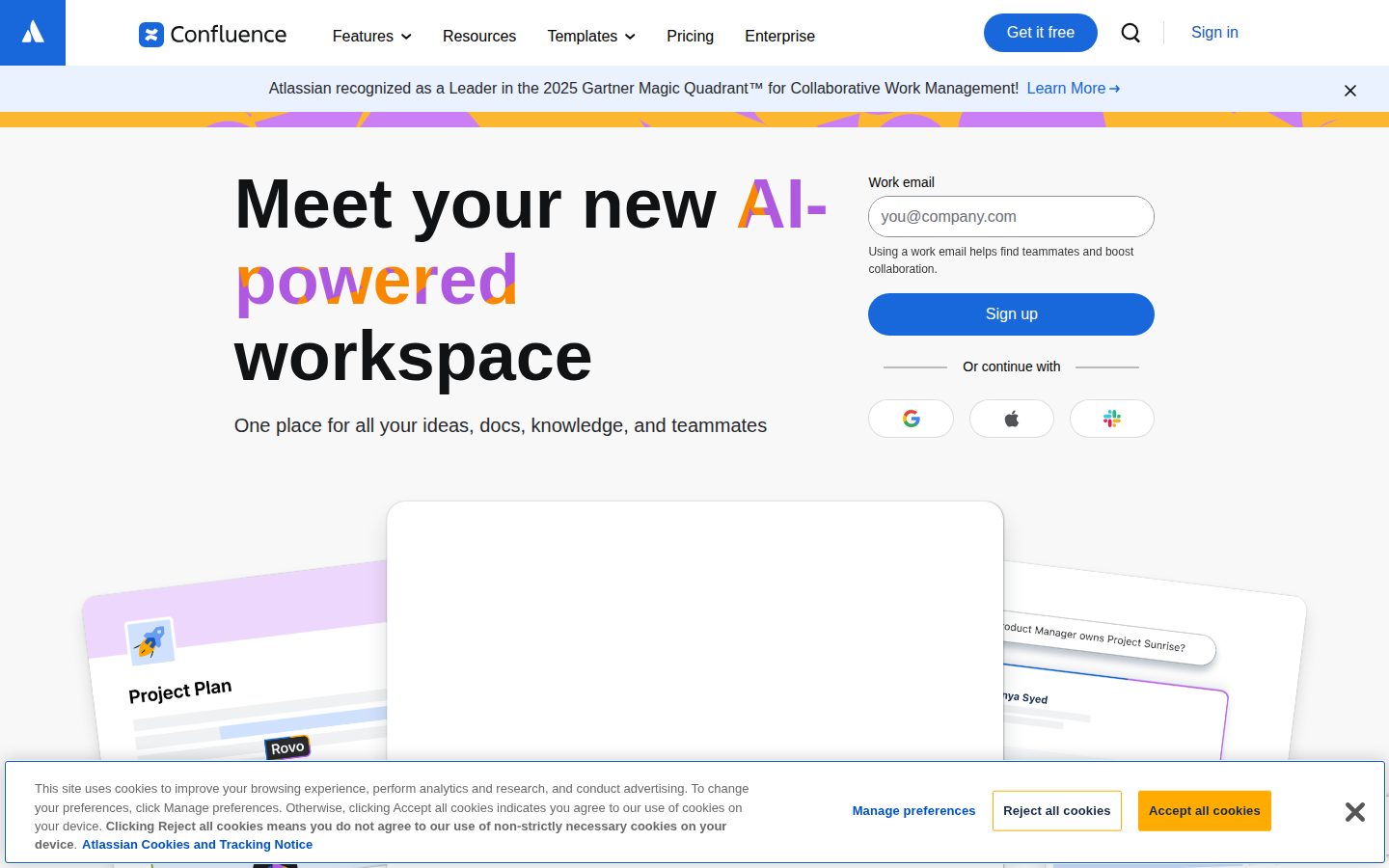
Team collaboration and knowledge sharing workspace
Confluence is a team workspace platform for creating, sharing, and organizing documentation and knowledge.
AI Panel Score
6 AI reviews
Reviewed
AI Editor ApprovedApproved and published by our AI Editor-in-Chief after full panel analysis.Atlassian Confluence is a collaborative workspace platform designed for teams to create, share, and manage documentation and knowledge bases. The software enables users to create wiki-style pages with rich text formatting, embed multimedia content, and organize information in structured spaces and page hierarchies.
The platform serves organizations of all sizes that need to centralize their documentation, from software development teams managing technical specifications to marketing teams creating campaign plans and HR departments maintaining policy documents. Confluence integrates closely with other Atlassian products like Jira for project management workflows.
Key capabilities include real-time collaborative editing, customizable templates for different content types, advanced search functionality, and permission controls for managing access to sensitive information. The platform also offers commenting, @mentions, and notification systems to facilitate team communication around shared content.
Confluence competes in the team collaboration and knowledge management space alongside tools like Notion, Microsoft SharePoint, and GitBook. It differentiates itself through its deep integration with development workflows and enterprise-grade security features, making it particularly popular among software development organizations and larger enterprises requiring robust documentation management.
Searches across all connected apps, tools, and data sources to return relevant, accurate answers in seconds.
AI-powered audio briefings that deliver updates on work activity in an audio format for on-the-go consumption.
AI-generated summaries of pages and comments to help users get up-to-date on work happening around them without reading in full.
AI-powered drafting tool that helps users beat the blank page by generating PRDs, social briefs, annual plans, and other documents in seconds using ready-to-use templates.
AI agents that assist with tasks such as catching up on meeting notes, brainstorming ideas, and crafting product requirements.
Real-time collaborative editing environment where multiple team members can work on the same document simultaneously.
Async video communication content type that allows teams to record and share video messages within Confluence.
Visual workspace for creating ideas, diagrams, and flowcharts collaboratively within Confluence.
Structured content type designed for organizing and managing data in a tabular, organized format within Confluence.
Core documentation content type used for creating and sharing knowledge across teams and projects.
Pre-built templates available for every content type to help teams quickly start documents, plans, and other work artifacts.
Native integrations with external tools and apps, including Jira, Loom, and Rovo, to consolidate knowledge, projects, video, and AI insights in one collection.
Free forever for up to 10 users
Everything you need to get started, for growing teams
Connect work across teams with advanced features and reliability
Advanced analytics, scale and security for enterprises. Billed annually only — contact sales for pricing.
Bundling Rovo into every paid Confluence tier ends the Notion comparison for most CIOs.
“Confluence isn't winning on craft — it's winning by making AI a bundled feature of a contract you already signed. The Notion comparison stops being interesting once Rovo is free at $6.40 Standard.”
Atlassian moved Rovo from a separate seat add-on into every paid Confluence Cloud plan. That collapses the AI question for buyers already on Jira. The Notion-versus-Confluence debate gets quieter when AI Search and Page Summaries are inside a contract finance already approved.
The strategic substance is the Teamwork Graph and Rovo Agents — the surface where third-party AI tools now plug in. That's the moat versus Notion AI and SharePoint Copilot, both of which want Confluence's seat. At $6.40 Standard and $12.30 Premium, the math is friendly even before you count the bundled AI.
The catch is the org size where Confluence stops being the obvious answer. Under 50 people, Notion's craft and shape advantage still wins the room. Pilot Premium against a Notion workspace for 90 days on one product team. Don't migrate the org until Rovo's search beats your existing setup.
51,978 customers above $10K Cloud ARR signals Confluence is still the enterprise wiki peers default to.
Picking a public profitable category default needs no defense memo; the board has heard of it.
Templates and Rovo Page Summaries shorten setup, but real value still requires space architecture work.
Rovo bundling makes Confluence the path of least resistance for any org already standardized on Jira.
NASDAQ:TEAM with $5.2B FY25 revenue, 19.7% growth, 300,000+ customers and 23 years in market.
Engineering orgs running Jira who want AI inside an existing Atlassian contract.
Small teams under 50 people who care more about page craft than enterprise governance.
Confluence is the Jira-coupled knowledge spine — Notion wins the standalone wiki bake-off.
“The Cloud-only path is now committed: Data Center end-of-life lands March 28, 2029, with no new Data Center licenses sold after March 30, 2026. Rovo ships free on Standard at $6.40/user, which makes the real question whether you want a Jira-coupled knowledge spine or a standalone wiki like Notion.”
Atlassian closed the Data Center off-ramp at March 28, 2029. New Data Center licenses stop March 30, 2026 — every Confluence decision now is a Cloud decision.
The strategic value isn't Pages versus Notion's blocks. It's the Jira coupling: Spaces, page hierarchies, and macros that resolve issue keys live. Rovo ships at no upfront cost on Standard ($6.40/user) and Premium ($12.30/user), with 70 credits and 250 indexed objects per seat each month. That's an AI search layer wired into the permission model engineering already runs.
The catch is the tax on solo writers. The editor still feels like a wiki with a coat of paint compared to Notion or GitBook, and the Teamwork Collection bundle assumes Jira and Loom seats alongside. For a mature engineering org already on Atlassian, lock-in compounds in your favor. For a 30-person product team without Jira, it's overhead.
Durable category leader for engineering knowledge management; Notion and GitBook are taking greenfield SMB share.
Spaces, page hierarchies, and Jira issue-key macros mirror how engineering knowledge is actually structured.
Native Jira, Loom, and Trello plus the Teamwork Collection bundle make this the most connected knowledge tool in any Atlassian shop.
Data Center end-of-life March 28, 2029 forces every customer to Cloud and into Atlassian's billing path.
Twelve content types from Pages to Whiteboards to Databases plus Rovo's AI layer; depth is real, but Notion's blocks remain the editor benchmark.
Engineering and product orgs who already run on Jira.
Small teams who write docs without Jira in the stack.
Standard $8.15/user annual, Premium $16 — SSO hides behind Atlassian Guard at roughly $4/user.
“Four tiers: Free up to 10 users, Standard $8.15, Premium $16, Enterprise sales-led around $23-$25. SSO isn't in Standard or Premium — Atlassian Guard adds about $4/user, which procurement should price into the comparison.”
The number that matters isn't on the pricing page. Atlassian Guard is the SSO add-on for Standard and Premium — roughly $4/user/month on top of the seat fee. Standard alone runs $8.15/user annual. Add Guard and you're close to Premium, without the audit logs.
50 users on Premium: 50 × $16 × 12 = $9,600/year. Add the 30% seat creep finance teams underestimate. Year 3 lands closer to $13K. Notion Business at $15/user annual is a dollar cheaper. Confluence ships Rovo in Premium, no AI surcharge.
The catch is Enterprise. No published rate — sales-led, typically $23-$25/user once data residency and SCIM enter the quote. Atlassian is public (NASDAQ:TEAM), Confluence shipped 1.0 in March 2004 — vendor risk is near zero. Get the auto-renewal window in writing.
Atlassian is public on NASDAQ:TEAM with mature SOC 2 and procurement workflows used by tens of thousands of buyers.
Annual commit is the default discount; monthly flex billing carries a premium and standard auto-renewal applies.
Free, Standard, and Premium are published per-user; Enterprise sits behind a sales call with no posted rate.
Page insights, advanced analytics, and tight Jira integration make documentation value measurable at sprint close.
Atlassian Guard at roughly $4/user pushes real Standard cost above sticker, though Rovo AI is bundled in Premium.
Engineering teams already standardized on Jira.
Small teams who need SSO included in the seat fee.
The page tree drag and the Markdown paste are still where Confluence loses writers daily.
“Live Docs and Databases finally land in 2026, but the page-tree spinner on a 4,000-page space and the Markdown-to-ADF paste conversion remain the daily fights. The 10-user minimum on the Standard $6.40/seat tier means a 4-writer team subsidizes six empty chairs.”
The page tree still loads top-down with no lazy expansion. On a 4,000-page space, the left-rail spinner is part of your Tuesday morning. Notion paginates. GitBook collapses. Confluence asks you to wait.
The Live Docs editor finally gives writers real co-edit without the 2024 page-lock dance, and the Databases content type is genuinely useful for changelog tables and decision logs. The catch is paste behavior: drop Markdown in and Confluence converts it to ADF immediately, with no plain-text editor to drop back into — CONFCLOUD-68272 has been open for years. For a writer who lives in MDX or Hugo, that's a daily fight.
REST API v1 deprecation pushed to March 31, 2025 is the real story for docs pipelines that pull pages into a static-site build. The 10-user minimum on Standard at $6.40/seat means a 4-writer team pays for ten. Rovo summaries are fine, search is faster than 2023.
Page-tree load on large spaces and the Markdown paste conversion show up as friction every working week.
Atlassian docs cover macros and storage format well, but the ADF schema reference reads like it was written for the parser, not for writers.
Markdown-to-ADF paste, no plain-text editor, the 10-user billing minimum, and ADF-only API responses add up fast.
Macros, REST API v2, Forge, and the Confluence Cloud CLI give power users real depth — the discoverability gap is the only weak spot.
The Jira link is unmatched for engineering docs — backlinks, smart links, and Forge apps make it the default wiki for dev teams.
Engineering organizations with Jira workflows who need a wiki tied into their issue tracker.
Solo writers or small teams who want a Markdown-native editor with Hugo or Astro pipelines.
Confluence after twenty years still has the empty page nobody wants to fill, and Rovo finally helps.
“Confluence has been the enterprise wiki since 2004, and twenty years of habits show — both the comfort and the bloat. Rovo is the first AI add that earns its tile in the sidebar instead of feeling tacked on.”
Twenty years in, Confluence still opens to a blinking page hierarchy, and that's both its strength and its weight. Live Docs finally shipped real-time co-editing the way Notion has had it for years, and Whiteboards mean you stop tab-switching to FigJam mid-meeting. The Rovo button — generally available since October 2024 — is the first Atlassian AI thing that doesn't feel like a marketing tile.
Day thirty is when Page and Comment Summaries earn their keep. A 60-comment thread on a PRD becomes three bullets, and Audio Briefings let you catch up on a walk. Standard is $6.40 a user, Premium $12.30 — fair. Free still covers a 10-person team forever.
The catch is navigation. Spaces, page trees, labels, breadcrumbs — three months in, finding last quarter's doc still leans on search more than browse. SharePoint feels worse, but that's not really praise.
Live Docs and Whiteboards show the team caring about feel, though some legacy edges remain in the editor.
Spaces, page trees, and labels reward investment but month three still leans on search over browse.
iOS and Android handle reading and quick edits, but real authoring still wants a laptop.
A blank Confluence is intimidating; templates help but the page-tree mental model takes time.
Twenty years running enterprise loads — autosave, permissions, and uptime rarely surprise.
Teams in the Atlassian ecosystem who already live in Jira.
Solo users who want a clean blank canvas.
Twenty-two years old, public since 2015, and Notion still keeps eating the modern half of the market.
“Confluence is the rare survivor in team docs — Atlassian launched it in 2004 and it's still where most enterprise software teams write things down. The yellow flag is the rebrand to 'AI-powered workspace,' which is the same language Notion and Coda are using, on top of a product whose moat was always Jira plumbing.”
Confluence calls itself an 'AI-powered workspace' on the homepage now. Atlassian rebranded the product before — wiki to workspace to AI workspace — and the underlying thing still works. Twenty-two years shipping, public since December 2015, profitable: that's the actual story, not Rovo.
The substance holds. Pages, Whiteboards, Databases, and Live Docs sit in one product, and Standard runs $6.40/user/month against Notion Business at $20. The catch is Rovo Agents — bundled into the price, but new enough that the docs indicate features still moving each quarter.
The yellow flag is positioning. Notion took the new-team market while Atlassian was forcing the Server end-of-life on February 15, 2024. Confluence kept the existing-Jira-shops market. That's a real moat, but it's a moat from plumbing, not from the doc product itself.
The differentiator is Jira plumbing, not the doc product — in the open Notion/SharePoint/GitBook field Confluence looks crowded.
Markdown export exists, but page hierarchies, macros, and Jira links don't cleanly translate to Notion or GitBook.
Atlassian is public ($TEAM), profitable, and Confluence is core revenue — three-year bet is among the safest in the category.
The 'AI-powered workspace' rebrand is aspirational, though Atlassian avoids the inflated perf claims most repositioned products lean on.
Twenty-two years shipping, two prior rebrands without migration meltdown, public on NASDAQ since December 2015 — strong-survivor pattern.
Existing Atlassian shops who already standardize on Jira.
Solo creators who want a Notion-style page-as-app canvas.
Common questions answered by our AI research team
The content mentions a free tier exists, as the page ends with 'Get Confluence free,' but no specific limitations of the free plan compared to paid tiers are described in the available content.
Yes, Confluence supports multiple content types within the same workspace: Live Docs (real-time collaborative editing), Whiteboards (for ideas, diagrams, and flowcharts), Databases (for structured, organized content), Pages (for documentation and knowledge sharing), and Video (for clear, async communication), along with pre-built Templates.
Rovo AI can help beat the blank page by drafting content like PRDs, social briefs, and annual plans in seconds using AI-powered creation and ready-to-use templates. It also helps move projects from concept to strategy to action, and assists with polishing drafts through various project phases.
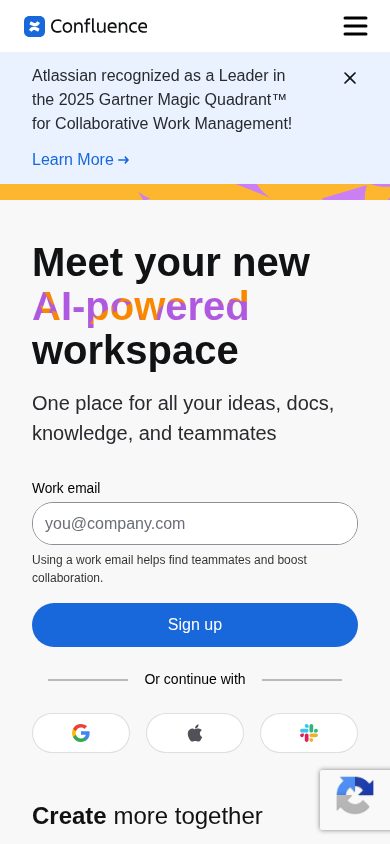
The content shows Google, Apple, and Slack as sign-in/authentication options ('Or continue with Google, Apple, Slack'). While Confluence does advertise broader integrations ('All the tools you know and love integrate smoothly with Confluence'), the content does not detail how deeply Slack, Google, or Apple integrations extend beyond sign-in.
The Teamwork Collection bundles Confluence, Jira, Loom, and Rovo together to bring knowledge, projects, video communication, and AI-powered insights into one collection. However, the content does not specify whether purchasing it replaces the need for separate subscriptions or how its pricing compares to individual plans.
Company
AtlassianFounded
2002Pricing
From $6/moFree Trial
AvailableFree Plan
AvailableAtlassian is a Sydney- and San Francisco-based enterprise software company behind Jira, Confluence, Trello, Bitbucket, and Loom, serving development and collaboration teams globally.