AutoGen logo

AutoGen Review

Visit

Multi-agent framework for building LLM-powered collaborative AI workflows

AutoGen is an open-source multi-agent framework for developers building applications where multiple AI agents collaborate to complete tasks.

AI Panel Score

7.1/10

6 AI reviews

Reviewed

About AutoGen

In practice, a developer using AutoGen defines agents as code — specifying each agent's role, the language model powering it, and the tools it can call. These agents then exchange messages in structured conversation loops, with each agent acting on the output of the previous one. A typical setup might include an assistant agent that generates code, a critic agent that reviews it, and an executor agent that runs it, all operating without manual intervention between steps.

AutoGen's highlighted capabilities include support for group chat patterns where multiple agents coordinate under an orchestrator, a built-in code execution environment, and compatibility with any OpenAI-compatible API endpoint — including local models. The framework also includes AutoGen Studio, a no-code interface for prototyping multi-agent workflows visually without writing Python directly. AgentChat, a higher-level API layered on top of the core, simplifies common patterns like two-agent debates or sequential task pipelines.

AutoGen targets software engineers, AI researchers, and teams building agentic applications in domains like data analysis, software development assistance, and task automation. The framework is open-source and free to use under an MIT license, with no paid tiers — compute costs depend entirely on the underlying model APIs a user connects. Comparable frameworks in the multi-agent space include LangGraph, CrewAI, and LlamaIndex Workflows.

AutoGen is a Python library installable via pip, with support for Linux, macOS, and Windows. It integrates with OpenAI, Azure OpenAI, Anthropic, Google Gemini, and locally hosted models via Ollama or similar. AutoGen Studio ships as a separate installable package with a browser-based UI. The project is maintained on GitHub and includes an active community extension ecosystem.

Features

AI

  • AgentChat Framework

    Build conversational single and multi-agent applications with Python 3.10+.

  • OpenAI Assistant Agent

    Leverages OpenAI Assistant API within the AutoGen framework.

Automation

  • Multi-Agent Orchestration

    Coordinates deterministic and dynamic agentic workflows for complex business processes.

Collaboration

  • gRPC Worker Runtime

    Distributes agents across multiple languages and systems via gRPC protocol.

Core

  • Async Agent Operations

    Supports asynchronous execution patterns for non-blocking agent task processing.

  • Core Event-Driven Runtime

    Manages scalable multi-agent systems through event-driven architecture for distributed workflows.

Customization

  • Extensions Ecosystem

    Allows developers to build custom implementations interfacing with external services and libraries.

  • Studio UI

    Web-based interface for prototyping agents without writing code.

Integration

  • MCP Tool Integration

    Connects agents to Model-Context Protocol servers for expanded capability access.

Security

  • Docker Code Executor

    Executes model-generated code in isolated Docker containers for safe evaluation.

Preview

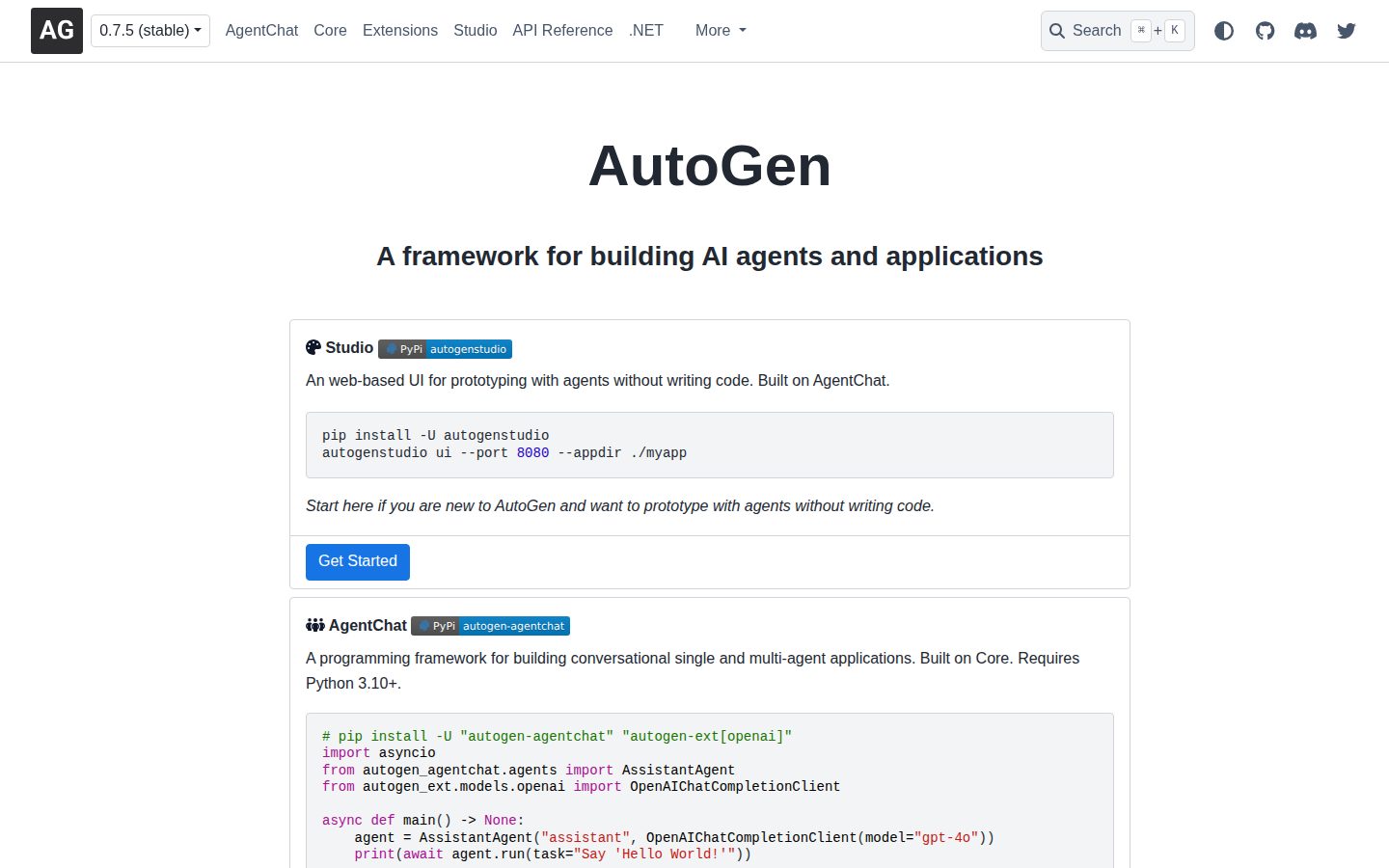
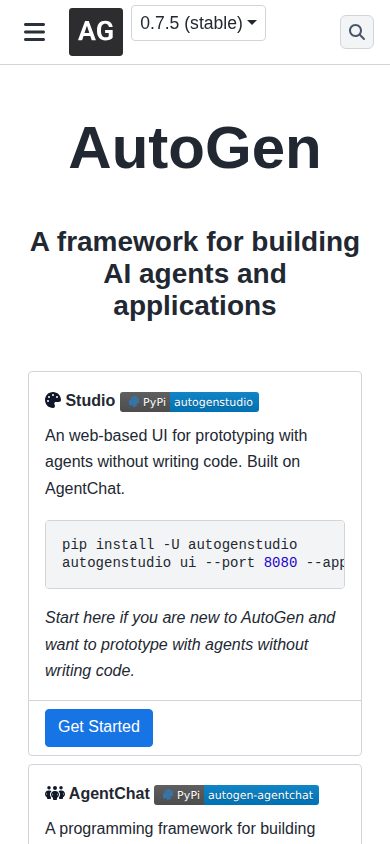
AutoGen desktop previewAutoGen mobile preview

Pricing Plans

Popular

Open Source (Free)

Free

Microsoft AutoGen is a fully open-source, MIT-licensed framework free for any developer or organization to use, modify, and distribute. Note: AutoGen is now in maintenance mode (community-managed, bug fixes only). New projects are directed to the successor Microsoft Agent Framework.

  • Multi-agent conversational framework for building AI agent applications
  • AutoGen Studio: no-code/low-code GUI for prototyping multi-agent workflows
  • AgentChat API for single and multi-agent Python applications
  • Core event-driven, asynchronous architecture
  • Modular extensions: custom agents, tools, memory, and models
  • Cross-language interoperability (Python and .NET)
  • Community support via GitHub Discussions and Discord
  • MIT License — no vendor lock-in; self-host anywhere
  • LLM provider costs (e.g., OpenAI API) billed separately by the provider

AI Panel Reviews

The Decision Maker

The Decision Maker

Strategic bet, vendor viability, timing, adoption approval
6.5/10

Microsoft's free multi-agent framework now in maintenance mode — successor already exists.

AutoGen is MIT-licensed, free, and backed by Microsoft Research credibility. The problem: it's now in maintenance mode, with new projects directed to a successor framework.

The pricing data says it plainly — AutoGen is in maintenance mode, bug fixes only, with Microsoft pointing new projects to their Agent Framework successor. That's not a vendor risk. That's an end-of-life signal. Building on it today is a deliberate choice to inherit tech debt.

The technical bones are solid. Docker Code Executor, gRPC Worker Runtime, MCP Tool Integration, and AgentChat's conversational API cover real enterprise needs. It beats LangGraph on approachability and CrewAI on Microsoft ecosystem fit. AutoGen Studio gives non-Python teams a path in, which matters for adoption speed.

Two things concern me. One: no changelog visibility and no active roadmap means you're flying without instrumentation. Two: the successor framework isn't proven yet. Pilot AutoGen only if you're evaluating both side-by-side and have 90 days to form an opinion before committing architecture.

Competitive Positioning6.5

Peers using LangGraph or CrewAI are building on actively developed frameworks; AutoGen's maintenance status puts you at a growing disadvantage over 18 months.

Reputation Risk7.5

MIT license, Microsoft Research provenance, and 0 vendor lock-in makes this a defensible board conversation — maintenance mode status is the only asterisk.

Speed to Value7.5

pip install, AutoGen Studio for no-code prototyping, and AgentChat's high-level API mean a developer can have a working workflow in hours, not weeks.

Strategic Fit7.0

Multi-agent orchestration with gRPC Worker Runtime and async execution genuinely advances agentic capability, not just cost reduction.

Vendor Viability5.5

Microsoft Research backing is credible, but the pricing page explicitly states AutoGen is in maintenance mode — new projects are redirected to a successor framework.

Pros

  • MIT license — no vendor lock-in, self-host anywhere, zero framework cost
  • Docker Code Executor provides safe sandboxed code evaluation out of the box
  • AutoGen Studio lowers the floor for non-engineers prototyping agent workflows
  • Microsoft Research backing gives the architecture credibility with enterprise stakeholders

Cons

  • Explicitly in maintenance mode — no new features, community bug fixes only
  • Microsoft is already redirecting new projects to a successor framework
  • No public changelog or roadmap visibility based on scraped site evidence
  • Compute costs are entirely pass-through — OpenAI or equivalent APIs billed separately

Right for

Teams evaluating Microsoft's agentic ecosystem who need 90 days to assess AutoGen alongside its successor before committing.

Avoid if

You're starting a net-new agentic project with a 12-month production horizon — build on the successor framework instead.

The Domain Strategist

The Domain Strategist

Craft and strategy in the product's domain — adapts identity per category, same lens
7.2/10

Microsoft Research's multi-agent foundation is now in maintenance mode — build on the successor instead.

AutoGen pioneered the agent conversation pattern and the architecture holds up. But the pricing page confirms it's now maintenance-only, with new projects redirected to Microsoft's Agent Framework successor.

The event-driven, gRPC-distributed runtime is genuinely well-architected. Docker code execution in isolated containers, async operations, and MCP tool integration show a team that thought through real production concerns — not just demos. Someone here understood distributed systems before they understood agents.

The tradeoff is architectural, not superficial: AutoGen is MIT-licensed and community-managed, which sounds like freedom until your team hits a blocking bug in year two with no Microsoft engineering behind it. LangGraph and CrewAI are actively maintained by funded teams. If you're starting a net-new agentic application today, you're building on a foundation Microsoft itself has walked away from.

For teams already running AutoGen in production, the MIT license and stable API mean no forced migration. For anyone evaluating now, the successor framework is the right conversation — AutoGen is reference architecture, not a 3-year bet.

Category Positioning6.5

AutoGen defined multi-agent conversation patterns but LangGraph and CrewAI now own the active-development segment of this market.

Domain Fit7.5

AgentChat plus group chat orchestration maps directly to how engineering teams structure multi-step agentic pipelines.

Integration Surface8.0

OpenAI, Azure OpenAI, Anthropic, Gemini, and Ollama compatibility plus MCP integration covers nearly every LLM stack in use today.

Long-term Implications5.5

Maintenance mode is confirmed in the pricing tier description — community bug fixes only, no active Microsoft engineering roadmap.

Strategic Depth8.2

gRPC worker runtime, event-driven core, and Docker code executor indicate library-grade systems thinking, not a wrapper project.

Pros

  • Docker-isolated code execution is production-grade security thinking
  • gRPC cross-language runtime enables polyglot agent architectures beyond Python
  • MIT license means zero vendor lock-in on the framework layer
  • MCP tool integration future-proofs the capability surface

Cons

  • Explicitly in maintenance mode per the pricing page — no active feature roadmap
  • Microsoft has already redirected new projects to a successor framework
  • No hosted runtime or managed execution — all infrastructure is on you
  • Studio UI is prototyping-only; production deployments require full Python authoring

Right for

Teams auditing or extending existing AutoGen-based systems who need stable, MIT-licensed code they can fork and own.

Avoid if

You're starting a new agentic application and need a framework with an active engineering team behind it.

The Finance Lead

The Finance Lead

Money, total cost of ownership, contracts, procurement math
7.8/10

$0 license, but now in maintenance mode — real cost lives in your LLM API bills

AutoGen is MIT-licensed, free forever, zero procurement friction. The catch: it's officially in maintenance mode, with Microsoft directing new projects to a successor framework.

$0 license fee. No tiers, no SSO tax, no seat math. 50 engineers paying $0 × 50 = $0. Year 3 TCO is purely LLM API spend — OpenAI, Anthropic, Gemini, or self-hosted via Ollama. A team running GPT-4o at scale could easily hit $5K–$20K/year in API costs depending on call volume. That's the real budget line.

Maintenance mode is the procurement flag. Based on the pricing page, bug fixes only — new development has moved to Microsoft's successor Agent Framework. Buying into a deprecated library has a migration cost. Call it 2–4 weeks of engineering time in year 2. Compare to LangGraph and CrewAI, which are actively developed. That delta matters for 3-year planning.

Contract flexibility is perfect — MIT license, self-host anywhere, no auto-renewal window, no termination clause to negotiate. Docker code executor and gRPC runtime are production-grade features. But the maintenance flag is real. Factor the migration sprint into TCO.

Billing & Procurement9.0

Zero procurement friction — pip install, no vendor onboarding, no invoice, no PO required.

Contract Flexibility10.0

MIT license, no vendor contract, no auto-renewal, no termination clause — maximum flexibility by definition.

Pricing Transparency9.5

$0, MIT-licensed, fully public — no pricing page needed because there is no pricing.

ROI Clarity6.5

ROI depends entirely on LLM API costs and engineering productivity gains — no built-in usage analytics to measure either.

Total Cost of Ownership7.0

Framework is free, but LLM API costs are unbounded and a migration to the successor framework adds engineering cost in year 2-3.

Pros

  • $0 license, no seat fees ever
  • MIT license — no lock-in, self-host anywhere
  • Docker code executor and gRPC runtime are production-grade
  • AutoGen Studio ships a no-code UI for prototyping

Cons

  • Officially in maintenance mode — new development stopped
  • Microsoft directing new projects to a successor framework, implying future migration cost
  • LLM API costs are unbounded and unpredictable
  • No built-in usage metering to forecast API spend

Right for

Developers who need a proven multi-agent framework today and can absorb a future migration to Microsoft's successor.

Avoid if

Teams building a 3-year production system who can't budget for a mid-cycle framework migration.

The Domain Practitioner

The Domain Practitioner

Daily hands-on reality in the product's domain — adapts identity per category, same lens
7.2/10

Powerful multi-agent primitives, but maintenance-mode status changes the calculus

AutoGen's event-driven runtime and Docker code execution are genuinely solid engineering. The maintenance-mode flag in the pricing notes is a real signal — new projects are being redirected to the successor Microsoft Agent Framework.

AgentChat plus the Core event-driven runtime is a capable stack. Async agent operations, gRPC worker runtime for cross-process distribution, MCP tool integration — these aren't demo features. Docker code executor isolating model-generated code is the right call for anything running in prod. The architecture shows someone actually thought about what happens when an agent writes a for-loop that shouldn't run unchecked.

The maintenance-mode flag in the pricing tier is the thing you can't ignore. Bug fixes only, community-managed. LangGraph and CrewAI are actively shipping. If you're greenfielding an agentic system in 2024, you're either betting on the successor framework or picking a competitor with active development velocity. That's not a small tradeoff.

AutoGen Studio gives non-Python prototyping, which is useful for convincing stakeholders without wiring up a full agent graph. But power users will live in the Python API — and the docs evidence (no changelog scraped) makes discoverability of advanced patterns uncertain. Category norm is a changelog. AutoGen doesn't show one publicly.

Day-3 Reality6.5

Maintenance-mode means bug accumulation without active fixes — daily friction will grow, not shrink, over time.

Documentation Practitioner-Fit6.8

Docs exist but the scrape shows no blog, no changelog, no API reference page — hard to assess depth for advanced patterns.

Friction Surface7.0

gRPC worker runtime and async operations are solid, but no public changelog makes tracking breaking changes harder than it should be.

Power-User Depth8.2

Core event-driven architecture, cross-language interoperability via .NET, and the extensions ecosystem give real depth for engineers willing to go past AgentChat.

Workflow Integration7.8

pip-installable, OpenAI-compatible API support, and Python 3.10+ fit naturally into standard ML engineering workflows.

Pros

  • Docker code executor is security-first, not security-as-afterthought
  • gRPC worker runtime enables genuine multi-language distributed agent systems
  • MIT license, self-hostable, zero vendor lock-in on the framework itself
  • MCP tool integration connects to a growing external capability ecosystem

Cons

  • Explicitly in maintenance mode — new projects directed to successor framework
  • No public changelog visible, making dependency management harder
  • LangGraph and CrewAI have active development velocity; AutoGen doesn't
  • LLM costs entirely external — no cost controls or budget guardrails in-framework

Right for

Engineers evaluating multi-agent patterns for research or existing projects already built on AutoGen.

Avoid if

You're greenfielding a production agentic system and need an actively maintained framework behind it.

The Power User

The Power User

Daily human experience, onboarding, polish, learning curve, reliability
7.2/10

Powerful multi-agent framework, but it's now in maintenance mode — plan accordingly.

AutoGen is genuinely capable infrastructure for building multi-agent AI workflows, backed by Microsoft Research and a real extension ecosystem. It's in maintenance mode now, which changes the calculus for new projects.

MIT-licensed, free, and backed by Microsoft Research — AutoGen's starting position is strong. The feature list is serious: Docker code execution, gRPC distributed runtimes, async operations, MCP tool integration, and AgentChat for simpler pipeline patterns. That's not a toy. For a developer who needs agents that can generate code, critique it, and run it without hand-holding, this does the job.

The catch is right there in the pricing notes: AutoGen is in maintenance mode. Bug fixes only, community-managed, and new projects are pointed toward Microsoft's successor framework. Compare that to LangGraph or CrewAI, which are actively shipping. Starting a production build on a framework in maintenance is a real risk, not a hypothetical one.

AutoGen Studio softens the learning curve, but this is still a Python-first, docs-heavy tool. The mobile story is basically nothing — it's a dev framework, not a product. Onboarding is homework, not a welcome mat. Experienced engineers will move fast. Everyone else will spend a long weekend with the docs.

Daily Polish6.0

Studio UI exists but the scraped site shows no changelog or blog — hard to tell if rough edges are getting filed down, especially in maintenance mode.

Learning Curve6.5

AgentChat and Studio help early, but multi-agent orchestration patterns and gRPC distribution configs are genuinely steep; maintenance mode means less community momentum to lean on.

Mobile Parity2.0

This is a Python developer framework — mobile parity is not a concept that applies, and Studio UI in a mobile browser isn't a real workflow.

Onboarding Experience6.5

AgentChat API and Studio UI lower the floor, but Python 3.10+ requirement and agent-as-code setup means day one is documentation-heavy for most users.

Reliability Feel7.5

Docker code executor and event-driven async architecture suggest the team thought about failure modes; gRPC worker runtime adds real distributed robustness.

Pros

  • Fully free, MIT-licensed — no seat costs, just underlying API usage
  • Docker code executor and async runtime show real engineering depth
  • AutoGen Studio gives non-Python users a way in
  • Compatible with OpenAI, Anthropic, Gemini, and local models via Ollama

Cons

  • Officially in maintenance mode — new projects directed elsewhere
  • No mobile experience by design — dev-only tool
  • Onboarding is homework; expects experienced Python developers
  • No active changelog or blog visible — hard to track what's changing

Right for

Developers who need a proven, free multi-agent framework and can tolerate building on a maintained-but-not-evolving foundation.

Avoid if

You're starting a new production project and need a framework that's actively shipping features and improvements.

The Skeptic

The Skeptic

Contrarian. Watch-outs, deal-breakers, broken promises, category patterns
6.8/10

Microsoft Research pedigree, but it's in maintenance mode — that's the whole story.

AutoGen is technically solid, MIT-licensed, and free forever. It's also explicitly being wound down in favor of a successor framework. That's not a minor footnote.

Three tells on arrival. One: the pricing page quietly buries 'now in maintenance mode' in the free tier description. Two: no changelog, no blog, no API docs visible in the scrape. Three: Microsoft is redirecting new projects to a different framework entirely. That's not a pivot. That's a sunset.

The technical foundation is real. Docker code execution, gRPC worker runtime, MCP tool integration, AgentChat API — these aren't vaporware. Microsoft Research built something genuinely capable. MIT license means zero lock-in and clean exit portability. If you leave, you take your code. LangGraph and CrewAI are the live comparisons here — both are actively shipping.

The honest tradeoff: AutoGen may be the best-documented dead-end in the category. Great for learning multi-agent patterns. Risky as a production dependency when the maintainer is pointing you toward the exit.

Competitive Differentiation6.0

gRPC cross-language runtime and Studio UI were differentiators; LangGraph and CrewAI have closed the gap while actively shipping.

Exit Portability9.0

MIT license, pip-installable, self-hostable, no vendor data dependency — one of the cleanest exit stories in the category.

Long-term Viability3.5

Explicitly in maintenance mode per the pricing page — bug fixes only, new projects redirected to successor framework.

Marketing Honesty6.5

Maintenance mode disclosure exists but is buried in pricing copy rather than prominently surfaced — that's a calibration problem.

Track Record Match7.5

Microsoft Research origin matches the 'serious framework that outlived its internal priority' pattern — not a startup failure, but not a growth story either.

Pros

  • MIT license with zero lock-in — portability is genuinely best-in-class
  • Docker code executor and gRPC worker runtime show serious engineering depth
  • AutoGen Studio offers no-code prototyping without a SaaS subscription
  • Microsoft Research credibility means the architecture patterns are well-considered

Cons

  • Maintenance mode confirmed — community-managed bug fixes only, no new features
  • Microsoft is actively redirecting new users to a successor framework
  • No visible changelog or blog cadence based on scrape evidence
  • LangGraph and CrewAI are shipping actively while this winds down

Right for

Developers learning multi-agent patterns or running existing AutoGen workloads who aren't starting net-new production systems.

Avoid if

You're building a production agentic system that needs active maintenance, new integrations, or a vendor that's investing forward.

Buyer Questions

Common questions answered by our AI research team

Features

Can agents run fully autonomously without human oversight?

Yes, agents can run fully autonomously without human oversight.

Features

Does AutoGen support human-in-the-loop agent control?

Yes, AutoGen supports human-in-the-loop agent control, allowing variable levels of oversight depending on workflow needs.

Also in AI Agents & Assistants