Workforce intelligence platform connecting talent strategy to business outcomes
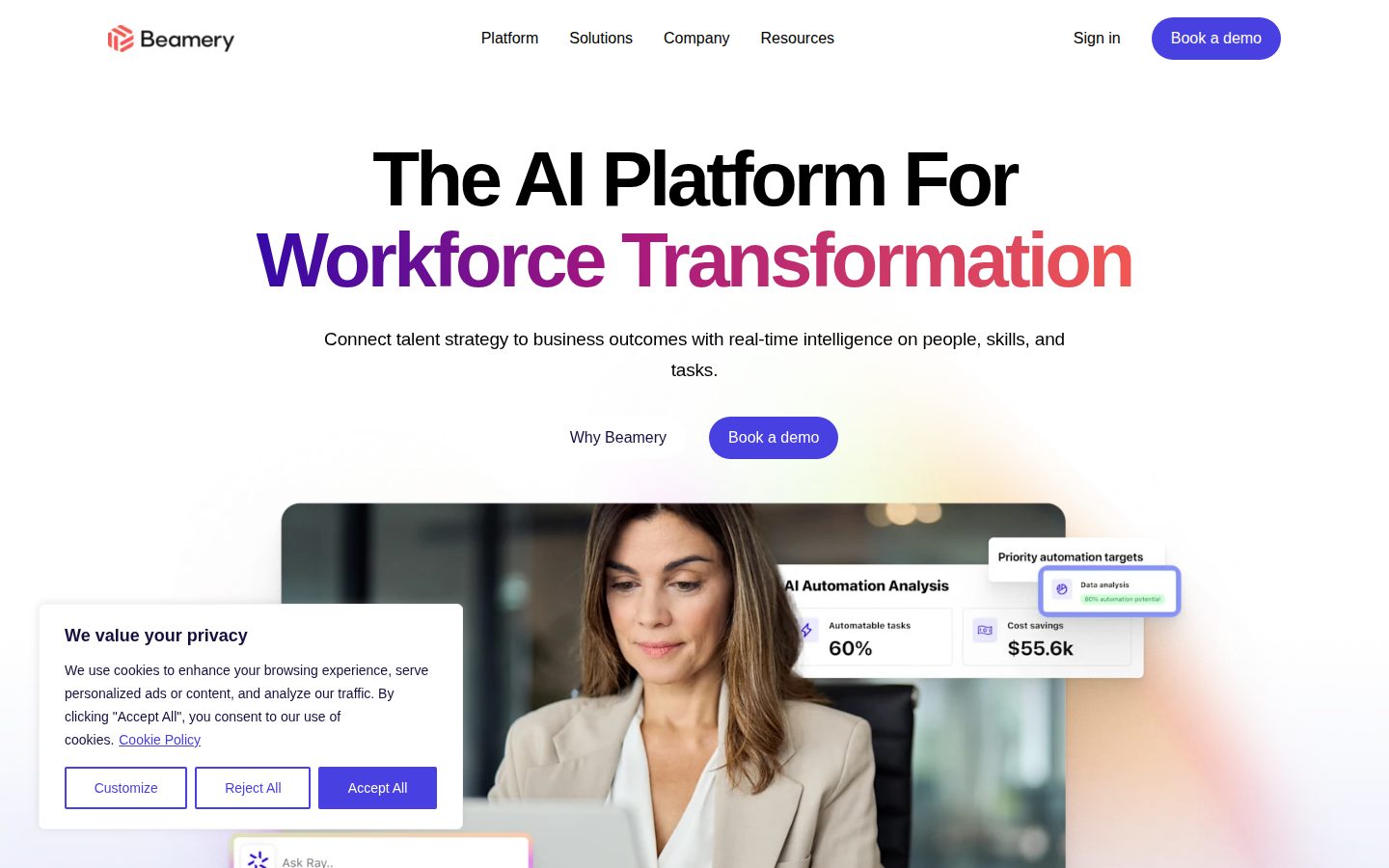
Beamery is an AI-powered workforce intelligence platform for enterprise HR, talent acquisition, and workforce planning teams.
AI Panel Score
6 AI reviews
Reviewed
AI Editor ApprovedApproved and published by our AI Editor-in-Chief after full panel analysis.Beamery is an AI-powered workforce intelligence platform for enterprise HR, talent acquisition, and workforce planning teams. The platform consolidates fragmented data on skills, roles, people, and labor market signals into a unified data layer, then applies AI to workforce planning, talent sourcing, candidate matching, and employee development. Its defining capability is a skills-based model that infers and maps skills across job descriptions, candidate profiles, and internal employee data, enabling skills-first hiring at scale. Pricing is quote-based. Key capabilities include Ray, an agentic AI talent advisor, AI-powered candidate matching, a talent CRM, and integrations with HR systems such as Workday and SAP. TopReviewed's six-seat AI review panel scored it 7.4/10, praising the skills inference engine's documented operation in 225,000-plus employee deployments while noting that the absence of public pricing slows procurement. It best fits enterprises above 10,000 employees running fragmented talent data across Workday or SAP.
In practice, users interact with Beamery through a suite of modules covering talent acquisition, workforce planning, and candidate experience. Recruiters use it to source candidates, match them to open roles based on inferred skills, and manage engagement through a Talent CRM. HR leaders and executives use the workforce intelligence layer to model future scenarios, identify skills gaps, assess automation risk, and plan reskilling or hiring strategies. An embedded AI advisor called Ray provides context-aware recommendations throughout these workflows.
Beamery's platform is built around four connected layers: a Data Platform that aggregates internal and external talent data, a Workforce Intelligence Suite for scenario modeling and planning, an Agentic AI layer (Ray) that delivers recommendations and accelerates workflows, and an Execution Suite for sourcing, matching, and engagement. The platform integrates with major HR systems including Workday and SAP, and is positioned to extend the value of those existing investments rather than replace them. Beamery also highlights ethical AI principles as a design consideration in how Ray operates.
Beamery targets large enterprises, with published case studies from organizations including Salesforce (75,000+ employees), Wells Fargo (225,000+ employees), Flex (140,000+ employees), and Hilti (30,000+ employees). Pricing is not publicly listed and requires direct contact with the vendor. Competitors in the talent intelligence and workforce planning space include Eightfold AI, Phenom, SeekOut, and iCIMS Talent Cloud.
Beamery is delivered as a web-based SaaS platform. It connects across an organization's existing HR technology stack via integrations and is designed for enterprise-scale deployment. No public API documentation or self-serve onboarding is indicated on the homepage.

Uses AI to match candidates to open roles based on inferred and explicit skills, improving consistency and confidence in hiring decisions.
An embedded agentic AI consultant that accelerates recruiter and HR workflows by delivering transparent, context-aware recommendations for workforce planning and talent decisions.
Transforms unstructured data such as job descriptions into a customized skills framework by inferring skills across candidate profiles and internal employee data.
Enables executives and HR leaders to plan workforce strategy using real-time skills supply and demand data, balancing reskilling, hiring, and automation to meet business goals.
Models future workforce scenarios, uncovers talent risks, and analyzes how work gets done to enable precision planning around automation, reskilling, and hiring.
Automates talent sourcing and candidate engagement workflows, enabling recruiters to find and engage top talent faster as part of an end-to-end execution suite.
Surfaces relevant job opportunities to candidates and maps out personalized career paths by connecting their skills and ambitions to matching roles within the platform.
Aggregates fragmented data on skills, roles, people, and labor market signals into a single, connected, and trusted source of truth to power workforce decisions.
Provides a CRM for talent acquisition teams to build and nurture pipelines of active and passive candidates, keeping them engaged until vacancies arise.
Creates a unified data layer that consolidates internal employee data with external labor market signals to eliminate data quality risks and support consistent talent recommendations.
Connects with enterprise HR systems including Workday and SAP to unify data flows and deliver dynamic workforce intelligence across the talent lifecycle.
Beamery is an enterprise AI platform for workforce transformation. No public pricing tiers are listed; all plans require booking a demo or contacting the sales team.
Enterprise talent intelligence with real teeth, but budget for a long sales cycle.
“Beamery's skills-inference engine and Ray advisor are genuinely differentiated for large-scale workforce planning. No pricing transparency and no self-serve trial means this is a top-down, relationship-driven buy.”
Salesforce, Wells Fargo, Flex. Those aren't pilot customers — that's enterprise validation at 75,000 to 225,000 employees. Beamery's been in market long enough to earn logos like that, which answers the viability question better than any funding disclosure would.
The skills inference layer is the real asset here. Beamery transforms raw job descriptions into a structured skills framework, then maps that across candidates and internal employees. That's the capability Eightfold AI charges a premium for too — except Beamery layers on Ray, an agentic advisor that surfaces recommendations inside recruiter workflows, not just in reports nobody reads.
Two things give me pause. One: no public pricing, no trial, no API docs — this is a lengthy enterprise procurement, not a 90-day pilot. Two: the ROI timeline on workforce planning tools is slow. Expect 12-18 months before the board sees numbers worth defending.
Ray's agentic layer and unified data platform differentiate it from Eightfold AI and Phenom, but the skills-intelligence space is crowding fast.
Wells Fargo and Salesforce on the reference list makes this defensible in any board conversation.
No self-serve onboarding and complex data integration with enterprise HR systems means value realization takes quarters, not weeks.
Skills-based workforce planning with Workday and SAP integration advances talent strategy rather than just automating existing recruiting tasks.
Case studies from four enterprises over 30,000 employees each signals durability; no public funding data, but customer scale implies contract revenue.
Large enterprises with 10,000+ employees running fragmented talent data across Workday or SAP who need skills-based workforce planning at scale.
Your org is under 5,000 employees or needs fast, self-serve deployment to prove value before a budget commitment.
Enterprise-grade skills intelligence that reframes how CHROs think about workforce architecture.
“Beamery is built for organizations where workforce planning is a board-level conversation, not a spreadsheet exercise. The skills-first data layer is the real product — everything else is an execution surface on top of it.”
The four-layer architecture — Data Platform, Workforce Intelligence Suite, Ray, Execution Suite — tells me someone has actually mapped an enterprise talent lifecycle end-to-end. Skills inference from unstructured job descriptions is non-trivial work, and deploying it at Salesforce (75,000+ employees) or Wells Fargo (225,000+ employees) means the data model has survived contact with real organizational complexity. Eightfold AI builds a comparable skills ontology, but Beamery's scenario modeling layer and Ray's agentic workflow integration suggest a more complete planning-to-execution loop.
The Workday and SAP integrations are the right handshakes for any enterprise HR stack — without them, a workforce intelligence platform is just another siloed tool. No public API docs and no self-serve onboarding signal this is a white-glove deployment, which means implementation cost and timeline are real budget line items your CFO will ask about before you sign.
The genuine constraint here is data quality dependency. A skills inference engine is only as trustworthy as the underlying HR data it ingests — messy job architecture or inconsistent internal profiles will surface as noisy recommendations. If your org hasn't done foundational job architecture work, Beamery's ceiling drops significantly until that debt is cleared.
Competes directly with Eightfold AI and Phenom at the enterprise tier, with a more unified planning-to-execution story than point solutions like SeekOut.
Distinct workflows for executives, HR leaders, recruiters, and candidates maps closely to how enterprise People teams actually divide accountability across the talent lifecycle.
Native Workday and SAP connectors are the right anchors for enterprise stacks, though the absence of public API documentation limits our ability to assess depth beyond those two systems.
Adopting Beamery's skills framework creates a proprietary data asset over time, but also a switching cost — three years in, your workforce architecture lives inside their ontology.
Skills-based workforce planning with scenario modeling and an agentic AI advisor (Ray) goes well beyond sourcing tools — this is infrastructure for long-range talent strategy.
Large enterprises with 10,000+ employees that are ready to operationalize a skills-based talent strategy at the board level.
Your organization hasn't done foundational job architecture work — the skills inference layer won't compensate for messy underlying data.
No pricing page, no trial, no overage rate — enterprise opacity at full scale.
“Beamery targets 30,000-to-225,000-employee organizations. Zero public pricing. Year-3 TCO is entirely opaque without a sales cycle.”
No published price. No tiers. No free trial. Contact sales is the only path. For a team modeling budget, that's a procurement delay, not a feature. Category norm for enterprise talent intelligence — Eightfold AI runs the same playbook — but opacity still has a cost: finance can't pre-qualify this before legal gets involved.
Case studies show Salesforce at 75,000+ employees, Wells Fargo at 225,000+. That's the buyer profile. Mid-market teams will spend 6-8 weeks in a sales cycle and likely get declined. Workday and SAP integrations are named, which suggests implementation services aren't zero — expect $50K-$150K in integration and onboarding costs on top of license, based on category norms for this stack tier.
Ray, the agentic AI advisor, and the Skills Inference layer are differentiated features. The tradeoff: no changelog, no API docs, no self-serve onboarding. ROI measurement depends entirely on what Beamery's team models for you. That's hand-wavy until contract signature.
No invoicing model, payment terms, or procurement onboarding information visible — full friction sales cycle required before any number surfaces.
No public auto-renewal terms, cancellation policy, or term length — standard enterprise hostage contract risk, nothing disclosed.
No pricing page, no tiers, no starting number — contact sales only, per their site.
Workforce scenario modeling and skills gap analysis are concrete capabilities, but ROI measurement relies on vendor-provided framing with no self-serve benchmarks published.
No public license cost; Workday/SAP integration depth suggests $50K-$150K implementation on top of license, based on category norms.
Large enterprises above 10,000 employees already running Workday or SAP with a dedicated HR tech budget.
You need a price before a sales call or lack a six-figure implementation budget.
Enterprise talent intelligence that earns its seat at the table — if you survive onboarding
“Beamery brings genuine skills-based matching and workforce scenario planning to enterprise recruiting teams at Salesforce or Wells Fargo scale. No pricing transparency, no self-serve trial, and no public API docs mean you're committing blind.”
The Skills Inference engine is the real differentiator here. Pulling unstructured job descriptions and mapping them into a live skills framework is the kind of thing that usually takes a team of sourcers months to do manually. For a recruiter running 40+ requisitions across a large org, having Ray surface candidates by inferred skills rather than keyword matching is a meaningful workflow shift — closer to what Eightfold AI promises, but with a Talent CRM baked in rather than bolted separately.
Day-3 reality is the honest concern. No self-serve trial, no public docs, no changelog. That means everything you learn comes from a CSM or an internal champion. When the demo ends and you're building your first pipeline, you're relying on institutional knowledge you haven't had time to build. Workday and SAP integrations are confirmed, but integration depth isn't documented publicly — and for an enterprise stack, that detail matters on week one, not month three.
Beamery is genuinely strong for HR orgs with 10,000+ employees that already have fragmented talent data and need a unified layer. The tradeoff: smaller TA teams get little from this complexity, and without transparent pricing, budget conversations with finance start at zero.
No self-serve onboarding or public docs means early workflows depend entirely on vendor support, which is a real friction source after the demo ends.
Blog exists but no docs, no changelog, and no public API reference — the evidence reads as marketing-first, not practitioner-first.
No public API docs and contact-only access create invisible friction points that only appear when you're three weeks into a rollout and need to troubleshoot independently.
Workforce Intelligence Suite scenario modeling and Ray's agentic recommendations suggest real depth for senior TA and HR strategy leaders who push beyond basic sourcing.
Confirmed Workday and SAP integrations plus a built-in Talent CRM suggest genuine stack compatibility for enterprise recruiters rather than a parallel workflow demand.
Enterprise TA and HR strategy teams at 10,000+ employee orgs with fragmented talent data and a mandate to move toward skills-based hiring.
You're a mid-market recruiter who needs to be productive in the tool within a week without a dedicated CSM.
Enterprise-grade workforce intelligence that earns its complexity — if you can afford the conversation
“Beamery is built for HR teams at 30,000+ employee scale who need skills-based planning, not another ATS. No pricing page, no free trial — this thing starts with a sales call and it knows it.”
The skills inference engine is the real product here. Beamery takes messy job descriptions and employee profiles and builds an actual skills taxonomy from them — not checkboxes, inferred connections. That's genuinely hard, and Eightfold AI is the only competitor doing it at comparable depth. Ray, the embedded AI advisor, sounds like demo-stage branding, but the four-layer architecture — data platform, intelligence suite, agentic AI, execution — suggests real engineering underneath, not a chatbot wrapper.
The tradeoff is obvious and significant: zero self-serve. No pricing page, no free trial, no public API docs. You're buying a vendor relationship before you see a single screen. For a team at Salesforce (75,000 employees) or Wells Fargo (225,000 employees), that's normal procurement. For anyone smaller, it's a hard stop.
Web-only, no mobile parity mentioned anywhere. For executives doing scenario modeling on a flight, that stings. Daily polish is unknowable from outside the demo, but the changelog absence and no public docs tell you this isn't a product team obsessed with transparency.
No changelog, no public docs, and no evidence the team has sweated empty states or micro-copy — unknowable from outside, but the signals aren't great.
Skills-based workforce planning is genuinely complex, and the four-layer architecture (Data Platform, Intelligence Suite, Ray, Execution Suite) will take months to internalize without guided onboarding.
Web-only platform with no mobile experience indicated — for a workforce intelligence tool used by traveling executives, that's a real gap.
No free trial, no self-serve, no onboarding path visible — first touch is a sales demo, which is homework by definition.
Enterprise deployments at Wells Fargo (225,000 employees) and Flex (140,000 employees) suggest the platform holds weight, even if loading behavior is unverifiable externally.
Enterprise HR and talent acquisition teams at large organizations who need skills-based workforce planning integrated with Workday or SAP.
You're under 5,000 employees or need to evaluate the product without a sales process first.
Skills-first pitch is real; exit story is not.
“Beamery has legitimate enterprise traction — Salesforce, Wells Fargo, Flex are real logos. But no pricing page, no changelog, no public API, and no free trial means every risk lands on the buyer.”
Three tells before I dig in. One: 'Workforce Transformation' in the H1 — the kind of superlative that ages poorly. Two: no changelog visible, so shipping cadence is opaque. Three: contact-only pricing at enterprise scale with zero self-serve signal.
The skills inference layer and Ray agentic AI are named, described features — not vaporware bullets. Case studies cite 225,000-employee Wells Fargo. Workday and SAP integrations are listed explicitly. That's more evidence than most contact-sales vendors provide. Eightfold AI pitches nearly identical skills-ontology positioning, and they've survived several years, which tells me the category isn't dying.
The exit story worries me. No public API docs means your data lives in Beamery's model. Migrating skills inferences and CRM pipeline history in 18 months would be painful. Strong fit for large enterprises already on Workday. Weak fit for anyone who wants leverage in a renewal negotiation.
Skills-ontology plus agentic AI advisor Ray is a real differentiator, but Eightfold AI and Phenom pitch nearly identical capabilities — hard to score the moat without third-party benchmarks.
No public API documentation and proprietary skills-inference model means your data architecture is tightly coupled to Beamery's platform with no visible migration path.
No public funding round data visible, no changelog cadence, blog exists but signals are thin — could go either way on a 3-year horizon.
'Workforce Transformation' headline is aspirational boilerplate; no pricing, no SLA page, and no changelog make verification of delivery claims nearly impossible.
Four named enterprise logos at scale (Salesforce 75k+, Wells Fargo 225k+) match the pattern of surviving talent-intelligence vendors, not the ones that quietly shutdown.
Large enterprises already on Workday or SAP needing skills-based workforce planning at 10,000+ employee scale.
You need transparent pricing, a clean data exit strategy, or a self-serve evaluation path before committing.
Common questions answered by our AI research team
Beamery integrates with Workday and SAP, connecting and enhancing data across your HR ecosystem for dynamic workforce intelligence throughout the talent lifecycle.
Ray is Beamery's embedded agentic AI consultant. Built on ethical AI models, Ray accelerates workflows and delivers transparent, context-aware recommendations to help understand and shape the future workforce.
Yes. Beamery transforms unstructured data, including job descriptions, into a customized skills framework, inferring and mapping skills to enable skills-first hiring at scale.
Yes. Beamery's Workforce Intelligence Suite lets you model future scenarios, uncover talent risks, and plan with precision by balancing automation, reskilling, and hiring to meet business goals.
Beamery uses AI and actionable insights around candidate skills and potential to spot top talent, match them to roles, and build diverse, high-performing teams faster.


Beamery is a London-based HR technology company offering an AI platform for enterprise workforce planning, talent acquisition, and employee development.