Learning management system for higher education and enterprise training
Blackboard Learn is a learning management system (LMS) for higher education institutions, government agencies, and corporate training programs.
AI Panel Score
6 AI reviews
Reviewed
AI Editor ApprovedApproved and published by our AI Editor-in-Chief after full panel analysis.Blackboard Learn is a learning management system for higher education institutions, government agencies, and corporate training programs. It provides course delivery, assessment, and student engagement tools in a centralized platform, connecting to the broader Anthology ecosystem for accessibility, outcomes assessment, accreditation, and institutional analytics. Key capabilities include an AI Design Assistant for rubric and assessment generation, built-in SafeAssign plagiarism detection, Blackboard Ally accessibility tools that generate audio, ePub, and Braille formats, SIS and third-party integrations, and Illuminate analytics and reporting. Pricing is quote-based on annual contracts, though a free trial is available. TopReviewed's six-seat AI review panel scored it 7.0/10, praising Ally's native accessibility compliance that competitors don't match out of the box while noting fully opaque pricing, with third-party estimates ranging from roughly $9,500 to over $100,000 annually. It best fits institutions with strict accessibility compliance requirements and existing Anthology relationships.
In practice, instructors use Blackboard Learn to build and deliver course content, set up assignments and assessments, grade submissions, and communicate with students through discussion boards and messaging. Students access course materials, submit work, track their grades, and participate in collaborative activities through a web-based interface or mobile apps.
The platform includes Blackboard Ally, which automatically checks course files for accessibility compliance and generates alternative formats such as audio, ePub, and electronic Braille. Beyond the core LMS, Blackboard Learn connects to companion products including Anthology Adopt for course material management, Anthology Evaluate for faculty and course evaluation, Anthology Outcomes for assessment planning, and Anthology Illuminate for institutional analytics. The platform supports LTI integrations, enabling third-party tools to be embedded directly into the course environment.
Blackboard Learn is primarily used by colleges, universities, government training programs, and large enterprises. It competes with Canvas by Instructure, Moodle, D2L Brightspace, and Schoology. Pricing is not published on the website and is structured as institutional contracts; prospective customers are directed to contact sales for a quote. A trial option is available through the website.
The platform is accessible via web browsers and has dedicated iOS and Android mobile apps. Blackboard Learn is available as a cloud-hosted (SaaS) deployment. Anthology offers implementation, adoption support, and professional development services as add-ons to the core product.
Generative AI capabilities that help instructors build course structures, auto-generate assessment questions aligned to course content, and create grading rubrics to streamline course development.
Holistic data analytics and reporting tools surface inline insights on learner progression, help identify at-risk students, and evaluate the effectiveness of individual courses across the institution.
An integrated video-classroom service enabling live virtual sessions, office hours, and real-time video conferencing directly within the Blackboard LMS environment.
Students and instructors can communicate through discussion threads, real-time messaging, announcements, and email replies, with unread indicators and read/unread controls for announcements.
Instructors can create a wide variety of graded and ungraded tests and surveys, with support for auto-grading, printable answer keys, and release conditions tied to student performance criteria.
Anthology Ally automatically scans course content for accessibility compliance, identifies issues in the content editor, and generates alternative formats such as audio files or translated text for learners.
A customizable grading interface that lets instructors manage grades, set weights and overrides, provide per-question audio/video feedback, and post scores for students to review directly.
Blackboard supports competency-based programs with goal alignment tools, release conditions tied to learner performance, and personalized learning paths to meet individual student needs.
Blackboard supports scalable integration with student information systems, authentication protocols, and collaboration tools like Zoom, Microsoft Teams, OneDrive, Google Drive, Box, and Dropbox.
A native mobile app available on iOS and Android provides full LMS functionality on the go, including offline course file downloads, grading, discussion participation, and support for over 30 languages.
Built-in plagiarism detection via SafeAssign is integrated directly into assessment workflows, and optionally connects with Turnitin Feedback Studio for more advanced academic integrity checks.
Granular system, course, and institution roles allow administrators to control user access to administrative features, course content, and the institutional portal, with support for fully custom role configurations.
Blackboard Learn (by Anthology) is a fully sales-led product with no publicly listed pricing tiers. Pricing is custom-quoted based on institution size, number of users, deployment option (SaaS/self-hosted), desired features, and contract length (1-, 3-, or 5-year terms). Third-party sources estimate annual costs ranging from ~$9,500–$50,000+ for smaller institutions (up to 1,000 users) and $100,000+ for large enterprises (10,000+ users). A UK public-sector benchmark cites roughly £13–£20 per user per year. Additional fees apply for implementation, premium support, integrations, and content migration. Contact Anthology sales at anthology.com to obtain a formal quote.
Blackboard is the incumbent everyone complains about and nobody drops.
“Thirty-year-old LMS with real institutional depth and a compliance story Canvas can't match out of the box. The switching cost is the moat — in both directions.”
Anthology's been around long enough that viability isn't the worry. Third-party estimates put enterprise contracts at $100,000+ annually for 10,000+ users. That's a real business. They're not disappearing.
Blackboard Ally is the differentiator worth taking seriously. Auto-generated ePub, audio, and Braille alternatives — plus Title II compliance hooks — that's a genuine moat for higher ed and government buyers. Canvas doesn't ship that natively. The AI Design Assistant for rubric and assessment generation is newer and harder to evaluate without public changelog evidence.
The tradeoff: this platform carries legacy weight. Instructors who've used both will tell you Canvas feels faster. Pricing is opaque — you're negotiating a multi-year contract blind. That's a process tax on procurement, not a dealbreaker, but budget for 90 days of implementation time before anyone sees value.
Canvas and D2L Brightspace are winning new deals; Blackboard retains loyal institutions but isn't the default choice for greenfield buyers.
Blackboard is a known quantity — peer institutions won't raise eyebrows, but it doesn't signal innovation to a forward-looking board.
Implementation services are add-ons; multi-year contracts and content migration mean this isn't live in weeks.
Deep fit for higher ed and government; corporate training buyers should pressure-test whether they need this much institutional infrastructure.
Anthology is an established edtech company with decades in market and enterprise contracts in the $100K+ range — not a startup risk.
Higher ed institutions or government agencies with existing Anthology relationships and serious accessibility compliance requirements.
You're a corporate training team that needs fast deployment and transparent per-seat pricing.
Mature institutional LMS with deep compliance architecture and a real AI layer now built in.
“Blackboard Learn is the incumbent choice for institutions that need accreditation alignment, accessibility compliance, and enterprise SIS integration in a single contracted system. The Anthology ecosystem adds genuine depth, but the sales-only pricing model and opaque contract structure create procurement friction that Canvas and D2L don't.”
Blackboard Ally is the standout architectural decision here. Automatic accessibility scanning, alternative format generation — audio, ePub, electronic Braille — and Title II compliance tooling built natively into the content layer is something Canvas doesn't match out of the box. For any institution managing federal accessibility obligations, that's not a minor feature; it's a risk management pillar.
The AI Design Assistant for auto-generating rubrics and assessment questions aligned to course content shows Anthology is moving the product forward, not just maintaining it. Illuminate Analytics surfacing at-risk learner signals inline is exactly where learning technology should be headed. The tradeoff: at $100,000+ annually for large deployments, you're buying a platform relationship, not a product subscription — and that relationship means your roadmap dependence is real.
If we adopt this in year one, by year three we're deeply enmeshed in the Anthology ecosystem — Evaluate, Outcomes, Illuminate — which compounds value if the suite holds together, but makes exit costly. Canvas by Instructure is lighter to procure and iterate on. Blackboard wins on compliance depth and institutional scale; it loses on agility.
Blackboard is the established incumbent competing against Canvas and D2L Brightspace; it holds on compliance depth and scale, but Canvas leads on UX modernization and procurement simplicity.
Role-based access management, SIS integration, accreditation alignment via Anthology Outcomes, and early-alert analytics map directly to how higher education and enterprise L&D operations actually run.
LTI support plus named integrations with Zoom, Microsoft Teams, Google Drive, Panopto, and 20+ others gives an adequate surface for most institutional stacks.
Five-year contract terms and deep Anthology ecosystem dependency create real switching costs; value compounds if the suite coheres, but roadmap lock-in is the structural risk.
Twelve documented features including competency-based learning paths, SafeAssign integrity tools, and Ally accessibility scanning indicate library-grade LMS depth built for institutional complexity.
Colleges, universities, or large government agencies that need built-in accessibility compliance, accreditation tooling, and a deeply integrated institutional suite under one contract.
Your institution needs fast procurement cycles, transparent per-seat pricing, or the flexibility to swap learning tools without a multi-year contract commitment.
£13-£20/user/year estimate, zero published tiers, and a 5-year lock-in option.
“No pricing page. No published tiers. Every number comes from third-party benchmarks, not Anthology invoices.”
Third-party estimates put smaller institutions (sub-1,000 users) at $9,500–$50,000/year. Large deployments (10,000+ users) exceed $100,000 annually. A UK public-sector benchmark cites £13–£20/user/year — useful for triangulation, not budgeting. Implementation, premium support, and content migration are separate line items. No published rates for any of them.
The 1-, 3-, and 5-year term options create real lock-in risk. No termination-for-convenience language is visible publicly. Auto-renewal windows aren't disclosed. That's a procurement problem before the contract is signed. Canvas by Instructure runs the same playbook on pricing opacity — but at least Canvas has more third-party benchmarks circulating.
SafeAssign and Blackboard Ally are bundled, which matters — Turnitin add-on is optional and costs extra. AI Design Assistant is listed as native. Those are genuine inclusions worth modeling. But year-3 TCO for a 500-user institution could range $75K–$200K+ depending on add-ons. That range is too wide to plan against.
Fully sales-led, custom-quoted, with optional premium support and integrations priced separately — procurement friction is high.
1-, 3-, and 5-year terms are available but no public auto-renewal window or termination-for-convenience terms are disclosed.
No published tiers, no pricing page — 100% sales-gated with estimates sourced only from third parties.
Illuminate Analytics and early-alert tools for at-risk students provide measurable outputs, but institutional ROI benchmarks aren't published.
Implementation, premium support, and migration are confirmed add-ons with zero published rates; year-3 range is $75K–$200K+ for a mid-size institution.
Large universities or government agencies with dedicated procurement teams and tolerance for opaque, negotiated contracts.
Your institution needs published pricing and predictable multi-year TCO before engaging a sales rep.
Enterprise LMS that earns its contract price but fights you on day three
“Blackboard Learn is a fully-loaded institutional LMS with genuine depth — SafeAssign, Ally accessibility scanning, competency paths, Illuminate analytics. The daily trainer friction is real, though: opaque pricing, no public docs, and a UI that rewards patience over speed.”
After the demo, instructors will spend their first real week building course shells, uploading content, and watching Blackboard Ally flag accessibility issues inline. That's actually useful — auto-generating audio and ePub alternatives saves real prep time. The AI Design Assistant generating quiz questions aligned to course content is a legitimate time saver for anyone building assessments from scratch. These aren't vapourware features; they're in the workflow where trainers actually live.
The friction accumulates in navigation. Canvas by Instructure's course setup is faster to learn cold; Blackboard's role-based access system is powerful but granular enough to become its own administration overhead. Gradebook customization — weights, overrides, per-question video feedback — is strong once configured, but configuration takes real time. $9,500–$100,000+ annually on a multi-year contract means you're committed before you've discovered the rough edges.
For large institutions running compliance training, government programs, or accreditation-heavy curricula, the Anthology ecosystem depth (Outcomes, Evaluate, Illuminate) is hard to match. For smaller training teams, that same ecosystem feels like overhead they didn't sign up for.
Role-based access configuration and navigation depth create real ramp time after the demo; Ally and AI Design Assistant are genuine daily wins once past setup.
No public docs, blog, changelog, or API reference surfaced — the capabilities page scores N across the board, which is a real gap for practitioners troubleshooting independently.
Granular admin controls and multi-ecosystem navigation (Evaluate, Outcomes, Illuminate) add weekly overhead that solo trainers and small teams will feel acutely.
Competency-based learning paths, release conditions tied to performance criteria, custom role configurations, and Illuminate analytics give advanced administrators serious leverage.
SIS integrations, Zoom, Microsoft Teams, Google Drive, and 20+ LTI connectors mean it fits most institutional stacks without forcing new tool habits.
Large universities, government training programs, and enterprises running accreditation-heavy or compliance-driven curricula that need the full Anthology ecosystem.
Your training team is small, needs fast onboarding, or can't absorb a multi-year six-figure contract before discovering the tool's rough edges.
The incumbent LMS that works, costs a fortune, and knows it
“Blackboard Learn is feature-complete and deeply integrated for higher ed and government. But you're paying institutional contract money — $9,500 to $100,000+ — for a product that still feels like it was designed by committee.”
Twelve features on the list, and nearly every real need is covered — SafeAssign for plagiarism, Blackboard Ally for accessibility compliance, an AI Design Assistant for rubric and quiz generation, Collaborate Ultra for live sessions. That's not shallow breadth. That's years of enterprise procurement requirements bolted into one platform. For a compliance-heavy institution worried about Title II or accreditation, the Anthology ecosystem actually pulls weight.
The daily experience, though. Discussion boards and gradebook workflows carry that classic enterprise-LMS energy — functional, not joyful. Canvas has spoiled a generation of students and faculty on cleaner UI. Blackboard Ultra improved things, but Day 3 still has that 'I know this works, I just don't love it' feeling. The mobile app claims full parity including offline downloads and 30+ languages, which is genuinely better than most LMS competitors.
No public pricing is the real friction for buyers. Third-party estimates put smaller institutions at $9,500–$50,000 annually. That's a serious budget conversation before you've seen a single screenshot.
Ultra interface improved the experience but discussion boards and gradebook still feel like institutional software, not consumer-grade tools.
Role-based access management and competency-based learning paths are powerful but deeply non-obvious — admins need training, instructors need onboarding support.
Native iOS and Android apps with offline file downloads, grading, and 30+ language support is real parity, not a read-only afterthought.
A trial exists but no self-serve pricing or guided setup path — implementation services are sold separately, which signals the onboarding is homework.
Decades-old platform with SaaS deployment and enterprise SLAs behind it — category norm is solid uptime for this tier.
Large universities, government agencies, or enterprises that need compliance-grade accessibility, accreditation tooling, and a deep integration ecosystem.
You're a smaller institution or company that wants fast setup, transparent pricing, and a tool faculty will actually enjoy opening every morning.
30-year-old incumbent with real integration depth — but the exit is ugly
“Blackboard Learn is the enterprise LMS that won by surviving, not by being loved. Deep Anthology ecosystem lock-in is the price of its institutional breadth.”
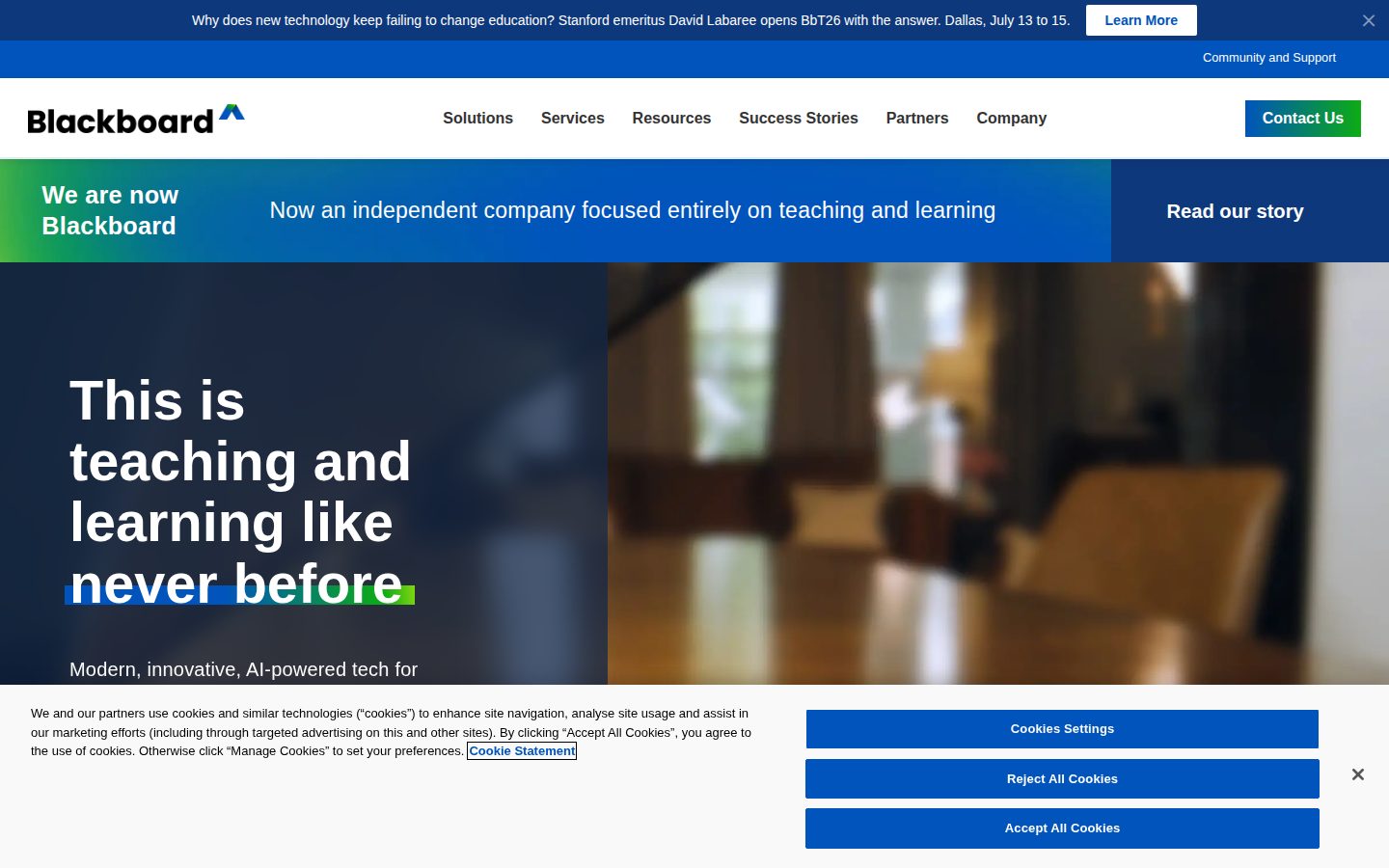
Three tells on the website. One: 'like never before' in the H1 — exactly the kind of superlative that ages poorly for a product older than most of its users. Two: zero public pricing, zero API docs, zero changelog visible. Three: the AI positioning is thin — 'AI Design Assistant' that auto-generates quiz questions isn't a moat in 2024.
Here's what's actually solid. Blackboard Ally accessibility tooling is genuinely differentiated — auto-generating ePub, audio, and electronic Braille from course files. SafeAssign is baked in, not bolted via third-party. The Anthology ecosystem — Illuminate analytics, Evaluate, Outcomes — gives compliance-heavy institutions a coherent stack. Third-party estimates put contracts at $9,500–$100,000+ annually depending on headcount. That's institutional pricing, full stop.
The exit story is what worries me. Canvas by Instructure uses open LTI standards too, but Canvas migrations are documented. Blackboard migrations are a professional services engagement. If Anthology shifts strategy — and they've shifted before — you're negotiating an exit, not running one.
Blackboard Ally accessibility auto-formatting is a genuine edge vs. Canvas and Moodle, but AI Design Assistant features are table-stakes across the category now.
Deep Anthology ecosystem coupling — Illuminate, Evaluate, Outcomes — plus no public migration tooling means exit is a paid professional services project, not a clean lift.
Anthology Inc. is a post-merger entity with institutional contracts spanning 1–5 years; no public funding signals, but government and higher-ed contract stickiness is real.
No public pricing, no API docs, no changelog — the website is a lead-gen wall with aspirational H1 copy and zero grounded evidence of shipping cadence.
Blackboard has survived 30+ years and multiple ownership changes; it matches the 'slow-moving institutional incumbent' pattern, not the 'shut down in 18 months' one.
Compliance-heavy universities or government agencies that need accessibility tooling, SIS depth, and multi-year institutional contracts.
You need transparent pricing, fast iteration cycles, or a clean exit path within 18 months.
Common questions answered by our AI research team
Yes, Blackboard Learn includes built-in generative AI capabilities that save faculty time and enable collaborative, personalized learning experiences for students.
Yes, Blackboard Ally helps institutions meet Title II requirements by delivering accessible, inclusive digital content personalized to each learner's needs.
Yes, Blackboard Evaluate simplifies the course evaluation process from survey delivery to reporting, giving faculty and administrators timely feedback to improve learning outcomes.
Yes, Blackboard offers AI-powered learning management solutions specifically for government agencies, supporting secure and scalable workforce skills and regulatory training programs.
Yes, Blackboard integrates with Blackboard Ally, an accessibility tool that helps instructors deliver inclusive digital content and supports Title II compliance.
Company
BlackboardFounded
1997Pricing
Contact for pricingFree Trial
AvailableBlackboard is a Washington, D.C. education technology company providing learning management systems to higher education institutions, government agencies, and corporate training programs.