AI evaluation and observability platform for LLM applications
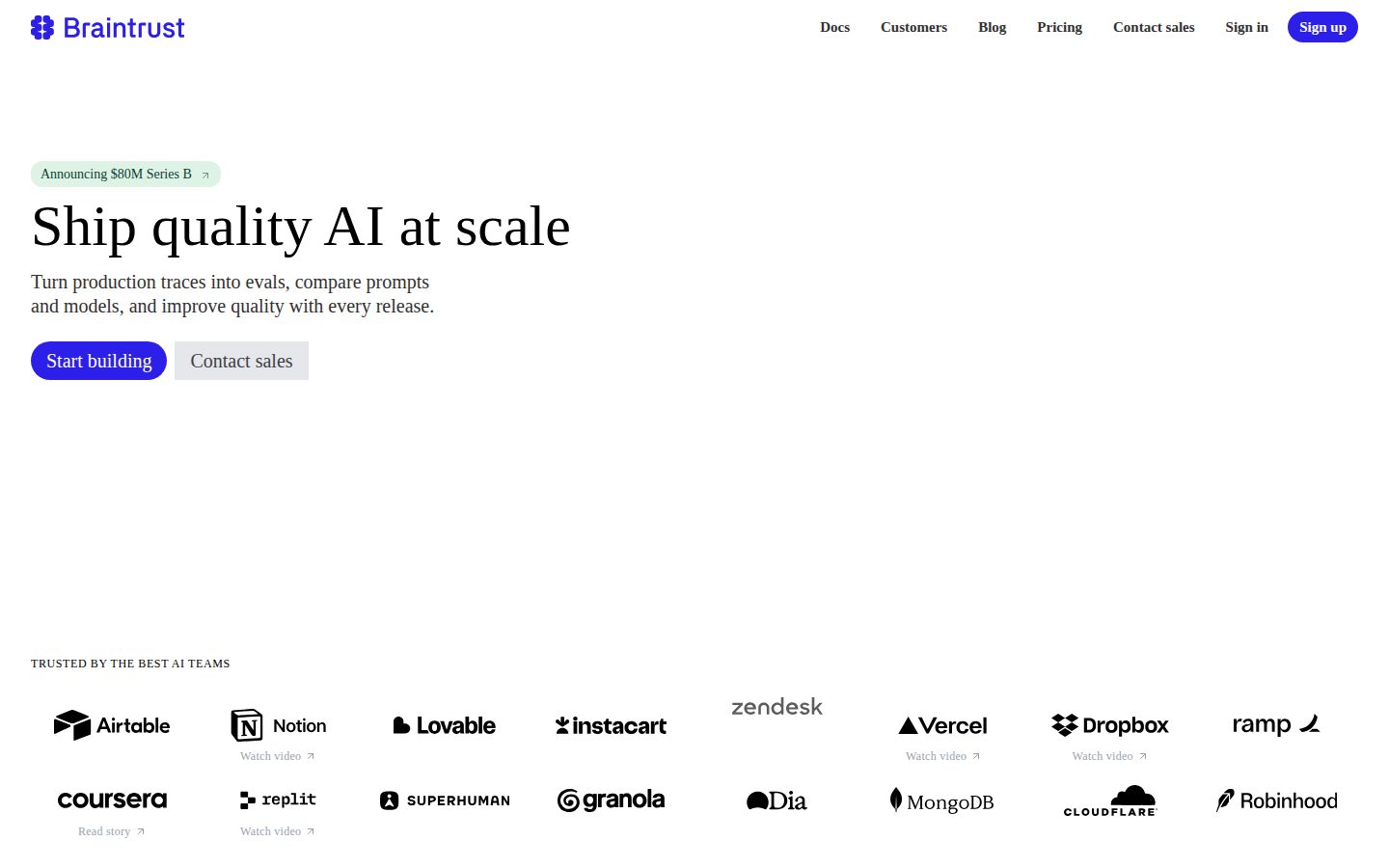
Braintrust is an evaluation and observability platform for AI applications and large language models.
AI Panel Score
6 AI reviews
Reviewed
Braintrust is an evaluation and observability platform designed for developers building applications with large language models and AI systems. The platform provides comprehensive tools for testing, monitoring, and improving AI application performance through systematic evaluation frameworks.
The platform offers evaluation tools that allow developers to create test sets, run experiments, and measure AI model performance across various metrics. Braintrust includes data management capabilities for organizing evaluation datasets and tracking model outputs over time. The platform also provides observability features to monitor AI applications in production and identify potential issues or performance degradation.
Braintrust targets AI engineers, machine learning teams, and organizations deploying LLM-powered applications who need reliable ways to evaluate and monitor their AI systems. The platform integrates with popular AI development workflows and supports various model types and use cases. In the growing market of AI development tools, Braintrust positions itself as a specialized solution for the critical challenge of AI application evaluation and quality assurance.
AI-assisted optimization that auto-generates improved prompts, scorers, and datasets.
Runs experiments to compare prompts and models side by side to measure quality differences.
Monitors production in real time to find errors, latency issues, and unexpected outputs using search, dashboards, and automated topics.
Blocks bad releases before production by running automated evaluations as a quality gate.
Purpose-built database for querying complex AI traces.
Allows users to build and manage datasets from production traces with human feedback and user signals.
Supports LLM judges, code-based scorers, and human review to quantify AI output quality.
High-throughput trace ingestion with real-time monitoring for capturing AI application outputs.
Connects your IDE and agents directly to your AI stack via MCP protocol.
Captures traces from AI applications using OpenTelemetry in addition to direct AI provider wrapping.
Platform is certified under SOC 2 Type II and compliant with GDPR and HIPAA regulations, with hybrid deployment options.
Provides single sign-on via SAML and granular access control permissions for team management.
1 GB/month data + 10K scores included, 14-day retention. Unlimited users/projects/experiments. Community support.
5 GB/month data + 50K scores, 30-day retention. Adds custom topics, charts, environments, basic RBAC.
Custom contracts with SAML SSO, custom RBAC, S3 export, premium SLAs.
Ankur Goyal sold Impira to Figma, then built the AI eval platform Notion and Cloudflare actually use.
“Braintrust closed an $80 million Series B led by ICONIQ in February 2026 at an $800 million valuation. Pro runs $249 a month for 5 GB of traces and 50K scores, with overage that gets real fast.”
Notion, Replit, Cloudflare, Ramp, and Dropbox all run evals on Braintrust. That's the strongest production reference list I've seen in AI observability. Ankur Goyal sold Impira to Figma in 2023, started this the same year, and just closed an $80 million Series B from ICONIQ in February 2026 at an $800 million valuation.
The wedge is Brainstore — a purpose-built trace database — paired with Release Gating that blocks bad model versions before production. Pro is $249 a month for 5 GB of traces and 50K scores. LangSmith bundles with LangChain, but Braintrust is framework-agnostic and SOC 2 Type II plus HIPAA certified out of the box.
The catch is scoring overage math. At $1.50 per 1K scores past 50K, a heavy eval workload clears Pro's budget by month two. Pilot Starter free for one production app, measure score volume for 30 days, then negotiate Enterprise before standardizing.
LangSmith ships with LangChain lock-in; Braintrust competes on neutrality and a purpose-built trace database called Brainstore.
Notion, Replit, Cloudflare, Ramp, and Dropbox on the customer list plus SOC 2 Type II and HIPAA make this an easy board defense.
OpenTelemetry support and one-click conversion of production traces into eval datasets shortens the path from logs to regression tests.
Framework-agnostic SDKs across Python, TypeScript, Go, Ruby, and C# slot into any existing AI stack without rewrites.
$121M raised across three rounds, ICONIQ-led $80M Series B in Feb 2026 at $800M valuation funds a defensible 36-month runway.
AI engineering teams who need framework-agnostic LLM evaluation in production.
Solo developers prototyping a single LangChain side project on a free tier.
Braintrust's Brainstore-backed bet that observability and evals are one workflow is the right architectural call for eval-driven teams.
“Ankur Goyal founded Braintrust in 2022 and closed an $80M Series B led by ICONIQ at an $800M valuation in February 2026, betting evals and observability belong in one workflow. For a head of AI engineering picking a quality substrate through 2029, the call is whether Brainstore plus Release Gating beats stitching LangSmith with Arize Phoenix.”
Ankur Goyal founded Braintrust in 2022 after Impira and a stint inside Figma. The $36M Series A from Andreessen Horowitz's Martin Casado in 2024 became an $80M Series B led by ICONIQ at an $800M valuation in February 2026. The opinionated bet: observability and evals belong in one workflow, with Brainstore underneath.
Pro lands at $249 per month for 5 GB of processed data and 50K scores, 30-day retention; overage runs $3 per GB and $1.50 per 1K scores. Release Gating turns evals into a CI step a head of AI engineering can defend to security.
But the opinionated shape cuts both ways. If your team standardized on LangSmith inside LangChain or Arize Phoenix on OpenTelemetry, the migration tax is real and Brainstore is the lock-in surface. The 3-year ceiling is eval-driven quality control — strong fit for teams treating evals as the release gate.
$800M valuation with a16z and ICONIQ places Braintrust alongside LangSmith and Arize as the top three in LLM evaluation.
Eval-driven workflow with one-click trace-to-dataset promotion matches how senior AI engineers actually iterate.
OpenTelemetry support plus SDKs in Python, TypeScript, Go, Ruby, and C# keep instrumentation framework-agnostic.
Brainstore is proprietary, so the lock-in surface is the trace database itself, not just management layers.
Brainstore, Loop Agent, and Release Gating show real engineering depth beyond a tracing UI.
Heads of AI engineering who treat evals as the release gate.
Teams already standardized on LangSmith inside LangChain.
a16z led a $36M Series A in October 2024 — Pro publishes at $249/month, but every score meters separately.
“Pro tier publishes at $249/month with 5 GB and 50K scores included. Overage bills $3/GB and $1.50/1K — volume-billed scores are the real TCO question.”
Ankur Goyal — ex-Figma, ex-Impira — shipped Braintrust in August 2023. Andreessen Horowitz led a $36M Series A in October 2024. Total raised lands near $45M. Pro tier publishes at $249/month.
Model a small AI team on Pro. $249 × 12 = $2,988/year base. Add 20 GB overage at $3/GB monthly — another $720. 50K extra scores at $1.50/1K — $900. All-in lands near $4,600. Compare Langfuse self-hosted at zero license cost. Braintrust trades sticker for managed Brainstore and Loop Agent automation.
The catch is volume-billed scores. Every eval invocation meters separately — success scales the invoice. SAML SSO and S3 export sit behind the Enterprise quote. No published cap on score overage. That is the procurement question.
Self-serve Pro removes sales friction; SAML SSO sits behind the Enterprise tier.
Monthly Pro avoids annual lock; Enterprise terms and auto-renewal unpublished.
Starter and Pro publish with explicit overage rates; Enterprise stays on quote.
Brainstore and experiment comparison make eval quality measurable against releases.
Base is predictable, but per-score and per-GB overage scales with usage success.
Small AI teams who need managed eval infrastructure without self-hosting overhead.
Teams whose evaluation volume makes per-score billing unpredictable.
Braintrust's Brainstore turns 50K production traces into a real query database — LangSmith still ships a logs viewer.
“Braintrust's SDK lets engineers write an eval in Python or TypeScript and stream traces into the UI in seconds. The Pro tier at $249/month includes 5 GB of processed data and 50K scores, then the meter takes over at $3/GB.”
Writing an eval in plain Python or TypeScript and watching it stream into the UI in seconds is the part competitors fumble. Braintrust's SDK is genuinely minimal — define a task, a scorer, a dataset, hit run. The trace shows up before you tab back.
Brainstore is the part that earns the $249/month Pro tier. Querying 50K production traces with regex filters and grouping by latency percentile feels like a real database, not a logs viewer pretending. LangSmith makes you wait. The catch is the meter — 5 GB processed data included, then $3/GB and $1.50 per 1K scores on top.
Loop Agent auto-generates scorer variants from a failing trace, which sounds like demo magic but actually saves the 20-minute exercise of writing a JSON judge by hand. Docs are written by engineers who use the tool — code samples run, error messages link to the right page. 14-day retention on Starter is tight for regression hunting.
SDK is minimal and traces stream in seconds; Brainstore replaces the typical logs-viewer fumble.
Docs read like they were written by the engineers using the tool — code samples run and error pages link correctly.
The metered pricing creates usage anxiety and 14-day Starter retention forces an early Pro upgrade.
Brainstore querying, Loop Agent, Release Gating, and custom code scorers reward teams that go deep.
Framework-agnostic with native SDKs for Python, TypeScript, Go, Ruby, C#, plus OpenTelemetry and MCP support.
AI engineers who ship LLM features behind release gates.
Solo developers who run fewer than ten evals a month.
Braintrust treats evals like real software, but the meter on data and scores makes you watch the gauge.
“The free Starter is generous enough to actually learn the product before paying — 1 GB and 10K scores beats the usual demo-only tier. The catch is that 14-day retention and $4/GB overages mean your first production month is a billing surprise unless you plan it.”
The free Starter tier is honest in a way most observability tools aren't. 1 GB, 10K scores, 14-day retention, unlimited users and projects — you can run a real eval before talking to sales. LangSmith makes you book a call faster.
Brainstore is the part that feels designed by someone who'd actually use it daily. The docs call it a purpose-built database for AI traces, and querying nested LLM calls feels different from grepping JSON. The Loop Agent that auto-generates prompts and scorers is a feature you'll either trust or quietly turn off. Founded 2023 by Ankur Goyal, ex-Figma — the Figma sensibility shows in the small stuff.
But the meter is real. Pro is $249/month for 5 GB and 50K scores, then $3/GB and $1.50/1K on top. A noisy week in production and you're explaining the bill to finance. Worth it if you're shipping LLM features that matter.
Brainstore queries and the trace UI show real attention to how the product feels on day three.
Production-trace-to-dataset in one click flattens month-three discoverability, but the scoring system has real depth to grow into.
Web-only dev tool — mobile isn't a real use case for AI engineers debugging traces.
Starter free tier with 1 GB and 10K scores lets you build a real eval before any sales call.
Framework-agnostic SDKs in Python, TypeScript, Go, Ruby, C# plus OpenTelemetry support give it a solid feel.
AI engineers shipping LLM features who need real evals instead of vibes.
Solo hobbyists who only need basic LLM call logging.
Ankur Goyal's $36M Series A at $150M post — Brainstore is the bet, category density is the catch.
“Ankur Goyal raised a $36M Series A from a16z in October 2024 to bet that evaluation and observability belong in one workflow. The catch is the crowd — LangSmith, Arize, and Langfuse are all swinging at the same problem with similar pitches.”
Ankur Goyal came out of Impira and Figma. Founded Braintrust in 2022. $36M Series A led by Martin Casado at a16z, October 2024, post at $150M. Datadog, Databricks Ventures, and Greg Brockman on the cap table. That's the cohort signal worth knowing.
Brainstore is the interesting bet — a purpose-built store for AI traces, not Postgres glued to ClickHouse like Langfuse runs. Release Gating blocks bad merges via scorers in CI. Pro is $249 a month for 5 GB and 50K scores. LangSmith targets the LangChain crowd. Braintrust targets everyone else.
But the yellow flag is category density. LangSmith, Arize, Langfuse, Helicone, Laminar — all swinging at the same problem. Framework-agnostic is the moat they claim. Exit is decent on traces, sticky on scorers and datasets. Honest take: real team, fair price, crowded battlefield.
Brainstore plus Release Gating is a real combined wedge, but LangSmith, Arize, and Langfuse claim the same space.
OpenTelemetry support and framework-agnostic SDKs ease trace export, though scorers and datasets create workflow stickiness.
$36M Series A from a16z in October 2024 with Datadog and Databricks Ventures participating signals strong 3-year runway.
Landing page claims map to the documented Brainstore, Release Gating, and OpenTelemetry features without aspirational stretch.
Founded 2022 with $121M total raised, but the AI evaluation cohort is too young to separate winners from casualties.

AI engineers who ship LLM applications outside the LangChain ecosystem.
Teams who need open-source self-hosting without a vendor account.
Common questions answered by our AI research team
The Pro plan costs $249/month, which includes 5 GB processed data (+$3/GB overage) and 50k scores (+$1.50/1k overage) with 30 days retention.
Yes, Braintrust is HIPAA compliant. A Business Associate Agreement (BAA) is available on Enterprise plans, required when handling protected health information (PHI).
Native SDKs are available for Python, TypeScript, Go, Ruby, C#, and more.
Yes, production traces can be turned into eval datasets with one click, letting you build regression tests from real failures and edge cases rather than synthetic examples.
Yes, Braintrust is framework agnostic and works with any stack you're already using — no framework lock-in, no rewrites, and no vendor dependencies required.
Company
BraintrustFounded
2023Pricing
From $249/moFree Trial
AvailableFree Plan
AvailableBraintrust is a San Francisco-based AI evaluation and observability platform for building and testing LLM applications.