Brex logo

Brex Review

Visit

AI-powered financial platform for growing businesses

Brex is a financial technology platform that provides corporate credit cards and expense management software for businesses.

AI Panel Score

7.9/10

6 AI reviews

Reviewed

AI Editor Approved

About Brex

Brex is a financial technology company that provides comprehensive financial services for businesses, particularly targeting startups, scale-ups, and growing companies. The platform combines corporate credit cards with expense management software and banking services in a unified solution.

The core offering includes corporate credit cards with higher credit limits based on business metrics rather than personal credit scores, making it accessible to newer businesses. The platform features automated expense tracking, real-time spending controls, receipt capture through mobile apps, and integrations with popular accounting software like QuickBooks and NetSuite.

Brex serves businesses across various industries, from early-stage startups to established companies looking for modern financial tools. The platform is designed to replace traditional corporate banking relationships and expense management systems with a more streamlined, technology-driven approach.

The company operates in the competitive fintech space alongside other corporate financial platforms, positioning itself as a comprehensive solution that eliminates the need for multiple financial service providers. Brex generates revenue through interchange fees, subscription fees for premium features, and other financial services.

Features

AI

  • AI-Powered Expense Management

    AI agents automate expense reporting, eliminate finance busywork, and accelerate finance operations across the platform.

Automation

  • Auto-Generated Receipts

    Automatically generates receipts for transactions at major merchants, Uber, and car rental providers, eliminating manual receipt collection.

  • One-Click Accounting

    Auto-prepares expenses from card swipe to month-end close and syncs automatically with accounting systems.

Core

  • Bill Pay

    Global bill pay with vendor self-service, PO matching, and the ability to make payments from external bank accounts.

  • Business Banking

    Startup banking integrated with cards, bill pay, travel, and reimbursements in a single scalable platform.

  • Corporate Credit Cards

    Corporate cards with up to 20x higher credit limits that work in 100+ countries without requiring a personal guarantee.

  • Global Spend Management

    Corporate cards and spend management that drives 100% policy compliance with no receipt chasing across 100+ countries.

Customization

  • Auto-Provisioning Rules

    Admins can set rules to automatically provision budget limits and product/role access based on employee attributes like department, location, and title.

  • Custom Roles & Policy Engine

    Allows finance teams to create custom roles and a single adaptive policy that automatically adjusts to every spend scenario.

Integration

  • 1,000+ Native Integrations

    Automatic syncing across thousands of native integrations including 30+ HRIS tools, Sage Intacct, and AI workspaces like ChatGPT and Claude.

Mobile

  • International WhatsApp & SMS Notifications

    Sends international SMS and WhatsApp notifications to employees for expense management from anywhere in the world.

Security

  • 1Password Integration

    Links Brex accounts with 1Password to enable secure, frictionless payments in two clicks.

Preview

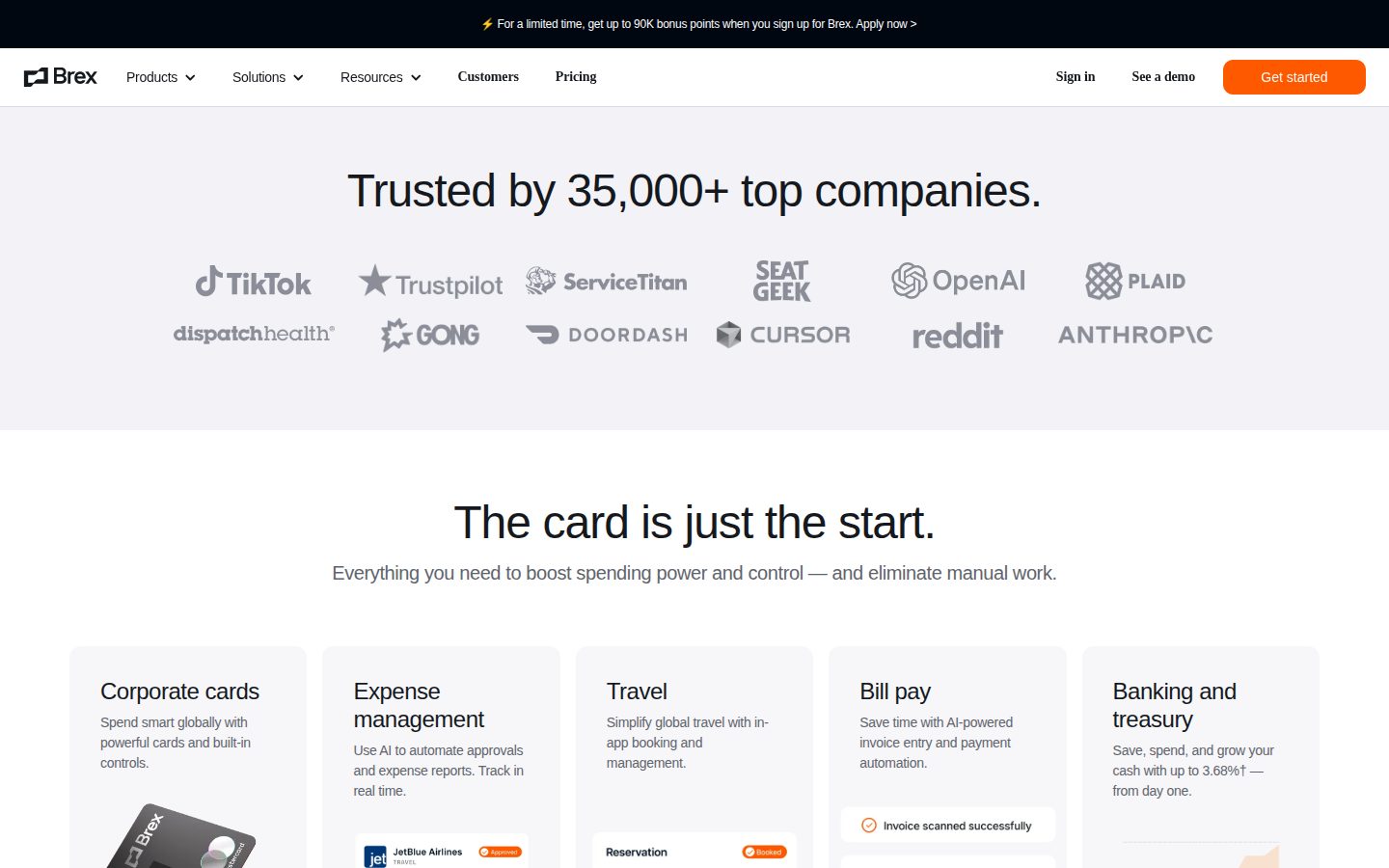
Brex desktop previewBrex mobile preview

Pricing Plans

Starter

Free

Free plan for growing companies

  • Corporate cards
  • Business banking account
  • Expense management
  • Basic reporting
  • Mobile app and native integrations
Popular

Premium

$12/monthly

Per-user per-month for advanced operations

  • All Starter features
  • Accounting automation
  • Live Budgets
  • Bill pay
  • Travel expense management and API access

AI Panel Reviews

The Decision Maker

The Decision Maker

Strategic bet, vendor viability, timing, adoption approval
8.2/10

Brex is now a Capital One subsidiary, and that's the line that ends most board debates about it.

The $5.15B close in April 2026 flipped Brex from a startup-bet to a national-bank question. The harder call is whether the announced 50% Startups team headcount bump is real backing or a goodwill window.

Vendor risk on Brex is closed. Capital One paid $5.15B in April 2026 — a discount to the $12.3B peak, but the buying conversation is different now. Picking a Capital One subsidiary doesn't need a defense memo. Picking Mercury at the same Series still does.

The strategic-fit question is what to do with that umbrella. Brex announced a 50% Startups team headcount expansion, and Premium runs $12 per user per month with AI Agents and Bill Pay as the real product to evaluate. The 1Password Integration and Custom Roles policy engine are the daily-use pieces a CFO actually feels.

The tradeoff is parent metabolism. National banks ship roadmaps on quarterly cadence, not weekly. Pedro Franceschi staying as CEO buys 18-24 months of independence — past that, the call is Capital One's. Renew if you're on it. Run a 90-day Bill Pay pilot before you standardize the org.

Competitive Positioning7.7

Ramp passed Brex on TPV in 2023 per Sacra, but the Capital One distribution muscle changes the next two years.

Reputation Risk8.5

Buying a Capital One subsidiary is the lowest-risk choice on the board agenda this quarter.

Speed to Value8.0

Free Starter and $12 Premium with native QuickBooks/NetSuite syncs means month-end close payback inside one cycle.

Strategic Fit7.8

AI Agents, Bill Pay, and 1,000+ integrations cover modern finance ops, but the roadmap is now the parent's call.

Vendor Viability9.0

Capital One subsidiary as of April 2026 — vendor existence is no longer a question.

Pros

  • Capital One ownership eliminates the vendor-survival conversation at the board level.
  • 50% Startups team headcount expansion announced post-close signals real product investment, not a wind-down.
  • Premium at $12 per user per month with AI Agents and 1,000+ native integrations is honest pricing for the depth.
  • Pedro Franceschi staying as CEO preserves product velocity through the integration window.

Cons

  • National bank parent ships on quarterly cadence — weekly product velocity is unlikely past 2027.
  • Strategic direction past the 18-24 month independence window is Capital One's call, not Brex's.
  • Ramp has been ahead on total payment volume since 2023 and ships AI features faster.

Right for

Series B-and-up startups who want a finance stack the board won't question.

Avoid if

Bootstrap operators who need weekly product velocity from their card vendor.

The Domain Strategist

The Domain Strategist

Craft and strategy in the product's domain — adapts identity per category, same lens
8.0/10

Capital One owns the roadmap now, and the AI-Native Accounting API is the bet that survives integration.

Capital One closed the $5.15B Brex acquisition on April 7, 2026, and Pedro Franceschi stays as CEO. The strategic question for any finance chief renewing now is whether the AI-Native Accounting API and Empower platform keep their pace inside a national bank's metabolism.

Capital One closed the Brex deal on April 7, 2026 at $5.15 billion — about 60% off the 2021 $12.3B peak. Franceschi stays. The product still ships. But every roadmap question for the next 36 months runs through a national-bank approval cycle that Ramp and Mercury don't have.

The piece worth defending is the AI-Native Accounting API that shipped January 2026. Two-way ERP sync with auto GL coding is the architectural shape a finance chief actually needs — Brex says 70% of expenses now run on automation. Empower at $12 per user/month buys live budgets, the policy engine, and bill pay.

The catch is release cadence inside a $470B-asset bank. Brex won the startup CFO segment shipping fintech-fast — automated reimbursements, WhatsApp approvals, OpenAI as a customer. Capital One operates on different cycles. Worth renewing if the API and Empower stay decoupled from the parent's compliance stack. Worth a competitive bid otherwise.

Category Positioning7.8

Was a category co-leader; now consolidated post-Capital One while Ramp passed Brex on TPV by 2023.

Domain Fit8.2

Empower is shaped for the startup-to-scaleup CFO workflow with OpenAI as a reference customer.

Integration Surface8.3

1,000+ native integrations including Sage Intacct, NetSuite, ChatGPT, and Claude span the modern finance stack.

Long-term Implications7.4

Capital One ownership introduces 3-year roadmap uncertainty inside a national-bank approval cycle.

Strategic Depth8.0

AI-Native Accounting API and the agent platform represent real automation architecture, not surface AI features.

Pros

  • AI-Native Accounting API gives two-way ERP sync with auto GL coding, compressing month-end close.
  • Empower pricing is honest — Starter free, Premium $12 per user/month, no per-card markup games.
  • 1,000+ native integrations including Sage Intacct, NetSuite, ChatGPT, and Claude make the workflow surface compound.
  • Pedro Franceschi staying as CEO post-acquisition keeps founder continuity through the Capital One transition.

Cons

  • Capital One ownership creates 3-year roadmap uncertainty inside a national-bank approval cycle.
  • The $5.15B acquisition price was about 60% below the 2021 peak — signals momentum loss versus Ramp.
  • Qualification floor of $75K in a US bank account or VC backing excludes bootstrap businesses.

Right for

Finance teams at growth-stage startups who want unified spend management with deep accounting automation.

Avoid if

CFOs who require strict vendor independence from large banking parents.

The Finance Lead

The Finance Lead

Money, total cost of ownership, contracts, procurement math
7.8/10

Premium runs $12/user, Enterprise hides behind sales — Brex earns on interchange, not the seat fee.

Three tiers: Essentials free, Premium $12/user/month, Enterprise custom. Interchange is the real revenue line, which means seat math underplays the true vendor relationship.

The seat fee isn't where Brex makes its money. Interchange — roughly 2% of every card swipe — is the line that actually funds the platform. That changes how you negotiate. Premium at $12/user/month looks cheap because it is cheap; the spend you route through the cards is the real price.

Run the math at 50 users on Premium: 50 × $12 × 12 = $7,200/year. Add Bill Pay and Auto-Provisioning Rules — bundled, no upcharge. Navan's expense tier runs $15/user above the first five seats. Brex undercuts by 20%, with $6M in FDIC sweep coverage on the banking side.

The catch is Enterprise. No published rate. Cross 250 seats or need multi-entity controls and you're in a custom quote. Procurement should get the renewal cap and termination-for-convenience clause in writing before the second year auto-renews.

Billing & Procurement8.0

Integrated banking with $6M FDIC sweep coverage and standard invoicing reduces vendor sprawl.

Contract Flexibility7.0

Standard fintech auto-renewal with no published termination-for-convenience or notice window.

Pricing Transparency7.5

Essentials and Premium are published; Enterprise sits behind a sales call with no posted rate.

ROI Clarity8.0

Card spend visibility plus 1,000+ integrations including 30+ HRIS tools makes value measurable at month-end close.

Total Cost of Ownership7.8

Premium at $12/user bundles bill pay and banking, but interchange-funded economics shift the real cost to card volume.

Pros

  • Premium at $12/user/month bundles Bill Pay, expense management, and banking with no add-on tax.
  • $6M in FDIC sweep coverage through program banks is rare for a fintech card platform.
  • 1,000+ native integrations including 30+ HRIS tools means no separate provisioning vendor.
  • Essentials at $0 covers small teams without forcing a sales call.

Cons

  • Enterprise tier has no published rate — sales-led quote required past mid-market.
  • $75K bank balance or VC-backing qualification floor blocks bootstrapped LLCs.
  • Auto-renewal and termination-for-convenience terms are not published; negotiate before signing.

Right for

Finance teams who want corporate cards and expense management on one platform.

Avoid if

Bootstrapped LLCs who cannot meet the VC-backed or $75K balance qualification.

The Domain Practitioner

The Domain Practitioner

Daily hands-on reality in the product's domain — adapts identity per category, same lens
8.0/10

One-Click Accounting and the Sage Intacct sync are why AP teams stop dreading month-end close on Brex.

Brex's One-Click Accounting plus bidirectional Sage Intacct sync removes the AP coordinator's worst close-week busywork. The catch is the qualification floor — $75K in bank or VC backing keeps the bootstrap LLC outside the door.

Month-end close is where Brex earns the seat. One-Click Accounting auto-prepares expenses from card swipe through GL coding, and the Sage Intacct sync runs both directions — receipts hit the right cost center without an AP coordinator chasing Slack threads. Compare Bill.com, where you still tab through dropdowns per line.

Auto-Generated Receipts covers Uber, hotels, and major merchants — kills the receipt-chase email AP sends every Friday. Live Budgets and the Custom Roles policy engine route approvals by department and title without rebuilding workflow when someone's promoted. Premium at $12 per user per month is honest pricing.

The catch is the qualification floor — Brex still wants $75K in a US bank account or VC backing, so the bootstrap LLC gets steered toward Mercury or Ramp. Capital One's January 2026 acquisition at $5.15B is the durability signal AP teams care about.

Day-3 Reality8.0

Close-week automation is real once qualified, but rejected applicants meet the friction at the door.

Documentation Practitioner-Fit7.7

Integration docs for ERPs are solid; some sections lean marketing-heavy on AI capabilities.

Friction Surface7.6

Auto-Generated Receipts removes daily receipt chasing, but the upfront qualification gate is sharp.

Power-User Depth8.1

Custom Roles policy engine and Live Budgets scale from 10-person startups to multi-entity finance ops.

Workflow Integration8.3

Bidirectional Sage Intacct and NetSuite syncs are best-in-class for AP teams running standard ERPs.

Pros

  • Bidirectional Sage Intacct and NetSuite sync removes manual GL coding from month-end close.
  • Auto-Generated Receipts at Uber and major merchants kills the Friday receipt-chase email.
  • Live Budgets and the Custom Roles policy engine route approvals by department and title automatically.
  • Premium at $12 per user per month is honest pricing for the automation it delivers.

Cons

  • Qualification floor of $75K in a US bank account locks out bootstrapped solo founders.
  • Customizable ERP integrations sit behind the Premium tier rather than the free Essentials plan.
  • Capital One's January 2026 acquisition leaves product-roadmap questions open for the next year.

Right for

Finance ops teams who run month-end close on NetSuite or Sage Intacct.

Avoid if

Bootstrapped solo founders who cannot meet the $75K bank balance floor.

The Power User

The Power User

Daily human experience, onboarding, polish, learning curve, reliability
7.9/10

Brex's expense flow is one of the better daily ones, but the Capital One deal changes the story.

Auto-Generated Receipts kills the worst part of corporate cards — the photo-of-a-crumpled-Uber-receipt ritual. The catch is the Capital One acquisition closed in 2026 at a $5.15B discount, and nobody knows yet what the roadmap looks like.

The thing that earns Brex its keep on a Tuesday is Auto-Generated Receipts. You swipe at Uber or a hotel and the receipt just appears in the expense — no photo, no Slack reminder from finance at month-end.

Essentials is $0/user and Premium is $12/user/month — honest pricing for the category. Ramp ships similar AI features for free, but Brex's policy engine and 1,000+ integrations go deeper for a finance team that wants real control. International WhatsApp notifications for spend approvals is the small touch that says someone on the team flies a lot.

But the day-thirty truth is the Capital One acquisition closed in 2026 at $5.15B, well off Brex's $12.3B peak. The product is still good. The roadmap is now someone else's call. Worth using if you're on it. Worth pausing before a big migration.

Daily Polish8.0

Auto-Generated Receipts, mobile-first capture, and WhatsApp notifications show real attention to the daily flow.

Learning Curve7.5

The adaptive policy engine and 1,000+ integrations have depth, which means a finance team owns real setup work.

Mobile Parity8.2

iOS and Android are first-class with receipt capture and international SMS — this product's mobile is not an afterthought.

Onboarding Experience7.7

Free Essentials tier lets you start without a sales call, though KYB and card setup still take real time.

Reliability Feel7.8

Nine years in, $6M FDIC insurance via program banks, and proven scale through the 2024 fintech downturn.

Pros

  • Auto-Generated Receipts removes the worst monthly chore for cardholders.
  • Free Essentials tier lets startups adopt without a sales call.
  • Adaptive policy engine and 1,000+ integrations give finance teams real control.
  • Cards work in 210+ countries with local-currency support in 50+.

Cons

  • Capital One acquisition at $5.15B in 2026 leaves the long-term roadmap uncertain.
  • Ramp ships comparable AI features at $0 and iterates faster on cost-control workflows.
  • Premium at $12/user/month adds up quickly once you need ERP customization at scale.

Right for

Finance teams who already use Brex daily.

Avoid if

Buyers planning a big migration in 2026.

The Skeptic

The Skeptic

Contrarian. Watch-outs, deal-breakers, broken promises, category patterns
7.5/10

Down-round outcome — Capital One closed at $5.15B in April 2026 versus the $12.3B 2022 peak.

Brex shipped a real product and survived the SVB-collapse boom, but Ramp passed them on payment volume and Capital One closed the acquisition in April 2026 at $5.15B. The honest watch now is whether AI Agents and the 1,000+ native integrations roadmap survive integration into a national bank.

Founded 2017 out of Y Combinator by Dubugras and Franceschi. Peak valuation $12.3B in 2022. Ramp passed them on TPV by end of 2023 at $30B per Sacra. Capital One closed the acquisition April 7, 2026 at $5.15B. That's a down-round.

But the acquisition is the call now, not the cards. Franceschi stays as CEO. Premium runs $12 per user per month, Starter is free, and the Custom Roles & Policy Engine and Live Budgets are real product. The catch is roadmap pace inside a national bank — different metabolism than Block or Square.

Exit story is workable. QuickBooks and NetSuite syncs are documented; data leaves with you. What worries me isn't what they say — it's what's missing. No public commitment on whether AI Agents and the 1,000+ native integrations get full investment, or get folded into Capital One Business.

Competitive Differentiation7.0

Ramp passed Brex on TPV per Sacra and Capital One ownership softens the standalone differentiation story.

Exit Portability7.7

QuickBooks and NetSuite syncs are documented and bidirectional, so data and workflows leave with you.

Long-term Viability7.6

Capital One backing eliminates existential risk, but 24-month roadmap continuity inside a national bank is the honest hedge.

Marketing Honesty7.4

AI-native pitch is credible — AI Agents and 1,000+ integrations are real, though post-acquisition messaging may shift.

Track Record Match7.5

Survived SVB collapse with $2B in 36-hour deposit influx, but ceded TPV lead to Ramp by end of 2023.

Pros

  • Capital One ownership reduces existential risk — Brex isn't going under as a vendor.
  • Premium at $12 per user per month is reasonable for the integration breadth.
  • Custom Roles & Policy Engine and Live Budgets are functional product, not roadmap vapor.
  • QuickBooks and NetSuite syncs make an exit portable if direction shifts.

Cons

  • Down-round outcome — $12.3B in 2022 to $5.15B at acquisition is the honest signal.
  • Ramp overtook Brex on TPV by end of 2023 per Sacra — category-leader claim is softer now.
  • No public commitment yet on roadmap continuity inside Capital One Business.

Right for

Finance teams who want a unified card and expense platform with deep accounting integrations.

Avoid if

Buyers who need full clarity on a vendor roadmap before signing.

Buyer Questions

Common questions answered by our AI research team

Pricing

How much does the Brex Premium plan cost?

The Brex Premium plan costs $12 per user/month. It includes everything in Essentials plus multiple customizable expense policies, dynamic expense review chains, AI-powered compliance audit detection, live budgets, and customizable ERP and HRIS integrations.

Integration

Does Brex support ERP integrations?

Yes, Brex supports accounting integrations on all plans. The Premium plan includes customizable ERP integrations and HRIS integrations, and Brex offers thousands of two-way ERP integrations with AI-generated suggestions and automated GL coding.

Features

What is the FDIC insurance limit on Brex accounts?

Brex safeguards capital with up to $6M in additional FDIC insurance through its program banks.

Setup

Can startups use Brex for free?

Yes, startups can use Brex for free on the Essentials plan at $0/user/month. It includes global card acceptance, AI-powered custom rules, accounting integrations, bill pay, reimbursements, and travel booking.

Features

How many countries does Brex operate in?

Brex operates in 120+ countries, with cards accepted in 210+ countries and territories, and local-currency cards available in 50+ countries.

Product Information

  • Company

    Brex
  • Founded

    2017
  • Pricing

    Freemium
  • Free Plan

    Available

Platforms

webiosandroid

About Brex

Brex is a San Francisco-based financial platform offering corporate cards, spend management, banking, and bill pay for startups and enterprises.

Resources

API

Also in AI Finance