Betterment logo

Betterment Review

Visit

Automated investing, high-yield savings, and retirement planning in one place

Betterment is an automated investing and financial planning platform for individual retail investors.

AI Panel Score

7.9/10

6 AI reviews

Reviewed

AI Editor Approved

About Betterment

Users sign up, answer questions about their financial goals and risk tolerance, and are placed into diversified ETF-based portfolios. From there, Betterment handles ongoing portfolio management automatically—rebalancing allocations, reinvesting dividends, and applying tax-loss harvesting without requiring manual input. Users can set multiple goal-based buckets (retirement, emergency fund, large purchase) and track progress across all of them in a single dashboard.

Beyond the core automated investing account, Betterment offers a high-yield cash account (Cash Reserve) with FDIC insurance up to $8 million for joint accounts through its network of program banks—16x the standard FDIC limit at most firms. It also provides traditional, Roth, and SEP IRAs with automated tax coordination across account types, and a self-directed investing option where users can trade individual stocks and ETFs with no commission or management fees and see tax impact estimates before executing a sale. A Premium plan tier at an additional 0.40% annual fee unlocks unlimited access to licensed human financial advisors, with a $100,000 minimum balance requirement.

Betterment targets individual investors who want a low-effort, automated approach to building wealth—particularly those who do not want to actively manage portfolios. The platform operates as a registered investment adviser and acts as a fiduciary. Management fees for automated investing accounts are percentage-based; the self-directed investing account carries no management fee. Competitors in the robo-adviser category include Wealthfront, SoFi Invest, and Schwab Intelligent Portfolios. Vanguard Digital Advisor and Fidelity Go are comparable offerings from traditional brokerages.

Betterment is accessible via web browser and mobile apps on iOS and Android. Customer support is available five days per week; human advisor access requires the Premium plan or an additional per-session fee. Checking accounts are offered through a partnership with nbkc bank, Member FDIC.

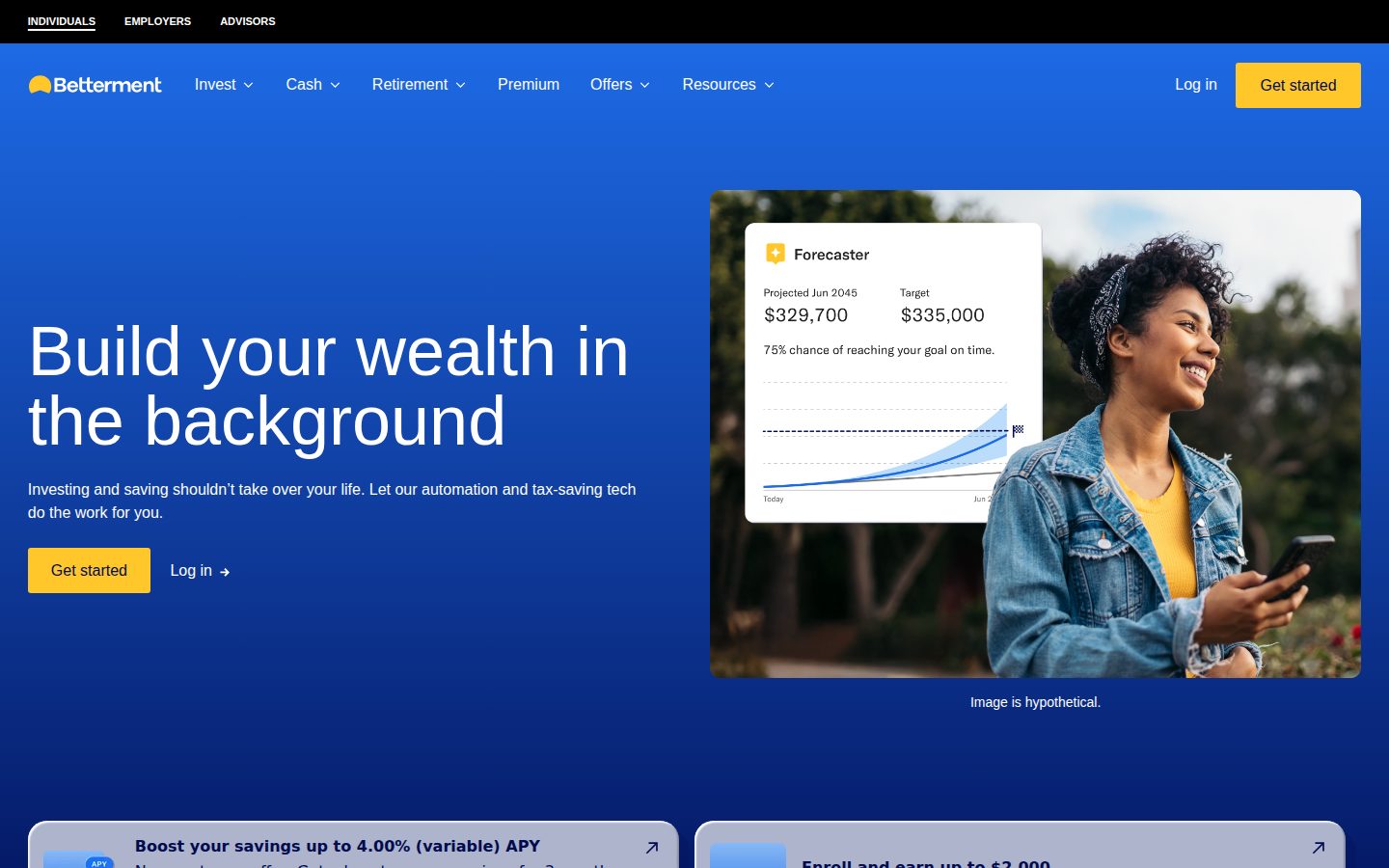
Features

Analytics

  • Retirement Planning Tools

    Builds a personalized retirement plan, recommends how much to save, and adjusts the plan over time based on the user's financial situation.

Automation

  • Automated Portfolio Rebalancing

    Continuously handles all trading, rebalancing, reinvesting, and tax management across globally diversified, expert-built portfolios without requiring user action.

  • Recurring Savings Automation

    Enables users to set up recurring savings transfers into their cash or investing accounts, automating consistent contributions toward financial goals.

  • Tax Coordination Across Accounts

    Coordinates retirement and taxable accounts together to maximize tax efficiency and minimize the overall tax burden across a user's portfolio.

  • Tax-Loss Harvesting

    Automatically turns market dips into tax savings by harvesting losses, with nearly 70% of eligible customers covering their taxable advisory fees through estimated tax savings.

Core

  • Goal-Based Portfolio Management

    Sets up separate investment portfolios tied to specific financial goals (e.g., retirement, vacation, down payment) with adjustable risk profiles based on goal type and time horizon.

  • High-Yield Cash Reserve

    A high-yield cash account offering up to 4.00% variable APY with $0 fees, FDIC insurance up to $8 million (joint), and easy transfers to investing accounts.

  • IRA Retirement Accounts

    Offers traditional, Roth, and SEP IRAs with automated technology, tax-coordination across retirement accounts, and personalized retirement planning tools.

  • Outside Account Aggregation

    Allows users to connect external accounts so Betterment can gather a fuller financial picture to inform goal-setting and investment recommendations.

  • Self-Directed Investing

    Lets users choose from thousands of stocks and ETFs with no commission or management fees, fractional share trading, and a tax impact preview before selling.

Support

  • Licensed Financial Advisor Access

    Provides access to licensed financial advisors by phone, with unlimited access available under the Premium plan for an additional 0.40% annual fee on balances of $100,000 or more.

Preview

Betterment desktop previewBetterment mobile preview

Pricing Plans

Popular

Digital (Base Investing)

Contact sales

Standard automated investing plan for most customers, fee charged as a percentage of assets under management (0.25% annually, implied by context)

  • Automated investing with expert-built diversified portfolios
  • Tax-loss harvesting to turn market dips into tax savings
  • High-yield Cash Reserve account at 3.25%–4.00% variable APY
  • IRA accounts (Traditional, Roth, SEP) with tax-advantaged growth
  • Self-directed investing with no commission or management fees
  • Ongoing rebalancing, reinvesting, and tax optimization

Premium

Contact sales

Upgraded plan with unlimited access to licensed financial advisors; requires minimum $100,000 in eligible investing balances. Costs an additional 0.40% on invested balances.

  • Everything in the base plan
  • Unlimited access to licensed financial advisors by phone
  • Requires minimum $100,000 across eligible investing balances
  • Personalized in-depth financial advice
  • Advanced tax coordination across accounts
  • Retirement planning with personalized recommendations

AI Panel Reviews

The Decision Maker

The Decision Maker

Strategic bet, vendor viability, timing, adoption approval
7.8/10

Betterment is the default robo-adviser for a reason — fiduciary, automated, no excuses.

Solid execution on automated investing with real tax efficiency. Not a competitive edge, but a smart financial infrastructure choice.

0.25% annually with tax-loss harvesting that covers advisory fees for nearly 70% of eligible users. That's not a feature — that's a payback argument the board can follow. FDIC coverage up to $8M joint through program banks is a genuine differentiator over Wealthfront and Schwab Intelligent Portfolios.

The tradeoff is visibility, not capability. Betterment is a black box by design. If your team wants to understand the portfolio decisions — or override them — the self-directed account exists, but that's a different product. Premium plan requires $100K minimum, so advisor access costs real money.

This won't move your competitive position. No API, no changelog, no integration story. It's personal financial infrastructure. Pilot it for your own balance sheet, not your product strategy.

Competitive Positioning5.0

Wealthfront and Fidelity Go are credible alternatives — adopting Betterment signals good hygiene, not market leadership.

Reputation Risk8.5

Fiduciary status and $8M FDIC coverage through program banks make this a defensible, board-neutral choice.

Speed to Value7.5

Automated onboarding and goal-based buckets mean the platform is functional from day one, no manual configuration required.

Strategic Fit5.5

This is personal wealth management, not a B2B or operational tool — it saves nothing in company cost structure.

Vendor Viability8.5

Betterment is one of the oldest robo-advisers in the category — a registered investment adviser and fiduciary with a decade-plus in market.

Pros

  • Tax-loss harvesting with documented payback: ~70% of eligible users offset advisory fees
  • FDIC coverage up to $8M joint — 16x the standard limit at most firms
  • 0.25% annual fee structure is transparent and switches automatically at $24K
  • Fiduciary status removes a real governance question

Cons

  • No API, no changelog, no integration path for teams that want programmatic access
  • Premium advisor access requires $100K minimum — high bar for most individual users
  • Portfolio decisions are opaque by design; limited override without switching to self-directed

Right for

Individual investors who want automated, low-effort wealth building without managing a single trade.

Avoid if

You need portfolio transparency or advisor access without a $100K threshold.

The Domain Strategist

The Domain Strategist

Craft and strategy in the product's domain — adapts identity per category, same lens
7.8/10

Betterment automates the retail wealth stack well, but stops short of institutional-grade financial architecture.

At 0.25% annually with tax-loss harvesting and goal-based bucketing, Betterment is a well-priced passive wealth engine for individuals. The fiduciary standing and $8M FDIC coverage signal serious infrastructure thinking.

Tax-loss harvesting covering advisory fees for nearly 70% of eligible customers is a meaningful efficiency claim — that's not a demo stat, that's a retention argument. The fee structure is clean: $5/month flat below $24K, then 0.25% AUM once balances or deposit cadence justify it. Compare that to Wealthfront's flat 0.25% with no flat-fee floor, and Betterment's pricing is slightly more accessible at entry but converges quickly.

The $8M joint FDIC coverage through program banks is architecturally smart — they've built sweep infrastructure that most retail platforms haven't bothered with. Goal-based portfolio management with outside account aggregation gives this more planning surface than a simple robo-adviser, though the advisor access requiring a $100K minimum and an extra 0.40% fee means the human layer is priced like a premium add-on, not a core service.

If you adopt this for personal wealth management, in three years you have a low-friction, tax-optimized core portfolio that largely runs itself. The ceiling is the Premium tier — there's no self-directed estate planning, no tax filing integration, no business account support. Solid personal finance infrastructure; not a CFO's enterprise treasury tool.

Category Positioning8.2

Betterment sits at the top of the robo-adviser tier alongside Wealthfront, differentiated by the $8M FDIC structure and tax-loss harvesting scale claims that most competitors don't match publicly.

Domain Fit6.5

Well-matched for individual retail investors; mismatched for any practitioner managing business accounts, corporate treasury, or complex multi-entity holdings.

Integration Surface7.0

Outside account aggregation connects external holdings, but no API access and no payroll or tax-filing integrations limit workflow depth for power users.

Long-term Implications7.8

Fiduciary standing plus automatic rebalancing and fee-tier auto-switching create a compounding, low-maintenance wealth path with minimal lock-in risk since assets are standard ETFs.

Strategic Depth7.5

Tax-loss harvesting and cross-account tax coordination show genuine planning depth, but no estate planning layer or advanced tax filing integration limits the ceiling.

Pros

  • Tax-loss harvesting with a documented 70% fee-offset rate for eligible customers
  • $8M joint FDIC coverage through program bank sweep — 16x standard limits
  • Clean fee floor: $5/month flat transitions automatically to 0.25% AUM at $24K
  • Fiduciary registered investment adviser status with goal-based multi-bucket tracking

Cons

  • Premium advisor tier costs an extra 0.40% annually and requires $100K minimum — expensive for mid-balance users
  • No API, no payroll integration, no tax-filing export limits CFO-grade workflow adoption
  • Self-directed account has no management fee but lacks the planning depth of the automated tier
  • No business or corporate account support — purely a retail personal finance product

Right for

Individual investors who want a tax-efficient, largely automated personal wealth engine with minimal ongoing management overhead.

Avoid if

You need business treasury management, corporate account infrastructure, or deep tax-filing integration with your existing finance stack.

The Finance Lead

The Finance Lead

Money, total cost of ownership, contracts, procurement math
7.8/10

0.25% annually, tax-loss harvesting that offsets fees for 70% of eligible users

Betterment's fee math is unusually honest for a retail investment platform. The $5/month-to-0.25% switch at $24K is clean, predictable, and documented without a sales call.

$5/month under $24K. 0.25% annually above it — or if you set $200+/month in recurring deposits. 3-year TCO on a $50K balance: $125/year, or $375 total. Premium adds 0.40%, totaling 0.65% annually — $650/year at $100K minimum. Tax-loss harvesting offsets that for nearly 70% of eligible customers, based on their pricing page. ROI story has teeth.

Tradeoff: Premium's $100K floor locks out younger accumulators. Wealthfront charges 0.25% flat with no such tier — simpler structure, no advisor upside. Betterment's FDIC coverage ($8M joint through program banks) is the standout cash feature, 16x category norm.

No auto-renewal risk — this is AUM-based billing, not a subscription trap. Cancel anytime, assets transfer out. Procurement is individual retail, so no contract negotiation room, but no procurement friction either. Billing model is as clean as this category gets.

Billing & Procurement8.5

Automatic fee-tier switch at $24K balance is clean; no invoice complexity, no onboarding cost.

Contract Flexibility8.5

AUM billing with no term lock-in; cancel and transfer assets without contractual penalty.

Pricing Transparency9.0

$5/month flat fee, 0.25% AUM threshold, and 0.40% Premium add-on all published without a sales call.

ROI Clarity8.0

Tax savings offset advisory fees for nearly 70% of eligible customers — a measurable, published ROI figure, not a hand-wave.

Total Cost of Ownership8.2

$375 over 3 years on $50K balance; tax-loss harvesting covers fees for ~70% of eligible users, per their published claim.

Pros

  • 0.25% annual fee is fully published — no sales call required
  • Tax-loss harvesting covers fees for ~70% of eligible users per their own data
  • $8M FDIC joint coverage through program banks — 16x standard
  • Self-directed investing carries zero management or commission fee

Cons

  • Premium human advisor access requires $100K minimum — excludes most accumulators
  • 0.25% AUM fee still trails Fidelity Go's zero-fee structure for balances under $25K
  • 4.00% Cash Reserve APY is variable — rate risk not priced in by most buyers

Right for

Individual retail investors with $25K–$250K who want automated portfolio management without active involvement.

Avoid if

You're under $100K and need regular human advisor access — the per-session add-on fee makes that expensive fast.

The Domain Practitioner

The Domain Practitioner

Daily hands-on reality in the product's domain — adapts identity per category, same lens
7.8/10

Betterment automates the boring parts of wealth-building — but power users will hit a ceiling

Solid robo-adviser with genuine tax infrastructure. The 0.25% annual fee and tax-loss harvesting claim covering fees for 70% of eligible customers is a credible value proposition for passive investors.

The $5/month flat fee under $24K is a fair on-ramp, and the automatic switch to 0.25% annually at $24K is clean fee design — no user action required. Tax-loss harvesting is the real differentiator. Wealthfront makes the same claim, but Betterment's 70% fee-offset stat is specific enough to take seriously. The $8M FDIC ceiling on joint Cash Reserve accounts is genuinely differentiated infrastructure, not marketing fluff.

Day-three reality: goal buckets and automated rebalancing run without friction. Outside account aggregation gives a fuller picture without manual reconciliation. Where it softens is the Premium tier — 0.40% additional fee plus a $100K minimum for unlimited advisor access is a steep unlock. Fidelity Go includes human advisor touch at no extra cost.

Self-directed investing with tax impact preview before a sale is a strong power-user feature — that's portfolio-level tax awareness most retail platforms skip. The ceiling is real though: no API, no docs, no changelog. Advanced users who want to script or model scenarios externally hit a wall fast.

Day-3 Reality8.2

Automated rebalancing, recurring transfers, and goal buckets run passively — minimal daily friction for the target user.

Documentation Practitioner-Fit6.5

Pricing page exists but no changelog, API docs, or technical depth — reads like product marketing, not practitioner documentation.

Friction Surface7.8

Fee structure auto-upgrades at $24K and Cash Reserve transfers are seamless; advisor access gating at $100K is the main recurring friction point.

Power-User Depth7.0

Tax impact preview on self-directed sales and cross-account tax coordination are genuinely advanced features, but no API or scripting surface limits sophisticated users.

Workflow Integration7.5

Outside account aggregation and multi-account tax coordination reduce context-switching, but no API means no integration into personal finance modeling workflows.

Pros

  • Tax-loss harvesting with a specific 70% fee-offset claim — not a vague benefit
  • $8M FDIC coverage on joint Cash Reserve accounts is a structural differentiator
  • Auto fee-tier switch at $24K removes a common friction point
  • Tax impact preview before selling in self-directed account is rare at this price point

Cons

  • Premium advisor access requires $100K minimum — Fidelity Go offers human touch with no such floor
  • No API, changelog, or technical docs limits power users and external modeling
  • 0.40% Premium surcharge on top of base fee compounds quickly on larger balances
  • No free trial means fee exposure starts at account open

Right for

Passive retail investors who want automated tax optimization without building or managing a portfolio themselves.

Avoid if

You want to script portfolio analysis, integrate with external tools, or need advisor access without a six-figure minimum.

The Power User

The Power User

Daily human experience, onboarding, polish, learning curve, reliability
8.1/10

Set it, forget it, and actually sleep — Betterment earns that promise

Betterment does the unglamorous work of investing so you don't have to think about it daily. Tax-loss harvesting alone covering fees for nearly 70% of eligible customers is a real number, not a marketing line.

The fee structure tells you who this is for. Under $24K you're paying $5/month flat — annoying but survivable. Hit $24K or set up $200/month in recurring deposits and it flips to 0.25% annually, automatically. That little escalator is genuinely thoughtful design. Wealthfront charges a flat 0.25% from dollar one. Schwab Intelligent Portfolios charges zero but sweeps your cash into lower-yield accounts. Betterment's model at least has a logic you can follow.

The goal-bucket system is where daily use actually lives. Retirement, vacation, down payment — separate risk profiles, one dashboard. Outside account aggregation means it's not flying blind on your full picture. The $8 million joint FDIC coverage on Cash Reserve is the kind of detail that sounds boring until it isn't.

The tradeoff: human advisor access costs a full extra 0.40% annually and requires $100K minimum. That's the Premium plan. For most people using this, that's out of reach for years. Mobile is full-featured on iOS and Android, not read-only — that matters for a product marketing itself as wealth in the background.

Daily Polish8.0

Goal-based buckets with adjustable risk profiles and a tax impact preview before selling suggests someone actually thought through the daily touch points.

Learning Curve8.5

The flat-to-percentage fee transition at $24K is automatic and the self-directed investing option with tax impact previews grows with you as you get more comfortable.

Mobile Parity7.8

iOS and Android apps are listed as full platforms, not companion apps — category norm for robo-advisers is mixed, and Betterment appears to clear that bar.

Onboarding Experience8.3

Answer questions about goals and risk tolerance, get placed into a diversified ETF portfolio — that's a 10-minute onboarding, not a homework assignment.

Reliability Feel8.0

Automated rebalancing, dividend reinvestment, and tax-loss harvesting running without user input implies solid background processing; no public evidence of systemic outages.

Pros

  • Tax-loss harvesting covered advisory fees for nearly 70% of eligible customers — that's a concrete, verifiable claim
  • FDIC coverage up to $8M on joint Cash Reserve accounts, 16x the standard limit
  • Fee structure has a real logic: $5/month flat until $24K, then 0.25% annually
  • Self-directed investing with no commissions and tax impact preview before you sell

Cons

  • Human advisor access locked behind $100K minimum and an extra 0.40% annually — that's premium pricing for a feature that should scale down
  • No free trial, no free plan — you're paying from day one even at small balances
  • Cash Reserve APY is variable, meaning that 4.00% headline rate can drift down without notice

Right for

Someone who wants automated wealth-building without staring at a portfolio every day.

Avoid if

You want hands-on trading or regular human advisor access without hitting $100K first.

The Skeptic

The Skeptic

Contrarian. Watch-outs, deal-breakers, broken promises, category patterns
7.8/10

16 years in, still standing — robo-advice's closest thing to a survivor

Betterment has outlasted most of its 2010-era peers. The fee structure is transparent, the FDIC-stacking story ($8M joint coverage) is a genuine differentiator.

Three tells I track in this category: vague fee language, no fiduciary disclosure, marketing that promises returns. Betterment clears all three. Fees are spelled out — $5/month under $24K, 0.25% above it. Fiduciary status is front-and-center. No return guarantees visible. That's rarer than it should be.

The tax-loss harvesting claim is specific and falsifiable: nearly 70% of eligible customers offset advisory fees through estimated tax savings. That's a number I can hold them to. Wealthfront makes similar claims. Schwab Intelligent Portfolios buries costs in cash drag. Betterment's structure is cleaner to audit.

Two flags. Exit portability is ETF-based, so in-kind transfers are possible — but goal-bucket setup and tax-coordination logic don't migrate. You're starting over behaviorally. And the Premium tier's $100K minimum means the advisor story is irrelevant for most users.

Competitive Differentiation7.4

The $8M FDIC coverage via program banks is a concrete moat; tax-loss harvesting is table stakes vs. Wealthfront but still ahead of Fidelity Go.

Exit Portability6.5

ETF holdings transfer in-kind, but goal-bucket logic, tax-coordination history, and behavioral scaffolding are platform-locked with no export story visible in docs.

Long-term Viability7.9

No changelog or API visible, but 16+ years of operation, registered investment adviser status, and a named banking partner (nbkc) suggest institutional durability.

Marketing Honesty8.5

Fee tiers are explicit, fiduciary status disclosed, and the 70% tax-savings claim is specific enough to be verifiable — no vague superlatives in evidence.

Track Record Match8.2

Betterment is one of two original robo-advisers still operating at scale; Wealthfront survived, FutureAdvisor did not — Betterment's pattern matches the survivors.

Pros

  • Fee structure is unusually transparent — $5/month flat or 0.25% AUM, auto-switching at $24K
  • $8M joint FDIC coverage through program banks is a genuine structural advantage
  • Tax-loss harvesting claim is specific and auditable, not just marketing copy
  • Self-directed account carries zero management fee — rare in the wrapper-fee robo category

Cons

  • Premium advisor access requires $100K minimum — irrelevant tier for most target users
  • No API, no changelog visible — hard to assess shipping cadence or roadmap health
  • Goal-bucket logic and tax-coordination history don't port cleanly if you leave

Right for

Retail investors who want low-effort, tax-aware automation and won't need to migrate platforms anytime soon.

Avoid if

You want unlimited human advisor access without a six-figure balance requirement.

Buyer Questions

Common questions answered by our AI research team

Features

What does Betterment's tax-loss harvesting actually do?

Tax-loss harvesting turns market dips into tax savings by selling losing positions to offset gains. Nearly 70% of eligible customers covered their taxable advisory fees through estimated tax savings.

Pricing

How much does Betterment charge for automated investing?

Automated investing costs $5/month for balances under $24K (without $200+ monthly recurring deposits), or 0.25% annually once you reach $24K or set up $200+ in monthly recurring deposits.

Security

How is cash protected at Betterment?

Cash in Betterment's Cash Reserve is FDIC insured up to $4M (individual) or $8M (joint) through program banks — 16x what most firms offer. Betterment itself is not a bank.

Features

Can I trade individual stocks on Betterment?

Yes, Betterment's self-directed investing lets you trade thousands of stocks and ETFs with no commissions and no management fee — Betterment waives its wrap fee on self-directed assets.

Pricing

What happens to my fee once my balance hits $24,000?

Once your balance reaches $24,000 (or you set up $200+/month in recurring deposits), you automatically switch from the $5/month flat fee to a 0.25% annual fee.

Product Information

Platforms

webiosandroid

About Betterment

Betterment is a New York-based automated investing and savings platform offering robo-advisory portfolios, cash management accounts, and retirement planning tools for individual investors.

Also in AI Finance