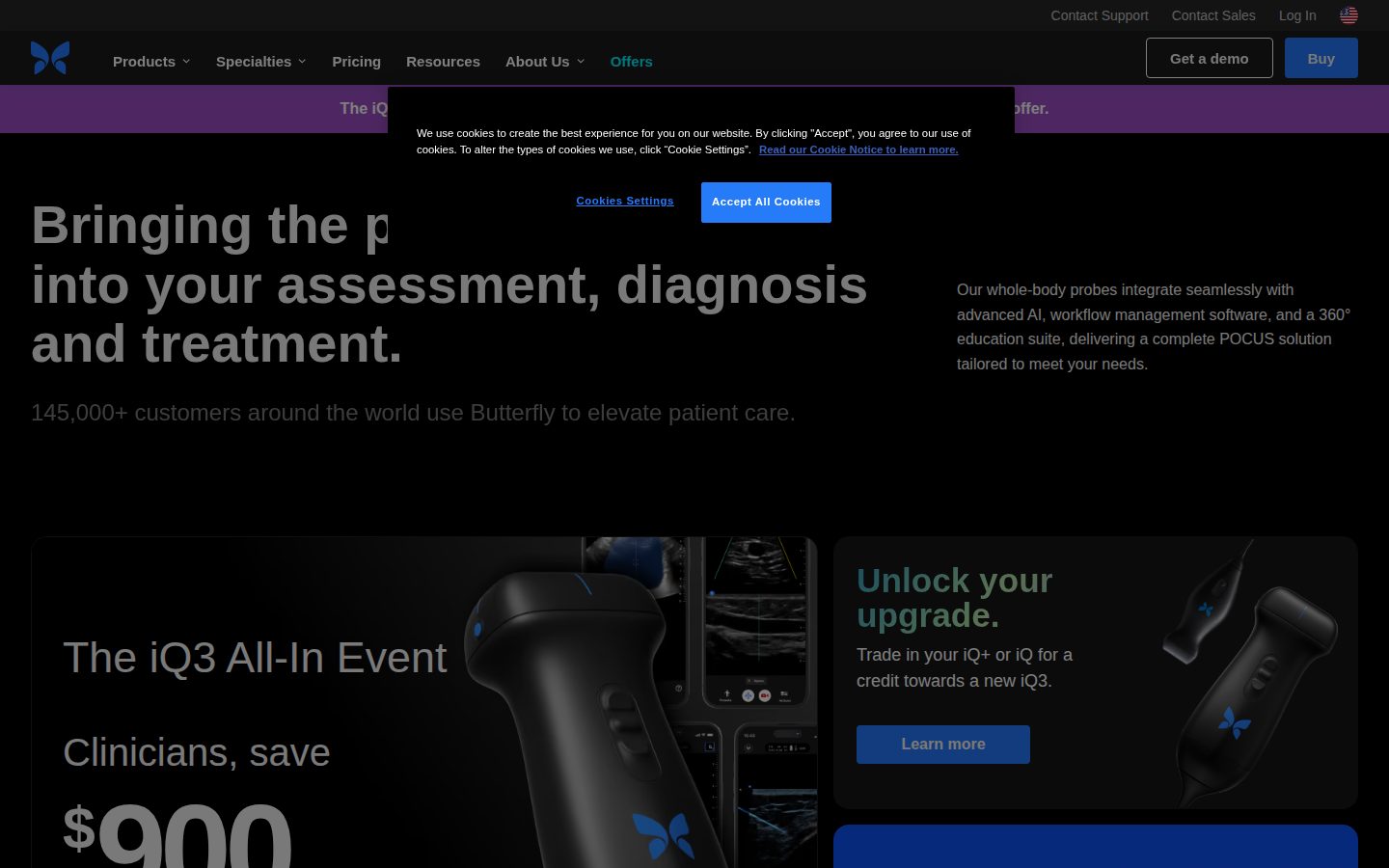
Handheld whole-body ultrasound with AI for point-of-care clinical use
Butterfly Network is a point-of-care ultrasound (POCUS) platform for individual clinicians, hospitals, and medical educators.
AI Panel Score
6 AI reviews
Reviewed
In practice, a clinician carries a single Butterfly iQ3 probe and connects it to a mobile device to perform ultrasound exams at the bedside, in an emergency department, or in a rural clinic. The probe covers whole-body imaging without requiring separate transducers for different anatomical regions. Captured images feed into the Butterfly software platform, where AI tools assist with image analysis and workflow steps such as documentation and charge capture.
The platform includes three distinct layers beyond the hardware: AI-powered image guidance, a workflow management system designed for health system-wide deployment, and a 360° education suite aimed at training clinicians on POCUS technique and interpretation. A published case study from the University of Rochester Medical Center reported a 116% increase in ultrasound charge capture after system-wide deployment. Butterfly also cites third-party research showing POCUS use reduced patient length of stay by 1.1 days and reduced costs by 50% in one hospital system.
Butterfly Network targets three segments: individual clinicians building a private practice, health systems seeking a centralized ultrasound platform across facilities including rural sites, and medical schools incorporating POCUS into curricula. The iQ3 is sold with public pricing; a limited-time promotional discount of $900 is advertised, and a trade-in program exists for prior iQ+ and iQ models. Competitors in the handheld ultrasound category include Philips Lumify, GE Healthcare Vscan Air, and Clarius.
The Butterfly iQ3 probe connects to iOS and Android mobile devices, with workflow and image management accessible via the Butterfly app. Health system deployments integrate with existing clinical workflows for documentation and billing. The platform is cleared for clinical use and is available in multiple countries, with 145,000+ customers reported worldwide.

Advanced AI is integrated with the probe to assist clinicians in interpreting ultrasound images during assessments, diagnoses, and treatments.
A clinical capability for performing lung ultrasound to detect and quantify B-lines as part of pulmonary disease assessment.
System-wide POCUS deployment enables hospitals to improve ultrasound charge capture, as evidenced by a reported 116% increase at University of Rochester Medical Center.
A configurable ultrasound solution for individual clinicians to incorporate POCUS into their personal practice workflows.
A complete POCUS solution that integrates hardware, AI, workflow software, and education into a single platform tailored to clinical needs.
A single handheld probe that connects to smartphones or tablets and supports whole-body imaging at the point of care.
A software layer that manages ultrasound workflows, enabling system-wide deployment and centralized delivery of POCUS across care settings.
An integrated ultrasound platform designed for deployment across an entire hospital or care system, centralizing ultrasound software and delivery.
The probe is compact enough to be carried in a clinician's pocket throughout a shift, enabling immediate bedside imaging without waiting for radiology equipment.
A built-in education suite designed to train clinicians and medical students in point-of-care ultrasound techniques and interpretation.
A dedicated ultrasound platform built specifically for medical education environments, including academic institutions and training programs.
Whole-body handheld ultrasound probe for individuals, health systems, and medical education, with AI and workflow software integration.
One $3,899 probe replacing a cart: the ROI math is hard to argue with.
“Butterfly iQ3 is a mature POCUS platform with 145,000+ customers and published outcome data. The hardware-plus-AI model is differentiated; the enterprise integration story is solid.”
145,000 customers and a published 116% charge capture increase at University of Rochester aren't marketing claims — they're defensible board numbers. The iQ3 at $3,899 with a 3-year warranty is a one-time buy that replaces multi-transducer carts costing multiples of that. Against Philips Lumify or GE Vscan Air, Butterfly's whole-body single-probe story is the clearest differentiator.
Two things I'd push on. One: DICOM integration requires an additional purchase on individual plans — that's a gotcha for any health system already running PACS. Two: the Advanced AI tier with Auto B-Line Counter and Auto Bladder Volume is a separate plan, so budget accordingly at the enterprise level.
For health systems, the 360° education suite and SSO via SAML 2.0 make system-wide rollout credible. The 1.1-day reduction in patient length of stay cited in third-party research is the kind of outcome a CFO understands. Pilot a department, measure charge capture, then scale.
Single whole-body probe versus multi-transducer competitors like GE Vscan Air is a real operational advantage for clinicians.
University of Rochester and third-party clinical research give this credibility that peers and the board will recognize.
116% charge capture improvement post-deployment is a fast, measurable return that finance can track.
Moves POCUS from a shared radiology resource to a clinician-carried tool — that's workflow transformation, not cost trimming.
Publicly traded, semiconductor-based manufacturing, 145,000+ customers — they're not going anywhere.
Health systems and emergency departments that want bedside ultrasound without radiology cart logistics.
Your team won't commit to POCUS training — the hardware investment stalls without clinical adoption.
A $3,899 probe that rewires how medicine gets practiced at the bedside.
“Butterfly iQ3 is the most architecturally complete POCUS platform in the handheld category — hardware, AI, workflow, and education in a single deployment. The 116% charge capture improvement at University of Rochester isn't a vanity metric; it's a clinical operations signal.”
The semiconductor-based single-probe design is the right clinical bet. Eliminating transducer swaps changes bedside behavior — clinicians actually carry it, which means it gets used. B-line quantification and auto bladder volume are clinical-grade AI features, not demo features. That's a meaningful difference from where Philips Lumify sits today.
The three-layer architecture — hardware, workflow management, 360° education suite — reads like someone who's deployed a clinical platform before, not just built a device. SAML 2.0 SSO and MDM support tell me enterprise IT will let this through the firewall. DICOM integration requiring an add-on purchase on individual plans is a real friction point for solo practitioners who want PACS connectivity day one.
If a health system deploys this at scale, in three years they own a documented POCUS competency baseline across their medical staff. That's durable institutional value. The risk is AI interpretation ceiling — as regulatory scrutiny on diagnostic AI tightens, the feature roadmap lives at the FDA's pace, not Butterfly's.
145,000+ customers and a three-segment strategy spanning individual clinicians, health systems, and medical education gives Butterfly a broader moat than Lumify or GE Vscan Air.
Pocket-carry form factor, bedside workflow integration, and a built-in education suite match how emergency, critical care, and rural clinicians actually operate.
SAML 2.0 SSO and MDM support are enterprise-ready, but DICOM/PACS integration requiring an add-on on individual plans creates a friction point for solo clinicians.
System-wide deployment builds institutional POCUS competency over time, but AI diagnostic feature velocity is constrained by FDA clearance timelines.
Single-probe whole-body coverage plus clinical AI tools like Auto B-Line Counter shows genuine platform thinking, not hardware-first feature stacking.
Health systems and academic medical centers deploying POCUS broadly across care settings including rural and emergency.
Solo clinicians who need immediate PACS integration without paying for add-ons.
$3,899 one-time probe, 116% charge capture lift — the math works
“Hardware-first model at $3,899 with a 3-year warranty sidesteps the per-seat SaaS trap. ROI evidence is unusually concrete for medical hardware.”
Sticker is $3,899 for the iQ3 — one-time, not recurring. Three-year warranty included. Compare to Philips Lumify at ~$199/month ($7,164 over 3 years) or GE Vscan Air at comparable one-time pricing. At 50 clinicians, fleet cost is $194,950 hardware-only. Add DICOM integration — separate purchase, price unpublished — and enterprise software licensing. Year 3 TCO is opaque without a sales call.
The ROI story is unusually honest. University of Rochester posted a 116% charge capture increase post-deployment. Third-party data shows 1.1-day length-of-stay reduction and 50% cost reduction in one system. Those are named, cited outcomes — rare in this category. Auto B-Line Counter and Auto Bladder Volume Calculation sit behind the Advanced Technology plan; pricing for that tier isn't public.
SSO via SAML 2.0 and MDM support signal enterprise readiness. DICOM add-on cost and Advanced Technology plan pricing require vendor contact — that's the procurement friction point. Contract terms aren't published. For individual clinicians, the math is clean. For health systems, budget a negotiation.
One-time hardware model reduces recurring billing friction; DICOM and enterprise tier add-ons reintroduce procurement complexity.
No published contract terms, auto-renewal windows, or cancellation clauses — standard opacity for medical hardware vendors.
iQ3 at $3,899 is public, but Advanced Technology plan pricing and DICOM add-on costs require a sales call.
116% charge capture increase at University of Rochester and 1.1-day LOS reduction are named, cited outcomes — not hand-wavy estimates.
Hardware one-time cost is clear; enterprise software tiers, DICOM integration fees, and fleet management costs are unpublished.
Health systems and individual clinicians who can model ROI on charge capture and want a one-time hardware cost over recurring SaaS fees.
Your procurement team needs fully published TCO before vendor contact and can't absorb opaque enterprise software tier pricing.
One $3,899 probe that replaces a cart — if you can build the habit
“Butterfly iQ3 is the most complete handheld POCUS platform on the market for clinicians who commit to it. The hardware story is strong; the daily workflow friction is where it earns or loses you.”
Single probe, whole-body coverage. That's the clinical pitch, and it holds up. The iQ3 at $3,899 with a 3-year warranty is defensible against Philips Lumify's subscription model or GE Vscan Air's dual-probe requirement. Lung B-line detection and auto bladder volume are the kind of AI assists that actually change a bedside workflow — not demo features. The 116% charge capture improvement at University of Rochester is a real number health system administrators will print out.
Day-three reality: DICOM integration requires an additional purchase on individual plans. That's a quiet gotcha. If your EMR workflow depends on PACS push, budget for it. The 360° education suite helps with technique, but image interpretation confidence takes months of reps — the AI guides you, it doesn't replace that learning curve.
For rural clinicians and emergency medicine, this fits naturally in a pocket and removes the 'waiting for radiology' fight entirely. For hospitalists in a PACS-heavy system, the integration cost and setup overhead are real. 145,000+ customers worldwide suggests the adoption curve is real, not vaporware.
Single-probe whole-body coverage survives daily use; DICOM requiring extra purchase on individual plans is a recurring friction point.
Buyer Q&A answers are specific and technically grounded — SAML 2.0, MDM, DICOM details — suggesting someone clinical-adjacent wrote them, though no public changelog or API docs exist.
iOS and Android support removes device lock-in, but PACS integration costs and the add-on AI tools in the Advanced Technology tier create tiered friction depending on your plan.
Auto B-Line Counter and Auto Bladder Volume on the Advanced Technology plan show a clear beginner-to-power-user progression tied to real clinical workflows.
SSO via SAML 2.0 and MDM support indicate genuine health system IT readiness, not just a consumer app with enterprise aspirations.
Emergency medicine physicians, rural clinicians, and health systems wanting a single centralized POCUS platform with billing and workflow infrastructure.
Solo practitioners who need immediate PACS integration without additional purchase or who won't commit to building POCUS technique over months.
A $3,899 probe that makes a radiologist's cart look absurd
“Butterfly iQ3 puts whole-body ultrasound in a coat pocket — genuinely useful hardware paired with AI and education tools that health systems are actually deploying. The price is real, the clinical outcomes data is real, and 145,000 customers suggests this isn't vaporware.”
The iQ3 is one probe for everything. Cardiac, lung, abdominal — no swapping transducers, no waiting for the cart. For a rural clinician or an ER doc, that's not a feature, that's a different job. The 116% charge capture improvement at University of Rochester isn't marketing fluff; that's a CFO conversation that gets a health system to actually deploy this thing across facilities.
The AI layer — Auto B-Line Counter, Auto Bladder Volume — does the work that used to require a specialist looking over your shoulder. That's real daily value, not a checkbox. The 360° education suite means new clinicians aren't just handed hardware and told good luck.
The tradeoff: DICOM integration costs extra on individual plans, which stings at $3,899 already. And compared to Clarius or Philips Lumify, Butterfly's software depth means more to learn upfront. Day one, the hardware wows you. Day thirty, you're either deep in the workflow or annoyed by the billing add-ons.
AI-guided imaging and workflow software feel considered, but DICOM requiring an add-on purchase suggests some rough edges in the daily clinical loop.
POCUS itself is a skill, and the platform depth for health system deployments adds configuration overhead that solo clinicians will feel early on.
iOS and Android support isn't an afterthought here — the entire product is built around a mobile device as the primary screen, which is the right call.
The 360° education suite built into the platform is a genuine welcome mat, though whole-body POCUS has a real learning curve regardless of tooling.
145,000+ customers and a 3-year warranty on the iQ3 hardware signals a mature, accountable product — not a startup experiment.
Emergency physicians, rural clinicians, and health system administrators who want one portable imaging tool that works across departments.
You need deep radiology-grade imaging review workflows without paying for additional integration modules.
3,899 dollars, one probe, real hospital data — harder to dismiss than most
“Butterfly iQ3 has actual deployment numbers from named institutions and a hardware moat competitors haven't fully matched. Exit story is messier than software — you've got proprietary hardware in your pocket.”
Three tells worth flagging. One: pricing page lists iQ3 as 'Free' — that's a data error, not honesty; the buyer FAQ correctly says $3,899. Two: no changelog, no API, no docs publicly listed. Three: 'democratize medical imaging' is the kind of language that ages poorly in SEC filings. That said, the 116% charge capture increase at University of Rochester is a named institution with a specific metric. That's not typical marketing filler.
Philips Lumify and GE Vscan Air are real competitors. Butterfly's single-probe whole-body coverage is a genuine differentiator — Lumify requires swappable transducers. The 360° education suite and SSO/MDM enterprise stack suggest a real health system sales motion, not just a gadget play. 145,000 customers worldwide is either auditable or it isn't — no public data to verify.
Exit portability is the honest concern. Images via DICOM/PACS helps, but the probe itself is proprietary silicon. If Butterfly shifts pricing or shuts a tier, you're holding a $3,899 paperweight. They're a public company — that's verifiable stability, but also quarterly pressure that has historically forced POCUS pivots.
Single probe covering whole-body imaging is a concrete hardware advantage over Philips Lumify's multi-transducer model; B-Line Auto Counter AI is a named clinical differentiator.
DICOM/PACS integration exists but requires additional purchase on individual plans; the proprietary iQ3 hardware creates real lock-in that pure software platforms don't.
Public company status provides auditable stability, but no changelog or public roadmap is visible — quarterly earnings pressure has historically caused POCUS platform pivots in this category.
Pricing page labels iQ3 as 'Free' — contradicts the $3,899 buyer FAQ answer directly; 'democratize' headline language is aspirational, though named case studies add credibility.
Publicly traded company, 145,000+ reported customers, and a named University of Rochester deployment with a specific 116% metric — stronger evidence than most POCUS entrants showed.
Health systems or ED clinicians who need a single portable probe with enterprise workflow integration and can absorb the $3,899 hardware bet.
You need clean data portability or are evaluating on a short procurement cycle where hardware lock-in is a disqualifier.
Common questions answered by our AI research team
The iQ3 probe costs $3,899 and includes a 3-year warranty.
The Advanced Technology plan includes Auto Bladder Volume Calculation and Auto B-Line Counter AI tools.
Yes, Single Sign-On (SSO) is supported, validated via the SAML 2.0 protocol against a corporate user database.
Yes, Mobile Device Management (MDM) restricts Butterfly Compass ecosystem login to authorized devices only, enforcing consistent security policies.
Yes, Basic DICOM (PACS/MWL) integration is available, though it requires an additional purchase on individual plans.