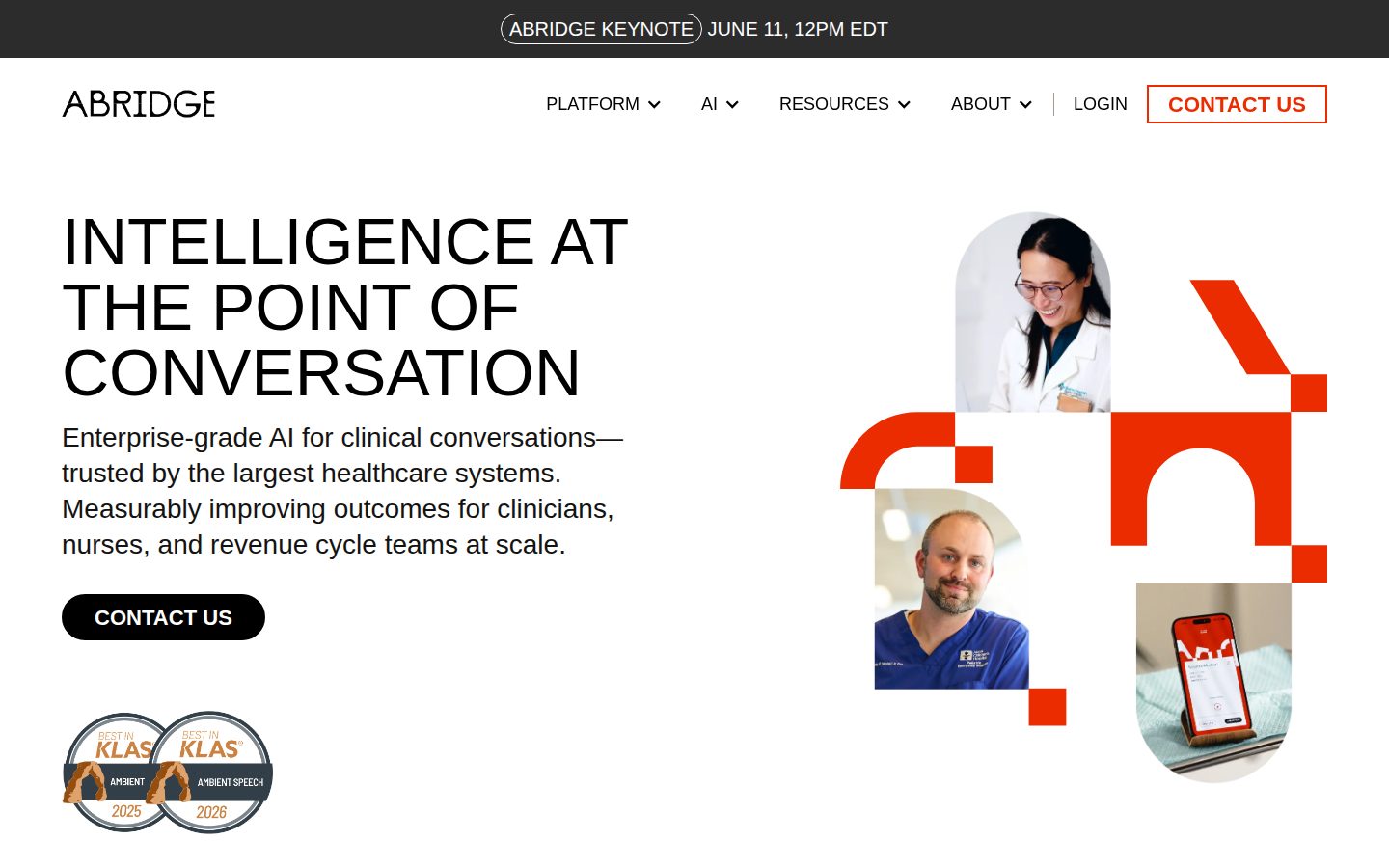
AI clinical documentation from live patient-clinician conversations
Abridge is an ambient AI clinical documentation platform for healthcare systems, clinicians, and nurses.
AI Panel Score
6 AI reviews
Reviewed
In practice, a clinician speaks with a patient as they normally would, and Abridge captures the conversation to generate a structured clinical note in real time—without requiring manual transcription or post-visit dictation. The workflow is embedded directly inside Epic, spanning versions from Haiku to Hyperdrive, so clinicians never leave their existing EHR environment to access the tool.
Beyond note generation, Abridge addresses revenue cycle workflows by identifying documentation gaps at the point of conversation. It also supports nursing documentation and multilingual clinical encounters, serving diverse care settings and specialties. The platform's Contextual Reasoning Engine is the underlying infrastructure layer the company highlights as responsible for producing billable and compliant output, not just transcription.
Abridge targets large enterprise healthcare systems; named customers include Johns Hopkins Medicine, Kaiser Permanente, Duke Health, and Mayo Clinic. Pricing is not publicly listed and appears to be enterprise-contracted. Competitors in the ambient clinical AI documentation category include Nuance DAX (Microsoft), Suki, and Nabla.
The platform integrates natively with Epic and is built to operate across multiple care settings and specialties. Deployment appears to be cloud-based and enterprise-managed, with no self-serve onboarding visible on the public site.

Captures patient-clinician conversations in real time and automatically converts them into structured, clinically useful, and billable clinical note drafts integrated directly into EHR workflows.
Integrates evidence-based content from UpToDate (Wolters Kluwer), NEJM Group, and JAMA Network to surface context-aware, peer-reviewed clinical insights to clinicians before, during, and after patient conversations within existing workflows.
An AI architecture that produces contextually aware notes by dynamically integrating data from previous patient encounters, health system-specific guidelines, and individual clinician preferences to generate more clinically useful and billable documentation.
A first-of-its-kind technology that maps every highlighted region of an AI-generated summary back to the substantiating evidence in the source conversation transcript and underlying audio, enabling clinicians to trust and verify AI outputs.
Provides health system administrators with tools to control user access and track and monitor Abridge usage across the entire health system in a single centralized dashboard.
Detects medications and other orders mentioned during patient encounters and surfaces them directly inside Epic, allowing clinicians to rapidly place orders based on the conversation without duplicate data entry.
AI models intelligently recognize and group medical problems using language that aligns with appropriate billing codes, enabling more precise and revenue-cycle-compliant clinical notes at the point of care.
Supports 55+ clinical specialties and operates across outpatient, emergency department, and inpatient care settings, with specialty-specific note structures such as H&P, progress notes, and consult note types for inpatient care.
Provides an automatic speech recognition engine purpose-built for healthcare, supporting 28+ languages and handling cross-talk, background noise, and rapid language switches—including when medical interpreters are present.
Extends ambient AI documentation capabilities beyond physicians to nursing staff, with purpose-built workflows co-developed with partners such as Epic and Mayo Clinic to support nursing-specific documentation needs.
Integrates natively across the full Epic ecosystem—from Haiku to Hyperdrive—allowing clinicians to capture conversations, review notes, and close documentation without leaving Epic workflows, including SmartPhrases and templates.
Delivers enterprise-grade, 100% HIPAA-compliant security with multiple layers of controls, encrypting all data in-transit and at rest with 256-bit encryption and storing it exclusively within secure, U.S.-based data centers.
Abridge is an enterprise-only AI ambient medical scribe platform sold exclusively through direct health system contracts. There is no public pricing page, no self-serve signup, no individual or small-practice tier, and no free trial. All pricing is negotiated directly with Abridge's enterprise sales team via a 3–6 month procurement process. Third-party analyst estimates place enterprise pricing roughly in the range of $250–$800/month per provider depending on contract size, integration depth, and volume, but Abridge does not publish or confirm any rate card publicly.
Johns Hopkins, Mayo, Kaiser on the roster — this isn't a pilot-stage bet.
“Abridge is the category leader in ambient AI clinical documentation, with deep Epic integration and a serious enterprise customer list. No public pricing means every deal is a negotiation, which matters.”
55 specialties, 28 languages, and Mayo Clinic running 2,000+ physicians on it. That's not a proof-of-concept customer list — that's a platform that's been stress-tested at scale. The Linked Evidence feature, which maps every AI summary back to the source audio, is the kind of trust infrastructure that gets past clinical governance committees.
The Epic native integration — Haiku through Hyperdrive — is the real moat here. Nuance DAX has the Microsoft distribution muscle, but Abridge built inside Epic rather than alongside it. That's a meaningful difference when your clinicians won't tolerate workflow disruption.
The tradeoff: no public pricing, no self-serve trial, no changelog visibility. You're buying blind on cost and committing your entire EHR environment to a vendor relationship you can't stress-test cheaply. Get the contract terms before your Epic team falls in love with the demo.
Nuance DAX has Microsoft's weight behind it, but Abridge's Contextual Reasoning Engine and nursing-specific workflows are differentiated, not just competitive.
Peer-reviewed evidence integration from NEJM and JAMA, HIPAA-compliant 256-bit encryption, and marquee health system logos make this a defensible board conversation.
Epic-native workflow means no parallel tool adoption, but enterprise contracting with no trial path will slow time-to-deployment.
Real-time prior authorization and revenue cycle gap detection push this beyond documentation savings into clinical operations advancement.
Named customers include Johns Hopkins, Kaiser Permanente, and Mayo Clinic — systems that run multi-year due diligence before signing anything.
Large health systems already on Epic that need ambient documentation at scale across multiple specialties and care settings.
You need transparent pricing or a low-commitment pilot before locking in an enterprise EHR integration.
Abridge is the ambient documentation bet that large health systems should take seriously right now.
“55+ specialties, native Epic embedding, and a Contextual Reasoning Engine that targets billing compliance — not just transcription. Johns Hopkins, Mayo, Kaiser, and Duke are real validation signals, not press release padding.”
The Linked Evidence feature is the most clinically significant differentiator here. Mapping every AI-generated summary region back to the source audio means attending physicians can actually defend their documentation in a peer review or audit — that's not a UX feature, that's a liability management feature. No public evidence Nuance DAX has matched this at the same architectural depth.
The Smart Problem Grouping and Billing Alignment capability signals someone who understands how revenue cycle and clinical documentation are actually the same problem. Real-time prior authorization at the point of conversation, announced August 2025, extends that logic further. If this delivers, it compresses what today takes a separate PA workflow into the encounter itself.
The tradeoff I'd flag to any CMO: this is an Epic-first architecture. If your system runs Cerner or Oracle Health, Abridge's deepest integration value disappears. Enterprise-contracted pricing with no public floor also means budget predictability requires negotiation, not procurement catalog math.
Peer-reviewed evidence surfacing via UpToDate, NEJM, and JAMA Network differentiates Abridge from Suki and Nabla, which remain documentation-only plays without clinical decision support layering.
28+ languages, 55+ specialties, nursing-specific workflows co-developed with Mayo Clinic — this maps to how large academic medical centers and community health systems actually operate.
Native embedding across Haiku to Hyperdrive with SmartPhrase and template support means zero context-switching — clinically, that's the only integration that actually changes behavior.
Adoption at scale creates deep workflow dependency inside Epic; if your system ever migrates EHRs, the integration value resets to near zero.
Contextual Reasoning Engine integrating previous encounter data, health-system guidelines, and clinician preferences shows architecture built for clinical nuance, not generic LLM transcription.
Large Epic-deployed health systems looking to reduce after-hours charting burden and tighten revenue cycle compliance simultaneously.
Your system runs Cerner or Oracle Health and you need ambient documentation with equivalent EHR-native depth.
55 specialties, zero published pricing — strong clinical AI, procurement nightmare.
“Abridge has Johns Hopkins, Kaiser, Mayo. No pricing page, no free trial, no self-serve anything. You're buying through a sales cycle.”
The clinical depth is real. 55+ specialties, 28+ languages, Epic-native across Haiku to Hyperdrive, nursing workflows co-built with Mayo Clinic. The Contextual Reasoning Engine producing billable-aligned documentation isn't just transcription — Smart Problem Grouping maps to billing codes at point of care. That's revenue cycle value, not just clinician convenience. Named anchor clients include Duke Health and Kaiser Permanente.
No published price. Zero. Category norm for enterprise health IT is $20-$80/seat/month — Nuance DAX runs roughly $150-$600/provider/year depending on contract. Abridge almost certainly lives in that range, likely higher given the feature breadth. A 200-provider system at $50/seat/month = $120K/year. Year 3 with seat creep and add-ons, budget $200K+. No invoice to verify any of this.
Contract terms aren't public either. No termination for convenience language visible, no auto-renewal window disclosed. Procurement friction is high — no trial, no self-serve, no pricing page. Nuance DAX carries Microsoft's contract infrastructure; Abridge is a Series C startup. Procurement will ask about that.
Enterprise-only, sales-gated, no trial or self-serve path — procurement cycle will be long and friction-heavy.
No public contract terms, auto-renewal windows, or cancellation provisions visible anywhere on the site.
No pricing page, no tiers, no published rates — contact-only, full stop.
Billable note alignment, after-hours charting reduction, and revenue cycle gap identification are measurable outputs — ROI story is more concrete than most ambient AI competitors.
No public rates; category suggests $150-$600/provider/year, but integration, training, and enterprise onboarding costs are entirely opaque.
Large health systems already on Epic with budget for enterprise AI contracts and a procurement team to negotiate them.
You need published pricing, a trial period, or contract flexibility before committing.
Epic-native ambient AI that actually fits clinical workflow, not around it
“Abridge sits inside Epic natively—Haiku to Hyperdrive—so the charting friction that kills resident morale largely disappears at the point of care. The enterprise-only model means no solo practice or small group gets access, and pricing opacity makes budget conversations painful.”
The Contextual Reasoning Engine isn't marketing fluff—it's doing something Nuance DAX hasn't fully cracked: pulling prior encounter data and health system guidelines into note generation contextually, not just transcribing and dumping text into a template. Linked Evidence, which maps every AI-generated summary back to the source audio, is the feature I'd demo to any skeptical attending. No more 'where did that come from?' when reviewing a note you didn't type. That's trust infrastructure, and ambient AI without it is a liability.
The 55+ specialties and 28+ languages matter operationally. AltaMed deploying this for multilingual communities isn't a marketing case study—it's solving a real interpreter workflow problem. Automated Order Queuing surfacing medications directly in Epic removes a duplicate-entry step that adds minutes per encounter at scale. Smart Problem Grouping aligning to billing codes means revenue cycle isn't chasing documentation gaps post-visit.
The tradeoff: zero self-serve. No free trial, no pricing page, no solo practitioner path. Small practices are excluded entirely. Deployment is enterprise-managed, which means IT dependency for rollout and change management overhead. If your health system isn't already on Epic, Abridge isn't your tool.
Epic-native embed means no context switching; Linked Evidence and order queuing reduce post-visit cleanup, but enterprise IT dependency could slow initial configuration.
No public changelog or API docs visible, but specialty-specific note structures across 55+ specialties and co-developed nursing workflows with Mayo Clinic suggest clinical input shaped the product.
Ambient capture with multilingual support across 28+ languages and cross-talk handling eliminates the manual correction loop that plagues competitors like Suki in noisy care settings.
Clinician preference learning in the Contextual Reasoning Engine and enterprise analytics dashboard give advanced users customization depth, though discoverability can't be assessed without access.
Full Epic ecosystem coverage from Haiku to Hyperdrive with SmartPhrases and templates is the deepest EHR integration in the ambient AI category.
Mid-to-large Epic-based health systems looking to cut after-hours charting and close revenue cycle gaps at the point of care.
Your practice isn't on Epic or you need transparent pricing before entering a vendor conversation.
The ambient note-taker that actually lives inside Epic — not beside it
“Abridge is doing something real for clinicians drowning in after-hours charting. The Epic-native integration and 55+ specialty support put it ahead of most ambient AI competitors.”
Johns Hopkins, Kaiser, Mayo Clinic. That's not a beta customer list. That's a product that survived procurement, credentialing, and clinical informatics scrutiny at some of the most demanding health systems in the country. The Contextual Reasoning Engine isn't just transcription — it's generating billable notes that account for previous encounters and health system guidelines. That's the gap Nuance DAX hasn't fully closed.
The Epic deep integration is the real differentiator. Clinicians don't leave their workflow. SmartPhrases, order queuing, nursing documentation — it's all in there. The Linked Evidence feature, where every AI summary traces back to the actual audio, is smart trust-building. Day three, when you're about to sign a note you didn't fully review, that matters.
The tradeoff is real though: no pricing page, no self-serve trial, no solo-practice path. This is enterprise-or-nothing. If you're a small clinic or independent provider, Abridge isn't coming for you anytime soon.
Linked Evidence tracing summaries back to source audio shows serious attention to the moments clinicians actually stress about.
28+ language support and 55+ specialty-specific note structures suggest the product scales with clinical complexity over time.
iOS and Android are listed as supported platforms, and Epic Haiku is a mobile EHR — so mobile use appears intentional, not an afterthought.
No self-serve trial and enterprise-only contracting means onboarding is a multi-month IT project, not a first-ten-minutes experience.
HIPAA compliance with 256-bit encryption and U.S.-only data centers signals infrastructure maturity expected at Mayo Clinic scale.
Large health systems already on Epic that need to reduce after-hours charting across multiple specialties and care settings.
You're a small or independent practice looking for a self-serve ambient documentation tool with transparent pricing.
Epic-native moat, zero public pricing — the kind of bet that requires a procurement team
“Abridge has the customer logos that make this category real: Johns Hopkins, Kaiser, Mayo. The Epic deep integration and 55+ specialty support aren't vaporware — they're the actual product story.”
Three tells worth noting. One: no pricing page, no changelog, no API docs visible. That's a feature for enterprise sales cycles, not a bug — but it means you're buying blind on cost. Two: the Contextual Reasoning Engine is doing heavy marketing lifting. 'Contextually aware and billable' is a claim that either holds up in an audit or it doesn't — no public evidence either way. Three: Linked Evidence, which maps AI output back to source audio, is a genuinely differentiated trust mechanism. Nuance DAX can't point to that specifically.
The customer list anchors this. Mayo Clinic co-developing the nursing workflow, 2,000+ physicians on record — that's not a pilot. Multilingual support across 28+ languages with real deployer AltaMed is concrete, not a roadmap promise.
The exit story is the real concern. Epic-native is a moat and a trap simultaneously. If you leave, you're rebuilding documentation workflows inside EHR from scratch. No self-serve, no API, no migration tooling visible. Suki and Nabla both offer lighter-touch options if this contract goes sideways.
Linked Evidence audio traceability and real-time prior authorization at the point of conversation are specific features Nuance DAX and Suki haven't publicly matched at this depth.
Epic-native with no visible API or data export docs means migration is a procurement and IT project, not a product decision — high switching costs baked in by design.
No public funding disclosure, but Mayo Clinic and Kaiser as design partners plus August 2025 feature shipping suggests an active, well-resourced team — not a zombie vendor.
'Intelligence at the point of conversation' is unusually restrained for AI healthcare — but 'first-of-its-kind' for Linked Evidence is the kind of superlative that ages poorly if Nuance ships something similar.
Johns Hopkins, Kaiser Permanente, Duke, and Mayo are not reference customers you fake — this matches the pattern of category winners, not Theranos-adjacent healthcare AI.
Large health systems already on Epic that need ambient documentation at scale across multiple specialties and care settings.
You're a small practice, want transparent pricing before engaging sales, or need clean data portability.
Common questions answered by our AI research team
Yes, Abridge integrates directly inside Epic across all versions, from Haiku to Hyperdrive, allowing clinicians to use the full platform without ever leaving Epic.
Johns Hopkins Medicine, Kaiser Permanente, Duke Health, Mayo Clinic, AltaMed Health Services, and Sharp HealthCare are among the healthcare systems using Abridge.
Yes, Abridge supports nursing documentation. Mayo Clinic's deployment includes 2,000+ physicians alongside existing nursing documentation efforts, and Abridge has a dedicated nursing product line.
Yes, Abridge supports multiple languages. AltaMed Health Services partnered with Abridge specifically to bring AI documentation technology to multilingual communities.
Yes, Abridge announced Real Time Prior Authorization at the Point of Conversation on August 12, 2025.
Abridge is a Pittsburgh-based AI company that transcribes and summarizes clinical conversations, generating structured medical notes from physician-patient encounters.