Viz.ai logo

Viz.ai Review

Visit

AI-powered care coordination platform with 50+ FDA-cleared algorithms

Viz.ai is an AI-powered care coordination platform for hospitals and health systems that analyzes medical imaging to accelerate diagnosis and treatment.

AI Panel Score

8.0/10

6 AI reviews

Reviewed

AI Editor Approved

What is Viz.ai?

Viz.ai is an AI-powered care coordination platform for hospitals and health systems that analyzes medical imaging to accelerate diagnosis and treatment. It processes CT scans, EKGs, and echocardiograms using more than 50 FDA-cleared AI algorithms to auto-detect suspected diseases and alert clinical teams in real time. Coverage spans neurology, cardiology, vascular medicine, trauma, radiology, and pulmonology through modules such as Viz Neuro, Viz Cardio, and Viz Trauma, while the Viz.ai One interface consolidates detection and care coordination, with mobile and desktop access and 24/7 on-call clinical support included. Pricing is quote-based, with no free plan or trial. TopReviewed's six-seat AI review panel scored it 8.0/10, praising the broadest FDA-cleared algorithm portfolio in the category while noting the absence of public pricing makes procurement slow and renewal costs opaque. It best fits health systems running high-volume stroke, cardiac, or vascular programs across multiple specialties.

About Viz.ai

In practice, Viz.ai integrates into a hospital's imaging workflow to automatically analyze incoming scans as they are acquired. When a suspected condition is detected—such as a large vessel occlusion in a stroke case or an abdominal aortic aneurysm—the platform sends real-time alerts to the relevant clinical team members via mobile or desktop, enabling rapid coordination without manual handoffs. Clinicians can review imaging directly from their phones within seconds of a suspected finding.

The platform's flagship product, Viz.ai One, consolidates disease detection and care coordination into a single interface. Specific algorithm suites are organized by specialty: Viz Neuro covers neurovascular diseases, Viz Cardio addresses cardiovascular conditions, Viz Vascular targets vascular medicine, Viz Trauma supports trauma center workflows, Viz Radiology assists radiologists in prioritizing worklists, and Viz Pulmonary Suite focuses on pulmonary care. The platform also includes a Life Sciences arm that partners with pharmaceutical and medical device companies to support clinical trial enrollment and patient identification.

Viz.ai is designed for health systems, hospitals, stroke centers, and trauma centers that handle high volumes of time-sensitive imaging cases. It also serves life sciences organizations seeking AI-powered tools for research optimization and patient access programs. Pricing is not publicly listed; prospective customers are directed to request a demo. Competitors in the AI medical imaging and care coordination space include Aidoc, RapidAI, and Intelerad.

The platform supports both mobile and web access, with 24/7 on-call clinical specialists and dedicated implementation and customer success support included. Integration with existing hospital imaging infrastructure is part of the deployment process.

Features

AI

  • FDA-Cleared AI Algorithms

    Analyzes medical imaging data including CT scans, EKGs, and echocardiograms using over 50 FDA-cleared AI algorithms to auto-detect suspected diseases in seconds.

  • Viz Cardio

    AI-powered suite of solutions developed to detect and address cardiovascular conditions and route patients to appropriate care pathways.

  • Viz Neuro

    AI-powered suite of solutions that accelerates detection and treatment of suspected neurovascular diseases, including alerting clinical teams to potential large vessel occlusions (LVOs).

  • Viz Pulmonary Suite

    The first comprehensive AI-powered solution dedicated to pulmonary care delivery, extending disease detection capabilities to pulmonology workflows.

  • Viz Radiology

    AI-powered suite that accelerates patient diagnosis and treatment by enabling radiologists to optimize their time for informed decisions and recommendations.

  • Viz Trauma

    AI-powered capabilities tailored to streamline communications and improve patient response in accordance with rigorous trauma center guidelines.

  • Viz Vascular

    AI-powered suite of solutions designed to identify vascular conditions such as abdominal aortic aneurysm (AAA) and automatically refer high-risk patients for urgent care.

Collaboration

  • Real-Time Clinical Alerts

    Connects clinicians to suspected disease alerts within seconds of detection, enabling immediate team activation via mobile or desktop device regardless of location.

Core

  • Viz.ai One

    An all-in-one AI-powered care coordination solution that integrates disease detection, clinical alerting, and workflow optimization across therapeutic areas into a single platform.

Customization

  • Viz Life Sciences

    Partners with pharmaceutical and medical device companies to develop customized AI-powered solutions for treatable diseases, supporting clinical trial enrollment and patient adherence.

Mobile

  • Mobile and Desktop Access

    Allows clinicians to view imaging data and receive care coordination alerts on both mobile and desktop devices in real time.

Support

  • 24/7 On-Call Clinical Support

    Provides dedicated around-the-clock on-call clinical specialists, implementation experts, and a customer success team to assist with platform use and deployment.

Preview

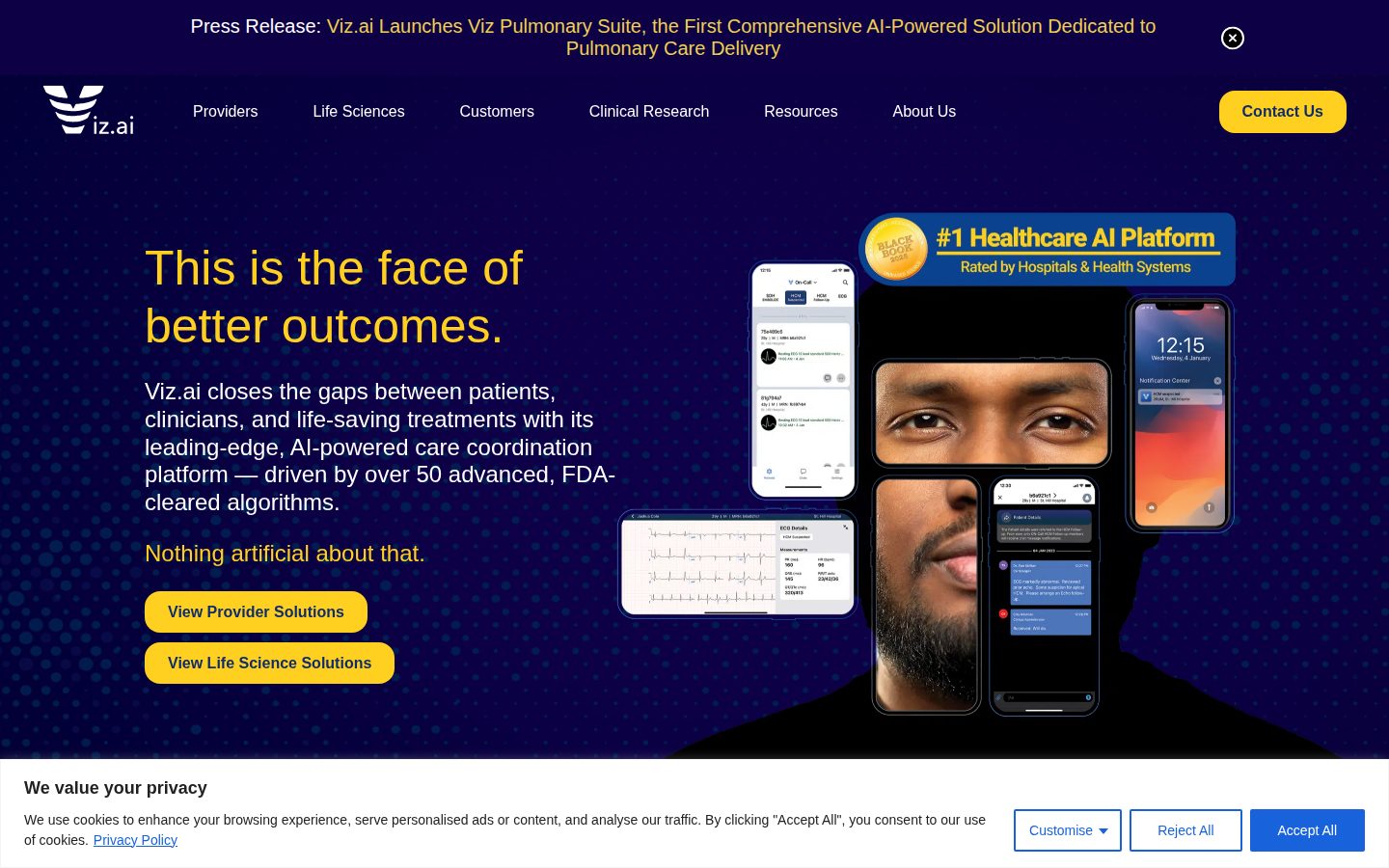
Viz.ai desktop previewViz.ai mobile preview

Pricing Plans

Contact Sales

Contact sales

Viz.ai (viz.ai) is an enterprise-grade, AI-powered care coordination and medical imaging platform sold exclusively to hospitals and healthcare organizations. It offers multiple suites covering neuro, cardiovascular, vascular, and trauma imaging workflows. No public list pricing is published; all pricing requires contacting Viz.ai's sales team directly for a custom quote.

  • AI-powered detection of strokes, aneurysms, and other critical conditions from CT/MRI scans
  • Real-time care coordination across mobile, desktop, and radiology workflows
  • Multi-specialty suites: neuro, cardiovascular, vascular, and trauma
  • Clinically validated algorithms for accelerated treatment decisions
  • Integration with existing hospital systems (PACS, EHR)
  • Multidisciplinary team collaboration and patient data sharing across facilities
  • Life science and pharmaceutical partnership workflows

AI Panel Reviews

The Decision Maker

The Decision Maker

Strategic bet, vendor viability, timing, adoption approval
8.5/10

1,700 hospitals don't lie — Viz.ai is the default stroke-to-surgery coordination bet.

Over 50 FDA-cleared algorithms across six specialty suites. This isn't a pilot product — it's embedded infrastructure at scale.

1,700 hospitals. That's not a growth metric, that's a moat. Viz.ai One consolidates detection, alerting, and coordination into a single platform covering neuro, cardiology, vascular, trauma, radiology, and pulmonology — areas where minutes cost lives. Against Aidoc and RapidAI, they've got the broadest cleared algorithm count and the Life Sciences arm adds a revenue diversification story the competitors haven't matched publicly.

The tradeoff is real: no public pricing, no free trial, no changelog visible. Enterprise-only contact sales means long procurement cycles and opaque renewal math. Your CFO will ask what you're paying per algorithm suite. You won't have an easy answer until deep in the deal.

Three questions I'd take into the demo. One: what does the Viz Neuro alert-to-treatment time delta look like in your peer hospitals? Two: what's the EHR integration footprint — how many IT hours does deployment actually take? Three: what happens to our data in the Life Sciences arm? That last one matters more than people realize.

Competitive Positioning8.5

Broader specialty coverage than Aidoc or RapidAI publicly shows, and the Life Sciences partnership arm is a differentiator competitors haven't matched at scale.

Reputation Risk9.0

FDA-cleared algorithms and peer-hospital scale make this a defensible board conversation; no sketchy provenance here.

Speed to Value7.5

Real-time LVO and AAA alerts can shorten treatment windows within weeks of go-live, but integration with existing PACS and EHR adds deployment friction.

Strategic Fit8.5

Viz.ai One advances time-sensitive care workflows rather than just automating existing manual steps — that's a clinical capability upgrade.

Vendor Viability9.0

1,700 hospital deployments and 50+ FDA clearances signal a vendor that's past survival stage — this is durable infrastructure.

Pros

  • 50+ FDA-cleared algorithms across six specialty areas — the broadest cleared portfolio in the category
  • Real-time mobile alerts connecting clinicians within seconds of detection, per the platform spec
  • 24/7 on-call clinical support included — not a add-on
  • Life Sciences arm diversifies the vendor's business model beyond pure hospital SaaS

Cons

  • No public pricing — procurement will be slow and renewal math is invisible until you're locked in
  • No changelog or API docs visible, which limits integration visibility pre-contract
  • Contact-only sales means no self-serve evaluation path for smaller health systems
  • Enterprise deployment complexity — PACS and EHR integration scope isn't disclosed publicly

Right for

Health systems running high-volume stroke, cardiac, or vascular programs that need real-time coordination infrastructure across multiple specialties.

Avoid if

You're a smaller hospital without a dedicated IT integration team and a defined procurement runway.

The Domain Strategist

The Domain Strategist

Craft and strategy in the product's domain — adapts identity per category, same lens
8.6/10

50+ FDA-cleared algorithms across six specialties makes this a serious clinical infrastructure bet.

Viz.ai has built what looks like genuine clinical architecture, not a demo layer over commodity imaging pipelines. Trusted by over 1,700 hospitals, this isn't a pilot-phase product.

50+ FDA-cleared algorithms spanning neuro, cardio, vascular, trauma, radiology, and pulmonary isn't a feature list — it's a regulatory moat. Clearance at that volume signals years of clinical validation work and IRB-grade evidence behind each algorithm. Aidoc and RapidAI compete in this space, but the breadth of Viz.ai One's consolidated interface across six therapeutic areas is harder to match than any single-specialty point solution.

The real-time alerting architecture — mobile imaging review within seconds of acquisition — maps directly to how stroke and STEMI protocols actually run. Door-to-needle time is a clinical outcome metric, not an IT metric, and any platform that tightens that window earns serious attention. The 24/7 on-call clinical support model also signals they understand hospital operations, not just software deployment.

The constraint I'd flag: no public pricing and no API documentation visible. Enterprise-only sales cycles mean your procurement team is blind until late in the negotiation, and integration depth with your PACS and EHR stack isn't fully evidenced in public materials. If your health system runs a fragmented imaging infrastructure, that integration surface needs hard validation before contract.

Category Positioning8.7

1,700+ hospital deployments and a Life Sciences arm targeting clinical trial enrollment positions Viz.ai well ahead of single-specialty competitors like RapidAI in total addressable clinical surface.

Domain Fit8.8

Real-time LVO and AAA alerting to mobile devices maps directly to time-sensitive clinical workflows where minutes determine outcomes, not convenience.

Integration Surface7.5

PACS and EHR integration is listed as part of deployment, but no API documentation is publicly available, making pre-contract technical due diligence harder than it should be.

Long-term Implications8.2

If you build care coordination workflows and team activation protocols on Viz.ai One, you're three years deep into a platform dependency before you see competitive alternatives mature.

Strategic Depth9.0

50+ FDA-cleared algorithms across six specialty suites represents a regulatory and clinical validation investment that functions as a genuine moat, not a roadmap promise.

Pros

  • 50+ FDA-cleared algorithms is a regulatory barrier competitors can't close quickly
  • Viz.ai One consolidates detection and care coordination into a single clinical interface across six specialties
  • Real-time mobile alerting architecture aligns with how stroke, trauma, and STEMI protocols actually run
  • 24/7 on-call clinical specialists signals operational maturity, not just software support

Cons

  • No public pricing means procurement cycles are opaque until late-stage negotiation
  • No visible API documentation makes pre-deployment integration assessment difficult
  • Platform depth creates real switching costs once team activation workflows are built on top of it

Right for

Health systems running high-volume, time-sensitive imaging across neurology, cardiology, or trauma who need a validated, multi-specialty care coordination layer.

Avoid if

Your imaging volume doesn't justify enterprise-grade deployment complexity or your EHR and PACS infrastructure hasn't been standardized.

The Finance Lead

The Finance Lead

Money, total cost of ownership, contracts, procurement math
6.2/10

50 FDA-cleared algorithms, zero public pricing — every number requires a sales call.

Viz.ai is deployed in 1,700+ hospitals with genuine clinical depth across 6 specialty suites. No pricing page means every TCO conversation starts blind.

50+ FDA-cleared algorithms across neuro, cardio, vascular, trauma, radiology, and pulmonary. That's real breadth. 1,700 hospitals is a defensible install base. The clinical product isn't the risk here.

The risk is the invoice you can't model. No public pricing. No tier structure. No overage rates. Enterprise healthcare SaaS at this scale — Aidoc and RapidAI play the same game — typically runs $150K–$500K annually per health system, based on category norms. 3-year TCO at a mid-size system could land north of $1M once PACS integration, EHR hooks, and staff training are included. No public data to verify that range. That's the problem.

Contract terms aren't published. Auto-renewal windows, termination clauses, data export formats — all opaque. Procurement will spend cycles negotiating blind. ROI evidence exists in the stroke literature, but finance teams can't build a business case from press releases. Budget owners want a number. Viz.ai won't give one upfront.

Billing & Procurement3.5

Enterprise healthcare procurement with no self-serve path means long sales cycles and high procurement friction.

Contract Flexibility3.0

No published auto-renewal windows, term lengths, or cancellation terms — category norm is 1-3 year locked agreements.

Pricing Transparency1.5

No pricing page, no tiers, no published rates — contact sales only, per their site.

ROI Clarity5.5

Stroke and LVO detection have published outcome data, but finance-facing ROI calculators aren't publicly available.

Total Cost of Ownership3.5

PACS/EHR integration plus 6 specialty suites plus 24/7 support staff suggest high 3-year cost; no public data to model it.

Pros

  • 50+ FDA-cleared algorithms — regulatory moat competitors can't replicate quickly
  • 1,700+ hospital deployments — proven at scale
  • 6 specialty suites plus Life Sciences arm in one platform
  • 24/7 clinical support included in deployment

Cons

  • Zero pricing transparency — every number requires a sales call
  • TCO is unmodelable without vendor engagement
  • Contract terms undisclosed — auto-renewal and exit clauses unknown
  • No free trial or proof-of-concept path visible on pricing page

Right for

Large health systems with dedicated procurement teams and budget authority to negotiate enterprise contracts.

Avoid if

Your CFO needs a TCO model before engaging sales — you won't get the numbers to build one.

The Domain Practitioner

The Domain Practitioner

Daily hands-on reality in the product's domain — adapts identity per category, same lens
8.2/10

50 FDA-cleared algorithms, real-time LVO alerts, and a care coordination layer that actually ships to production.

Viz.ai One consolidates stroke, cardiac, vascular, trauma, and pulmonary detection into a single alerting platform trusted by over 1,700 hospitals. The clinical depth is real; the opacity on pricing and docs is the honest friction.

Real-time LVO alerting to a mobile device within seconds of CT acquisition — that's the workflow that sold Viz.ai to stroke programs, and the evidence supports it holding up at scale. Viz Neuro, Viz Cardio, Viz Vascular, Viz Trauma, Viz Pulmonary: each suite maps to an actual on-call rotation, not a marketing taxonomy. That structural match to how hospitals actually staff is where Viz.ai beats Aidoc and RapidAI on day-to-day coordination, not just detection.

The daily friction surfaces in implementation, not in the alert flow. No public changelog, no public docs portal — meaning your clinical informatics team is flying on vendor-provided training materials and whatever the 24/7 on-call specialists can walk through at 2am. That's not disqualifying for an enterprise platform, but it does mean your power-user radiologist can't self-serve troubleshooting.

Pricing opacity is the tradeoff. Every contract is a negotiation, which means smaller health systems without procurement muscle may land at worse terms than academic centers. The Life Sciences arm adds a revenue diversification story, but it's tangential to the clinician using this on a Monday morning trauma activation.

Day-3 Reality8.0

Mobile-first alert delivery and specialty-specific suites map cleanly to actual on-call workflows, but absence of a public changelog suggests clinicians can't track what changed after updates.

Documentation Practitioner-Fit6.5

No public docs portal visible from the evidence — clinical teams are reliant on 24/7 specialist support, which works but isn't the same as practitioner-readable reference material.

Friction Surface7.5

Alert-to-mobile in seconds is frictionless; onboarding a new specialty suite without public docs or self-serve resources adds vendor-dependency friction that compounds over time.

Power-User Depth7.8

50+ FDA-cleared algorithms across six specialty suites gives experienced clinical users real depth, but discoverability depends on vendor-led training rather than self-discoverable UI paths.

Workflow Integration8.5

PACS and EHR integration baked into deployment, and the real-time mobile alerting means no new manual handoff steps — that's the category-defining workflow win.

Pros

  • Over 50 FDA-cleared algorithms covering stroke, cardiac, vascular, trauma, and pulmonary — not a single-condition tool
  • Real-time mobile alerts within seconds of CT acquisition, matching actual on-call response patterns
  • 1,700+ hospital deployments suggests proven integration with real hospital PACS environments
  • Viz.ai One consolidates multi-specialty detection and coordination into one interface

Cons

  • No public pricing — smaller health systems negotiating without benchmarks are at a disadvantage
  • No public docs portal; clinical informatics teams can't self-serve troubleshooting
  • No free trial or sandbox — evaluation requires a full demo and sales cycle
  • Changelog absence means clinicians can't track algorithm updates affecting clinical decisions

Right for

High-volume stroke centers, trauma programs, and health systems that need multi-specialty AI alerting integrated into existing PACS workflows.

Avoid if

Your organization lacks the IT and clinical informatics bandwidth to manage an enterprise vendor-dependent deployment with no self-serve documentation.

The Power User

The Power User

Daily human experience, onboarding, polish, learning curve, reliability
8.4/10

Viz.ai is doing the unglamorous work that saves actual lives

Over 50 FDA-cleared algorithms running across 1,700+ hospitals — this is mission-critical infrastructure, not a SaaS experiment. The contact-only pricing is a friction wall, but for time-sensitive stroke and trauma care, the platform earns its seat.

Viz.ai One consolidating neuro, cardio, vascular, trauma, radiology, and pulmonary workflows into a single interface — that's the kind of decision that shows someone thought hard about what a clinician at 2am actually needs. Real-time alerts hitting mobile within seconds of a suspected large vessel occlusion isn't a feature. It's the entire point.

The mobile experience reportedly isn't read-only theater. Clinicians can pull actual imaging on their phones immediately post-alert. That's meaningful parity, not an afterthought. Compared to Aidoc or RapidAI, Viz.ai's breadth across six therapeutic areas is hard to match in a single platform without stitching things together.

The honest tradeoff: no public pricing, no free trial, no changelog visible. Evaluating this against budget is a phone call, not a click. For a hospital system that's all fine. For anyone trying to run a quick comparison, it's a wall. The 24/7 clinical support inclusion is smart — onboarding something this consequential needs humans on the other end.

Daily Polish8.2

Specialty-organized suites and mobile imaging access suggest intentional daily workflow design, not just feature accumulation.

Learning Curve7.5

Viz.ai One's unified interface helps, but six specialty suites across neurology, cardiology, trauma, and more means depth takes time to navigate well.

Mobile Parity8.6

iOS and Android with real imaging review and real-time alerts — the platform is explicitly built around mobile-first clinical response, not just notification ping.

Onboarding Experience7.0

Dedicated implementation experts and 24/7 clinical support are included, but no self-serve trial means onboarding starts with a sales call.

Reliability Feel8.5

1,700+ hospital deployments and FDA-cleared status across 50+ algorithms signals production-grade reliability that's been stress-tested in real clinical settings.

Pros

  • Over 50 FDA-cleared algorithms across six therapeutic areas — serious regulatory breadth
  • Mobile imaging review in real time, not just push notifications
  • 24/7 on-call clinical specialists included in deployment
  • 1,700+ hospitals deployed — this isn't a pilot product

Cons

  • No public pricing — every evaluation starts with a sales conversation
  • No free trial or self-serve access to test fit before committing
  • No public changelog makes it hard to track how fast the platform evolves
  • Enterprise-only model means smaller facilities or independent clinics are effectively locked out

Right for

Health systems and hospital networks running high-volume, time-sensitive imaging workflows across stroke, cardiac, and trauma care.

Avoid if

You need transparent pricing upfront or are evaluating solo-practice or small-clinic deployment.

The Skeptic

The Skeptic

Contrarian. Watch-outs, deal-breakers, broken promises, category patterns
7.8/10

50 FDA clearances and 1,700 hospitals — actually meaningful numbers.

Viz.ai has real regulatory weight and deployment scale that most AI imaging competitors can't match. The exit story is rough, but the clinical moat is harder to replicate than it looks.

Three tells I usually flag: no pricing page, no changelog visible, and an H1 that reads like a pharma ad. All three present here. But then the 50+ FDA-cleared algorithms and 1,700 hospitals show up — those aren't marketing rounding errors. RapidAI and Aidoc are credible rivals, but neither has published comparable algorithm clearance depth. That gap is real, based on what's publicly visible.

The tradeoff worth naming: this is a deeply embedded enterprise sale. No free trial, no public pricing, contact-only. Once a hospital integrates Viz.ai One into their PACS and EHR workflows, the exit cost is high. That's not a defect — it's the category norm. But buyers should price in switching friction before signing.

No API docs visible, no changelog cadence to verify shipping velocity. That's a watch item. The Life Sciences arm is either a smart second revenue leg or a distraction. Could go either way. For time-sensitive imaging workflows — stroke, AAA, trauma — the real-time mobile alert architecture is the right design. The regulatory stack here is genuinely hard to clone quickly.

Competitive Differentiation8.0

50+ FDA-cleared algorithms across six specialty suites is a regulatory moat; Aidoc and RapidAI don't appear to match that clearance breadth publicly.

Exit Portability4.5

Deep PACS and EHR integration with no public API means migration is a clinical workflow re-implementation, not a data export — high switching cost by design.

Long-term Viability7.5

No public funding data visible, but 1,700 hospital customers and a Life Sciences revenue arm suggest multiple income vectors; no changelog cadence is a mild flag on shipping velocity.

Marketing Honesty6.5

"Leading" and "proven" in the meta copy are the kind of superlatives that age poorly, but the 1,700-hospital stat and 50+ FDA clearances are concrete anchors that pull it back from pure vapor.

Track Record Match8.5

1,700 hospital deployments across stroke, AAA, and cardiology workflows matches the pattern of durable clinical AI vendors — not the pattern of tools that quietly sunset.

Pros

  • 50+ FDA-cleared algorithms — the regulatory depth is real, not a roadmap promise
  • Six specialty suites under one platform reduces the multi-vendor sprawl most health systems hate
  • Real-time mobile alerts for LVO stroke and AAA detection match actual clinical urgency
  • 24/7 on-call clinical support is a meaningful differentiator in a category where implementation failure is common

Cons

  • No pricing transparency — enterprise contact-only means long sales cycles before you know if it fits budget
  • No visible API or changelog, so shipping velocity and integration depth can't be independently verified
  • Exit portability is low — PACS and EHR integration creates high switching costs once deployed
  • Life Sciences arm is an unknown risk: smart diversification or focus dilution, unclear from public materials

Right for

Health systems handling high-volume time-sensitive imaging — stroke centers, Level I trauma centers — that can absorb a complex enterprise deployment.

Avoid if

You need transparent pricing, fast procurement cycles, or a clean exit path if the vendor relationship sours.

Buyer Questions

Common questions answered by our AI research team

Features

How many FDA-cleared AI algorithms does Viz.ai include?

Viz.ai includes over 50 FDA-cleared AI algorithms.

Features

Which medical imaging types does Viz.ai analyze?

Viz.ai analyzes CT scans, EKGs, echocardiograms, and additional medical imaging data types.

Features

What therapeutic areas does Viz.ai cover?

Viz.ai covers neurology, cardiology, vascular medicine, trauma, radiology, and pulmonology.

Features

Can clinicians receive Viz.ai alerts on mobile devices?

Yes, clinicians receive real-time alerts on mobile or desktop devices, connecting them within seconds of suspected disease detection.

Setup

Does Viz.ai offer implementation support during setup?

Yes, Viz.ai provides dedicated 24/7 on-call clinical specialists and implementation experts to support setup and ongoing use.

Also in AI Healthcare