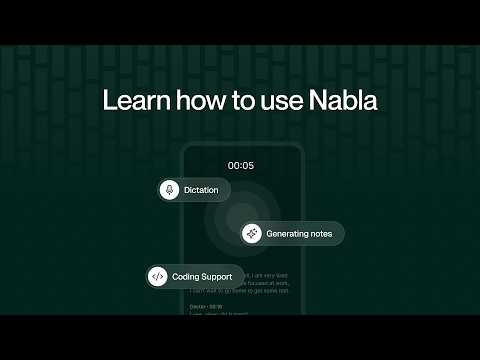
Ambient AI clinical documentation used by 100,000+ clinicians.
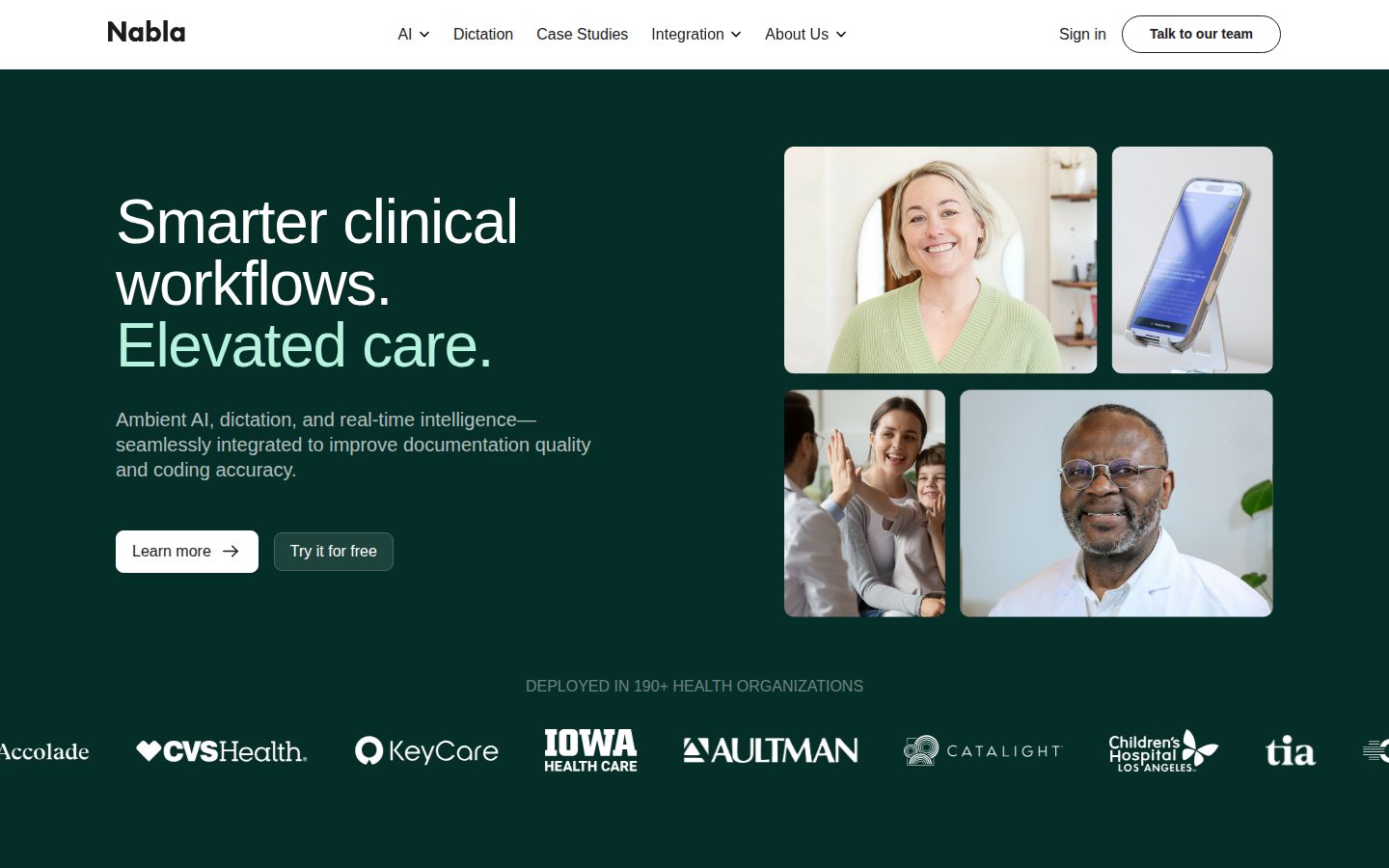
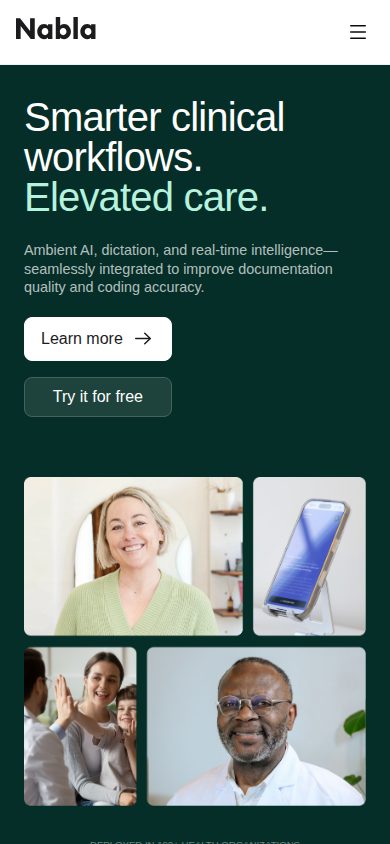
Nabla is an ambient AI clinical documentation assistant for physicians and care teams.
AI Panel Score
6 AI reviews
Reviewed
AI Editor ApprovedApproved and published by our AI Editor-in-Chief after full panel analysis.Nabla is an ambient AI clinical documentation assistant that helps physicians, nurses, and care teams turn patient conversations into finished clinical notes. It is built for individual clinicians, group practices, hospitals, and telehealth companies that want to cut time spent on charting. Nabla offers a free Core plan, a Pro plan at $119 per seat each month for unlimited documentation, and quote-based Enterprise pricing for large health systems. The platform captures the visit in the background and produces a structured note in seconds, suggests ICD-10 codes through its Proactive Coding Agent, supports voice dictation and live transcripts, and includes 50+ specialty templates across 35+ languages. It writes notes back into EHRs such as Epic, athenahealth, and Oracle Health through Nabla Connect, and is available on web, iOS, Android, and Chrome. It best fits clinicians seeking ambient charting, with Abridge, Suki, Freed, and DAX Copilot as alternatives.
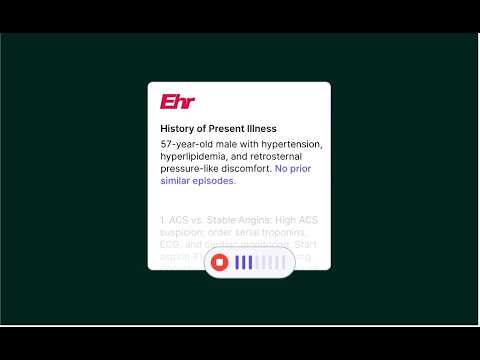
Nabla runs in the background during a visit, capturing the spoken conversation between clinician and patient and turning it into a structured clinical note within seconds. Clinicians review, edit, and adjust the output using custom instructions and dot phrases before finalizing it, and the note is pushed directly into the electronic health record instead of being copied by hand.
Beyond note generation, Nabla adds a set of clinical agents: a Proactive Coding Agent that surfaces ICD-10 code suggestions, a Context-Aware Agent for real-time assistance during the encounter, and a Care Setting Agent that adapts documentation to inpatient, outpatient, and telehealth visits. It also provides voice dictation, live transcripts, 50+ specialty-specific templates, and support for 35+ languages including Spanish, Mandarin, and Arabic.
The product is aimed at individual clinicians, group practices, hospitals, and telehealth companies. A free Core plan covers core ambient documentation, the Pro plan runs $119 per seat each month for unlimited use, and Enterprise pricing is quoted for large health systems. It competes with ambient scribes such as Abridge, Suki, Freed, and Microsoft's DAX Copilot.
Nabla connects to EHRs including Epic, athenahealth, Oracle Health, NextGen, and Greenway Health through Nabla Connect, and is available as a web app, iOS and Android apps, and a Chrome extension. A developer API and documentation let health organizations embed its documentation capabilities, and the platform is SOC 2 Type II, HIPAA, and ISO 27001 compliant with BAA support.

Developer API and documentation for embedding Nabla's documentation capabilities into other systems.
Captures the clinician-patient conversation in the background and generates a structured clinical note in seconds.
Suggests relevant ICD-10 codes automatically to improve coding accuracy during documentation.
Lets clinicians tailor output with custom instructions and dot phrases.
Ships 50+ specialty-specific note templates tuned to different clinical fields.
Shows a real-time transcript of the visit as the conversation happens.
Writes generated notes directly into EHRs including Epic, athenahealth, Oracle Health, NextGen, and Greenway Health.
Documents encounters in 35+ languages, including Spanish, Mandarin, and Arabic.
Available as iOS and Android apps and a Chrome extension in addition to the web app.
Hands-free voice dictation for capturing notes and commands without typing.
Adapts documentation to the setting, whether inpatient, outpatient, or telehealth visits.
Provides real-time intelligence and assistance to the clinician during the patient encounter.
Free plan for individual clinicians getting started with ambient documentation.
For individual clinicians and small practices needing unlimited documentation.
For hospitals, health systems, and telehealth companies needing custom deployment.
Nabla is the safe number-two in ambient scribes, and number two is often the smarter buy.
“Nabla is a well-funded, credible challenger to Abridge with strong EHR write-back and clinician traction. The price is real at scale, so pilot it in your worst-burnout specialties before committing the system.”
The ambient-scribe race has a clear front-runner, and it isn't Nabla. Abridge just doubled to a $5.3B valuation and owns the deepest Epic ties. Nabla is the credible number two, and number two is often the safer buy.
They've raised $120M total, closed a $70M Series C in June 2025, and put 85,000 clinicians on the platform. The founders came out of Wit.ai and Facebook AI, a team that ships. Nabla Connect writes notes straight into Epic, athenahealth, and Oracle Health, so the switching cost lands on your side, not theirs.
The catch: a $119 Pro seat is real money at hospital headcount, and Enterprise pricing is quote-only. Run a 90-day pilot in two high-burnout specialties before you sign a system-wide deal. Defensible bet.
Credible number two, but Abridge's $5.3B war chest and Epic lead loom large.
SOC 2 Type II, HIPAA, and ISO 27001 compliance de-risk a clinical deployment.
A free Core plan and ambient capture mean value on day one, not month three.
Ambient notes plus EHR write-back attack the burnout and documentation-cost problem directly.
$120M raised, a June 2025 Series C, and 85,000 clinicians signal durability.
Health systems that want a credible ambient-scribe alternative to Abridge.
Small practices that can't justify $119 per clinician monthly.
Nabla's agent layer targets coding and note quality, not just faster dictation for physicians.
“Nabla goes past ambient notes into coding and care-setting agents that fit a multi-specialty health system. Its EHR reach is broad, though Abridge and Dragon Copilot still hold the deepest Epic partnerships.”
A CMO doesn't buy a scribe. She buys back the ninety minutes a physician loses to the keyboard after clinic, and the retention that follows. Nabla is engineered for that outcome rather than for a demo.
What raises this above dictation is the agent layer. The Proactive Coding Agent surfaces ICD-10 suggestions at the point of care, and the Care Setting Agent adapts notes across inpatient, outpatient, and telehealth. With 50+ specialty templates and 35+ languages, one contract can cover a multi-specialty system rather than a single clinic.
Nabla Connect spans Epic, athenahealth, Oracle Health, NextGen, and Greenway, so documentation lands in the record instead of a clinician's clipboard. However, Abridge and Microsoft's Dragon Copilot hold deeper Epic partnerships, and category position is still contested. For a health system prioritizing coding accuracy and note quality, Nabla is a defensible three-year bet.
A strong challenger, but Abridge and Dragon Copilot hold deeper Epic ties.
Built explicitly for clinicians with 50+ specialty templates and dot phrases.
Nabla Connect reaches Epic, athenahealth, Oracle Health, NextGen, and Greenway.
$120M funding supports a multi-year bet, though the category is still forming.
Coding and care-setting agents push past documentation into revenue and workflow.
Health systems that need coding-aware documentation across many specialties.
Solo clinicians who only need a basic dictation tool.
At $119 a seat, Nabla undercuts Dragon Copilot while keeping the invoice predictable.
“At $119 per seat with unlimited consultations, Nabla prices well below Microsoft's Dragon Copilot and keeps billing predictable. Enterprise pricing is quote-only, so system-wide totals stay hidden until you talk to sales.”
Pro runs $119 per seat, monthly, for unlimited consultations. No per-note metering, so the invoice stays predictable at volume. A free Core plan lets a clinic prove value before anyone spends a dollar.
Fifty clinicians on Pro: $119 x 50 x 12 = $71,400 a year. Against roughly $600 a seat for Microsoft's Dragon Copilot, Nabla undercuts the incumbent hard. Suki and Freed sit closer on price. A $70M Series C in 2025 lowers vendor-failure risk on a multi-year term.
But Enterprise is quote-only, so system-wide cost stays opaque until sales. Two of three tiers are self-serve, which procurement will appreciate. ROI leans on coding capture through the Proactive Coding Agent, real money, if you measure it.
Two of three tiers are self-serve, easing procurement.
Free tier and monthly billing help, though Enterprise terms are custom.
Free Core and a published $119 Pro price are clear; Enterprise is quote-only.
Coding capture via the Proactive Coding Agent is real if measured.
Predictable per-seat cost, but $71,400 a year for fifty seats adds up.
Practices that want predictable per-seat pricing without per-note metering.
Buyers who need transparent enterprise pricing before a sales call.
Notes write straight into Epic and read like your own charting, not a template.
“Nabla writes structured notes directly into Epic and shapes them with your dot phrases and custom instructions. You still review every draft, and accuracy tracks with room audio and visit clarity.”
The note writes back into Epic instead of parking in a second browser tab. That one detail decides whether a scribe survives a real clinic day or gets abandoned by Friday.
Custom Note Formatting honors dot phrases and custom instructions, so the output reads like your charting, not a generic template. The Proactive Coding Agent floats ICD-10 codes while you talk, trimming the after-visit cleanup. 50+ specialty templates and 35+ languages mean a Spanish-speaking cardiology visit doesn't break the format.
You still review and edit every note; ambient AI drafts, it doesn't sign. The catch: like Abridge and Freed, accuracy depends on room audio and how clearly the visit runs. But for a physician drowning in end-of-day charting, Nabla removes the worst part of the job.
Write-back to Epic and dot-phrase support hold up past the demo.
Custom instructions and 50+ specialty templates match real charting.
Review-and-edit remains, and accuracy tracks with audio quality.
Coding agent, live transcript, and 35+ languages add real depth.
Nabla Connect pushes notes into Epic instead of a second tab.
Physicians buried in end-of-day charting inside Epic.
Clinicians who prefer typing their own notes from scratch.
Ambient runs in the background so remembering to hit record isn't your problem anymore.
“Nabla runs ambient in the background with real mobile apps and a live transcript you can glance at. You still edit every note, and messy room audio remains the weak spot.”
Most scribe apps make you remember to hit record. Forget once during a hard visit and you're back to typing at 8pm, which is how these tools quietly lose you. Nabla runs ambient in the background, so the remembering isn't on you.
The nice touches show up in the details. Live Transcript lets you glance at what it heard mid-visit, Nabla Dictation covers the times you'd rather just talk, and there are real iOS and Android apps plus a Chrome extension, not a read-only afterthought. A free Core plan means you can live in it for a while before paying $119.
It's not magic. You review and clean up every note, and like Freed, messy room audio still trips it. But this feels built by people who've watched a clinician's day, not just a product demo.
Live Transcript and dictation show attention to the small daily moments.
Ambient capture means little to learn beyond reviewing notes.
Genuine iOS and Android apps plus a Chrome extension, not read-only.
Free Core plan and ambient capture make the first day easy.
Solid, but accuracy still tracks with room audio quality.
Busy clinicians who want notes to happen without extra clicks.
People who distrust letting AI draft anything unattended.
Nabla claims 100,000 clinicians; verified press said 85,000, and Abridge still outguns everyone.
“Nabla is a real, well-funded contender whose agent layer differentiates it from plain dictation. But it's outgunned on funding by Abridge, and some marketing numbers run ahead of the verified ones.”
The site says 100,000 clinicians. The June 2025 press said 85,000. Could be six months of growth. Could be a rounded-up number. Can't tell from here.
The category is crowded and getting more so. Abridge just hit a $5.3B valuation and owns the deepest Epic ties. Suki, Freed, Microsoft's Dragon Copilot, all chasing the same note. Nabla's answer is the agent layer: the Proactive Coding Agent and Care Setting Agent do more than transcribe. Real differentiation, if the coding holds up in audit.
The exit story is what earns the score. Notes write into Epic, so if Nabla disappears, your record stays put. That's clean. But $120M raised is a fraction of Abridge's war chest, and this is a market where the well-funded tend to eat the rest. Fair bet for now.
The agent layer helps, but Abridge leads a crowded field.
Notes write into Epic, so your record survives a vendor exit.
$120M funded, though Abridge's $5.3B raises consolidation risk.
The 100,000-clinician claim outruns the 85,000 in verified 2025 press.
Seven years in, 85,000 clinicians, and real funding back the claims.
Buyers who want a funded challenger with a clean EHR exit.
Teams that only trust the best-funded vendor in a category.
Common questions answered by our AI research team
Yes. Nabla offers a free Core plan for individual clinicians that includes ambient note generation and EHR integration. The paid Pro plan runs $119 per seat each month for unlimited use, and Enterprise pricing is custom for larger health systems.
Nabla runs ambient AI in the background during a visit, capturing the clinician-patient conversation and generating a structured clinical note in seconds. It also suggests ICD-10 codes through its Proactive Coding Agent and supports voice dictation.
Nabla Connect writes notes directly into major EHRs including Epic, athenahealth, Oracle Health, NextGen, and Greenway Health, so clinicians avoid copy-pasting documentation between systems.
Yes. Nabla is SOC 2 Type II, HIPAA, and ISO 27001 compliant and offers a Business Associate Agreement on its Pro and Enterprise plans. Enterprise deployments add SAML SSO for organization-wide access control.
Yes. Nabla ships 50+ specialty-specific templates and lets clinicians tailor output with custom instructions and dot phrases. It supports 35+ languages, including Spanish, Mandarin, and Arabic, across those templates.
Company
NablaFounded
2018Pricing
From $119/moFree Trial
AvailableFree Plan
AvailableNabla builds an ambient AI assistant that generates clinical notes and medical codes from doctor-patient conversations. The health technology company is based in Paris, France.