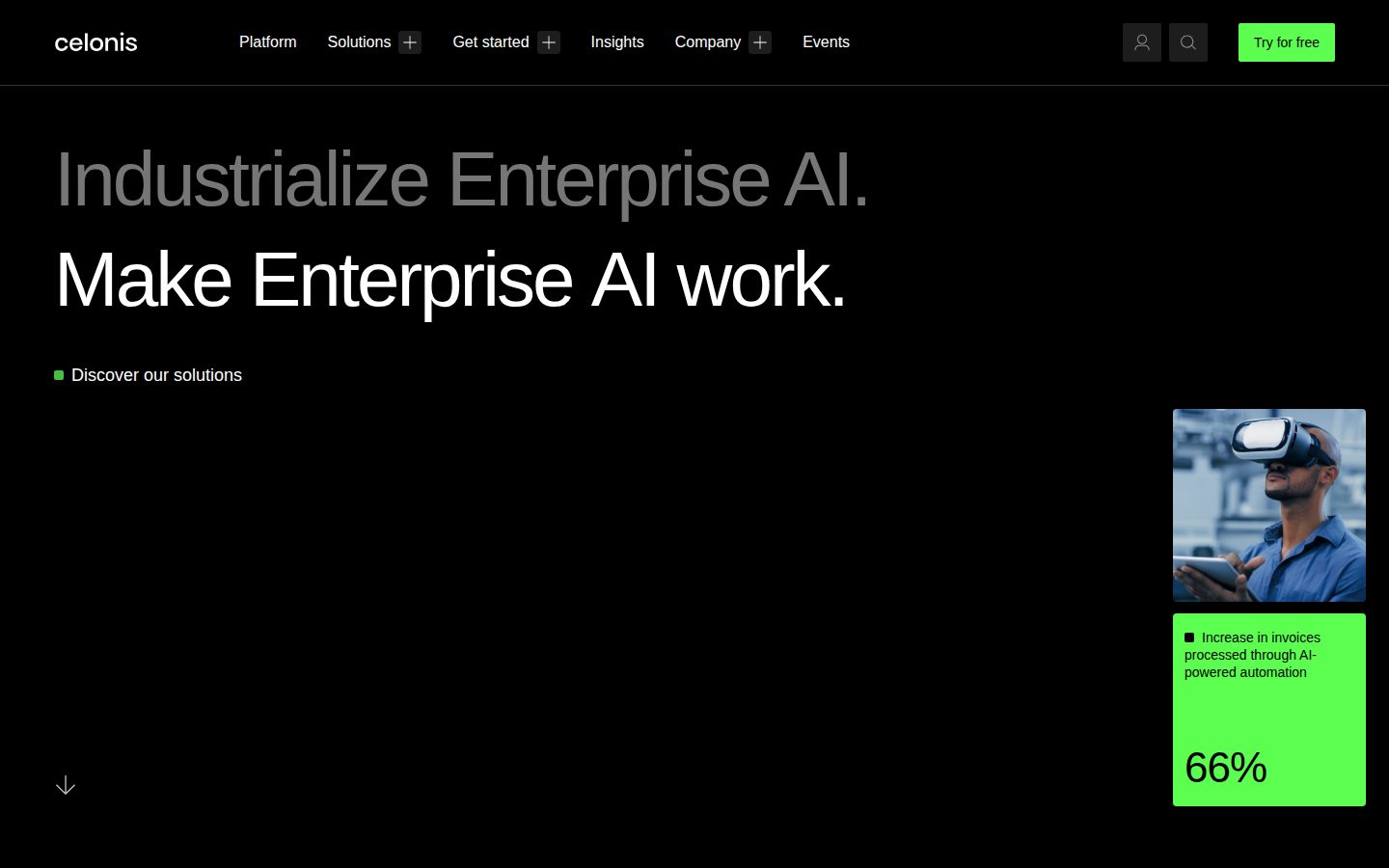
Process Intelligence platform for AI-driven enterprise operations
Celonis is a process intelligence and mining platform for large enterprises managing complex operational workflows.
AI Panel Score
6 AI reviews
Reviewed
AI Editor ApprovedApproved and published by our AI Editor-in-Chief after full panel analysis.Celonis is a process intelligence and mining platform that reconstructs how business processes actually run from event data captured across enterprise systems, then surfaces inefficiencies and opportunities for AI-driven improvement. Its Celonis Context Model combines end-to-end process data, business knowledge, and operational intelligence so AI agents and human workers share operational context for decisions. The platform targets large enterprises running SAP or Salesforce with complex, ERP-heavy workflows. Pricing is quote-based, though a free trial is offered. Key capabilities include process mining, simulation with what-if scenarios, AI agent orchestration, continuous process monitoring, and RoAI measurement for quantifying AI impact. TopReviewed's six-seat AI review panel scored it 7.4/10, praising the Context Model's operational grounding for AI agents while noting first-year costs can exceed $800,000 with a three-year non-cancelable minimum. It fits enterprises with multi-year transformation mandates and budget for a dedicated process intelligence practice.
Users connect Celonis to existing enterprise systems—ERP, CRM, procurement, and others—where it extracts and reconstructs actual process execution data into a visual process graph. From there, teams can analyze deviations from expected workflows, run simulations and what-if scenarios, and identify where automation or AI agents would have the highest measurable impact. The platform supports the full cycle from analysis to redesign to ongoing operational monitoring.
A central capability is the Celonis Context Model (CCM), announced alongside a planned acquisition of AI decision intelligence company Ikigai Labs. The CCM is positioned as an operational context layer for enterprise AI stacks, giving AI agents accurate knowledge of how business processes flow before they act. Specific functional areas covered include supply chain (on-time delivery, inventory optimization, supplier reliability), finance and shared services (cash flow, duplicate payment prevention, collections), and enterprise IT modernization (migration planning, technical debt identification). The platform also includes Return on AI (RoAI) measurement tooling to quantify the impact of AI deployments.
Celonis targets large enterprises across manufacturing, automotive, banking, and other industries. Customers referenced on its site include Fujitsu, PepsiCo, Standard Bank, and Uniper. The product is positioned in the process intelligence and process mining category, where competitors include SAP Signavio, IBM Process Mining, and UiPath Process Mining. Pricing is not publicly listed; prospective customers are directed to contact sales, and a free trial option is surfaced on the site.
Celonis is recognized as a Leader in the 2026 Gartner Magic Quadrant for Process Intelligence Platforms. The platform integrates with existing enterprise technology stacks and supports orchestration of both human workers and AI agents within operational workflows.

Orchestrates AI agents alongside people and existing systems within defined workflows, outcomes, and guardrails to drive measurable business outcomes.
Identifies high-impact AI use cases within enterprise operations and measures Return on AI investment to guide strategic AI deployment.
Powers Enterprise AI with real-time operational context from live business systems, enabling AI to be deployed where it drives measurable impact and integrated into existing workflows.
Continuously monitors process performance, adherence, and agent activity to ensure operations run as designed in real time.
Analyzes how business processes truly run by capturing event data, identifying inefficiencies, and surfacing the most impactful opportunities for improvement.
Runs process simulations, predictions, and what-if scenarios to evaluate potential changes before redesigning or deploying operations.
Automates actions to improve cash flow, prevent duplicate payments, reduce excess spend, and accelerate payment and collections cycle times.
Combines end-to-end process data, business knowledge, and operational intelligence to give AI agents and human workers shared operational context for reasoning and decision-making.
Uses objective process data to align, plan, and execute IT modernization strategy, separating true business differentiation from technical debt and reducing migration risk.
Improves on-time in-full delivery, reduces stockouts, optimizes inventory and load consolidation, and reduces operating costs across supply chain processes.
Enables re-engineering of business processes based on deep process insight, allowing teams to define workflows, outcomes, guardrails, and best practices for integrating Enterprise AI.
Celonis does not publish any named tiers or list prices publicly. All pricing is sales-led and negotiated directly with Celonis based on data volume (APC – Automated Process Capacity, measured in bytes), number of users, process count, and contract length. G2 explicitly confirms Celonis has not provided pricing information. Independent procurement sources (CheckThat.ai, SpendHound, Vendr) note that entry-level enterprise contracts start around $150K/year for software licensing, with typical enterprise annual contract values averaging ~$286K according to SpendHound's dataset of 160 real customers. Forrester's TEI study documents a composite enterprise customer paying $1.26M in Year 1, scaling to $5.25M by Year 3. A free/Snap plan was historically available for evaluation (up to 1GB of data), but its availability is considered ambiguous as of 2024. Contracts are annual (non-cancelable, non-refundable), with a typical minimum term of 3 years. Buyers should also budget for implementation ($120K–$500K+ one-time) and ongoing CoE staffing ($200K–$700K/year). Contact Celonis sales for a quote.
Celonis owns process mining, but the $286K average contract demands proof before you sign.
“1,400 enterprise customers and a Gartner Leadership position make Celonis the default pick in process intelligence. The TCO — $150K entry, $1.26M Year 1 at scale, plus $500K implementation — means you'd better know exactly what you're fixing.”
Celonis has been building this category longer than SAP Signavio or UiPath Process Mining have been serious about it. The Celonis Context Model is a real differentiator: giving AI agents shared operational context before they act is the right architecture for enterprise AI deployments. Fujitsu, PepsiCo, Standard Bank — that's a credible customer wall.
The cost math is brutal, though. SpendHound's dataset of 160 real customers puts average ACV at $286K. Stack on implementation and CoE staffing, and Year 1 is easily $800K before you've changed a single workflow. Speed to value is slow — process mining requires data extraction, model validation, and change management before anything ships.
Two things: this is a 3-year minimum commitment, non-cancelable. And the free trial exists, but there's no path to self-service evaluation at real data volume. Pilot the trial hard. Nail your ROI case before the contract conversation starts.
SAP Signavio and UiPath Process Mining are real alternatives, but neither has Celonis's depth on AI agent orchestration or the CCM's operational context layer.
Citing a Gartner Leader with PepsiCo and Standard Bank as reference customers is a board-defensible choice by any measure.
Implementation runs $120K–$500K+ one-time and CoE staffing adds $200K–$700K/year — meaningful outcomes take quarters, not weeks.
The Celonis Context Model directly advances enterprise AI strategy — it's operational infrastructure for AI agents, not just cost reduction on existing workflows.
Gartner 2026 Magic Quadrant Leader, 1,400+ enterprise customers, and a planned acquisition of Ikigai Labs signals a company investing in its next act, not managing decline.
Large enterprises running SAP or Salesforce who need to understand their actual process flows before deploying AI agents at scale.
Your org can't staff a Center of Excellence or commit to a multi-year implementation investment.
The process intelligence category leader, but the TCO will reshape your data budget fast.
“Celonis is the category-defining process mining platform with genuine AI orchestration depth via the Celonis Context Model. The cost structure — $286K average ACV plus $120K–$500K implementation — makes this a board-level data investment, not a team tool.”
Process mining at Celonis's depth isn't just dashboards on top of ERP logs. The platform reconstructs actual execution graphs from event data across SAP, Salesforce, and ServiceNow, then layers simulation and what-if scenarios on top. That's the architecture of a living operational twin, not a BI tool with a process skin. The 2026 Gartner Magic Quadrant Leader recognition confirms this isn't a new entrant — Celonis has held this position long enough to build real connector depth.
The Celonis Context Model is the strategically interesting bet. Giving AI agents shared operational context before they act solves a real problem my team faces every time we try to deploy decisioning pipelines into messy ERP workflows. The planned Ikigai Labs acquisition extends that into decision intelligence territory. If that integration lands cleanly, the ceiling here rises meaningfully above SAP Signavio or UiPath Process Mining.
The constraint is commitment structure. Contracts are annual, non-cancelable, minimum 3-year terms. If we adopt this, in year three we're running a Center of Excellence that costs $200K–$700K annually just to operate the platform. That's a data org headcount decision, not a software decision. Right for enterprises with 50+ process workflows to govern. Wrong for teams still figuring out their data foundation.
2026 Gartner Magic Quadrant Leader with 1,400+ enterprise customers and a clear moat over SAP Signavio and UiPath Process Mining in process intelligence depth.
Supply chain, finance automation, and IT modernization coverage maps directly to the process domains where a Head of Data actually gets pulled into operational firefighting.
Pre-built connectors to SAP, Salesforce, and ServiceNow cover the core enterprise stack; API access is included, though public API docs weren't surfaced in the evidence.
3-year non-cancelable contracts and CoE staffing requirements mean adoption is an org design decision — strong upside if resourced, a sunk cost if not.
Process Intelligence Graph plus CCM plus RoAI measurement tooling shows a platform team that understands the full analytics-to-action cycle, not just visualization.
Large enterprises with complex multi-system process workflows and budget for a dedicated process intelligence practice.
Your data org is still consolidating its data warehouse or lacks dedicated process analytics headcount.
$286K average contract, $1.26M Year 1 composite — budget accordingly or walk away.
“Celonis is a category leader in process intelligence with 1,400+ enterprise customers and a Gartner Magic Quadrant Leader designation. The TCO is brutal and fully opaque until you're already in the sales cycle.”
Entry contracts start around $150K/year in licensing alone. Forrester's TEI composite shows $1.26M in Year 1, scaling to $5.25M by Year 3. Add implementation at $120K–$500K one-time, plus Center of Excellence staffing at $200K–$700K annually. No sticker price exists — zero. SAP Signavio publishes at least some pricing; Celonis won't even confirm tiers publicly.
The APC model — licensed by data volume in bytes — creates genuine budget exposure. No public overage rate. Volume grows as you connect more systems. Year 3 cost creep isn't a soft risk; it's structurally embedded in the model. Contracts are annual, non-cancelable, non-refundable, with typical 3-year minimums. No termination for convenience.
The RoAI measurement tooling is a real differentiator — you can quantify AI impact, which most competitors can't claim. The Celonis Context Model gives AI agents operational grounding before they act. For a 50-seat team this product makes no sense. For a $5B manufacturer running SAP, the math might close. Know your size before the first call.
Fully sales-led, no self-serve, no published payment terms — procurement cycles will be long and friction-heavy.
Annual contracts, non-cancelable, non-refundable, 3-year minimums — no termination for convenience clause documented.
Zero published tiers, zero list prices, APC model unexplained publicly — procurement enters blind.
RoAI measurement tooling and Forrester TEI study provide quantifiable impact frameworks — rare in this category.
Forrester composite hits $5.25M by Year 3 including licensing, implementation, and CoE staffing — TCO is real but painful.
Large enterprises — manufacturing, banking, automotive — already running SAP or Salesforce at scale who can absorb $1M+ Year 1 commitment.
Your annual software budget is under $500K or your team can't staff a dedicated Center of Excellence.
Best process intelligence available, if you can survive the procurement and implementation gauntlet
“Celonis is the category leader in process mining — Gartner says so, 1,400 enterprise customers confirm it. But this is a $150K floor commitment with a 3-year lock-in, and that shapes every dimension of the daily analyst experience.”
Process Mining is the core, and it's genuinely differentiated. The Celonis Context Model reconstructing actual execution paths — not assumed ones — from ERP and CRM event data is the analytical foundation that SAP Signavio and UiPath Process Mining can't easily replicate. Querying process deviations against a living digital twin of operations is exactly what a process analyst needs. The what-if simulation layer on top of that is the kind of depth that turns a six-week consulting engagement into an afternoon.
Day three, though, means onboarding into a tool your org paid $286K average annual contract value to license — plus $120K–$500K implementation on top. That cost pressure creates organizational dynamics that slow the analyst down. Data pipeline configuration, connector setup with SAP or ServiceNow, CoE sign-off cycles — these aren't tool friction, they're enterprise friction amplified by the spending commitment.
Docs are marked N across the board in the scraped evidence. No public changelog, no public API docs. For an analyst trying to self-serve past the initial implementation, that's a genuine daily fight. The RoAI measurement tooling is compelling on paper, but without practitioner-facing documentation, validating methodology independently is hard.
Post-demo, analysts land inside a heavy enterprise deployment with CoE dependencies and no self-serve docs — the living digital twin is powerful once configured, but configuration is a long runway.
Website evidence shows docs=N, changelog=N, API=N — no public practitioner-facing technical documentation surfaced, which is a real gap for analysts doing independent validation work.
APC volume-based licensing means analysts potentially gate their own queries based on byte consumption, which is an unusual and friction-generating mental overhead not seen in competitors like SAP Signavio.
Process simulation, what-if scenarios, AI use case identification with RoAI measurement, and full AI agent orchestration give advanced analysts a genuinely deep analytical surface that few competitors match.
Pre-built connectors to SAP, Salesforce, and ServiceNow are the right integration surface for enterprise analysts; the Celonis Context Model slots into existing AI stacks without requiring a rip-and-replace.
Large enterprise process analysts embedded in manufacturing, banking, or supply chain orgs with existing SAP infrastructure and a funded Center of Excellence.
Your org doesn't have a dedicated CoE budget or wants self-serve onboarding without a multi-year commitment.
Best process intelligence money can buy — and it costs a lot of money
“Celonis is the Gartner Magic Quadrant leader in process mining for a reason: 1,400+ enterprise customers and a $286K average contract value don't lie. But this is a tool that takes months to feel, not minutes.”
The Celonis Context Model is genuinely interesting — the idea that AI agents need shared operational context before they act, not just after something breaks, is the right instinct. Process Mining reconstructing how workflows actually run (versus how the flowchart says they run) is where the real value lives. Fujitsu, PepsiCo, Standard Bank aren't logos you slap on a homepage without receipts.
But let's talk about what you're buying into. Entry contracts start around $150K/year, typical deals run $286K, and a Forrester composite shows $1.26M in Year 1 alone. Add implementation costs up to $500K and ongoing CoE staffing. This isn't software you try — it's a program you commit to. SAP Signavio is the closest comparable and it's the same world: enterprise-priced, implementation-heavy, not something a team of six evaluates over a free trial.
The daily-use dimensions — mobile parity, onboarding feel, micro-copy — are almost beside the point here. This runs on web, the free trial exists mostly for evaluation theater, and the real onboarding is a professional services engagement. The tradeoff is a powerful platform that genuinely works, in exchange for a multi-year commitment and a lot of organizational lift.
The platform targets analysts and process engineers, not casual users — the evidence suggests depth over delight, which is appropriate for the audience.
Process simulation, what-if scenarios, and the Celonis Context Model are powerful but the recommended CoE staffing model implies this doesn't get easy fast.
Web-only platform with no mobile capability listed — for operational monitoring that's a real limitation when something breaks at 7pm.
A free trial exists but real onboarding is a professional services engagement starting at $120K — that's not a welcome mat, that's a runway.
1,400+ enterprise customers including Fujitsu and PepsiCo running live operational workflows implies the platform holds up under real load.
Large enterprises in manufacturing, banking, or supply chain that have complex ERP environments and budget for a multi-year operational transformation program.
Your organization has fewer than a few hundred employees or can't absorb a $150K+ annual commitment plus significant implementation overhead.
1,400 customers, $286K average contract — real product, real lock-in
“Celonis is a legitimate category leader in process mining with a 2026 Gartner MQ Leader placement and named enterprise customers. The lock-in story is severe, and the AI repositioning could go either way.”
Three tells upfront. One: no pricing page, no API docs page, no changelog surfaced — opacity this deep at enterprise scale is a choice, not an oversight. Two: 'Industrialize Enterprise AI' is the kind of headline that'll read as dated in 18 months. Three: the Celonis Context Model launched alongside a planned Ikigai Labs acquisition — positioning that hasn't shipped yet treated as a live differentiator.
What's real: $286K average annual contract across 160 verified buyers. $1.26M Year 1 for a Forrester composite customer. Gartner Leader, 2026. Named customers include Fujitsu and PepsiCo. SAP Signavio and UiPath Process Mining are real competition, but Celonis has more runway and more deployments than either.
The exit story is brutal. APC volume-based licensing, 3-year non-cancelable contracts, $120K–$500K implementation costs. You're not evaluating software — you're committing to an operational transformation program. If direction shifts, migration isn't a project, it's a write-off.
Process Intelligence Graph and the CCM are meaningful separators vs. SAP Signavio and UiPath Process Mining, if the Ikigai acquisition closes and ships as positioned.
Three-year non-cancelable contracts, APC licensing tied to data volume, and $120K–$500K implementation costs mean exit is practically a write-off.
Category-defining revenue scale, Gartner recognition, and active M&A signal a team with real staying power — no public distress indicators visible.
The Context Model is featured as current capability but was announced alongside an acquisition not yet closed; no pricing, docs, or changelog visible publicly.
1,400 enterprise customers, Gartner Leader placement, and named logos like PepsiCo and Fujitsu match the pattern of durable enterprise software, not vaporware.
Large enterprises with complex ERP-heavy operations, a budget above $500K all-in Year 1, and a multi-year transformation mandate.
You need transparent pricing, short contract terms, or a clean exit path inside 18 months.
Common questions answered by our AI research team
The Celonis Context Model combines end-to-end process data, business knowledge, and operational intelligence to give AI agents and human workers shared operational context for reasoning, decision-making, and reliable action—eliminating Enterprise AI's operational blind spots.
Celonis supports Supply Chain, Finance and Shared Services, Enterprise IT Modernization, and cross-industry functions including manufacturing, banking, and automotive, plus strategic initiatives for AI deployment and Process Excellence.
Yes. Uniper transforms enterprise work using Celonis Process Intelligence and Microsoft AI together.
Yes. A free trial and demo option are both available directly from the Celonis website.
More than 1,400 companies worldwide use Celonis to analyze, design, and operate AI-driven processes.