PostHog logo

PostHog Review

Visit

Open-source product analytics, session replay, feature flags, and more in one platform

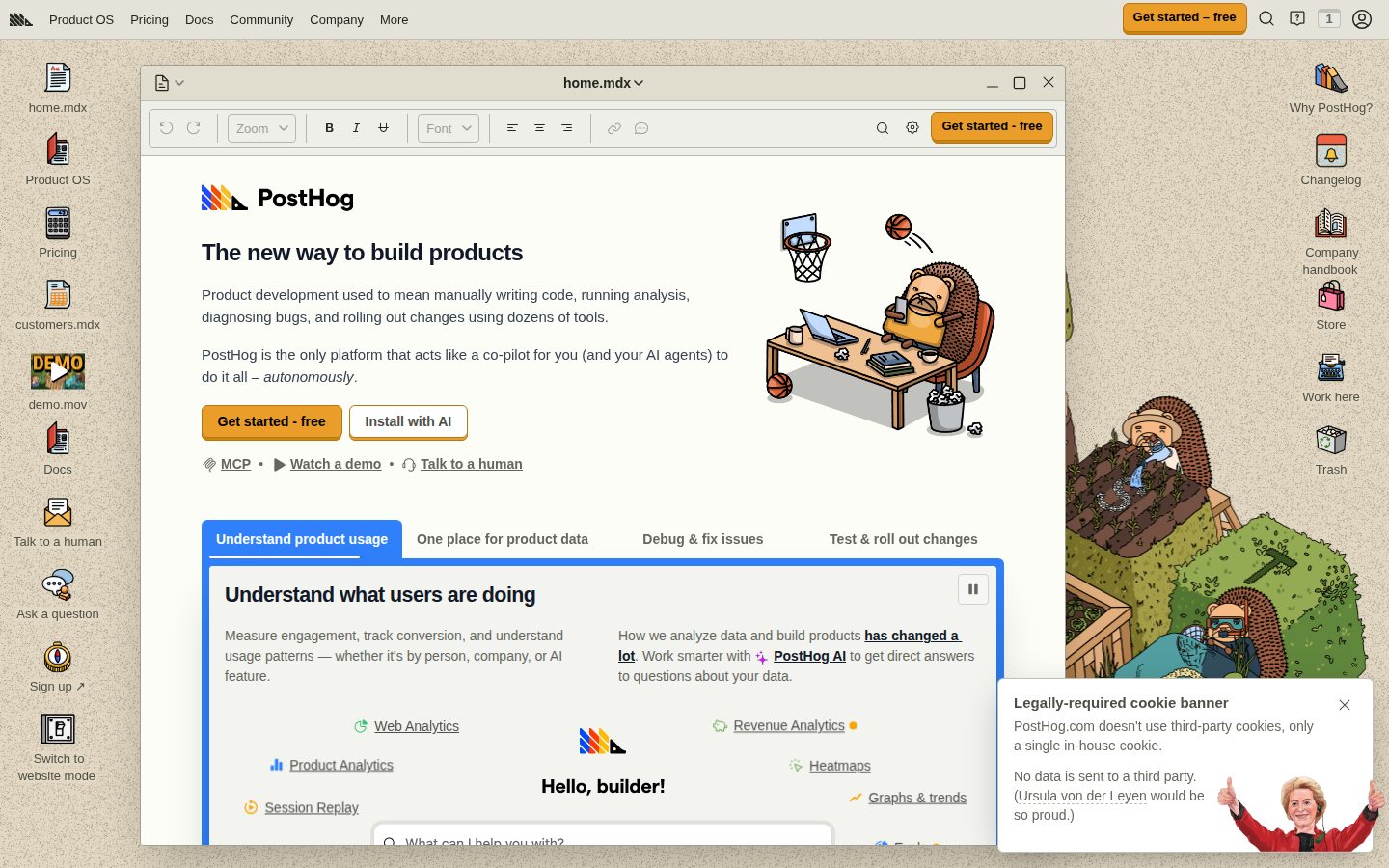
PostHog is an open-source product and data tools platform for software teams who want to understand and improve their products.

AI Panel Score

0 AI reviews

About PostHog

PostHog integrates into web, mobile, or backend applications via SDKs or a setup wizard that auto-detects the framework. Once installed, it captures events automatically and lets developers query user behavior through funnel analysis, retention charts, path analysis, and custom SQL. Feature flags can be evaluated client-side or server-side for gradual rollouts, and A/B experiments are built directly on top of those flags.

Distinctive capabilities include session replay, which records user interactions for debugging without additional code when using posthog-js; LLM analytics for tracking token usage and costs across OpenAI, Anthropic, and LangChain integrations; and a built-in data warehouse that lets teams query external sources like Stripe, HubSpot, Postgres, and S3 alongside PostHog event data using SQL. The CDP layer supports batch exports to BigQuery, Snowflake, Redshift, S3, and more, as well as real-time event destinations for tools like Slack, Salesforce, Intercom, and Customer.io.

PostHog targets product engineers and development teams at startups and growth-stage companies who prefer a consolidated toolset over separate analytics, feature flag, and session replay vendors. It is open-source and can be self-hosted or used as a cloud-managed service. The free tier includes generous usage limits, with paid plans priced on a usage-based model. Competitors in overlapping categories include Mixpanel and Amplitude (analytics), LaunchDarkly (feature flags), FullStory and Hotjar (session replay), and Optimizely (A/B testing).

PostHog exposes a REST API with US and EU cloud endpoints, supports reverse proxy deployment via Cloudflare, Vercel, Nginx, and other providers, and offers an official MCP server for AI coding assistant integrations. SDKs cover JavaScript, Python, Ruby, Go, PHP, iOS, Android, React Native, and more.

Features

AI

  • LLM Analytics

    Tracks LLM API calls, token usage, and costs with integrations for OpenAI, Anthropic, LangChain, and other AI providers.

  • MCP Server for AI Coding Assistants

    Provides an official Model Context Protocol server that integrates PostHog with AI coding tools like Claude Code via a wizard-installed plugin.

Analytics

  • A/B Testing (Experiments)

    Runs multivariate experiments built on feature flags, allowing teams to create experiments in the UI and render variants using getFeatureFlag calls.

  • Product Analytics

    Tracks user events and behaviors across web, mobile, and backend applications to provide funnel analysis, trends, and other product insights.

  • Session Replay

    Records and plays back user sessions to help developers debug UX issues and observe how users interact with the app, enabled by default with posthog-js.

  • Web Analytics

    Provides web traffic and visitor analytics as a built-in product within the PostHog platform.

Automation

  • Alerts

    Sends notifications when monitored metrics cross defined thresholds, including spike detection for usage anomalies.

Core

  • Data Warehouse

    Queries external data sources such as Stripe, HubSpot, Postgres, and S3 alongside PostHog data using SQL.

  • Error Tracking

    Captures and tracks frontend exceptions via posthog.captureException, enabling automatic error monitoring when the feature is enabled.

  • Feature Flags

    Evaluates named flags client-side or server-side via local evaluation to enable gradual rollouts, entitlements, and targeted feature delivery.

  • Surveys

    Renders in-app popup surveys configured in the PostHog UI automatically via posthog-js with no extra code required.

Integration

  • Customer Data Platform (CDP) / Data Pipelines

    Syncs PostHog event and person data to dozens of destinations (Slack, Salesforce, HubSpot, ad platforms, etc.) and ingests data from external sources via batch exports, real-time destinations, and transformations.

Preview

PostHog desktop previewPostHog mobile preview

Pricing Plans

Free

Free

Generous free tier for each product with no credit card required

  • 1 million product analytics events/month free
  • 5,000 session replay recordings/month free
  • 1 million feature flag requests/month free
  • 1.5k survey responses/month free
  • 100k error tracking exceptions/month free
  • 1 project, 1-year data retention
Popular

Pay as you go

Contact sales

Usage-based pricing after free tier limits; add a credit card to unlock higher limits and more features

  • Product analytics from $0.00005/event (after 1M free)
  • Session replay from $0.005/recording (after 5k free)
  • Feature flags from $0.0001/request (after 1M free)
  • Surveys from $0.10/response (after 1.5k free)
  • 6 projects, 7-year data retention
  • Email support, set per-product billing limits

AI Panel Reviews

AI panel reviews are being generated for this product.

Buyer Questions

Common questions answered by our AI research team

Pricing

How much does PostHog cost?

Usage-based with generous free tiers. Product analytics: 1M events/month free then $0.00005/event. Session replay: 5K recordings/month free then $0.005/recording. Set per-product billing limits to cap spend.

Features

What product surfaces does PostHog include?

Product Analytics, Session Replay, Feature Flags, A/B Testing, Web Analytics, Revenue Analytics, LLM evals and traces, plus a managed Data Warehouse — all on one platform.

Setup

Can I self-host PostHog?

Yes. PostHog ships an MIT-licensed open-source build for on-premise deployment. Managed Cloud is also available with regional options in US Virginia and EU Frankfurt.

Integration

Does PostHog integrate with Stripe?

Yes. PostHog connects with payment systems like Stripe for revenue analytics, plus error trackers and support platforms via 120+ data warehouse integrations.

Features

How long does PostHog retain my data?

Free tier keeps 1 year of data; paid plans extend retention to 7 years. Paid also raises the project cap from 1 to 6 and adds email support.

Also in AI Analytics