AI chat agents that handle bookings, sales, ads, and support on WhatsApp, Instagram, and Facebook
Chatfuel is an AI-powered messaging automation platform for businesses that communicate with customers on WhatsApp, Instagram, and Facebook.
AI Panel Score
6 AI reviews
Reviewed
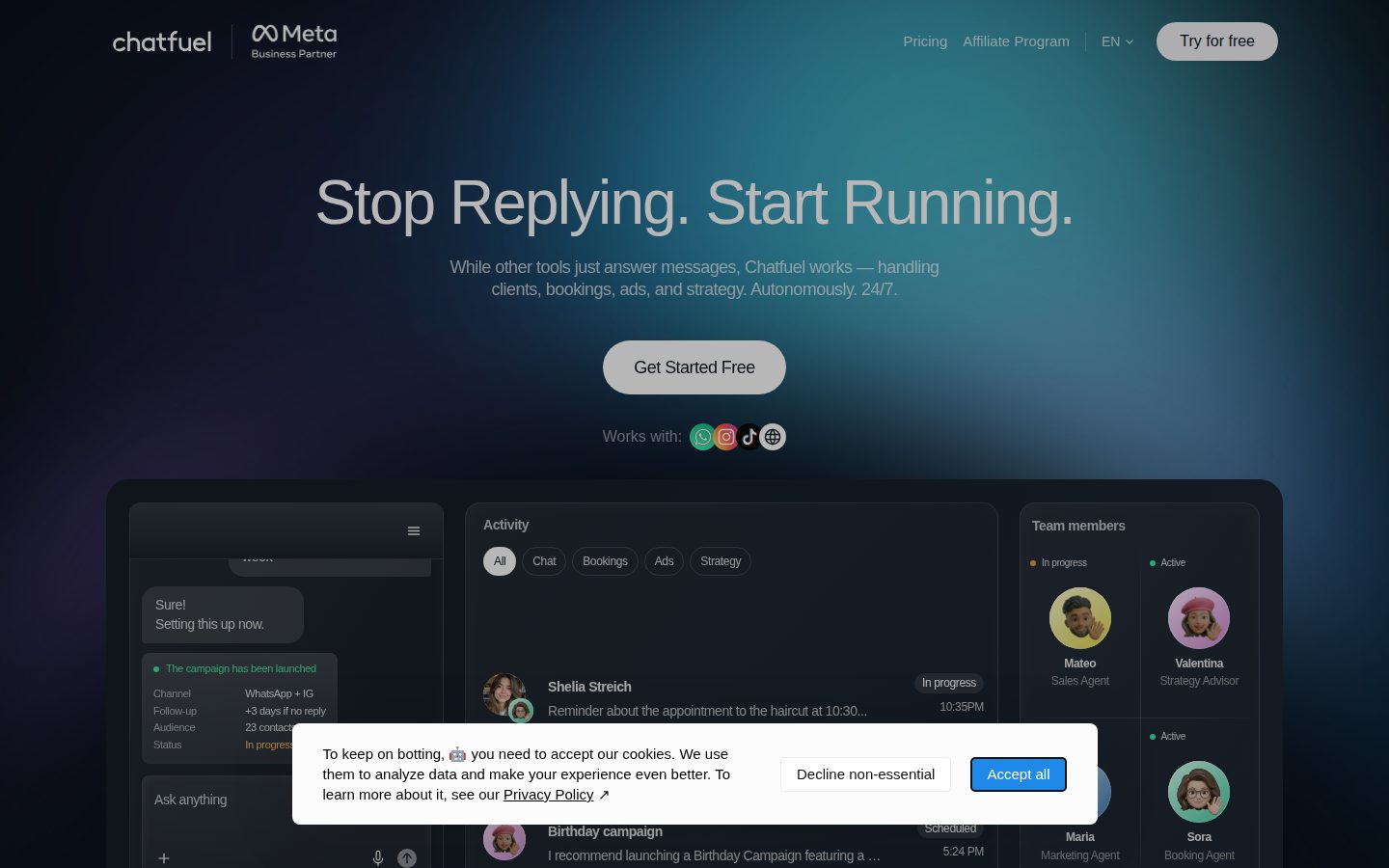
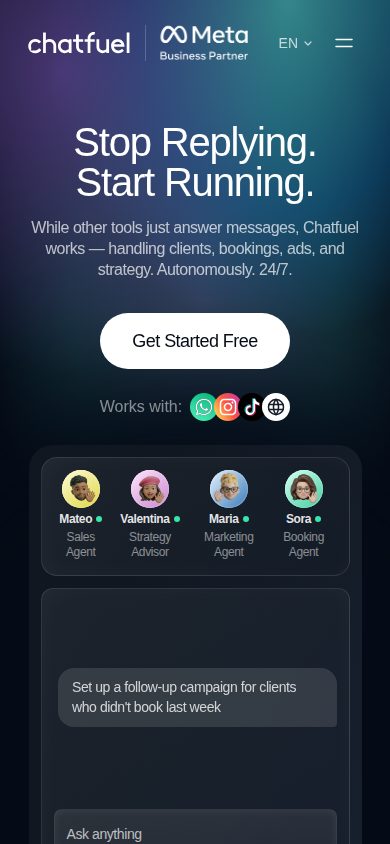
AI Editor ApprovedApproved and published by our AI Editor-in-Chief after full panel analysis.Chatfuel works through a set of named AI agents that a business owner interacts with by typing or sending a voice message. Instead of configuring rule-based chatbot flows, users assign tasks to agents like Mateo (Sales), Maria (Marketing), Sora (Booking), and Valentina (Strategy), who then carry out the work across connected messaging channels. The interface shows an activity feed of what each agent is doing, such as sending appointment reminders, replying to inbound messages, or scheduling a campaign.
The platform highlights several specific capabilities: automatic replies to DMs, comments, and story replies across Instagram, WhatsApp, and Facebook; a booking and scheduling system with confirmations and no-show handling; click-to-chat ad campaign launches directly from the AI interface; and daily strategy briefings with performance recommendations. Chatfuel is built on Meta's messaging infrastructure and is listed as an Official Meta Partner and WhatsApp Business Solution Provider, which allows it to operate across Meta-owned messaging channels.
Chatfuel is aimed at small and mid-sized businesses that rely on direct messaging for sales, appointments, and customer service, such as service-based businesses handling bookings. It sits in the customer messaging automation and AI chatbot category alongside tools like ManyChat, Tidio, and Intercom. The website states there is no contact limit and no credit card is required to start, indicating a freemium or free-to-start pricing structure, though specific paid plan pricing is not listed on the homepage.
Chatfuel operates as a web-based platform connected to WhatsApp Business, Instagram, and Facebook Messenger accounts, with no desktop or mobile app described on the page beyond the messaging channels it integrates with.

Chatfuel's AI agent proactively completes assigned business tasks rather than just reacting, acting like an AI coworker that gets things done.
Uses defined rules and inbuilt NLP so chatbots can understand and answer user requests based on keyword and phrase recognition.
Users can tell their AI Coworker what they need via a voice message and it carries out the task, functioning like a business manager in your pocket.
Offers an analytics dashboard to track chatbot performance and identify frequently unanswered questions for improvement.
Automatically answers DMs, comments, and story replies across Instagram, WhatsApp, and Facebook instantly.
Provides in-platform testing that lets users preview and interact with their bot exactly as customers would before publishing it live.
Supports building and deploying chatbots across Facebook Messenger, Instagram, and WhatsApp, with channel-specific customization.
A drag-and-drop canvas lets users build chatbot automations by creating flows composed of triggers and content sequences.
Chatbots are built using content blocks (similar to website pages) that users can customize and link into different conversational pathways without coding.
Connects to Shopify to automate product recommendations, abandoned cart recovery, order confirmations, shipping updates, and personalized product recommendations via WhatsApp.
Integrates with thousands of apps via Zapier, allowing users to sync leads to CRMs, email/SMS platforms, and other business tools.
When a chatbot doesn't understand a request, Chatfuel allows setup of default responses or transferring the conversation to a human agent via live chat.
Chatfuel's primary plan for small and mid-sized businesses running AI-powered chatbots on WhatsApp, Instagram, and Facebook Messenger; entry tier covers 150 active contacts, scaling up to 5,000 contacts at $279/month.
Premium tier for businesses needing more nuanced AI responses (complex customer inquiries, product recommendations, advanced support) via the full GPT-5 model, priced for 500 active contacts.
Custom tier for large organizations requiring dedicated support, higher contact volumes, and custom solutions; pricing requires contacting Chatfuel sales.
18,000 businesses, Meta partner status, but pricing pages that don't agree with each other.
“Chatfuel automates DM and booking work on WhatsApp and Instagram behind named AI agents. Solid for messaging-heavy SMBs, murky on what you'll actually pay.”
18,000 businesses and an Official Meta Partner badge. That's a real distribution moat — WhatsApp Business API access isn't trivial to get, and Chatfuel already has it.
Two things bug me. The pricing page shows Fuely Super at $39/month for 150 contacts, but the buyer FAQ quotes AI PRO at $49. That's not a rounding error, that's two different plans or a stale page — either way, sloppy for something billed by contact volume.
Competitively, this sits against ManyChat and Intercom, and the named-agent framing (Mateo, Sora, Valentina) is a real differentiator, not just marketing. Booking, ad launches, and strategy briefings in one interface is more than a flow builder. Pilot it for a single location handling bookings before you roll it across the portfolio.
Competes directly with ManyChat and Intercom; agent framing is a real differentiator, not just UI polish.
Meta Partner and WhatsApp Business Solution Provider status reads as credible, not risky.
No-code setup and no contract-to-start on free tier means fast pilot, per pricing page.
Automates existing DM/booking workflows rather than opening new revenue lines.
18,000+ businesses and Meta Partner status signal traction; no public funding data to confirm runway.
Service businesses running bookings and sales through WhatsApp or Instagram DMs today.
You need enterprise-grade transparency on pricing and roadmap before committing budget.
Solid frontline coverage for DM-driven SMBs, but escalation paths need real scrutiny before scaling support headcount around it.
“Chatfuel covers the volume end of the queue well: DMs, comments, story replies, bookings. What I need to see before I staff around it is how cleanly it fails over to a human.”
150 active contacts on Fuely Super at $39/month, jumping to $279 at 5,000 contacts, tells me this is priced for early-stage volume, not a mature support org. The named-agent framing (Mateo, Sora, Valentina) is a nice onboarding hook for non-technical owners, but my team doesn't manage 'coworkers,' we manage escalation SLAs and deflection rates. Live Chat Handoff exists, which matters more to me than any voice-command novelty.
GPT-5 mini on the entry tier versus full GPT-5 on Fuely Max at $139 is a real quality cliff for complex inquiries — that's the tradeoff I'd flag to any team scaling past pilot. Compared to Intercom or Tidio, Chatfuel's strength is native Meta channel depth (WhatsApp, Instagram, TikTok DM), not ticketing maturity or CSAT tooling. Three years in, this locks you into Meta's messaging ecosystem more than it builds a durable support operations layer.
Strong Meta-channel specialization versus ManyChat and Tidio, though thinner than Intercom on enterprise support depth.
Fits DM-heavy SMB support well but lacks the ticketing/SLA depth senior CS leaders expect at scale.
Zapier and Shopify integrations plus Official Meta Partner status give real workflow reach into CRM and commerce stacks.
150-contact entry tier and $279/5,000-contact jump signal a tool built for growth-stage churn, not 3-year stability.
Agent framing is clever UX but analytics dashboard and NLP are current-generation, not differentiated craft.
Small service businesses handling bookings and DM volume who need fast Meta-channel coverage without ticketing overhead.
Avoid if you run a support org that needs mature SLA tracking, CSAT reporting, or enterprise escalation workflows.
$39/month buys 150 contacts. Scale to 5,000 and you're at $279. Do that math first.
“Fuely Super starts at $39/month for 150 active contacts, scaling to $279 for 5,000. Two conflicting pricing pages in the evidence — one lists AI PRO at $49, another Fuely tiers at $39/$139 — that's a transparency problem, not a rounding error.”
$39/month, 150 contacts. That's the Fuely Super entry point. Scale to 5,000 contacts and you're paying $279/month — $3,348/year before Zapier or Shopify integration costs. Compare to ManyChat, similarly contact-tiered. Neither publishes a clean per-seat number, so budgeting means estimating contact growth, not headcount.
The buyer-question evidence names a different plan structure — AI PRO at $49/month — than the pricing table's Fuely Super at $39. Two pricing schemes in one evidence set. That's either a site migration mid-scrape or genuine confusion. Either way, procurement should get it in writing before signing.
Annual terms: 15% off at 6 months, 30% off at 12 months, on Fuely Super only. Fuely Max is monthly-only — no discount lever. Enterprise tier is quote-only, the usual black box. No credit card required to start is a real plus for a 30-day pilot before commitment.
No credit card required to start and a free tier lower onboarding friction for SMB buyers without legal review.
Annual discounts up to 30% on Fuely Super, but Fuely Max is monthly-only with no discount path.
Tiers are listed with numbers, but two conflicting pricing structures appear across the evidence — Fuely Super/Max vs. AI PRO.
Booking Agent no-show handling and analytics dashboard give trackable outcomes, but no published benchmark or case study numbers.
$39 to $279/month scales with contact count, not seats — unpredictable for a growing SMB customer base.
SMBs with under 5,000 contacts wanting WhatsApp and Instagram automation without a sales call.
Avoid if your contact volume will scale unpredictably past 5,000 within the first year.
Cute agent names, but when Sora double-books an appointment, who's answering the angry DM?
“Chatfuel hands off real customer conversations to named AI agents with almost no visible escalation path documented. Handoff to live chat exists on paper, but the daily reality of triaging AI mistakes across three channels isn't addressed anywhere in the evidence.”
Live Chat Handoff is listed as a feature, meaning when the bot doesn't understand, a human eventually gets pinged. Fine in theory. But nothing in the docs describes queue behavior, response-time expectations, or how a support agent picks up mid-conversation once Mateo or Sora has already committed to something with a customer, like a booking confirmation that needs correcting.
The analytics dashboard flags frequently unanswered questions, which helps prioritize what to fix. But I'm the one who inherits the aftermath when Sora mishandles a no-show or Valentina's strategy briefing recommends a promo that generates a support spike. Tools like Intercom and Tidio build their whole pitch around agent handoff quality; here it's a footnote.
$39/month for 150 contacts on Fuely Super with GPT-5 mini, jumping to $139 for full GPT-5 at 500 contacts, is a real cost lever if AI mistakes scale with contact volume and I'm the one cleaning up.
No documented workflow for what happens after an AI agent mishandles a booking or reply.
No docs, API, or changelog listed on the capabilities scrape; FAQ answers read as sales copy, not operational guidance.
Three channels (WhatsApp, Instagram, Facebook) plus autonomous agents means more surfaces where a support agent has to catch AI errors.
Analytics dashboard surfaces unanswered questions, a genuinely useful triage signal for a support team, even if buried.
Live Chat Handoff exists but escalation triggers and SLAs aren't specified anywhere in the evidence.
Small teams comfortable monitoring an AI agent's activity feed and manually catching its mistakes across channels.
You need documented escalation SLAs and audit trails before letting an AI agent touch live customer conversations.
Cute agent names, but the pricing math and the promise don't quite shake hands yet.
“Named AI agents like Mateo and Sora make the pitch feel personal instead of robotic. But the pricing story is a mess, and there's no mobile app for a tool that lives in your DMs.”
Three days in, the pitch is fun: type or talk to Mateo, Maria, Sora, Valentina, and they just go handle sales, bookings, ads. That's a nicer mental model than ManyChat's flow-chart maze. Voice-command task assignment is a genuinely different feel than clicking through blocks.
Month three is where I get nervous. The homepage says Fuely Super at $39/month for 150 contacts, scaling to $279 at 5,000. But the buyer Q&A talks about a totally different plan, AI PRO at $49, with a free trial that the pricing page says doesn't exist. That's not a rounding error, that's two pricing pages that never talked to each other. If I'm a service business trying to budget, that's a red flag before I've sent one message.
No desktop or mobile app either, just web plus the channels themselves. For a tool selling itself as your business manager in your pocket, that's a real gap against Intercom or Tidio's more unified setups.
Named agents and an activity feed show design thought, but conflicting pricing pages suggest nobody proofread the whole funnel.
Voice-command task assignment and named agents lower the ceiling from flow-builder complexity to conversational delegation.
No dedicated mobile or desktop app described, just a web platform tied to messaging channels.
No credit card required and no contact limit to start lowers the homework feel considerably.
In-platform bot testing before going live is reassuring, but two conflicting pricing structures ($39 Fuely Super vs $49 AI PRO) undercut trust.
Service businesses handling bookings and DMs who want an AI layer over WhatsApp and Instagram without building flow charts.
You need airtight, transparent pricing or a real mobile app before committing budget.
Named AI agents with human names, but the pricing page can't agree with itself.
“Two different answers for the entry AI tier ($39 Fuely Super vs $49 AI PRO) is the kind of inconsistency that makes me distrust the rest of the page. ManyChat solved this exact problem years ago without the personas.”
Mateo, Maria, Sora, Valentina. Cute. But naming your GPT-5-mini wrapper agents doesn't change what's underneath: a flow builder and NLP keyword matching, category-standard since 2016.
The pricing conflict is the real flag. Homepage evidence says Fuely Super is $39/month for 150 contacts, popular tier. Buyer Q&A says AI PRO is $49. Two different SKUs, or a page mid-migration? Either way, 'no contact limit' on the free tier doesn't match a $279/month plan capping at 5,000 contacts.
Meta Partner status is real and durable — that's infrastructure, not marketing. Exit is fine; WhatsApp Business API contacts aren't locked in, though flow logic doesn't travel. Competitively, this sits next to ManyChat and Tidio with no clear moat beyond the persona gimmick. 18,000 businesses claimed, no funding or changelog visible to size the company behind it.
Named agents (Sora, Mateo) are a UX wrapper over features ManyChat and Tidio already ship.
WhatsApp Business contacts and channels are Meta-owned; flow logic and agent config aren't portable.
Official Meta Partner status is solid; no changelog, docs, or funding data visible to verify shipping cadence.
Pricing page and buyer Q&A disagree on entry AI tier cost ($39 vs $49).
Follows the ManyChat/Tidio playbook with an AI-agent skin, not a new pattern.
Service businesses handling WhatsApp bookings who want a low-cost entry tier and don't mind some pricing-page confusion.
You need airtight documentation and consistent pricing before committing budget.
Common questions answered by our AI research team
Chatfuel Light is the free tier with Instagram, Facebook, and WhatsApp automations, a shared inbox, automated replies, flow builder, contact management, and templates. AI PRO adds an AI sales manager, AI knowledge base, AI-powered automations, broadcasts and re-engagement, lead qualification funnels, and advanced contact tools.
AI PRO costs $49 USD per month, with a 29% discount if billed yearly. A free trial is available.
Chatfuel works across WhatsApp, Instagram, and Facebook, responding to DMs, comments, and story replies on all three platforms.
The Booking Agent, named Sora, schedules appointments, sends confirmations and reminders, and handles no-shows.
Yes. You can direct your AI Coworker with a typed command or a voice message, and it will carry out the task without manual setup.


Chatfuel is a San Francisco-based chatbot automation platform that helps businesses manage sales and customer communication on Instagram, WhatsApp, and TikTok.