Gupshup logo

Gupshup Review

Visit

Conversational AI agents on WhatsApp, RCS, and SMS for 50,000+ businesses

Gupshup is a conversational AI platform for marketing, commerce, and customer support automation.

AI Panel Score

7.8/10

6 AI reviews

Reviewed

AI Editor Approved

What is Gupshup?

Gupshup is a conversational AI platform that helps businesses automate marketing, commerce, and customer support through autonomous AI agents on messaging channels. It suits marketing, sales, and support teams that reach customers at scale on WhatsApp, Instagram, SMS, and RCS. Pricing is usage-based: companies pay Meta's per-message rate plus a Gupshup platform fee, with negotiated volume discounts and enterprise plans arranged through sales, while a free trial and developer sandbox are available for testing. Core capabilities include the Auto Bot Builder for creating chatbots, an AI Co-Pilot that suggests replies and summarizes conversations for live agents, WhatsApp commerce with catalog browsing and checkout, drip and lifecycle campaign automation, AI-powered escalation to human agents, industry-specific templates, and real-time conversation analytics. It is a strong fit for high-volume consumer brands that run two-way messaging across many countries and channels. Alternatives worth comparing include Twilio, Infobip, MessageBird, Zoko, and Interakt.

About Gupshup

Gupshup runs customer conversations through autonomous AI agents that reply in natural language across WhatsApp, Instagram, SMS, and RCS. A business connects its messaging channels, builds an agent in the Auto Bot Builder, and the agent handles product inquiries, order updates, assisted shopping, and support without a human on the other end.

The Conversation Cloud adds an AI Co-Pilot that suggests responses and summarizes threads for live agents, drip and lifecycle campaign automation, WhatsApp commerce with catalog browsing and checkout, and AI-powered escalation that hands complex cases to a person. Real-time analytics track conversation and campaign performance across every channel, and industry-specific templates speed up setup.

It fits marketing, commerce, and support teams that engage customers at high volume on messaging apps. Pricing is usage-based: businesses pay Meta's per-message rate plus a Gupshup platform fee, with negotiated volume rates and enterprise plans for large deployments. Alternatives include Twilio, Infobip, MessageBird, Zoko, and Interakt.

As a Meta Business Partner, Gupshup provides Conversation APIs and a free developer sandbox for sending and receiving messages, with documentation at docs.gupshup.io for integrating messaging into existing apps and CRMs.

Features

Analytics

  • Real-Time Analytics

    Track conversation and campaign performance in real time across all connected channels.

Automation

  • Autonomous AI Agents

    Deploy AI agents that handle sales, marketing, and support conversations end to end across messaging channels.

Commerce

  • WhatsApp Commerce

    Enable catalog browsing, assisted shopping, automated invoicing, and checkout inside WhatsApp chats.

Development

  • Auto Bot Builder

    Create and configure customized chatbots and automated conversation flows without heavy coding.

Integration

  • Conversation APIs

    Send and receive messages programmatically and integrate messaging into existing apps and CRMs.
  • Omnichannel Messaging

    Reach customers on WhatsApp, Instagram, SMS, and RCS through a single messaging platform.

Marketing

  • Customer Segmentation

    Segment audiences and personalize conversations across the customer lifecycle.

  • Drip Marketing Campaigns

    Automate lifecycle and drip campaigns to personalize outreach across the customer journey.

Platform

  • Conversation Cloud

    A unified platform to build, deploy, and manage conversational experiences across every channel from one place.

Productivity

  • AI Co-Pilot

    Assist live agents with suggested responses and automatic summarization of conversation threads.

Workflow

  • AI-Powered Escalation

    Automatically hand off conversations from AI agents to human agents when a query needs a person.

  • Industry Templates

    Start faster with prebuilt, industry-specific conversation templates for common use cases.

Preview

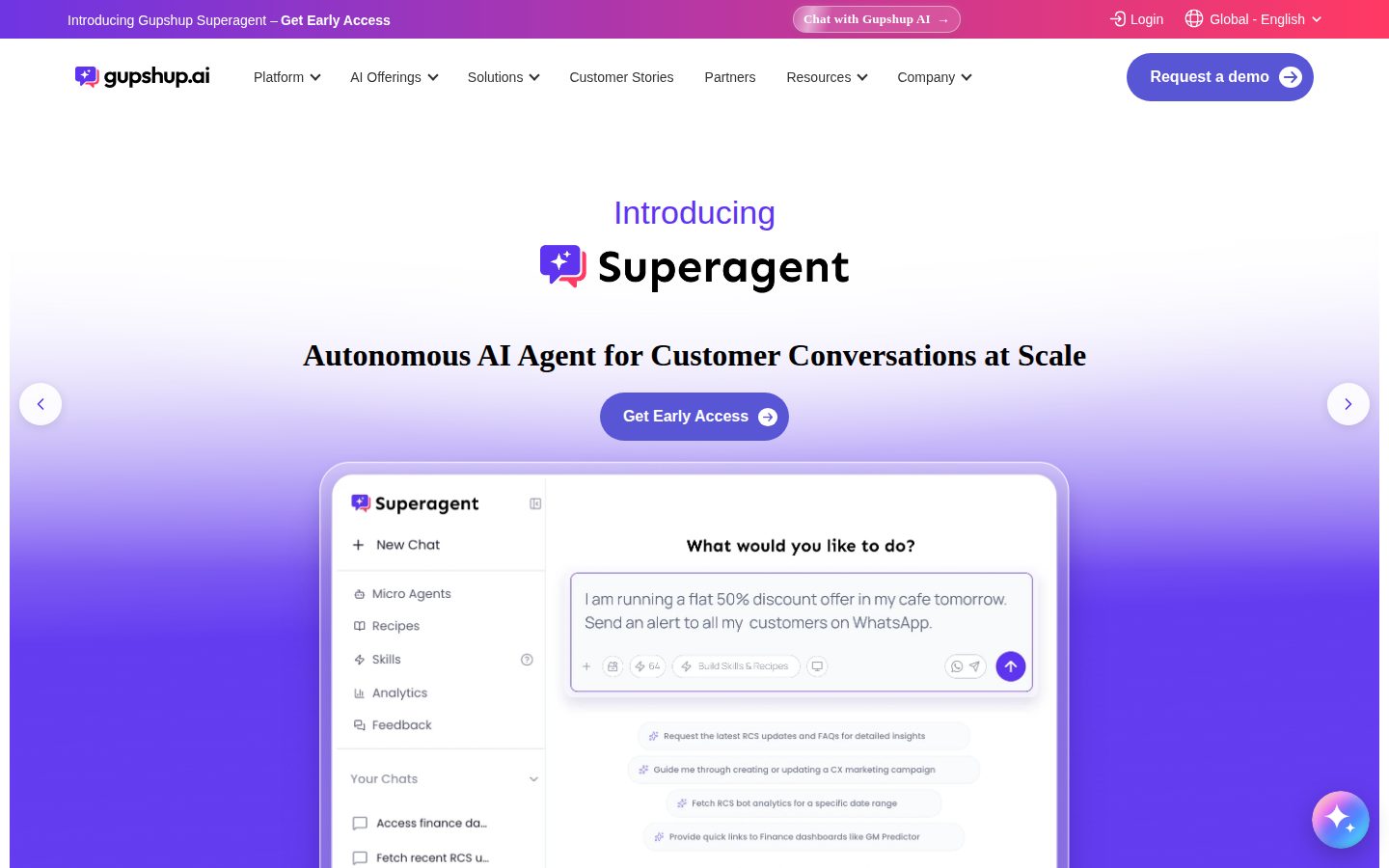
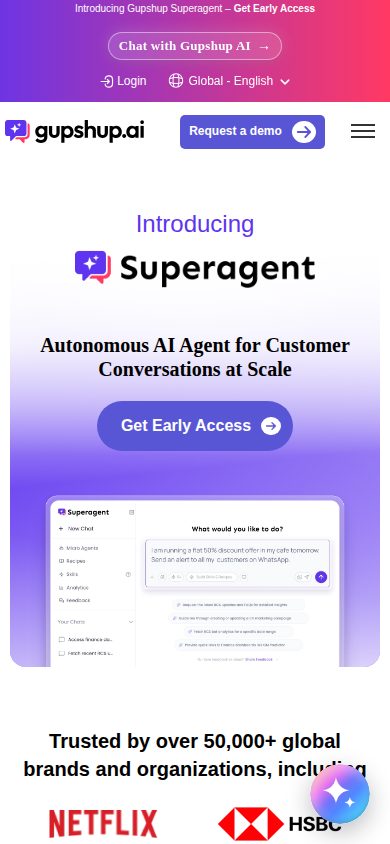
Gupshup desktop previewGupshup mobile preview

Pricing Plans

Pay As You Go

Contact sales

For businesses that want to start messaging and pay per message with no fixed monthly minimum.

  • Per-message billing (Meta rate plus Gupshup platform fee)
  • Auto Bot Builder and autonomous AI agents
  • WhatsApp, Instagram, SMS, and RCS channels
  • Free developer sandbox for testing
  • Real-time conversation analytics

Enterprise

Contact sales

For high-volume brands needing negotiated rates, volume discounts, and dedicated support.

  • Negotiated per-message rates
  • Volume discounts around 100,000+ messages per month
  • AI Co-Pilot for live agents
  • Omnichannel campaign automation
  • Enterprise-ready, secure infrastructure
  • Dedicated onboarding and support

AI Panel Reviews

The Decision Maker

The Decision Maker

Strategic bet, vendor viability, timing, adoption approval
8.1/10

A 22-year-old messaging vendor with real scale, tempered by a private valuation that keeps sliding.

Gupshup is a durable, Meta-decorated messaging platform handling 120 billion conversations a year for 50,000-plus businesses. The board question isn't survival — it's whether usage-based pricing and a marked-down valuation fit your risk appetite.

Twenty-two years is the number that anchors this decision. Gupshup has been in messaging since 2004 and won Meta's Partner of the Year in both 2023 and 2024 — that's a vendor unlikely to vanish on you. The valuation got marked down since 2021, but 50,000 customers don't churn overnight.

The Conversation Cloud is a consolidation play: bot builder, live-agent Co-Pilot, and campaigns across WhatsApp, Instagram, SMS, and RCS in one contract. Speed to value is the honest concern — WhatsApp number approval and agent tuning aren't same-day, and Twilio pitches you the same channels.

The catch is pricing you can't fully model up front, since the platform fee sits behind a sales call. Still, for a team already living in messaging, this is a defensible 3-year bet. Pilot one high-volume use case, then negotiate rates before you standardize.

Competitive Positioning8.0

A leading Meta BSP, but Twilio and Infobip contest the same channels.

Reputation Risk8.0

Meta Partner of the Year in 2023 and 2024 lowers the reputational downside.

Speed to Value7.8

WhatsApp number approval and agent tuning delay a same-day launch.

Strategic Fit8.2

Strong fit for teams consolidating messaging channels into one Conversation Cloud.

Vendor Viability8.0

Founded 2004 with 50,000-plus customers, though the private valuation has slid since 2021.

Pros

  • Twenty-two years in market and Meta Partner of the Year twice signal durable viability.
  • Conversation Cloud consolidates bot building, live-agent assist, and campaigns across four channels.
  • Usage-based pricing means no seat licenses to over-buy up front.

Cons

  • The platform fee isn't published, so all-in cost needs a sales call.
  • A valuation marked from $1.4 billion to roughly $500 million invites board questions.

Right for

Companies running high-volume customer messaging on WhatsApp and SMS.

Avoid if

Teams that need fully published pricing before a purchase.

The Domain Strategist

The Domain Strategist

Craft and strategy in the product's domain — adapts identity per category, same lens
8.2/10

For a support org, the decisive design choice is where the bot hands off to a human.

Gupshup's AI-Powered Escalation and Co-Pilot are built around the handoff moment that makes or breaks CSAT. Depth is real, but a CS leader should pressure-test containment quality before betting the queue on it.

The line that decides this for a customer success org is where automation stops and a person starts. Gupshup builds directly on that line: AI-Powered Escalation routes a stalled conversation to a live agent, and the AI Co-Pilot hands that agent a thread summary instead of a cold transcript. That's the difference between a rescued ticket and a repeated question.

Domain fit for support is strong. Autonomous agents cover order updates and product inquiries, containment reduces queue volume, and Conversation APIs wire the whole thing into your CRM. Against Twilio's more developer-first stack, Gupshup's Conversation Cloud is closer to a ready CS console than a toolkit.

Containment quality is the long-term concern no marketing page proves. The escalation logic is tunable, but whether it stays that way as your playbooks evolve is the open question. With 120 billion messages a year behind the models, the training signal runs deep.

Category Positioning8.1

A leading Meta BSP, positioned as a CS console rather than a raw toolkit.

Domain Fit8.3

Purpose-built for high-volume messaging support with human handoff baked in.

Integration Surface8.0

Conversation APIs and CRM hooks give a workable integration surface.

Long-term Implications7.9

Escalation logic must stay tunable as support playbooks evolve.

Strategic Depth8.2

Escalation, Co-Pilot, and campaigns cover the full support lifecycle, not one slice.

Pros

  • AI-Powered Escalation and Co-Pilot summaries target the exact handoff that drives CSAT.
  • Autonomous agents deflect routine support volume before it reaches the queue.
  • Conversation APIs integrate the platform into existing CRM and helpdesk stacks.
  • 120 billion messages a year gives the models unusually deep training signal.

Cons

  • Containment and escalation quality can't be verified from public materials alone.
  • A CS console this broad carries a real configuration and tuning burden.

Right for

Support leaders consolidating high-volume conversations across WhatsApp and SMS.

Avoid if

Small teams handling low ticket volume through email.

The Finance Lead

The Finance Lead

Money, total cost of ownership, contracts, procurement math
7.6/10

Two fees stack on every message, and only one of them is published.

Gupshup charges Meta's per-message rate plus a Gupshup platform fee, with no seat licenses and no public sticker. A study cites 270% ROI, but the platform fee sits behind a sales call.

Two costs ride on every message. Meta's per-message rate, then a Gupshup platform fee on top. The Meta side is public. The platform fee isn't. That's the transparency gap.

Pay-As-You-Go carries no monthly minimum. Volume discounts start near 100,000 messages a month. At that tier, a mid-market brand is modeling low-cents-per-message times volume — call it four to five figures monthly, before the fee you can't see. Twilio and Infobip meter the same way, so the structure is category-normal.

ROI has a data point: a study pegs it at 270%. Contract terms flex — pay per use, or negotiate enterprise rates that unlock the AI Co-Pilot. The catch is procurement can't price the platform fee without sales. Predictable structure, unpredictable invoice.

Billing & Procurement7.6

Per-message billing is standard, but enterprise pricing needs sales.

Contract Flexibility7.8

Pay-As-You-Go has no minimum; enterprise rates are negotiable.

Pricing Transparency7.0

Meta's rate is public but the Gupshup platform fee is not.

ROI Clarity7.8

A published study cites 270% ROI, a rare concrete number.

Total Cost of Ownership7.6

Usage-based cost scales cleanly, though the hidden fee clouds modeling.

Pros

  • Pay-As-You-Go carries no monthly minimum, so entry cost is low.
  • Usage-based billing means no seat licenses to over-provision.
  • A published study cites 270% ROI on the Conversation Cloud.

Cons

  • The Gupshup platform fee is not published anywhere on the pricing page.
  • All-in cost per message stays unpredictable until an invoice arrives.
  • Enterprise rates and Co-Pilot access require a sales conversation.

Right for

Finance teams comfortable with usage-based messaging spend.

Avoid if

Buyers who need a fixed monthly price locked in advance.

The Domain Practitioner

The Domain Practitioner

Daily hands-on reality in the product's domain — adapts identity per category, same lens
7.9/10

The Co-Pilot summary is what saves an agent when a half-finished chat lands in the queue.

For a support agent, Gupshup's value shows at the handoff, where the AI Co-Pilot summarizes a thread and suggests replies. The workflow is solid, but how much you can tune escalation stays hidden until you're in the console.

Strip away the demo and a support agent's real question is what the AI Co-Pilot does mid-shift. A chat the bot couldn't close drops into your queue, and you either scroll a cold transcript or the Co-Pilot hands you a summary and a suggested reply. That gap — ten seconds versus two minutes — is the whole value.

Workflow integration reads well for support. AI-Powered Escalation decides what reaches you, Conversation APIs pull customer context from the CRM, and docs.gupshup.io covers the setup properly. Compared to running raw Twilio, you're handed a console instead of assembling one.

The friction surface is the tuning. How finely you tune escalation triggers isn't visible until you're inside, and a bot that escalates too eagerly just moves the queue back to humans. The catch is you inherit whatever containment rate the bot delivers, and 120 billion messages of training won't guarantee your edge cases.

Day-3 Reality7.8

The Co-Pilot handoff genuinely speeds real ticket triage.

Documentation Practitioner-Fit8.0

docs.gupshup.io covers setup and channel integration well.

Friction Surface7.6

Escalation tuning depth is hidden until you're inside the console.

Power-User Depth8.0

Autonomous agents, Co-Pilot, and APIs offer real depth for power users.

Workflow Integration8.0

Escalation, CRM context, and multichannel routing fit an agent's day.

Pros

  • AI Co-Pilot summaries turn a cold transcript into a fast handoff.
  • AI-Powered Escalation filters what actually reaches a live agent.
  • Documentation at docs.gupshup.io covers channel setup thoroughly.
  • Conversation APIs pull CRM context into the agent's view.

Cons

  • Escalation and canned-response tuning depth isn't visible until you're in the console.
  • An over-eager bot pushes volume right back onto human agents.

Right for

Support agents handling high chat volume across messaging channels.

Avoid if

Agents who mostly work email and phone tickets.

The Power User

The Power User

Daily human experience, onboarding, polish, learning curve, reliability
7.6/10

Getting onto WhatsApp Business is the real hurdle here, not learning the app itself.

Gupshup feels built for scale, and the reliability numbers back that up, but the onboarding tests your patience. Once you're through Meta's approval, the Conversation Cloud is a lot of tool to settle into.

Signing up for Gupshup isn't like signing up for a normal app. You're getting a WhatsApp Business number approved through Meta first, and that's paperwork, not a click. Industry Templates soften the next part, so you're not staring at a blank bot builder wondering where to start. Day one still isn't frictionless.

Where it earns trust is reliability. A platform pushing 300 million messages a day, with peaks past 750 million, won't fall over when your campaign sends. That's the quiet confidence you want. Twilio has the same reputation, so this is table stakes, not a party trick.

The Conversation Cloud is a lot of surface — bots, Co-Pilot, campaigns, analytics — and the learning curve reflects that. It's web-first, so a live agent clearing the queue from their phone is out of luck. The catch is breadth cuts both ways: everything's in one place, but nothing feels lightweight.

Daily Polish7.6

The Conversation Cloud is capable but broad enough to feel heavy.

Learning Curve7.4

Breadth across bots, campaigns, and analytics takes time to master.

Mobile Parity7.4

The console is web-first, with no phone workflow for live agents.

Onboarding Experience7.2

WhatsApp Business approval through Meta slows the first-run experience.

Reliability Feel8.2

300 million messages a day signals infrastructure that holds under load.

Pros

  • Reliability is a genuine strength at 300 million messages a day.
  • Industry Templates give you a starting point instead of a blank builder.
  • One Conversation Cloud covers bots, campaigns, and analytics together.

Cons

  • WhatsApp Business approval through Meta makes onboarding slow and paperwork-heavy.
  • The console is web-first, so agents can't work the queue from a phone.
  • Breadth means a real learning curve before it feels comfortable.

Right for

Teams running high-volume messaging campaigns from a desktop.

Avoid if

Solo users wanting a quick, lightweight chat tool.

The Skeptic

The Skeptic

Contrarian. Watch-outs, deal-breakers, broken promises, category patterns
7.2/10

Raised at $1.4 billion in 2021 and marked to around $500 million by 2024 — yet still standing.

The 50,000-customer, 120-billion-message marketing is real, and so is a valuation that fell hard since 2021. Gupshup is a genuine survivor, but the growth story the homepage implies isn't what the cap table shows.

Raised at a $1.4 billion valuation in 2021. Fidelity marked it to roughly $500 million by 2024. That gap doesn't make the homepage. Founded in 2004, though. Not a two-year-old. Twenty-two years is a real record.

Marketing Honesty holds up better than most. The 120-billion-message claim checks out, and Meta named them Partner of the Year in 2023 and 2024. The 'leading platform' superlative is the kind that ages poorly, but the scale behind it is genuine. Differentiation is thinner — Twilio, Infobip, and Sinch sell the same channels.

Exit portability is the real watch. Your WhatsApp number ports to another BSP, but the Auto Bot Builder flows and Co-Pilot tuning don't come with you. So the switching cost is the automation, not the number. Long-term, a 20-year survivor with 50,000 customers isn't going anywhere, even at a marked-down price.

Competitive Differentiation7.2

Meta Partner status helps, yet Twilio and Infobip crowd the space.

Exit Portability6.9

The number ports out, but bot flows and tuning stay behind.

Long-term Viability7.4

Scale and longevity outweigh the private-market markdown.

Marketing Honesty7.0

Scale claims verify, though 'leading platform' is a soft superlative.

Track Record Match7.2

Twenty-two years is real, but the valuation markdown undercuts the hype.

Pros

  • Twenty-two years in market and 50,000 customers make survival credible.
  • The 120-billion-message and Partner of the Year claims check out.
  • A WhatsApp number ports to another BSP if you leave.

Cons

  • Valuation fell from $1.4 billion to roughly $500 million since 2021.
  • Auto Bot Builder flows and Co-Pilot tuning don't transfer on exit.
  • Twilio, Infobip, and Sinch sell the same channels and blur differentiation.

Right for

Buyers who value a long-standing vendor over the newest entrant.

Avoid if

Buyers who read a falling valuation as a dealbreaker.

Buyer Questions

Common questions answered by our AI research team

Pricing

How much does Gupshup cost?

Gupshup uses usage-based pricing: you pay Meta's per-message rate plus a Gupshup platform fee on every message, with no single flat rate. Volume discounts start around 100,000+ messages a month, and large deployments negotiate enterprise rates directly with sales.

Features

Which messaging channels does Gupshup support?

Gupshup runs conversations across WhatsApp, Instagram, SMS, and RCS from one Conversation Cloud. Autonomous AI agents, the Auto Bot Builder, and drip campaigns work across every channel, while an AI Co-Pilot assists live agents with suggested replies and summaries.

Integration

Does Gupshup offer an API for developers?

Yes. As a Meta Business Partner, Gupshup provides Conversation APIs and a free developer sandbox to send and receive messages programmatically. Documentation at docs.gupshup.io covers integrating WhatsApp and other channels into your own apps and CRM.

Setup

How do I build a chatbot in Gupshup?

You build agents in the Auto Bot Builder, connect your messaging channels, and deploy without heavy coding. Industry-specific templates speed setup, and AI-powered escalation automatically routes complex queries to human agents when the bot cannot resolve them.

Security

Is Gupshup secure and enterprise-ready?

Gupshup runs on enterprise-ready infrastructure and is Meta's #1 global WhatsApp partner, powering 120 billion+ messages a year for 50,000+ customers. It publishes privacy, data-protection, and security policies and offers enterprise plans with dedicated support.

Also in AI Chatbots