CodeWall logo

CodeWall Review

Visit

Autonomous attack agents that continuously test enterprise defenses

CodeWall is an autonomous adversarial testing platform for enterprise security teams.

AI Panel Score

7.1/10

6 AI reviews

Reviewed

Facts checked against codewall.ai

About CodeWall

CodeWall positions its product as an always-on adversary for enterprise security teams. Instead of relying on scheduled penetration tests or scarce human experts to check whether existing defenses hold, CodeWall runs autonomous attack agents that keep looking for vulnerabilities on an ongoing basis, operating independently of any fixed testing calendar.

The website highlights the agents' ability to share what they discover and to prove where an identified weakness could actually lead, rather than simply flagging a theoretical issue. CodeWall's research team has published writeups documenting specific findings, including an account of accessing Bain's competitive intelligence platform (13 Apr 2026) and another describing access to BCG's data warehouse, reported as 3.17 trillion rows with zero authentication (31 Mar 2026).

CodeWall is built for enterprises that already maintain layered security defenses and want continuous, controlled adversarial testing in place of or alongside periodic assessments. The site does not publish pricing details or plan names.

Features

AI

  • Autonomous AI Pentesting Agents

    Deploys AI agents that reason like attackers to continuously map attack surfaces, form hypotheses, and adapt mid-run rather than following static checklists.

  • Multi-Agent Collaboration via Shared Investigation Graph

    Multiple specialized agents collaborate by logging findings to a shared investigation graph, enabling discoveries in one system to inform attacks on connected systems.

Analytics

  • Compliance Tagging

    Tags findings for compliance purposes to help teams map vulnerabilities to regulatory requirements.

  • Customizable Alerts & Real-Time Monitoring

    Provides customizable alerts and real-time vulnerability monitoring to keep teams informed as new issues are found.

Automation

  • Continuous Re-scanning

    Agents continuously re-scan for new systems or applied fixes within authorized scopes, providing a permanent capability versus a once-a-year penetration test.

Core

  • Authenticated Testing

    Supports authenticated testing capabilities in addition to agents that start without credentials or inside knowledge, mimicking real-world attackers.

  • Automated Reconnaissance & Subdomain Enumeration

    Automatically discovers and enumerates subdomains and assets as part of mapping an organization's attack surface.

  • Broad Environment Coverage

    Supports testing across web applications, REST/GraphQL APIs, cloud infrastructures, and internal tools.

  • Multi-Phase Exploit Chaining

    Chains together multiple vulnerabilities across systems the way a real adversary would, allowing a weakness in one system to become an entry point into connected systems.

  • Verified Proof-of-Concept Evidence

    Delivers reproducible proof-of-concept exploits and a step-by-step view of each successful attack path complete with evidence, rather than theoretical risk scores.

Integration

  • CI/CD and CLI/REST API Integration

    Integrates with CI/CD pipelines through both CLI and REST API so testing operates within ongoing development and change-management processes.

  • Jira Integration

    Integrates with Jira so teams can assign discovered vulnerabilities to team members without returning to the dashboard.

Preview

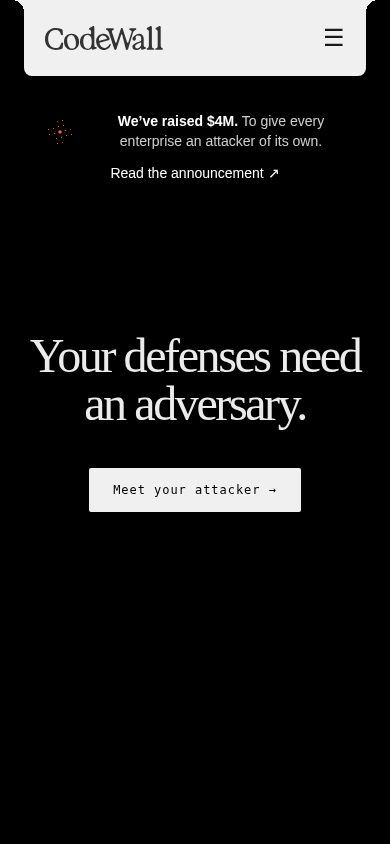
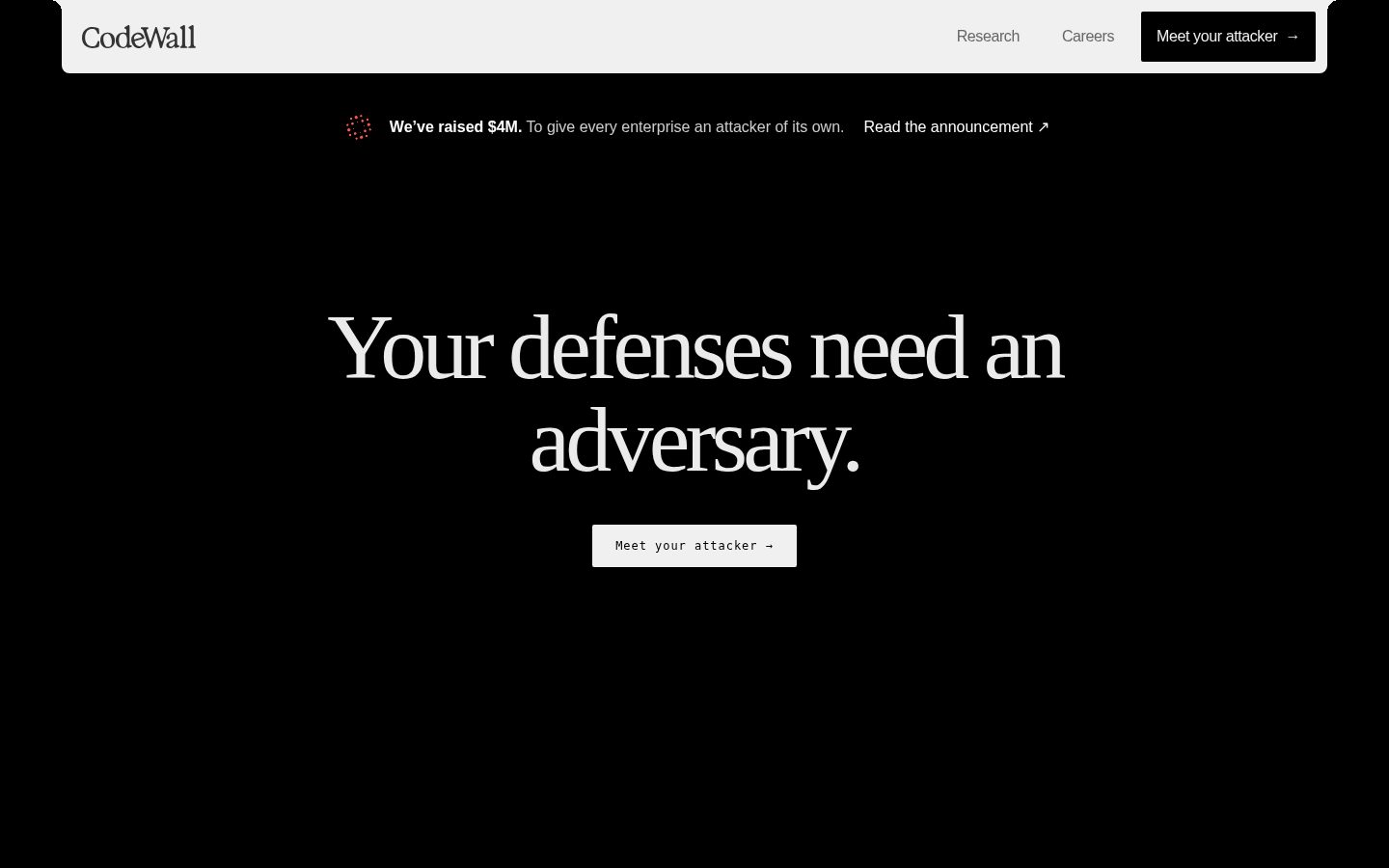
CodeWall desktop previewCodeWall mobile preview

Pricing Plans

Contact Sales

Contact sales

CodeWall is an enterprise, sales-led autonomous AI penetration testing / offensive security platform. There is no public list pricing; fees are determined per customer via a custom order, quote, or design partner agreement after contacting the CodeWall sales team.

  • Autonomous AI attack agents that simulate external attackers without requiring credentials, source code, or internal access
  • Continuous, sustained adversarial testing, verification, and remediation workflows
  • Attack path mapping across connected systems with evidence-based validation of exploitable weaknesses
  • Targeted at enterprise customers (e.g., financial institutions) needing repeated security assessments

AI Panel Reviews

The Decision Maker

The Decision Maker

Strategic bet, vendor viability, timing, adoption approval
7.6/10

An always-on red team that replaces the calendar, not the budget conversation.

“CodeWall swaps periodic pen tests for agents that never stop probing. The hard part is deciding what to do with a tool that finds things faster than your remediation team can close them.”

Twelve named features, from subdomain enumeration to Jira handoff, and they form an actual pipeline rather than a feature list. The investigation graph plus exploit chaining is the real architectural bet here: findings compound instead of sitting in isolated tickets.

That's also the risk. An agent that keeps testing around the clock, across web apps, APIs, cloud, and internal tools, needs a kill switch someone trusts. I didn't see that governance layer spelled out anywhere I could reach.

Compliance tagging and CI/CD integration suggest this is built to live inside a security team's existing stack, not bolt on top of it. That's the right instinct for something meant to run forever. Whether a continuous attacker is worth adopting before the vendor's own staying power is proven is a separate call entirely.

Competitive Positioning8.0

Multi-phase exploit chaining across connected systems via a shared investigation graph is architecturally different from a static checklist scan.

Reputation Risk6.5

Authenticated and unauthenticated testing modes are named, but scope controls for autonomous agents running unattended aren't clearly documented.

Speed to Value7.5

Reproducible proof-of-concept evidence with step-by-step attack paths means findings are actionable on day one, not buried in a risk score.

Strategic Fit8.0

Continuous adversarial testing across cloud, APIs, and internal tools is a capability shift, not a cheaper version of existing pen test cycles.

Vendor Viability7.0

Docs and blog are live, integrations (CLI, REST, Jira) are named specifically, which signals active build-out even without a visible changelog.

Pros

  • Investigation graph lets one agent's discovery inform attacks on connected systems
  • CI/CD, CLI, REST API and Jira integration fit existing security workflows
  • Proof-of-concept evidence gives engineering something concrete rather than a theoretical score
  • Covers web, API, cloud, and internal tools under one continuous model

Cons

  • No documented limits on what an unattended agent can touch mid-run
  • Compliance tagging maps to frameworks but depth of coverage is unclear
  • Shared investigation graph concentrates a lot of sensitive attack-path data in one place

Right for

Enterprise security teams running layered defenses who want continuous adversarial pressure instead of annual pen tests.

Avoid if

Skip it if you need documented agent scope controls locked down before anything autonomous touches production.

The Domain Strategist

The Domain Strategist

Craft and strategy in the product's domain — adapts identity per category, same lens
7.8/10

An always-on red team that forces a hard conversation about authorization scope and blast radius.

“CodeWall replaces the once-a-year pen test with autonomous agents that never stop probing. The research team's own published breaches — Bain's intelligence platform and a 3.17-trillion-row BCG warehouse with zero authentication — prove the model finds real things, but I need governance answers before I let agents loose on production.”

Continuous adversarial testing is the right direction. My pen test calendar has always been the weakest link in my program — a clean report in March tells me nothing about a misconfiguration pushed in August. CodeWall's shared investigation graph and multi-phase exploit chaining mean agents compound findings the way a real adversary would, not the way a checklist does.

What I need before signing is governance, not capability. Autonomous agents running credential-free recon against production, with CI/CD and REST API hooks, is a serious authorization-scope and change-management question for my team, not a procurement one. The $4M raise announced 14 Oct 2026 tells me this is early-stage; I'd want contractual clarity on containment before agents touch anything customer-facing.

Jira integration and compliance tagging suggest they understand SOC workflows, not just offense. Three years in, if this works, I've replaced scarce pentester cycles with a standing adversary. If scope controls lag the agent capability, I've handed an AI a permanent foothold-seeking mandate inside my own perimeter.

Category Positioning8.0

Positions clearly against scheduled pen testing with public research proving real-world exploit paths, a credible wedge in a lane still forming.

Domain Fit7.5

Continuous, credential-free testing matches how attackers actually operate, but enterprise security teams will want authorized-scope controls spelled out before deployment.

Integration Surface7.8

CLI/REST API, CI/CD hooks, and Jira integration mean findings route into existing remediation workflows rather than sitting in a standalone dashboard.

Long-term Implications7.0

A standing autonomous adversary inside your perimeter is a powerful capability and a governance commitment you can't easily unwind.

Strategic Depth8.2

Multi-phase exploit chaining and verified proof-of-concept evidence go beyond theoretical risk scoring — the Bain and BCG writeups back that up.

Pros

  • Published research showing actual access achieved, not hypothetical scoring, including a 3.17 trillion row unauthenticated data warehouse finding
  • Multi-phase exploit chaining and shared investigation graph mirror real adversary behavior across connected systems
  • CI/CD, CLI/REST API, and Jira integration fit directly into existing security and dev workflows

Cons

  • Enterprise-only, quote-based pricing with a custom order or design partner agreement means budgeting requires a sales cycle
  • Early-stage funding ($4M announced Oct 2026) raises questions about long-term support for a tool running inside production
  • Autonomous agents operating without a fixed schedule require clear authorization-scope controls I'd want documented before deployment

Right for

Enterprises with mature layered defenses who want continuous adversarial validation instead of annual pen tests.

Avoid if

Avoid if your organization needs fixed, auditable pricing and can't commit to a sales-led procurement cycle.

The Finance Lead

The Finance Lead

Money, total cost of ownership, contracts, procurement math
6.1/10

One price point: contact sales. No number, no tier, no math to run.

“CodeWall is quote-only with a custom order or design partner agreement. That's fine for a CISO. It's a wall for finance trying to model year-one spend.”

No price on the site. Not a range, not a seat count, not a usage meter. Just 'contact sales.' Can't build a TCO model from zero inputs.

Compare to the pricing-page norm in dev tooling: $20/seat, clear tiers, procurement signs off in a day. CodeWall skips that. Enterprise security tools often do — category norm is custom quotes for anything touching production attack surface. Still costs something: a sales cycle, a design-partner negotiation, legal review of scope-of-authorization terms before agents start probing anything.

ROI math is also absent from what I can see. Jira integration and CI/CD hooks via CLI/REST API suggest per-seat or per-integration cost could stack, but there's no published number to confirm or rule that out. $4M raised in October 2026 doesn't buy pricing transparency. Budgeting here means waiting for a quote, not running a spreadsheet.

Billing & Procurement4.0

Enterprise sales-led motion means a procurement cycle before any invoice exists.

Contract Flexibility5.5

Design partner agreement or custom order implies negotiation room, but terms aren't public.

Pricing Transparency3.0

Single tier, 'Contact Sales,' no published number anywhere I found.

ROI Clarity6.5

Verified proof-of-concept evidence and attack path mapping make impact concrete, even without cost-side numbers.

Total Cost of Ownership4.5

No seat price or usage metric to project year-1 vs year-3 spend.

Pros

  • Proof-of-concept evidence ties findings to demonstrated impact, not a risk score
  • CI/CD, CLI/REST API, and Jira integration reduce workflow friction once purchased

Cons

  • No published price, range, or tier structure to budget against
  • Custom order or design partner agreement means a sales cycle before cost is known

Right for

Enterprise security teams with budget authority ready to negotiate a custom contract.

Avoid if

You need a number on a page before you'll start a procurement conversation.

The Domain Practitioner

The Domain Practitioner

Daily hands-on reality in the product's domain — adapts identity per category, same lens
7.3/10

Agents that chain exploits live inside CI — but where's the kill switch?

“CodeWall's exploit-chaining and shared investigation graph are the right primitives for continuous offensive testing. The operational controls a security engineer actually lives with day-to-day are harder to confirm from the outside.”

What I want to know on day three isn't whether the agents found something — it's how I throttle them when they're hammering a staging environment at 3am mid-incident. The docs page exists, but I couldn't find granular detail on rate-limiting, pause/resume per-scope, or how the agent behaves when a target system itself is actively being remediated. That's the daily friction surface for anyone running 'always-on adversary' in prod-adjacent environments.

The shared investigation graph is the interesting architectural bet — agents logging findings so a credential leak in one system becomes the entry point for another. That's real adversary modeling, not checklist scanning. Jira and CLI/REST integration mean triage doesn't require living in a separate dashboard, which matters for on-call rotations.

Authenticated and unauthenticated modes both exist, which is good coverage. But I'd want documented escalation paths before green-lighting continuous agents against anything revenue-critical.

Day-3 Reality7.0

Continuous re-scanning and real-time alerts sound strong, but authorization-scope and throttling controls aren't clearly documented for an engineer on-call.

Documentation Practitioner-Fit6.9

A docs and blog presence exists with research writeups, but I couldn't confirm depth on API reference specifics an engineer needs for scoping agents safely.

Friction Surface6.8

Compliance tagging and customizable alerts help, but a quote-only enterprise model means every environment-specific control question goes through sales first.

Power-User Depth7.5

Multi-phase exploit chaining and multi-agent collaboration via a shared graph suggest real depth beyond single-vuln scanning.

Workflow Integration7.8

CLI, REST API, CI/CD and Jira integration mean findings land where security teams already triage work.

Pros

  • Multi-agent shared investigation graph models cross-system attack paths, not isolated findings
  • CLI, REST API and Jira integration fit into existing dev and security tooling
  • Compliance tagging helps map findings to regulatory frameworks without manual translation

Cons

  • Operational controls for pausing or scoping autonomous agents mid-run aren't clearly spelled out
  • Enterprise-only positioning means smaller security teams likely aren't the target buyer

Right for

Enterprise security teams with layered defenses who want continuous adversarial pressure-testing instead of annual pen tests.

Avoid if

You need clear self-serve documentation on agent throttling and scope controls before you'll run autonomous attackers near production.

The Power User

The Power User

Daily human experience, onboarding, polish, learning curve, reliability
7.1/10

An always-on attacker is a great pitch, but who's watching the agents at 2am?

“CodeWall sells continuous autonomous pentesting instead of the once-a-year fire drill. The idea is sound, but there's not much here about what the day-to-day of running it actually feels like.”

Most security tools I've looked at live or die on how they feel during the boring middle stretch, not the sales demo. CodeWall's whole pitch is that it never stops working, which is a good idea, but I couldn't find much about what that looks like from inside the dashboard day to day. Real-time alerts and Jira integration are mentioned, which is the right instinct, but 'customizable alerts' can mean thoughtful triage or a wall of noise depending on execution.

Authenticated testing plus unauthenticated agent runs is a solid design choice for covering both insider and outsider angles. But an agent that's supposed to run continuously needs a trustworthy on/off switch and clear status indicators, and that's the part I can't evaluate from the outside.

Contact-sales-only enterprise pricing means you won't get a feel for cost tiers before a call. For a tool meant to live quietly in production for months, that's a lot of trust to extend before you've seen the UI breathe.

Daily Polish6.5

No visible detail on dashboard states or alert tuning beyond 'customizable alerts' in the feature list.

Learning Curve7.0

CLI, REST API, and CI/CD integration give experienced security teams a familiar on-ramp, though compliance tagging and multi-agent output likely take time to interpret well.

Mobile Parity5.5

Platforms listed as web only, with nothing suggesting a mobile view for monitoring agent activity.

Onboarding Experience6.0

Enterprise sales-led motion with no public pricing or trial info means onboarding likely starts with a sales call, not a sandbox.

Reliability Feel7.0

Continuous re-scanning and a shared investigation graph suggest persistent state, but I found no detail on uptime, error handling, or agent failure modes.

Pros

  • Continuous authenticated and unauthenticated testing modes cover both insider and outsider attack angles
  • CLI, REST API, and Jira integration slot into existing pipelines rather than demanding a new workflow
  • Verified proof-of-concept evidence gives security teams something concrete to hand to engineering

Cons

  • No visible detail on what the agent's day-to-day dashboard or alert experience actually looks like
  • Enterprise-only, sales-led access means no self-serve way to kick the tires before committing
  • Web-only platform with nothing suggesting mobile monitoring for an always-on tool

Right for

Enterprise security teams with layered defenses who want ongoing adversarial pressure instead of annual pentest reports.

Avoid if

Skip it if you need to see pricing tiers or try a sandbox before looping in a sales team.

The Skeptic

The Skeptic

Contrarian. Watch-outs, deal-breakers, broken promises, category patterns
6.7/10

$4M buys you an attacker. Does it buy you a support contract in three years?

“The BCG and Bain writeups are real receipts, not screenshots of a dashboard. The company behind the agents is nine days old by funding-announcement standards, and that matters for something you'd run against production.”

Offensively Good Security is a good tagline. It's also the kind of line that ages badly if the agents ever misfire inside a client's authorized scope and the writeup goes the other direction.

The Bain and BCG findings, dated 13 Apr and 31 Mar 2026, are the strongest thing here. 3.17 trillion rows unauthenticated is a specific, checkable claim, not a risk score. That's rarer than it should be in this category, where I've watched vendors sell hypothetical CVSS scores as proof of capability.

What gives me pause: $4M, announced 14 Oct 2026. That's weeks old. Enterprise security tools need multi-year runway more than almost any other category — if CodeWall stalls, you're not swapping a SaaS seat, you're re-architecting continuous testing coverage. Jira and CI/CD hooks are nice. They don't fix a vendor that doesn't exist in 2029.

Competitive Differentiation7.0

Continuous autonomous agents versus scheduled pen tests is a real structural difference, not just repositioning.

Exit Portability6.0

Findings feed into Jira and CI/CD, but an always-on agent model leaves an open question about what coverage looks like the day after you leave.

Long-term Viability5.8

A $4M round announced 14 Oct 2026 is early-stage money for a tool meant to run inside production indefinitely.

Marketing Honesty7.5

The research writeups back the 'prove where it leads' claim with named targets and real numbers, not just a tagline.

Track Record Match7.2

Two documented findings with dates and specifics is real evidence, though it's two data points, not a track record.

Pros

  • Named, dated findings against real targets with concrete numbers, not theoretical scoring
  • Continuous model structurally different from calendar-based pen testing
  • CI/CD, CLI, REST API and Jira integration reduce handoff friction post-purchase

Cons

  • Funding announced 14 Oct 2026 is nine days old at review time
  • Enterprise-only, quote-based pricing means no way to gauge cost before a sales call
  • Long-term support story for an always-on security tool is unproven this early

Right for

Enterprises with layered defenses already in place who want continuous adversarial pressure-testing and can tolerate a sales-led onboarding.

Avoid if

You need multi-year vendor stability guarantees before putting an autonomous agent anywhere near production systems.

Buyer Questions

Common questions answered by our AI research team

Features

How does CodeWall differ from periodic pen testing?

Traditional pen testing relies on scarce experts and periodic assessments, leaving gaps between checks. CodeWall instead runs autonomous attack agents that continuously probe defenses, matching how real attackers never stop looking for a way in.

Features

Does CodeWall test defenses continuously or on a schedule?

CodeWall tests continuously rather than on a periodic schedule. Its autonomous agents keep searching for weaknesses around the clock instead of waiting for scheduled assessments.

Features

What do CodeWall's attack agents actually do?

CodeWall's autonomous attack agents continuously probe an enterprise's defenses, searching for ways in, sharing what they learn with each other, and demonstrating where a given weakness could lead.

Features

Does CodeWall show how a vulnerability could be exploited?

Yes. The attack agents demonstrate where a given weakness could lead, showing the real-world impact of a discovered vulnerability rather than just flagging it.

Security

Is CodeWall a funded, established company?

Yes. CodeWall has raised $4M, announced 14 Oct 2026, to give every enterprise an attacker of its own, and actively publishes research and news from its team.

Product Information

  • Company

    CodeWall
  • Pricing

    Contact for pricing

Platforms

web

About CodeWall

CodeWall develops autonomous AI agents that continuously test enterprise systems for security vulnerabilities, simulating attacker behavior.

Resources

Documentation
Blog

Also in AI Security