Constructor logo

Constructor Review

Visit

Product discovery for enterprise ecommerce, powering 400 billion requests a year

Constructor is an AI product discovery and search platform for enterprise ecommerce retailers.

AI Panel Score

7.9/10

6 AI reviews

Reviewed

AI Editor Approved

What is Constructor?

Constructor is an AI product discovery and search platform built for enterprise ecommerce retailers. It powers search, autosuggest, browse, recommendations, collections, and quizzes from a single Commerce Reasoning Engine that ranks products on real-time shopper behavior and intent, then uses reinforcement learning to optimize toward each retailer's chosen KPIs like revenue and conversion. Pricing is quote-based with no public plans, so teams contact sales for a proposal sized to catalog and traffic; average contracts run into six figures. Core capabilities include an AI Shopping Agent for natural-language finding, a Product Insights Agent that answers buyer questions, GenAI Attribute Enrichment, Retail Media monetization, and merchandiser dashboards with A/B experiments. It fits mid-market and enterprise retailers in apparel, grocery, and general merchandise that have outgrown keyword search. Alternatives worth comparing include Algolia, Bloomreach, Coveo, Klevu, and Searchspring, each offering ecommerce search and personalization at different scales and price points.

About Constructor

Constructor connects to a retailer's product catalog and serves every discovery surface from one Commerce Reasoning Engine: search, autosuggest, browse category pages, recommendations, collections, and quizzes. The engine reads real-time shopper behavior, context, and intent to rank products per person, and reinforcement learning re-tunes those rankings after each interaction toward the KPIs a retailer picks, such as revenue, conversion, or margin.

Beyond ranking, the platform adds an AI Shopping Agent for natural-language product finding and a Product Insights Agent that generates and answers buyer questions. Attribute Enrichment uses generative AI to fill and normalize catalog attributes, Retail Media places sponsored products inside results, and Cross-Channel & Offsite Discovery extends the same signals to email, SMS, push, and in-store campaigns. Merchandisers keep hands-on control through dashboards, boost-and-bury rules, and built-in A/B experiments.

Constructor targets mid-market and enterprise ecommerce teams in apparel, grocery, and general merchandise that have outgrown keyword search. Pricing is quote-based and negotiated per catalog size and traffic, with no public tiers, so buyers contact sales for a proposal. Direct competitors in the category include Algolia, Bloomreach, Coveo, Klevu, and Searchspring.

The platform is API-first, exposing REST APIs and SDKs so results render across web and native mobile storefronts, and its homepage headlines an integrate-with-anything approach to connecting existing catalogs and commerce stacks. A Merchant Intelligence Agent (beta) adds explainability, showing why any result ranks where it does and helping teams diagnose and fix ranking issues.

Features

AI Agent

  • AI Shopping Agent

    Lets shoppers search in natural language and returns products matched to their intent and context.

  • Product Insights Agent

    Generates and answers personalized product questions so shoppers can buy with more confidence.

Analytics

  • Merchant Intelligence Agent

    Explains why any result ranks the way it does and helps teams diagnose and fix ranking issues.
Automation

  • Attribute Enrichment

    Uses generative AI to fill and normalize product and category attributes for better discoverability.

Engagement

  • Quizzes

    Interactive product-finder quizzes that guide shoppers to relevant items and capture preference data.

Integration

  • Cross-Channel & Offsite Discovery

    Shares discovery intelligence to power email, SMS, push, and in-store marketing campaigns.

Merchandising

  • Collections

    Builds dynamic, curated product pages that reorder automatically from shopper signals.

  • Merchandiser Controls

    Dashboards, boost-and-bury rules, and A/B experiments that let merchandisers override AI ranking.

Monetization

  • Retail Media

    Serves sponsored products and ads inside discovery results to add ad revenue without hurting relevance.

Personalization

  • Browse

    Personalizes category and listing pages, reordering products for each shopper based on behavioral signals.

  • Recommendations

    Surfaces related and complementary products across the shopper journey using real-time behavioral data.

Search

  • Search & Autosuggest

    AI-driven ecommerce search and type-ahead that interprets shopper intent in real time instead of matching keywords.

Preview

Constructor desktop previewConstructor mobile preview

Pricing Plans

Contact Sales

Contact sales

Pricing requires contacting the vendor.

  • Full Commerce Reasoning Engine across all discovery surfaces
  • Search, Browse, Recommendations, Collections, and Quizzes
  • AI Shopping Agent and Product Insights Agent
  • Retail Media and Cross-Channel Discovery
  • Implementation in 8 weeks or less with enterprise support
  • Quote sized to catalog size and traffic volume

AI Panel Reviews

The Decision Maker

The Decision Maker

Strategic bet, vendor viability, timing, adoption approval
8.2/10

A decade-old, well-funded discovery engine with 98.5% retention that's worth a scoped pilot.

Constructor is a mature, well-capitalized product discovery platform that enterprise retailers keep renewing. The pricing is opaque and the commitment is six figures, so scope a pilot before you standardize on it.

98.5% client retention over three years is the number that earns a second meeting. Renewals like that don't happen by accident in enterprise search — they mean the Commerce Reasoning Engine is holding revenue, not just serving results.

The vendor question checks out. Founded in 2015, a $55M Series A in 2021, then a $25M Series B in 2024 at a $550M valuation. That's a decade-old company with fresh capital, not a bet on someone's runway.

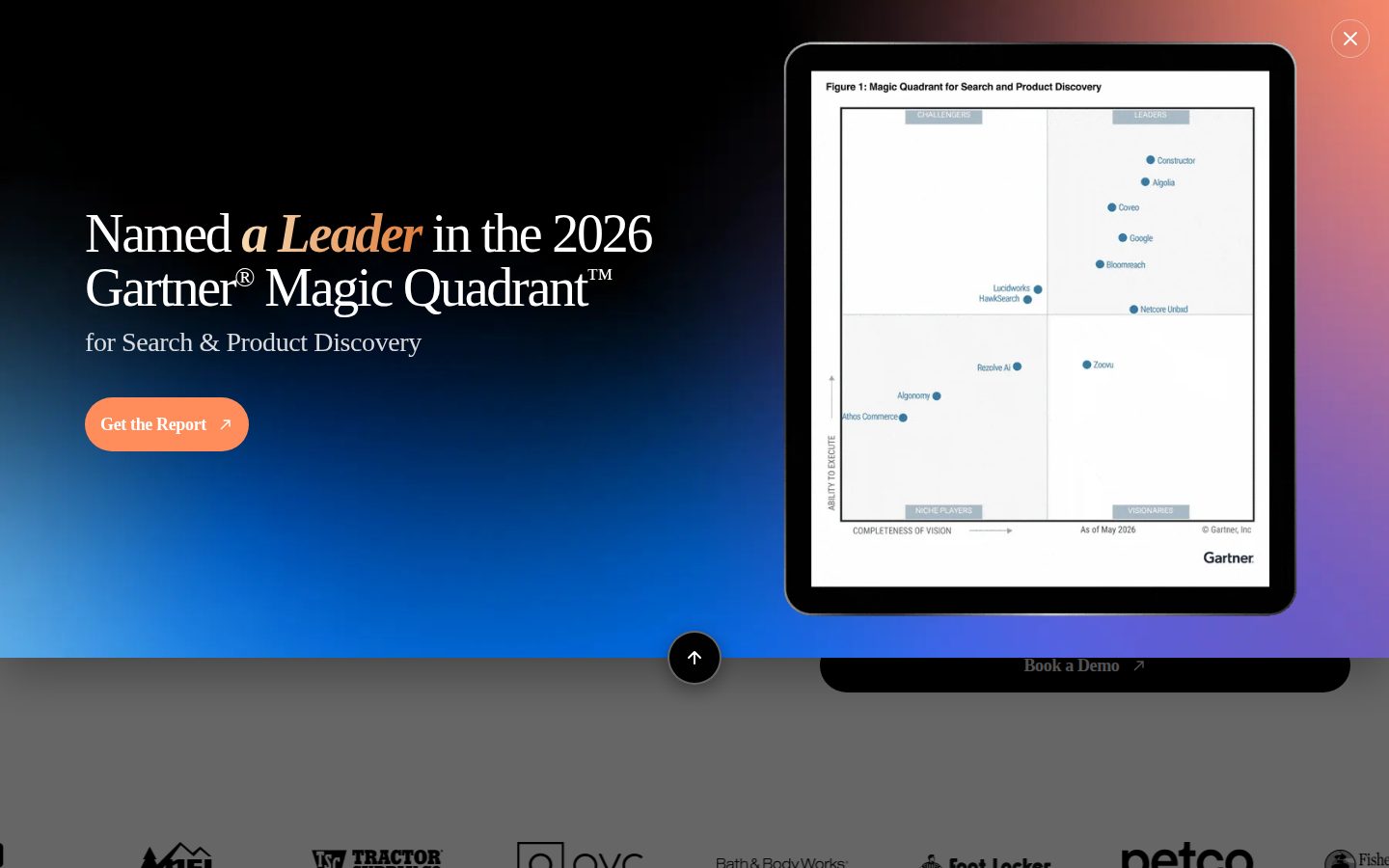
Constructor sits against Bloomreach and Coveo in enterprise discovery, and it holds its own. The catch is pricing — quote-only, six figures a year, with no public floor to benchmark. Run a scoped pilot on one category, hold them to the eight-week implementation, and check conversion lift before the org-wide deal.

Competitive Positioning8.0

Holds its own against Bloomreach and Coveo on KPI-driven ranking.

Reputation Risk8.0

Established brand serving 400 billion requests a year lowers adoption risk.

Speed to Value7.5

Cited eight-week implementation is fast for an enterprise discovery platform.

Strategic Fit8.0

Purpose-built for enterprise retailers who have outgrown keyword search.

Vendor Viability8.5

Founded 2015 with roughly $80M raised and 98.5% three-year retention signals durability.

Pros

  • Ten years in business with fresh 2024 capital signals durability.
  • 98.5% three-year retention shows customers renew rather than churn.
  • One engine covers search, browse, recommendations, and offsite discovery.
  • Eight-week implementation is fast for an enterprise platform.

Cons

  • Pricing is quote-only and commonly reaches six figures annually.
  • Deep adoption raises switching costs across every discovery surface.

Right for

Enterprise retailers who have outgrown keyword search.

Avoid if

Small stores who need transparent self-serve pricing.

The Domain Strategist

The Domain Strategist

Craft and strategy in the product's domain — adapts identity per category, same lens
8.3/10

Constructor consolidates six discovery surfaces onto one KPI-tuned engine that merchandisers can still override.

Constructor runs every discovery surface from one Commerce Reasoning Engine that optimizes toward the KPI you choose. The consolidation is a strong strategic bet for enterprise teams, provided you plan for the vendor concentration it creates.

The strategic question with any AI discovery engine is whether your merchandisers keep the wheel. Constructor answers it directly — the Commerce Reasoning Engine ranks on real-time behavior, but boost-and-bury rules and built-in A/B experiments let teams override it and test against revenue or margin.

That KPI-targeting is the real differentiator over Coveo and Algolia. Reinforcement learning retunes results after each interaction toward the goal you pick, so browse and collections pages compound toward conversion instead of just matching keywords. Across 400 billion requests a year, that is a lot of signal feeding the model.

The three-year risk is concentration. Running search, browse, recommendations, and offsite discovery on one vendor is efficient, but the switching cost climbs every quarter you deepen it. For a Head of E-commerce who has outgrown keyword search, it is still a bet worth making — just negotiate export terms up front.

Category Positioning8.5

KPI-targeting differentiates it clearly from Coveo and Algolia.

Domain Fit8.5

Serves every discovery surface enterprise ecommerce teams actually run.

Integration Surface8.0

API-first REST and SDK approach connects to existing commerce stacks.

Long-term Implications7.5

Consolidating all discovery on one vendor concentrates switching-cost risk.

Strategic Depth8.5

Reinforcement learning retunes results toward a chosen KPI after each interaction.

Pros

  • Reinforcement learning retunes results toward your chosen KPI.
  • Merchandisers keep override control via boost-and-bury and A/B tests.
  • API-first architecture integrates with existing commerce stacks.
  • Consolidates six discovery surfaces onto a single engine.

Cons

  • Running all discovery on one vendor concentrates strategic risk.
  • Merchant Intelligence Agent explainability remains in beta.

Right for

Heads of e-commerce who want one discovery stack.

Avoid if

Teams who need to avoid single-vendor concentration.

The Finance Lead

The Finance Lead

Money, total cost of ownership, contracts, procurement math
7.6/10

Strong ROI story undercut by quote-only pricing you can't benchmark before a sales call.

Constructor's KPI-based optimization makes ROI unusually measurable for a discovery platform. The catch is fully quote-based pricing with no public floor, which slows procurement and blocks easy benchmarking.

Constructor won't show you a number without a sales call. Contracts land in six figures a year, sized to catalog and traffic. For enterprise procurement that is normal, but it kills any quick benchmark.

Where the math turns defensible is ROI. The Commerce Reasoning Engine optimizes toward a KPI you set — revenue, conversion, margin — so lift is measurable against a control. Retail Media can even route ad revenue back through discovery, offsetting part of the license cost.

Two procurement cautions. Quote-based deals carry no published overage or renewal cap, so model a 15-20% year-two increase. And compare hard against Algolia, which publishes usage rates you can forecast. Constructor may win on results, but Algolia wins on the invoice you can predict.

Billing & Procurement7.5

Enterprise procurement is well supported despite opaque list pricing.

Contract Flexibility7.0

Quote-based deals carry no published overage or renewal caps.

Pricing Transparency6.5

No public tiers; pricing requires a sales call for a quote.

ROI Clarity8.3

KPI optimization makes discovery lift measurable against a control.

Total Cost of Ownership7.5

Six-figure annual contracts are sized to catalog and traffic.

Pros

  • KPI-based optimization makes ROI measurable against a control.
  • Retail Media can offset part of the license cost.
  • Enterprise procurement processes are well supported.

Cons

  • No public pricing blocks quick benchmarking.
  • Quote-based deals lack published overage or renewal caps.
  • Six-figure annual commitment prices out smaller retailers.

Right for

Buyers who can measure discovery ROI against revenue.

Avoid if

Finance teams who require published pricing to forecast.

The Domain Practitioner

The Domain Practitioner

Daily hands-on reality in the product's domain — adapts identity per category, same lens
8.0/10

Merchandisers keep hands-on control here, but the eight-week setup isn't a self-serve install.

Constructor gives merchandisers real override control through boost-and-bury rules, A/B tests, and an explainability agent. It takes about eight weeks to implement, so it rewards teams that commit rather than tinker.

First thing a merchandiser checks: when the engine ranks a hero product on page three, can you pull it up without filing a ticket? Constructor's Merchandiser Controls give you boost-and-bury rules plus built-in A/B experiments, so overrides are hands-on, not a support request.

The Merchant Intelligence Agent is the piece that earns trust. It explains why any result ranks where it does, which is the difference between arguing with a black box and fixing a bad category page. Searchspring and Klevu give you rules too, but rarely the why behind the ranking.

Setup is real work — implementation runs eight weeks through API integration, so this isn't something you spin up on a Tuesday. But once live, the daily loop of curating collections and testing merchandising rules moves faster than keyword tools. The 98.5% retention suggests merchandisers who get there tend to stay.

Day-3 Reality8.0

Boost-and-bury rules let merchandisers override rankings without a ticket.

Documentation Practitioner-Fit7.5

Public practitioner docs are thin for a closed enterprise tool.

Friction Surface7.5

Eight-week implementation means no quick self-serve setup.

Power-User Depth8.5

Merchant Intelligence Agent explains why any result ranks where it does.

Workflow Integration8.0

Dashboards fold A/B tests and curation into the daily loop.

Pros

  • Boost-and-bury rules let merchandisers override rankings by hand.
  • Merchant Intelligence Agent explains why any result ranks where it does.
  • Built-in A/B experiments test merchandising changes against KPIs.
  • Attribute Enrichment auto-fills catalog data for better discoverability.

Cons

  • Eight-week implementation rules out quick self-serve setup.
  • Public practitioner documentation is thin for a closed enterprise tool.

Right for

Merchandisers who want to override AI rankings directly.

Avoid if

Small teams who need a self-serve install.

The Power User

The Power User

Daily human experience, onboarding, polish, learning curve, reliability
7.8/10

Shoppers get a genuinely smarter search, but you'll never see a price without sales.

Constructor makes storefront search feel smart through its AI Shopping Agent and quizzes, and the operator dashboards look built for daily use. There's no free plan or public price, so you meet it only after your company signs on.

The piece shoppers feel is the AI Shopping Agent — you describe what you want in plain words and it finds the thing, instead of guessing the keyword the catalog wants. Quizzes do the same for people who don't know what they want yet. That's the good kind of hand-holding.

On the operator side, the dashboards look built for people who live in them daily, with boost-and-bury and A/B tests a few clicks away. It isn't a tool you self-serve into, though — implementation runs 8 weeks, so there's no free-plan tinkering first. You learn it because your company bought it.

Next to Klevu, the personalization feels deeper and less stitched together. Mobile parity isn't really the question here — results render in whatever storefront you run. The catch is you never see a price until you talk to sales, a small wall for a curious operator.

Daily Polish8.0

AI Shopping Agent and dashboards feel built for daily hands-on use.

Learning Curve7.5

Enterprise tool learned on the job after an eight-week rollout.

Mobile Parity7.5

Results render in the existing storefront, so mobile isn't a separate surface.

Onboarding Experience7.0

No free plan or self-serve trial; onboarding runs through sales.

Reliability Feel8.0

Powering 400 billion requests a year signals production reliability.

Pros

  • AI Shopping Agent handles natural-language product finding well.
  • Quizzes guide undecided shoppers toward relevant products.
  • Powering 400 billion requests a year signals production reliability.
  • Operator dashboards look built for daily hands-on use.

Cons

  • No free plan or self-serve trial to explore first.
  • Pricing stays hidden until you contact sales.

Right for

Operators who run high-traffic storefronts daily.

Avoid if

Curious users who want to trial before buying.

The Skeptic

The Skeptic

Contrarian. Watch-outs, deal-breakers, broken promises, category patterns
7.5/10

Real ten-year track record and clean exit path, with a beta feature to watch.

Constructor backs its claims with a decade in business, enterprise scale, and an API-first exit path. The pricing stays hidden and its flagship explainability agent is still in beta, both worth watching.

98.5% client retention over three years is a strong number. It's also self-reported and unaudited, and 'retention' can quietly count a shrinking account as retained. Still — a decade in business since 2015, and real customers behind 400 billion requests, is not nothing.

The funding shape is interesting. A $55M Series A in 2021, then a smaller $25M Series B in 2024. Down-sized follow-on, or capital-efficient growth — could go either way. The tripled valuation to $550M leans toward the second read.

Exit portability is the pleasant surprise. It's API-first, so leaving for Bloomreach or Coveo means re-pointing integrations, not rebuilding a storefront. The yellow flag is the Merchant Intelligence Agent still in beta — the explainability they market hardest isn't fully shipped yet.

Competitive Differentiation7.5

KPI-targeting reinforcement learning is a real edge over Coveo.

Exit Portability8.0

API-first design keeps leaving a re-point, not a rebuild.

Long-term Viability7.5

Tripled valuation to $550M offsets the smaller Series B.

Marketing Honesty7.0

Retention and scale figures are self-reported, and a beta feature is marketed heavily.

Track Record Match7.5

A decade since 2015 and real scale back the core claims.

Pros

  • A decade in business since 2015 backs the track record.
  • API-first design keeps the exit path clean.
  • Tripled valuation to $550M signals investor confidence.

Cons

  • Retention and scale figures are self-reported and unaudited.
  • Merchant Intelligence Agent is still marketed while in beta.
  • Quote-only pricing hides cost until a sales call.

Right for

Retailers who value a portable enterprise vendor.

Avoid if

Buyers who need transparent pricing up front.

Buyer Questions

Common questions answered by our AI research team

Pricing

How much does Constructor cost?

Constructor uses quote-based enterprise pricing with no public plans, so you contact sales for a proposal sized to your catalog and traffic. Contracts commonly reach six figures annually, reflecting its focus on mid-market and enterprise retailers rather than small stores.

Integration

Does Constructor integrate with my commerce platform?

Yes. Constructor is API-first, exposing REST APIs and SDKs so its results render in web and native mobile storefronts, and it connects to existing catalogs through prebuilt integrations. Its homepage headlines an integrate-with-anything, API-first approach.

Features

What can Constructor's AI shopping agents do?

The AI Shopping Agent lets shoppers search in natural language and returns products matched to intent, while the Product Insights Agent generates and answers personalized product questions. A Merchant Intelligence Agent explains why each result ranks where it does.

Setup

How long does Constructor take to implement?

Constructor cites implementations of eight weeks or less, handled with its team through API integration to your catalog. It reports a 98.5% average client retention rate over three years and powers 400+ billion requests annually, signaling production scale.

Features

How is Constructor different from keyword search?

Constructor ranks results with a Commerce Reasoning Engine that reads real-time shopper behavior and intent, not just keyword matches. Reinforcement learning retunes rankings after each interaction toward KPIs you set, such as revenue, conversion, or margin.

Also in AI E-commerce