Bloomreach logo

Bloomreach Review

Visit

AI-powered search, email, and personalization for commerce brands

Bloomreach is a commerce experience platform for retail, travel, and consumer brands.

AI Panel Score

7.8/10

6 AI reviews

Reviewed

About Bloomreach

In practice, marketers use Bloomreach to build and send personalized email campaigns, trigger cross-channel messages via SMS, mobile app, web, and ads, and optimize on-site search—all from a unified interface. Workflows are driven by customer behavioral data, allowing teams to set up automated journeys that respond to real-time signals like price drops, inventory changes, or browsing intent without requiring custom development.

Distinctive capabilities highlighted by Bloomreach include Autonomous Search, which uses intent-based understanding rather than keyword matching to connect shoppers to relevant products; Conversational Shopping, a generative AI shopping agent designed to replicate in-store associate guidance online; and Loomi AI's Connected Orchestration, which links email, paid ads, search results, and in-app experiences into a coordinated customer journey. The platform also supports online-to-offline data unification, enabling brands with physical or kiosk-based sales to track and act on loyalty behaviors across touchpoints.

Bloomreach targets mid-market to enterprise retailers, travel companies, and consumer brands—its customer base includes over 1,400 brands across those verticals. Pricing is not publicly listed and requires contacting sales, placing it in the enterprise contract category. Competitors in overlapping categories include Salesforce Marketing Cloud, Adobe Experience Cloud, Klaviyo (for email/SMS), and Algolia (for commerce search).

The platform is web-based and integrates across email, SMS, mobile apps, web properties, and paid ad channels. Loomi AI operates with real-time data processing latency between 5 milliseconds and 2 seconds depending on the use case, and the system is designed to function without custom development work for standard deployments.

Features

AI

  • AI-Powered Email Marketing

    Uses Loomi AI and deep first-party customer data to send personalized email campaigns designed to drive more revenue with fewer emails.

  • Autonomous Search

    A self-learning search engine powered by Loomi AI that understands shopper intent rather than just keywords to connect shoppers to relevant products, targeting a 20% boost in revenue per visit.

  • Conversational Shopping

    A generative AI shopping agent that replicates the expertise of a sales associate online to guide shoppers to the right purchase and increase conversion rates.

  • Real-Time Decisioning

    Processes customer data and adapts experiences in 5ms–2s to respond to intent changes instantly across all touchpoints.

  • Targeted Discount Personalization

    Identifies discount-sensitive customer segments using Loomi AI and triggers targeted promotional offers only to those customers to protect margin while improving conversion.

Analytics

  • Lookalike Audience Targeting & Segment Suppression

    Uses Loomi AI to identify and target high-value customer lookalikes while suppressing low-value segments to optimize acquisition costs and boost revenue.

Automation

  • Connected Cross-Channel Orchestration

    Coordinates campaigns seamlessly across channels including email, ads, web, search, and shopping agents through a single connected Loomi AI layer.

  • Marketing Automation

    Leverages predictive AI to personalize customer experiences across 13+ channels including SMS and mobile app, anticipating what customers want next to reduce manual work and increase loyalty.

  • Triggered Campaign Automation

    Automatically triggers personalized campaigns based on real-time signals such as price drops or availability changes to drive re-engagement and lift conversion rates.

Core

  • First-Party Data Unification

    Connects first-party customer and product data with business metrics and campaign performance to build a unified understanding of each customer in the context of the business.

  • Loomi AI Intelligence Platform

    A central AI engine that connects first-party customer and product data, business metrics, and campaign performance to power real-time personalization across all channels and products.

Integration

  • Online-to-Offline Data Unification

    Unifies online and offline customer data (e.g., kiosk transactions and digital interactions) to enable cross-channel loyalty tracking and personalization.

Preview

Bloomreach desktop previewBloomreach mobile preview

Pricing Plans

Contact Us

Contact sales

Custom pricing for enterprise and mid-market retail, travel, and beauty brands seeking AI-powered commerce personalization, search, and marketing automation.

  • AI-powered Email Marketing with Loomi AI personalization
  • Marketing Automation across 13+ channels (SMS, Mobile App, etc.)
  • Autonomous Search with self-learning AI intent understanding
  • Conversational Shopping agent powered by Loomi AI
  • First-party data unification across online and offline channels
  • Real-time decisioning (5ms–2s response time)

AI Panel Reviews

The Decision Maker

The Decision Maker

Strategic bet, vendor viability, timing, adoption approval
8.2/10

Bloomreach is the enterprise commerce personalization bet that's hard to argue against.

1,400+ brands, real-time decisioning at 5ms, and a unified stack from search to SMS. The tradeoff is enterprise pricing opacity and the commitment required to actually unlock the platform.

Loomi AI isn't a feature name. It's the entire architecture — connecting first-party data, product catalog, and campaign performance into one decisioning layer across 13+ channels. Autonomous Search using intent rather than keywords, plus Conversational Shopping as a GenAI sales associate, puts this well past Klaviyo's email-plus-SMS lane and starts competing with Adobe Experience Cloud on depth. Popeyes UK going 3x repeat visits from kiosk-to-digital unification is the kind of outcome that survives a board conversation. The downside: pricing requires a sales call, there's no trial, and platforms this broad take real time to deploy. If your team isn't ready to instrument first-party data correctly, Loomi can't save you. The platform's power is real. So is the implementation lift.

Competitive Positioning8.5

Autonomous Search and Conversational Shopping differentiate meaningfully from Klaviyo on depth and from Algolia on channel breadth.

Reputation Risk8.0

A recognized enterprise name with documented retail and travel deployments — adopting this doesn't raise eyebrows, it invites competitive questions.

Speed to Value7.0

No free trial, contact-only pricing, and a broad platform means the ramp isn't fast — standard deployments are no-code, but data instrumentation takes time.

Strategic Fit8.5

Connected orchestration across 13+ channels advances commerce personalization strategy rather than just automating existing email sends.

Vendor Viability8.5

1,400+ brand customer base and an established changelog suggest a product well past early-stage risk; no public funding data, but this isn't a startup.

Pros

  • Loomi AI unifies search, email, SMS, and paid ads in a single decisioning layer — most competitors stitch these together loosely
  • Real-time decisioning at 5ms enables triggered campaigns on price drops and inventory changes without custom dev
  • Online-to-offline data unification is a genuine differentiator for brands with physical or kiosk presence
  • Conversational Shopping agent goes beyond automation into active conversion guidance

Cons

  • No public pricing, no trial — you're negotiating blind against a sales team
  • Platform breadth means slower time-to-value if first-party data isn't already clean
  • Overkill for brands not running multi-channel commerce at scale

Right for

Mid-market to enterprise commerce brands running multi-channel operations who need search, email, and personalization unified under one AI layer.

Avoid if

Your data infrastructure isn't ready — the platform won't perform if first-party data is fragmented or incomplete.

The Domain Strategist

The Domain Strategist

Craft and strategy in the product's domain — adapts identity per category, same lens
8.4/10

Loomi AI's 13-channel orchestration makes Bloomreach a serious enterprise commerce marketing bet.

Bloomreach isn't a point solution — it's a commerce-specific operating layer for marketing teams that have outgrown Klaviyo or need more commerce depth than Salesforce Marketing Cloud delivers. The Loomi AI engine covering real-time decisioning, search, and cross-channel orchestration in one contract is a genuine architectural advantage for mid-market-to-enterprise retail and travel brands.

Loomi AI's Connected Orchestration is the structural differentiator here. Linking email, paid ads, Autonomous Search, and Conversational Shopping through a single AI layer — processing in 5ms–2s — means your campaign logic isn't siloed by channel. Most CMOs stitching together Klaviyo plus Algolia plus a CDP are managing three data contracts and three attribution models. Bloomreach collapses that surface.

The 1,400-brand customer base across retail and travel signals genuine vertical depth, not horizontal land-grabs. Autonomous Search with intent-based understanding rather than keyword matching, plus online-to-offline unification (the Popeyes UK kiosk case is concrete, not vague), shows the product team understands actual commerce workflows.

The constraint is real though: no public pricing, no free trial, no self-serve entry point. If we adopt this, in 3 years we're in a multi-year enterprise contract with switching costs baked into first-party data integration depth. That's acceptable for a $100M+ revenue brand — it's the wrong bet for teams that need agility over optimization.

Category Positioning8.6

Bloomreach sits above Klaviyo on orchestration complexity and challenges Salesforce Marketing Cloud specifically in commerce verticals where product-catalog-aware personalization matters most.

Domain Fit8.5

Triggered campaigns on price drops and inventory signals, plus online-to-offline loyalty unification, maps directly to how commerce marketing teams actually operate across channels.

Integration Surface8.0

13+ channel coverage including SMS, mobile app, ads, and search from one platform reduces the integration surface meaningfully versus a best-of-breed stack, though API documentation isn't publicly visible.

Long-term Implications7.8

Deep first-party data integration creates compounding personalization value over time, but also deep switching costs — a 3-year lock-in scenario that requires confidence in the vendor roadmap.

Strategic Depth8.8

Loomi AI covering search, email, conversational commerce, and real-time decisioning in one engine is library-grade depth — closer to Adobe Experience Cloud scope than point-solution territory.

Pros

  • Loomi AI unifies search, email, and cross-channel orchestration — reducing the number of point solutions and data contracts a CMO manages
  • Real-time decisioning at 5ms–2s is infrastructure-grade performance, not a marketing feature claim
  • Conversational Shopping and Autonomous Search are commerce-native capabilities Salesforce Marketing Cloud doesn't natively replicate
  • Online-to-offline data unification handles physical retail complexity that pure digital platforms ignore

Cons

  • No public pricing and no free trial means budget conversations start blind — procurement cycles will be long
  • Enterprise contract depth creates meaningful switching costs once first-party data integration is in place
  • No self-serve entry point makes it difficult to pilot before committing at scale

Right for

Mid-market to enterprise commerce brands running multi-channel operations who need search, email, and personalization unified under one AI layer.

Avoid if

Your team needs fast self-serve onboarding or you're not ready for an enterprise contract negotiation before seeing the product work.

The Finance Lead

The Finance Lead

Money, total cost of ownership, contracts, procurement math
6.2/10

1,400 brands, zero public prices — enterprise contract risk, full stop.

Bloomreach is a feature-complete commerce personalization platform. No pricing page means every number is negotiated, not published.

Zero sticker price. No free trial. No tier table. Based on their pricing page, it's a single 'Contact Us' with custom quotes. That's not transparency — that's a sales funnel with a moat around it. Category norm for platforms at this tier is annual contracts, 12-24 month terms, auto-renewal at 60-90 days. Assume that here.

Loomi AI across 13+ channels is real capability. Real-time decisioning at 5ms–2s, Autonomous Search, Conversational Shopping — the feature surface is wide. But wide platforms in this category carry integration costs procurement teams underestimate. Budget 15-25% of contract value annually for onboarding, data unification, and internal ops. Year 3 TCO routinely runs 2x the contract number.

Klaviyo wins on transparent pricing for email/SMS — published, per-contact, predictable. Algolia wins on search pricing visibility. Bloomreach beats both on breadth. That's the tradeoff: capability vs. cost certainty. If you can't forecast year-3 spend, you can't budget it.

Billing & Procurement3.5

Custom quotes only; procurement cycles will be slow, no self-serve onboarding, no trial to de-risk before signature.

Contract Flexibility4.0

No public contract terms; enterprise-only positioning and no free trial suggest multi-year commitments with limited exit optionality.

Pricing Transparency1.5

No published tiers, no starting price, no per-seat or per-contact rate — single 'Contact Us' only.

ROI Clarity6.5

Popeyes UK 3x repeat visits and Autonomous Search 20% revenue-per-visit claim give concrete anchors, though they're vendor-published figures.

Total Cost of Ownership4.5

13-channel scope plus first-party data unification implies heavy implementation lift; no public pricing makes 3-year modeling speculative.

Pros

  • 13+ channel orchestration from one Loomi AI layer — rare breadth
  • Real-time decisioning at 5ms–2s is a credible technical spec
  • Online-to-offline data unification is a genuine differentiator for omnichannel brands
  • 1,400+ brand customer base suggests durable commercial traction

Cons

  • Zero pricing transparency — every number requires a sales call
  • No free trial means no technical validation before contract commitment
  • Year-3 TCO is structurally unpredictable without published overage or usage rates
  • Implementation cost likely adds 15-25% annually on top of contract value

Right for

Mid-market to enterprise retailers who need email, search, and personalization unified and can absorb opaque enterprise contract terms.

Avoid if

Your team needs published pricing, self-serve onboarding, or predictable monthly billing — Klaviyo or Algolia will close faster.

The Domain Practitioner

The Domain Practitioner

Daily hands-on reality in the product's domain — adapts identity per category, same lens
7.8/10

Bloomreach is enterprise cross-channel muscle — if you can survive the sales cycle

1,400+ brands and 13+ channels in a single Loomi AI layer is genuinely impressive infrastructure. No free trial and contact-only pricing means most teams won't know what they're buying until the contract is signed.

Loomi AI's real-time decisioning at 5ms–2s isn't marketing copy — that latency range suggests actual infrastructure investment, not a batch-refresh system dressed up as real-time. Triggered campaigns firing on price drops or inventory signals without custom dev work is the kind of thing that normally lives in a Salesforce Marketing Cloud implementation with three agency sprints behind it. For a mid-market retailer running 13 channels, that's meaningful.

Day-three reality: the platform is web-based, no CLI, no stated API surface in the evidence. Marketers building complex journey logic will eventually hit the ceiling of what visual builders handle gracefully. Klaviyo wins on day-three simplicity for email-first teams. Bloomreach wins when search personalization, offline data, and email need to share the same customer profile — the Popeyes UK kiosk-to-digital unification driving 3–5x CLTV is the actual use case pitch.

The tradeoff is contact-only pricing with no trial. You're committing budget before you've felt the campaign builder. Documentation exists (changelog confirmed), but enterprise-only access patterns mean most practitioners evaluate on demos alone.

Day-3 Reality7.2

No free trial means day-three feel is invisible until post-contract; triggered automation and 13-channel orchestration suggest depth, but visual journey builders at this scale typically carry real configuration overhead.

Documentation Practitioner-Fit7.0

Changelog and blog confirmed present, but enterprise-only access patterns mean docs are likely written for implementation teams rather than the marketer setting up their first journey.

Friction Surface6.8

Contact-only pricing, no free trial, and no stated public API surface create friction at evaluation, onboarding, and integration stages before a single campaign launches.

Power-User Depth8.5

Autonomous Search intent modeling, Lookalike Audience suppression, and Targeted Discount Personalization protecting margin suggest the advanced feature surface is genuinely deep for power users.

Workflow Integration8.1

Connected Cross-Channel Orchestration linking email, ads, search, and in-app without custom dev is a genuine workflow win for commerce marketers running multi-touch campaigns.

Pros

  • Loomi AI unifies search, email, SMS, and offline data in one layer — not stitched together
  • Real-time decisioning at 5ms–2s enables triggered campaigns on inventory and price signals without dev tickets
  • Conversational Shopping agent covers a channel gap that Klaviyo and Algolia don't touch together
  • 1,400+ brand customer base across retail and travel gives the platform category credibility

Cons

  • No free trial — budget commitment before any hands-on workflow validation
  • Contact-only pricing makes total cost opaque at evaluation stage
  • No public API surface documented in evidence, limiting custom integration visibility
  • Enterprise sales cycle means slow time-to-first-campaign compared to Klaviyo self-serve

Right for

Mid-market to enterprise commerce brands that need search personalization, email, and offline data working from the same customer profile.

Avoid if

You're an email-first team under 50K contacts who needs self-serve onboarding and transparent pricing on day one.

The Power User

The Power User

Daily human experience, onboarding, polish, learning curve, reliability
8.1/10

Enterprise commerce personalization that actually earns its complexity

Bloomreach's Loomi AI engine connects 13+ channels with real-time decisioning that Klaviyo and Algolia can't match in one platform. The catch: no trial, no pricing page, and a learning curve that demands committed onboarding.

Bloomreach is doing something genuinely hard — connecting email, search, SMS, paid ads, and a generative shopping agent into one AI layer. The Autonomous Search feature alone, targeting a 20% revenue-per-visit lift, is the kind of thing that makes standalone tools like Algolia look narrow. And that Popeyes UK stat — 3-5x CLTV growth by connecting kiosk and digital orders — isn't demo fluff. That's real infrastructure.

Day three is where enterprise platforms either earn trust or lose it. No public pricing, no free trial, no sandbox to poke around in — you're flying blind until sales calls you back. That's not unusual at this tier, but it does mean your first real experience with the product is in a guided demo, which is basically the worst way to learn whether something will actually fit your workflow.

The 13+ channel orchestration is genuinely differentiated. But for any team under a hundred people, the operational weight of this platform will feel heavy. It's built for retailers with dedicated martech staff, not scrappy teams running lean.

Daily Polish7.5

Changelog and docs are present, which suggests active maintenance, but no public UI access makes it hard to verify micro-copy or empty state quality from evidence.

Learning Curve6.5

Connected Cross-Channel Orchestration across 13+ channels is powerful but the surface area is enormous — month three will feel very different from month one.

Mobile Parity6.8

Platform is web-based only; mobile is a delivery channel Bloomreach targets, not a surface its operators work from.

Onboarding Experience6.2

No free trial and no self-serve access means onboarding starts with a sales call — that's homework before the welcome mat.

Reliability Feel8.3

5ms–2s real-time decisioning SLA is a specific, testable claim, and 1,400+ enterprise brands suggest infrastructure that's been stress-tested.

Pros

  • Loomi AI unifies search, email, SMS, and ads in one engine — not stitched together
  • Real-time decisioning at 5ms–2s is a concrete, credible spec
  • Online-to-offline data unification is rare and genuinely useful for physical retail brands
  • Conversational Shopping agent goes beyond what Klaviyo or Algolia offer individually

Cons

  • No pricing transparency — you're committing to a sales process before you see a number
  • No free trial means your first real product experience is a guided demo
  • Operational complexity will overwhelm lean marketing teams without dedicated martech support
  • Web-only platform; mobile parity for operators isn't there

Right for

Mid-market to enterprise retailers or travel brands with dedicated martech staff who need unified search, email, and personalization in one AI-connected platform.

Avoid if

Your team is small, scrappy, or needs to evaluate the product before talking to sales.

The Skeptic

The Skeptic

Contrarian. Watch-outs, deal-breakers, broken promises, category patterns
7.8/10

1,400 brands, no public pricing, real capability underneath the superlatives

Bloomreach has the feature breadth and customer count to take seriously. The opaque pricing and 'agentic' language are yellow flags worth tracking.

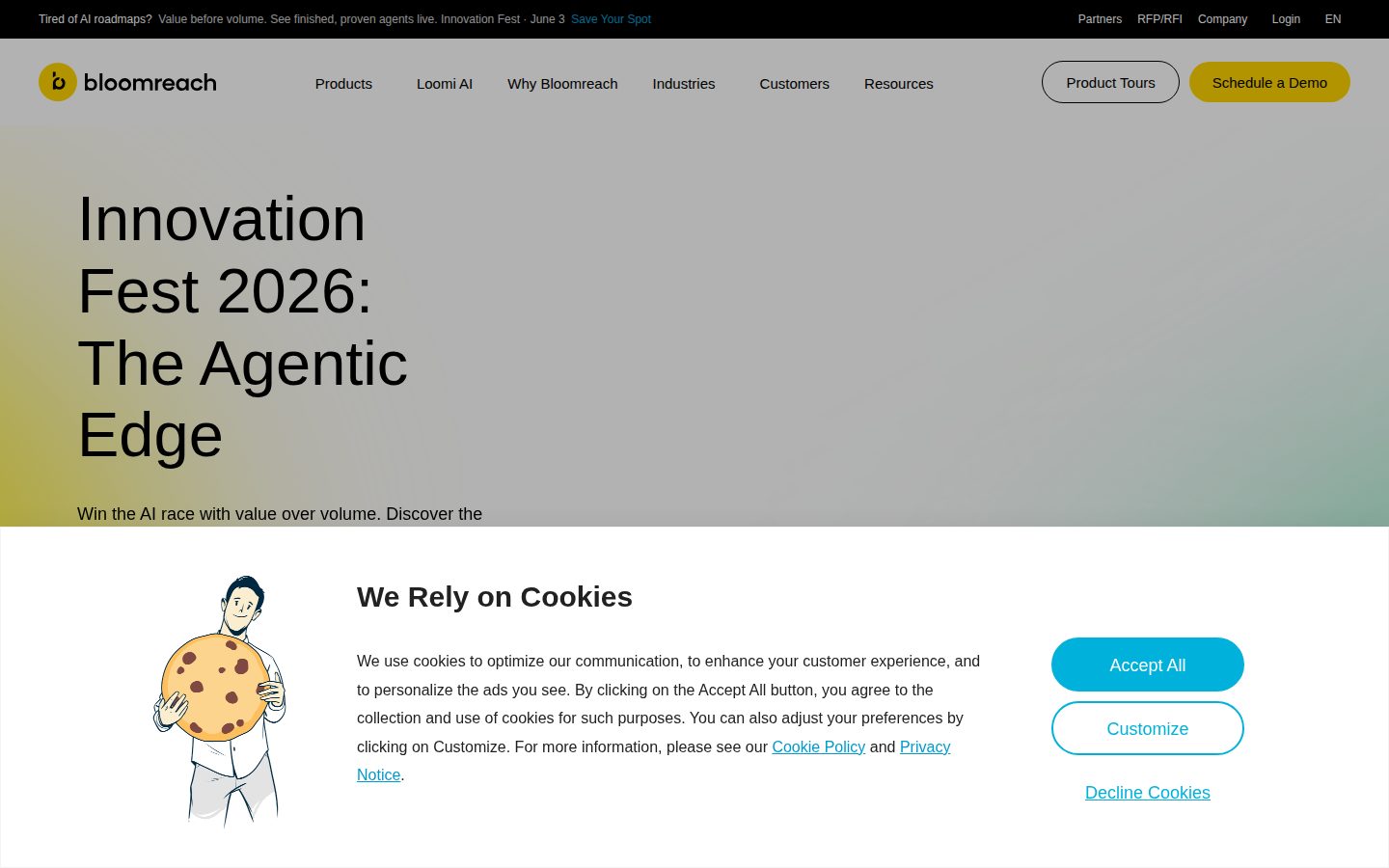
Three tells upfront. One: 'Innovation Fest 2026: The Agentic Edge' as the H1 — that's a conference headline, not a product claim. Two: no public pricing, no free trial, no API listed. Three: every feature has 'Loomi AI' attached to it, which is either a real unified engine or a naming strategy. Hard to tell from outside.

The actual capability stack is more credible than the marketing voice suggests. Autonomous Search targeting intent over keywords, real-time decisioning at 5ms–2s, online-to-offline unification — the Popeyes UK case (3x repeat visits) gives that last claim some teeth. Klaviyo owns email/SMS for SMBs. Algolia owns pure search. Bloomreach's moat, maybe, is the cross-channel coordination layer connecting both.

Exit story worries me. No API listed in the evidence. Custom pricing means custom contracts. First-party data unification built inside their walls. Migration off this after 18 months of behavioral data accumulation won't be clean. That's the tradeoff — genuine orchestration depth costs portability.

Competitive Differentiation7.6

Klaviyo owns email-first, Algolia owns search-first — Bloomreach's cross-channel orchestration bridging both with offline data unification is a real gap, if Loomi AI's coordination layer holds up.

Exit Portability4.5

No public API listed, custom contracts, and first-party data unification locked inside the platform means migration is a serious project, not a weekend task.

Long-term Viability7.9

Blog, changelog, and pricing page all active; 1,400+ enterprise customers is a real retention moat, though no public funding data makes the runway picture incomplete.

Marketing Honesty6.2

Loomi AI branding on every feature and an 'agentic' conference headline are the kind of superlatives that age poorly — though the 5ms–2s latency claim and Popeyes case add grounding.

Track Record Match8.1

1,400+ brands and a changelog present matches the pattern of durable enterprise SaaS, not a pre-revenue pitch — closer to Salesforce Marketing Cloud's trajectory than Sailthru's.

Pros

  • Real-time decisioning at 5ms–2s is a specific, verifiable claim — not just 'fast'
  • Online-to-offline data unification is rare; most competitors don't touch kiosk or physical loyalty data
  • Cross-channel orchestration across 13+ channels from a single layer is genuinely differentiated from Klaviyo or Algolia alone
  • 1,400+ brand customer base suggests real retention, not just acquisition

Cons

  • No public API listed — integration flexibility is an open question
  • No pricing transparency whatsoever; expect long sales cycles and negotiated contracts
  • Exit portability is low once behavioral data accumulates inside their unification layer
  • 'Agentic' and 'Loomi AI' applied to every feature makes it hard to assess what's truly AI-native vs. relabeled automation

Right for

Mid-market to enterprise retailers or travel brands that need search, email, and cross-channel personalization unified in one platform and can commit to an enterprise contract.

Avoid if

You need transparent pricing, a clean API for custom integrations, or a fast exit path if the vendor relationship sours.

Buyer Questions

Common questions answered by our AI research team

Features

How many channels does Bloomreach personalize simultaneously?

Bloomreach personalizes across 13+ channels simultaneously, including email, SMS, mobile app, web, ads, search, and shopping agents.

Features

How fast does Loomi AI process real-time decisioning?

Loomi AI processes data and adapts experiences in 5ms–2s, enabling real-time decisioning as customer intent changes.

Integration

Can Bloomreach connect online and offline customer data?

Yes. Loomi AI unifies online and offline data — Popeyes UK used it to connect kiosk and digital orders, driving 3x more repeat visits and growing CLTV 3-5x.

Features

Does Bloomreach include a conversational shopping agent?

Yes. Conversational Shopping is a GenAI-powered shopping agent that brings the expertise of a sales associate online to guide shoppers to the right purchase instantly.

Features

How many brands currently use Bloomreach?

Bloomreach is trusted by 1,400+ brands across retail, travel, beauty, and more.

Product Information

  • Pricing

    Contact for pricing

Platforms

web

Connect

Resources

Documentation
Blog
Changelog

Also in AI Marketing Tools