Contextual AI logo

Contextual AI Review

Visit

Enterprise AI for regulated and high-stakes environments

Contextual AI is an enterprise AI platform for regulated and high-stakes environments.

AI Panel Score

7.3/10

6 AI reviews

Reviewed

Facts checked against contextual.ai

About Contextual AI

Contextual AI is positioned as an enterprise AI product built for regulated and high-stakes environments, according to the company's own site. The available page content does not describe the specific workflow, interface, or day-to-day user experience of the product in detail.

The website content provided does not name specific features, integrations, or differentiating capabilities beyond the general framing of serving regulated and high-stakes industries.

Based on the available content, Contextual AI is intended for enterprises in regulated industries or those with high-stakes operational requirements. Pricing is usage-based, with On-demand and Enterprise plans as well as Component API pricing, including rates such as $3 per 1,000 pages for document parsing.

Features

AI

  • Grounded Language Model (Generation)

    Supplies a generation component designed to produce responses grounded in retrieved enterprise knowledge rather than relying on frozen, general-purpose LLM outputs.

  • Instruction-Following Reranker

    Offers a reranking component that reorders retrieved chunks based on natural-language instructions to improve relevance of results fed to the generator.

  • RAG 2.0 Unified Architecture

    Jointly optimizes retriever and generator components in a unified pipeline, rather than stitching together frozen models and vector databases, to deliver higher accuracy and groundedness.

Analytics

  • Evaluation and Unit Testing (LMUnit)

    Provides evaluation tooling to create natural-language unit tests and check whether generated responses match gold answers and are grounded in retrieved knowledge.

Automation

  • Synthetic Data Generation for Fine-Tuning

    Automatically generates synthetic training data under the hood when customers lack their own fine-tuning datasets, steerable using defined end-user personas.

Core

  • Agentic Document Parsing

    Provides a document understanding pipeline that parses complex enterprise documents, preserving reading order and table structure for downstream retrieval.

  • Specialized RAG Agents

    Enables enterprises to build specialized retrieval-augmented generation (RAG) agents capable of active retrieval and test-time reasoning over large volumes of structured and unstructured enterprise data.

Customization

  • Configurable Retrieval Parameters

    Allows adjustment of system prompts and retrieval parameters, such as the weighting between lexical and semantic search and the number of chunks retrieved and reranked.

  • Tuning API for Agent Specialization

    Lets teams jointly fine-tune multiple components of a RAG agent via a Python API to boost performance on domain-specific tasks and workflows.

Integration

  • Elasticsearch-Backed Scalable Indexing

    Uses a custom document understanding pipeline that chunks and embeds data before indexing it into an Elasticsearch cluster, supporting millions of documents per deployment.

Preview

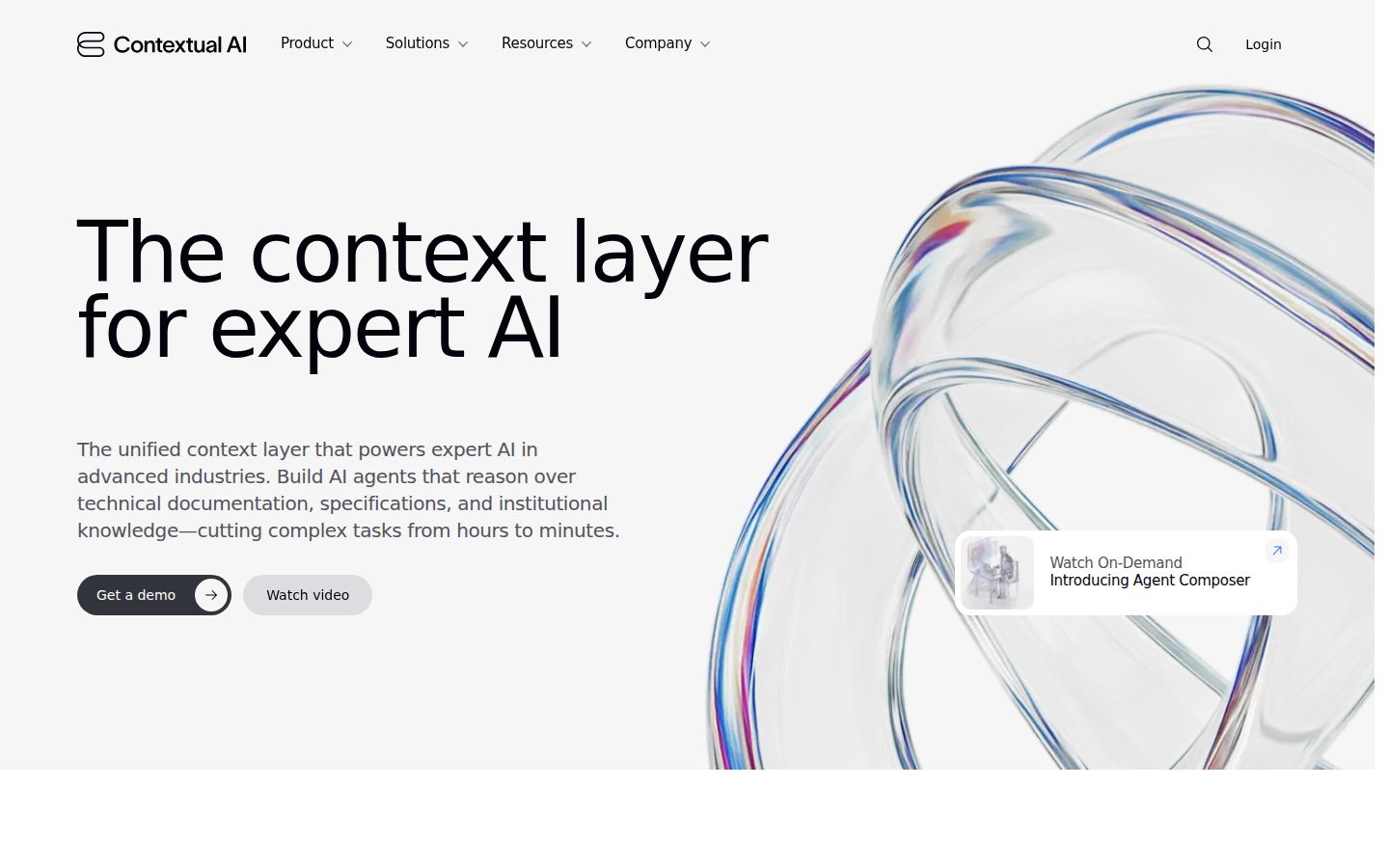
Contextual AI desktop previewContextual AI mobile preview

Pricing Plans

Popular

On-demand

Contact sales

Pay-as-you-go pricing that scales with platform usage; includes $25 in free credits to get started

  • Unlimited users, agents, and datastores
  • 1 workspace
  • SOC2 Type II and HIPAA compliance
  • Support for simple text documents
  • UI-based data ingestion
  • Pre-built agent templates

Enterprise

Contact sales

Custom pricing for organizations needing advanced performance, security, and deployment flexibility

  • Unlimited workspaces
  • SAML/SSO and role-based access control (RBAC)
  • Custom data retention and continuous data ingestion
  • Support for structured and unstructured data, complex docs, charts, and images
  • Customer VPC deployment option
  • Dedicated support, onboarding, and custom development services

Parse (Component API)

$3/monthly

Usage-based pricing for document understanding pipeline; Basic tier is text-only at $3 per 1,000 pages, Standard multimodal tier is $40 per 1,000 pages

  • Multi-stage document understanding pipeline
  • Converts unstructured content into AI-ready formats
  • Basic (text only) and Standard (multimodal) pricing tiers

Rerank (Component API)

Contact sales

Usage-based pricing per million tokens for state-of-the-art reranking; Rerank-v2 at $0.05/M tokens, Rerank-v2-mini at $0.02/M tokens

  • Instruction-following reranker
  • Greater control over knowledge prioritization
  • Two model tiers: v2 and v2-mini

Generate (Component API)

$3/monthly

Usage-based pricing for grounded large language model designed to minimize hallucinations; $3 per 1M input tokens, $15 per 1M output tokens

  • Highly grounded LLM output
  • Engineered to minimize hallucinations
  • Input/output token-based pricing

LMUnit (Component API)

$3/monthly

Usage-based pricing for evaluation-optimized model for preference and unit test style evaluation; $3 per 1M input tokens

  • Evaluation-optimized model
  • Supports preference and direct scoring
  • Natural language unit test evaluation

AI Panel Reviews

The Decision Maker

The Decision Maker

Strategic bet, vendor viability, timing, adoption approval
7.8/10

A real architecture bet on joint retrieval-generation, priced by the component, not the seat.

“Contextual AI sells RAG as a unified, jointly-optimized pipeline instead of stitched-together parts. The component pricing is unusually transparent for enterprise AI, but the top tiers are still a sales call.”

Parse, Rerank, Generate, LMUnit. Four named components, each individually priced and individually buyable, which is rare in this category. $3 per 1,000 pages for text parsing, $40 for multimodal, $0.05/M tokens for Rerank-v2 — that's a real rate card, not a 'request a demo' wall.

The pitch is RAG 2.0: joint-optimizing retriever and generator instead of bolting a vector database onto a frozen LLM. If that holds up, it's a genuine architectural difference from the standard retrieve-then-generate stack most teams run today. HIPAA and SOC2 Type II on the On-demand tier, customer VPC on Enterprise — that's compliance depth suited to the regulated-industry pitch.

Two gaps. I couldn't find a changelog, so shipping cadence is a guess. And Enterprise pricing — RBAC, custom retention, VPC — is quote-only, which is where the real spend lands.

Competitive Positioning8.2

RAG 2.0's unified architecture and instruction-following reranker are a clear design departure from stitched vector-DB-plus-LLM stacks.

Reputation Risk7.8

SOC2 Type II and HIPAA on-demand plus VPC on Enterprise cover the compliance bar regulated buyers need.

Speed to Value7.0

Pre-built agent templates and UI-based ingestion help, but Tuning API work implies real setup before payback.

Strategic Fit8.0

Joint retriever-generator tuning via the Python API is a capability upgrade, not just cheaper RAG.

Vendor Viability7.5

Component-level docs (Parse, Rerank, Generate, LMUnit) suggest active build-out, though I couldn't find a changelog to confirm cadence.

Pros

  • Transparent per-component pricing down to $0.02/M tokens for Rerank-v2-mini
  • Joint retriever-generator optimization is architecturally distinct from standard RAG
  • HIPAA and SOC2 Type II plus VPC deployment fit regulated buyers directly
  • LMUnit gives natural-language unit testing for grounding, not just output quality

Cons

  • Enterprise tier pricing is quote-only, which is where RBAC and VPC live
  • I couldn't find a changelog, so release pace is unclear
  • Tuning API and synthetic data generation imply real engineering lift before value lands

Right for

Regulated enterprises needing grounded, auditable RAG with VPC deployment and compliance certifications in hand.

Avoid if

Skip it if you just need a quick semantic search layer without compliance requirements.

The Domain Strategist

The Domain Strategist

Craft and strategy in the product's domain — adapts identity per category, same lens
7.8/10

A component architecture built for the governance reality of regulated knowledge work, not just search quality.

“Contextual AI treats parsing, reranking, and generation as separately governable components rather than a black box. That's the right shape for teams who have to answer audit questions about why an answer was produced.”

Most knowledge platforms hand you a single retrieval score and ask you to trust it. Contextual AI breaks the pipeline into Parse, Rerank, Generate, and LMUnit, each individually priced and individually inspectable — $3 per 1,000 pages for text parsing, $40 for multimodal. For a KM function that has to defend provenance to compliance or legal, that separability is the actual product, not a pricing quirk.

The gap is in the knowledge-ops layer above the models: taxonomy governance, content lifecycle, ownership of stale documents feeding the index. Elasticsearch-backed indexing handles scale, millions of documents per deployment, but says nothing about who retires a document when policy changes. That's still a build-it-yourself layer on top.

For a KM org already running document governance maturely, this is a strong accuracy layer to bolt on top. For one still establishing basic content ownership, you'll be building two things at once.

Category Positioning8.0

Positioning against stitched-together vector DB plus frozen LLM setups is a real architectural distinction, not just marketing language.

Domain Fit7.5

Component-level pricing and SOC2/HIPAA support match how regulated KM teams need to isolate and audit each pipeline stage.

Integration Surface7.5

Elasticsearch-backed indexing and a Python tuning API fit into existing data infrastructure rather than demanding a new one.

Long-term Implications7.0

Tuning API and synthetic data generation commit a team to ongoing engineering investment, not a configure-once deployment.

Strategic Depth8.0

Jointly optimized retriever-generator plus LMUnit's natural-language unit testing goes past standard RAG tooling depth.

Pros

  • Component-level pricing lets KM teams cost out parsing, reranking, and generation separately for budget accountability
  • Agentic document parsing preserves table structure and reading order, which matters for policy and spec documents
  • VPC deployment option fits data residency requirements regulated teams can't negotiate away

Cons

  • No visible tooling for document lifecycle governance or taxonomy management above the retrieval layer
  • Enterprise tier that includes RBAC and custom retention is quote-only, making total cost hard to model upfront
  • Synthetic data generation and tuning API require real engineering investment before the accuracy gains materialize

Right for

KM teams in regulated industries who already have document governance maturity and need an accuracy layer with auditable components.

Avoid if

Avoid if your organization still lacks basic content ownership and lifecycle processes, since this adds model complexity without solving that gap.

The Finance Lead

The Finance Lead

Money, total cost of ownership, contracts, procurement math
7.1/10

Component math is clean. Platform math is a sales call.

“Parse, Rerank, Generate, LMUnit price by the unit, not the seat. The two platform tiers that wrap them don't show a number.”

Parse at $3 per 1,000 pages, text only. Standard multimodal tier runs $40 per 1,000. Generate at $3/M input tokens, $15/M output. Rerank-v2-mini at $0.02/M tokens. That's a real rate card — procurement can model unit costs before a call.

But the two account-level tiers, On-demand and Enterprise, carry no number. On-demand gets $25 in free credits, then usage-based. Fine for a pilot. Scale to a team of 50 running document-heavy RAG workloads and you're estimating pages-per-month and tokens-per-query blind, then reconciling against an invoice.

Enterprise is where SSO, RBAC, and VPC deployment live. All quote-only. Component pricing builds a believable bottom-up model. Platform pricing forces a top-down guess until sales quotes it. Two different cost pictures, same product.

Billing & Procurement7.0

$25 in starter credits lowers the onboarding bar, but SOC2/HIPAA and RBAC sit behind the Enterprise quote path, adding a sales cycle for regulated buyers.

Contract Flexibility6.0

On-demand reads pay-as-you-go month to month; Enterprise terms, including renewal windows, aren't quoted anywhere I could find.

Pricing Transparency7.0

Component API rates are public down to $0.02/M tokens, but both platform tiers (On-demand, Enterprise) show no price.

ROI Clarity7.0

LMUnit gives a measurable grounding check, but tying that to dollars saved still requires your own benchmark against incumbent accuracy.

Total Cost of Ownership6.5

Multimodal Parse at $40/1,000 pages versus $3 text-only means 3-year cost swings hard on document mix, and that mix isn't priced upfront.

Pros

  • Component-level pricing (Parse, Rerank, Generate, LMUnit) is public and granular
  • $25 free credit lowers the cost of a first test
  • Token and per-page rates let finance model usage cost before committing

Cons

  • On-demand and Enterprise tiers carry no visible price
  • Multimodal Parse at $40/1,000 pages is 13x the text-only rate, and document mix isn't predictable upfront
  • Enterprise contract terms, including renewal and cancellation, aren't quoted

Right for

Finance teams that can forecast page and token volume and want unit-level cost control before scaling.

Avoid if

You need a single all-in number for budget approval without a sales call.

The Domain Practitioner

The Domain Practitioner

Daily hands-on reality in the product's domain — adapts identity per category, same lens
7.6/10

A citation engine built for people who have to defend their answers in an audit, not just a chat window

“Contextual AI reads like infrastructure for research teams that need provenance, not a search box for casual Q&A. The component split (Parse, Rerank, Generate, LMUnit) is the right shape for literature-heavy regulated work, if you have engineers to wire it.”

As a researcher, what I care about is whether the system can show its work. LMUnit's natural-language unit tests are the detail that matters here — being able to write a test case like 'does this answer cite the dosage table correctly' is closer to how I'd actually validate a retrieval pipeline than eyeballing outputs. That's a different daily habit than querying a chat interface and hoping.

The friction is in the seams. Parse, Rerank, and Generate are billed and presumably versioned separately, which means my day-3 reality is less 'ask a question' and more 'own a small pipeline.' For solo research work or fast literature scans across a few hundred PDFs, that's overhead I didn't sign up for. The payoff shows in corpora where provenance and reading order actually matter — regulatory filings, clinical protocols, long technical specs — not in quick fact-lookup.

The Tuning API for joint fine-tuning signals real power-user depth, but it also signals that the gap between 'logged in' and 'getting the accuracy gains' is an engineering project, not an afternoon.

Day-3 Reality7.3

LMUnit's test-writing workflow is a genuine researcher habit, but running a multi-component pipeline daily is heavier than a search box.

Documentation Practitioner-Fit7.0

I couldn't find a changelog, so I can't judge how release notes read, but the per-component API framing suggests docs written for engineers building pipelines.

Friction Surface7.2

Separate Parse/Rerank/Generate components mean separate billing, versioning, and failure points to track across a working week.

Power-User Depth8.0

The Tuning API for joint component fine-tuning and configurable retrieval weighting give real headroom past default settings.

Workflow Integration7.0

Fits research workflows built around document corpora and citations, but demands pipeline thinking rather than query-and-answer habits.

Pros

  • LMUnit lets you write natural-language unit tests for grounding, a real validation habit for research work
  • Configurable retrieval parameters (lexical/semantic weighting, chunk counts) give fine control over what feeds the generator
  • Elasticsearch-backed indexing scales to millions of documents per deployment

Cons

  • Running Parse, Rerank, Generate as separate billed components adds operational overhead versus a single search interface
  • Synthetic data generation and the Tuning API require engineering investment before you see accuracy gains
  • No visible higher-level tooling for organizing or tagging a growing research corpus beyond retrieval

Right for

Research teams working with large, citation-sensitive document sets who need provenance they can defend, not just an answer.

Avoid if

You're a solo researcher who wants quick literature lookups without standing up a multi-component pipeline.

The Power User

The Power User

Daily human experience, onboarding, polish, learning curve, reliability
6.8/10

Built for compliance teams, not for the person who has to use it every morning

“Contextual AI reads like infrastructure, not software you open daily. The regulated-industry fit is real but the day-to-day feel is invisible from what's public.”

There's no product tour here, no sandbox walkthrough, nothing that tells me what hour one actually looks like for a knowledge worker logging into this. What I can see is five billed components — Parse, Rerank, Generate, LMUnit, plus orchestration — which tells me this is assembled by engineers for engineers, not a single interface a compliance analyst opens and gets oriented in.

The $25 free credit on the On-demand tier is a nice touch, lets you poke at pricing before committing. But On-demand and Enterprise both sit behind contact-sales pricing for the actual platform experience, which means the first ten minutes probably involves a sales call, not a product.

No mobile mention anywhere, which tracks for a regulated-environment backend tool — nobody's parsing HIPAA documents from their phone. Learning curve is the real question mark: Tuning API and synthetic data generation sound powerful, but 'jointly fine-tune multiple components via Python API' is month-three territory, not day-one. This reads like a platform you integrate, not one you casually learn.

Daily Polish6.0

No interface walkthrough or screenshots surfaced, so I can't judge the small daily details at all.

Learning Curve6.5

The Tuning API and synthetic data generation for fine-tuning require real Python and ML familiarity before payoff, per the component docs.

Mobile Parity5.5

Platforms listed as web only, and nothing suggests mobile was ever part of the design brief for this kind of deployment.

Onboarding Experience6.2

The $25 free credit helps, but On-demand and Enterprise pricing both route to sales calls rather than a self-serve start.

Reliability Feel7.0

SOC2 Type II and HIPAA compliance plus Elasticsearch-backed indexing suggest solid backend engineering, even if I can't see error states.

Pros

  • Component-level API access to Parse, Rerank, Generate, and LMUnit for teams that want to build custom pipelines
  • VPC deployment option for teams that can't put regulated data in shared SaaS
  • $25 free credit lowers the barrier to a first test run

Cons

  • No visible walkthrough or interface preview, so first-session feel is a guess
  • Platforms listed as web only with nothing suggesting mobile access
  • Both main platform tiers require a sales conversation before you see a number

Right for

Engineering-led teams at regulated enterprises who want to build a custom retrieval pipeline rather than use an off-the-shelf search tool.

Avoid if

You want a product you or your team can open and understand within the first hour without a sales call or a Python API.

The Skeptic

The Skeptic

Contrarian. Watch-outs, deal-breakers, broken promises, category patterns
6.9/10

RAG 2.0 is a bold name for a category littered with 'unified' pitches that didn't survive.

“Contextual AI names its architecture and prices its components down to the token. What it doesn't show is a single screenshot of the thing working.”

Joint retriever-generator optimization is a real architectural claim, not just marketing copy. I've seen 'unified pipeline' framing before, from vendors who later quietly reverted to stitched-together vector DBs because joint tuning didn't hold up at scale. Doesn't mean Contextual AI follows that path. Means the claim deserves scrutiny past the landing page.

The component breakdown, Parse, Rerank, Generate, LMUnit, reads like a team that actually ships distinct things rather than one model with four marketing names. That's a good sign for track record match.

But SOC2 and HIPAA badges plus a VPC option is the same checklist every enterprise AI vendor in regulated verticals puts on page one. It's table stakes, not differentiation. And I couldn't find a changelog, so I can't tell if this moves monthly or sat still since launch.

Competitive Differentiation7.5

Joint retriever-generator optimization under one architecture is a structural bet most RAG tooling doesn't make, based on the component list.

Exit Portability6.0

Four separately billed components (Parse, Rerank, Generate, LMUnit) mean untangling a pipeline built across all four is harder than leaving a single-vendor search tool.

Long-term Viability6.5

Docs and a blog are visible, but I couldn't find a changelog, so release cadence and active maintenance are unclear.

Marketing Honesty7.0

Claims like 'minimize hallucinations' and 'production-grade' are superlatives, but they're backed by named components like LMUnit and Rerank-v2, not just adjectives.

Track Record Match6.8

Specific pricing and named model tiers (Rerank-v2-mini at $0.02/M tokens) suggest a real system, but no case studies or usage figures surfaced to confirm claims at scale.

Pros

  • Named architecture (RAG 2.0) with component-level specifics, not vague AI framing
  • LMUnit gives a concrete evaluation layer most RAG stacks lack
  • Per-component token and page pricing lets you audit cost by stage

Cons

  • No changelog visible, so update cadence is a guess
  • Four billed components mean four points of lock-in instead of one
  • No screenshots or workflow walkthrough to confirm day-to-day usability

Right for

Regulated enterprises that need VPC deployment and are willing to engineer a multi-component pipeline themselves.

Avoid if

You want a single search interface you can evaluate in an afternoon without a sales call.

Buyer Questions

Common questions answered by our AI research team

Features

What core components make up Contextual AI?

Contextual AI's core components include Parse, Rerank, and Generate, along with LMUnit for evaluation and agent orchestration tools.

Security

Does Contextual AI support private VPC deployment?

Yes, Contextual AI offers flexible deployment options including both SaaS and private VPC environments.

Features

What is LMUnit used for?

LMUnit is used for evaluation within the Contextual AI platform.

Features

Does Contextual AI offer agent orchestration tools?

Yes, Contextual AI includes agent orchestration tools as part of its platform.

Features

Is Contextual AI built for regulated industries?

Yes, Contextual AI is designed for organizations operating in regulated or high-stakes settings.

Also in AI Search & Knowledge