Embedding models and rerankers for search and retrieval over unstructured data
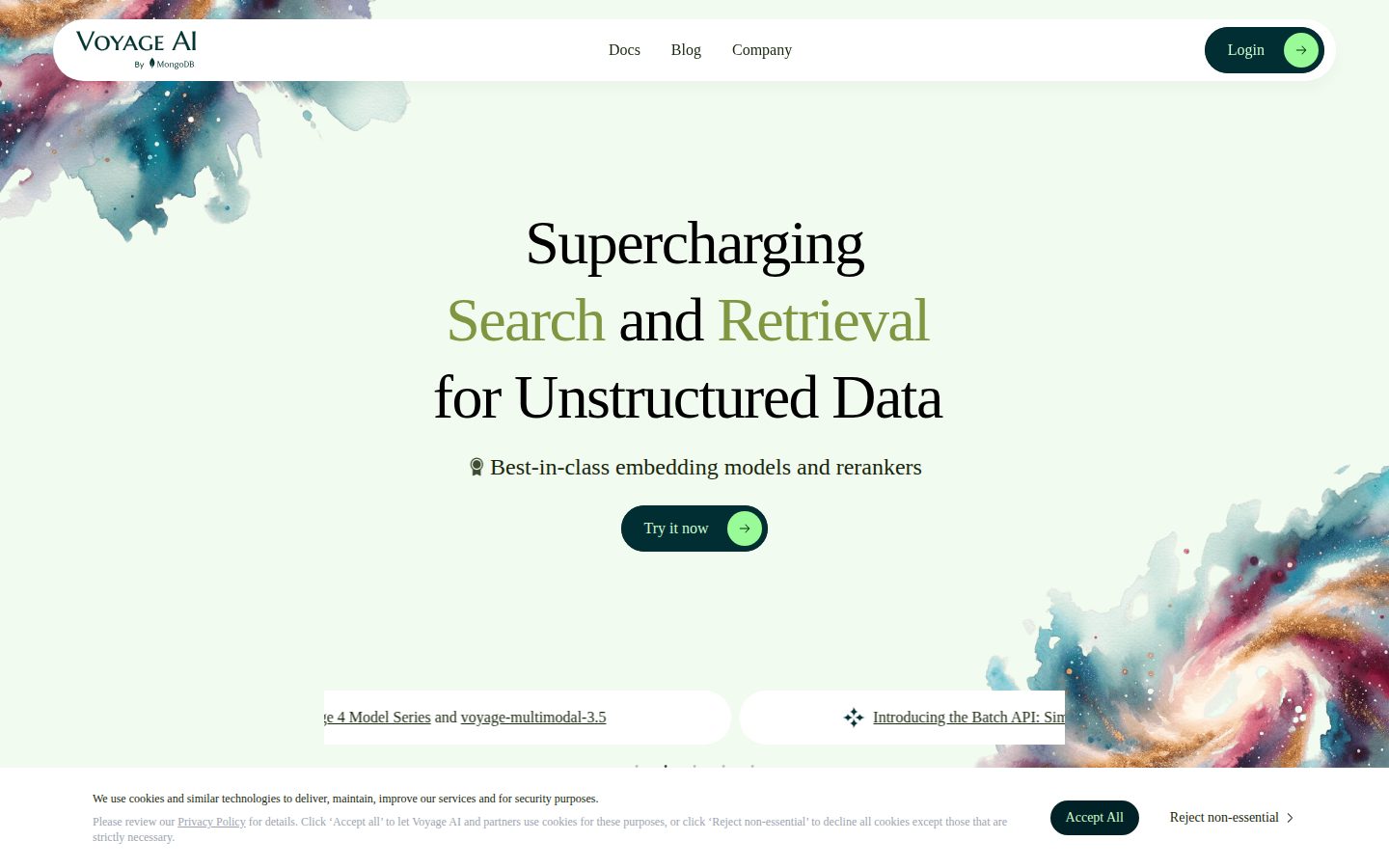
Voyage AI is an embedding and reranking API platform for building RAG and semantic search pipelines.
AI Panel Score
6 AI reviews
Reviewed
Voyage AI fits into a RAG pipeline between unstructured data and an LLM: documents are converted to vector embeddings using Voyage's models, stored in a vector database, and retrieved via similarity search. A reranker then re-scores candidate results before they are passed to the LLM, improving relevance and reducing the chance of irrelevant context reaching the model. Users interact with the system through an API, sending text or multimodal content and receiving embeddings or ranked lists in return.
The platform includes several model families. General-purpose models handle multilingual and cross-domain content out of the box. Domain-specific models—covering finance, legal, and code—are tuned on industry data for higher retrieval accuracy in those verticals. Multimodal models (including voyage-multimodal-3.5) support combined text and image inputs. Rerankers such as rerank-2.5 and rerank-2.5-lite add instruction-following capability and sit at a different price-performance point. A Batch API is available for large-scale, asynchronous workloads. The company also highlights voyage-context-3, which is designed to capture both chunk-level details and broader document context simultaneously.
Voyage AI targets developers and ML engineers building search, question-answering, or document retrieval systems who need embedding and reranking infrastructure without training their own models. Competitors in the embedding API space include OpenAI Embeddings, Cohere Embed, and Google Vertex AI Embeddings. Pricing is usage-based; a free tier appears to be available for initial access, with paid usage billed per token.
The product is API-first and designed to be plug-and-play with any vector database (Pinecone, Weaviate, Chroma, etc.) and any LLM. It is accessed via web API, making it platform-agnostic for backend integration on any operating system or cloud environment.

Provides embedding models highly optimized for industry-specific data including finance, legal, and code use cases.
Generates vector embeddings from unstructured data for use in search and retrieval pipelines, with general-purpose models ready for any purpose and language out-of-the-box.
Supports multimodal retrieval via voyage-multimodal-3.5, enabling embeddings across multiple data modalities beyond text.
Reranks retrieved documents to improve relevance before passing context to an LLM, with models like rerank-2.5 supporting instruction following and a new price-performance frontier.
A specialized model that captures focused chunk-level details while retaining global document context for improved retrieval accuracy.
Provides a Batch API for simpler and more efficient processing of large-scale embedding and retrieval workloads.
Offers 2x cheaper inference costs compared to competing models while maintaining superior retrieval accuracy.
Supports the longest commercial context length available at 32K tokens, allowing retrieval over large documents without chunking limitations.
Produces vectors that are 3x–8x shorter than standard embeddings, reducing vector search and storage costs significantly.
Delivers 4x smaller model size and faster inference speeds while maintaining superior retrieval accuracy compared to larger alternatives.
Offers fine-tuned models trained on a company's unique data and terminology to act as specialized librarians for proprietary content.
Designed for modular integration with any vector database and large language model, enabling flexible RAG pipeline assembly.
Usage-based access to Voyage AI embedding models and rerankers, billed per token consumed
Fine-tuned, company-specific models optimized for your organization's unique data and terminology
MongoDB paid $220M for this — that's your viability answer.
“Voyage AI is a focused embedding and reranking API with real technical differentiation: 32K context windows, domain-specific models, and costs that undercut OpenAI Embeddings. The MongoDB acquisition in February 2025 eliminates most survival risk.”
MongoDB acquired Voyage AI for $220 million in February 2025. That's not a feature — that's a balance sheet backstop. Vendor viability concern gone.
The technical case is specific. Voyage-context-3 captures chunk-level and document-level context simultaneously, which solves a real RAG failure mode. Low-dimensionality vectors run 3x–8x shorter than standard embeddings, cutting storage and search costs. The tradeoff: no public per-token pricing, so you can't model costs before you're already integrated.
Two things make this a strong bet. One: domain-specific models for finance, legal, and code mean the embeddings actually understand your content, not just tokenize it. Two: plug-and-play with Pinecone, Weaviate, or any vector DB means no lock-in beyond the model layer itself. Pilot it on a single RAG workload and compare retrieval quality against Cohere Embed head-to-head.
Outpaces OpenAI Embeddings on context length (32K tokens) and cost efficiency, but no public benchmark data is surfaced to show against Cohere Embed directly.
A $220M MongoDB acquisition makes this a board-defensible choice; no reputational downside visible in the evidence.
API-first, plug-and-play with any vector DB, and a free tier means a working integration in days, not quarters.
Domain-specific models for finance, legal, and code advance retrieval quality, not just cost reduction on existing pipelines.
Acquired by MongoDB for $220M in February 2025 — runway and survival are no longer the question.
ML engineers building RAG pipelines in finance, legal, or code who need domain-tuned embeddings without training their own models.
Your workloads are simple keyword search and you don't have a vector database already in the stack.
MongoDB's $220M bet on embeddings gives Voyage real infrastructure credibility.
“Voyage AI is a focused embedding and reranking API with genuine craft depth — 32K context windows, low-dimensionality vectors, domain-specific models for finance, legal, and code. The MongoDB acquisition changes the risk calculus significantly for anyone evaluating long-term vendor stability.”
The model architecture tells you something important: reduced vector dimensionality (3x–8x shorter than standard) plus 32K token context windows isn't a marketing slide — it's a deliberate infrastructure position. Someone made real tradeoffs to get there. voyage-context-3 capturing both chunk-level and document-level context simultaneously is the kind of retrieval nuance that separates teams who've actually debugged RAG precision from teams who haven't.
The MongoDB acquisition at $220M is the biggest strategic signal here. If you're building on Voyage today, in 3 years you're almost certainly building on a feature inside Atlas. That's either a moat or a migration risk depending on your stack. Teams already on MongoDB benefit enormously; teams on Pinecone or Weaviate should watch how the integration surface evolves post-acquisition.
Against Cohere Embed and OpenAI Embeddings, Voyage's domain-specific vertical models are a genuine differentiator for finance or legal retrieval workloads. No public per-token pricing on the page is a friction point for procurement.
Voyage sits above OpenAI Embeddings on retrieval craft and above generic APIs on vertical depth, but post-acquisition positioning vs. Cohere is still settling.
Domain-specific models for finance, legal, and code plus HIPAA and SOC 2 compliance map directly to how ML engineers build production RAG pipelines.
Plug-and-play with any vector DB and LLM, Batch API for async workloads — the integration surface is intentionally non-opinionated and stack-agnostic.
MongoDB acquisition de-risks vendor survival but introduces potential Atlas lock-in pressure over a 3-year horizon.
Low-dimensionality vectors, 32K context, instruction-following rerankers like rerank-2.5 — this is library-grade embedding infrastructure, not a thin API wrapper.
ML engineers building production RAG pipelines in finance, legal, or code domains who need best-in-class retrieval without training their own models.
Your architecture is fully committed to a competing vector DB ecosystem that MongoDB may eventually treat as a second-class integration target.
32K tokens, 2x cheaper inference — but pricing page shows zero dollar amounts.
“Voyage AI's token-based model is procurement-friendly in structure, but no published per-token rates means every TCO model starts with a blank cell. MongoDB acquired them for $220M in February 2025 — pricing strategy may shift.”
No published per-token rates. That's the first problem. The pricing page lists 'Pay as you go — Free' with no dollar figures attached. Compared to OpenAI Embeddings, which publishes rates openly, Voyage forces a discovery call or sandbox test to estimate costs. That's friction procurement doesn't need.
The efficiency numbers are real, though. Low-dimensionality vectors run 3x–8x shorter than standard embeddings — storage costs drop materially. 32K token context window means fewer chunking workarounds. For a team processing 10M tokens monthly, those savings compound. Year 3 TCO depends heavily on volume discounts no one can see yet.
The MongoDB acquisition adds a variable. Enterprise pricing could tighten post-integration. No published overage rates, no visible auto-renewal terms. SOC 2 and HIPAA compliance are confirmed — that removes one procurement blocker. Fine-tuned models require a sales conversation. Budget a 6–8 week vendor onboarding cycle for enterprise deals.
SOC 2 and HIPAA compliance confirmed, reducing compliance review time, but opaque pricing extends the procurement cycle.
No public auto-renewal terms, cancellation process, or term length details; enterprise fine-tuning is sales-gated.
No per-token rates published anywhere on the pricing page — zero dollar amounts visible without a sales contact.
Retrieval quality improvements are measurable via benchmark comparisons; 2x cheaper inference claim gives a quantifiable starting point.
3x–8x smaller vectors reduce storage costs meaningfully, but without published rates, year-3 TCO modeling requires assumptions.
ML engineers building RAG pipelines in finance, legal, or code who need domain-specific embeddings and can tolerate an opaque pricing negotiation.
Your procurement team requires published rates and contract terms before any vendor evaluation begins.
Voyage AI: Purpose-Built Embedding API That Earns Its Spot in RAG Pipelines
“32K context window and domain-specific models for finance, legal, and code make this a serious upgrade over OpenAI Embeddings for specialized retrieval. The MongoDB acquisition in February 2025 for $220M signals durability, but no public pricing page creates real procurement friction.”
The API-first design is the right call. Plug-and-play with Pinecone, Weaviate, Chroma — no adapter layers, no vendor lock-in on the vector DB side. The Batch API for async workloads tells me someone built this after watching teams hammer synchronous endpoints during document ingestion. voyage-context-3 capturing both chunk-level and document-level context simultaneously is the kind of detail that matters at 3am when retrieval quality is tanking a demo.
The 32K token context window is the clearest differentiator versus Cohere Embed or OpenAI's text-embedding-3 series. That's not a marketing number — that's fewer chunking headaches in production. Low-dimensionality vectors at 3x–8x shorter than standard means real storage savings at scale. The rerank-2.5 instruction-following capability is a workflow upgrade for pipelines where relevance criteria shift by query type.
No public pricing page is the daily fight. Usage-based billing with token pricing nowhere visible means every budget conversation requires a sales email. That's friction engineers hate. Fine-tuned company-specific models requiring sales contact is expected at enterprise tier, but the absence of a changelog is a red flag — can't track what broke between model versions.
API-first with broad vector DB compatibility means integration is straightforward, but missing public pricing page means cost modeling requires guesswork after the free tier.
Quick Start Tutorial exists in docs and a homepage 'Try it now' path suggests practitioner-oriented onboarding, though changelog absence limits operational confidence.
No changelog and no visible per-token pricing are recurring friction points; debugging model drift between versions or forecasting costs both require contacting sales.
Domain-specific models, instruction-following rerankers, voyage-context-3's dual-context architecture, and company-specific fine-tuning give clear depth progression from beginner to production-scale usage.
Modular RAG pipeline design with Batch API and plug-and-play integrations fits naturally into standard ML engineering workflows without demanding new tooling habits.
ML engineers building domain-specific RAG pipelines in finance, legal, or code who need best-in-class retrieval without training their own embedding models.
You need transparent, self-serve token pricing before writing a line of code.
Embedded deep in MongoDB now, and the retrieval quality story is real
“Voyage AI is a serious embedding and reranking API for developers who need better RAG pipelines without training their own models. The $220M MongoDB acquisition in February 2025 either cements its future or complicates its independence — probably both.”
The 32K token context window is the headline number here. Most embedding APIs force you to chunk aggressively and lose document-level coherence. Voyage's voyage-context-3 model is specifically built to hold chunk-level detail and broader document context at once — that's not marketing fluff, that's a real pipeline problem being solved. Domain-specific models for finance, legal, and code mean you're not forcing a general-purpose model to learn your terminology on the fly.
The tradeoff is that this is deeply a developer product. No UI to speak of. No dashboard polish to review. Daily Polish and Mobile Parity scores here are almost irrelevant — this lives in your backend, not your browser. Compared to OpenAI Embeddings, Voyage is a deliberate specialist play: narrower surface area, higher retrieval accuracy claim, lower vector dimensionality reducing storage costs 3x–8x.
Pricing is usage-based with a free tier, which is the right call for an API product. No public per-token rates visible, which is mildly annoying when you're trying to budget. The MongoDB acquisition adds long-term stability questions — great infrastructure backer, but enterprise absorption can slow the roadmap fast.
API-first product with docs and a quick-start tutorial — polish lives in the DX, not a UI, and the docs appear solid but no changelog is publicly visible.
Plug-and-play with Pinecone, Weaviate, Chroma, and any LLM keeps onboarding fast, but fine-tuned company-specific models require a sales conversation to unlock.
Web API product — mobile parity is essentially irrelevant, and the score reflects that this dimension simply doesn't apply here.
Quick Start Tutorial in docs plus a 'Try it now' homepage CTA suggests a low-friction first ten minutes for any developer who's integrated an API before.
A $220M acquisition target and HIPAA plus SOC 2 compliance signals production-grade reliability expectations; Batch API for async large-scale workloads reinforces this.
ML engineers and backend developers building RAG pipelines who need production-grade retrieval without training their own embedding models.
You want a self-serve, no-code search experience or need transparent pricing before committing to integration.
MongoDB's $220M acquisition either validates this or complicates it — probably both
“Solid embedding API with real technical differentiation: 32K context, low-dim vectors, domain-specific models for finance/legal/code. The MongoDB acquisition in February 2025 is the single biggest variable to watch.”
Three green flags first. The 32K token context window beats OpenAI Embeddings and Cohere Embed on docs I can find. Low-dimensionality vectors — 3x–8x shorter — aren't marketing padding; smaller indexes mean real cost savings at scale. Domain-specific models for finance and legal is a legitimate moat. Most competitors don't bother.
Two yellow flags. No public pricing page — billed per token, starting price unknown. That's annoying for budget planning. More importantly: MongoDB acquired this for $220M in February 2025. Maybe they leave it standalone. Maybe it becomes Atlas-only. Category history says acquisitions frequently collapse standalone access within 18–24 months. Watch the API terms.
Exit portability is actually decent. Embeddings are just vectors — swap to Cohere or OpenAI Embeddings, re-embed your corpus, done. Painful but not catastrophic. The reranker dependency (rerank-2.5) is stickier. If this goes paywalled or MongoDB-exclusive, that's the real migration cost.
32K context window, low-dim vectors, and domain-specific models (finance, legal, code) are concrete gaps vs. OpenAI Embeddings — not just feature-list fluff.
Embeddings re-generation is feasible with OpenAI or Cohere as fallback; reranker dependency is the harder lock-in risk if MongoDB closes the API.
No changelog visible, no public funding data needed post-acquisition, but MongoDB's strategic intent for this asset is still unclear 6 months in.
Claims like '2x cheaper' and '4x smaller model size' are specific and falsifiable — better than most, but no pricing page to verify the cost story.
Matches patterns of specialist API players that carved real niches (like Cohere early days), not vaporware — but acquisition-stage companies have a mixed survival record as standalone products.
ML engineers building RAG pipelines over finance, legal, or code documents who need better retrieval than OpenAI Embeddings without training their own models.
You need pricing transparency before building or you're worried about API continuity if MongoDB folds this into Atlas exclusivity.
Common questions answered by our AI research team
Yes, Voyage AI is HIPAA compliant. HIPAA is listed alongside SOC 2 under Privacy and Compliance.
Voyage AI models support up to 32K tokens, the longest commercial context length available.
Yes, Voyage AI offers domain-specific models highly optimized for finance, legal, and code.
Yes, Voyage AI is plug-and-play with any vector database and LLM.
Get started via the Quick Start Tutorial in the Docs, or click "Try it now" on the homepage to begin using embeddings directly.
Company
Voyage AIFounded
2023Pricing
Usage-basedFree Trial
AvailableFree Plan
AvailableVoyage AI is a Palo Alto, California-based AI research company developing embedding and reranking models for retrieval-augmented generation, acquired by MongoDB in February 2025.