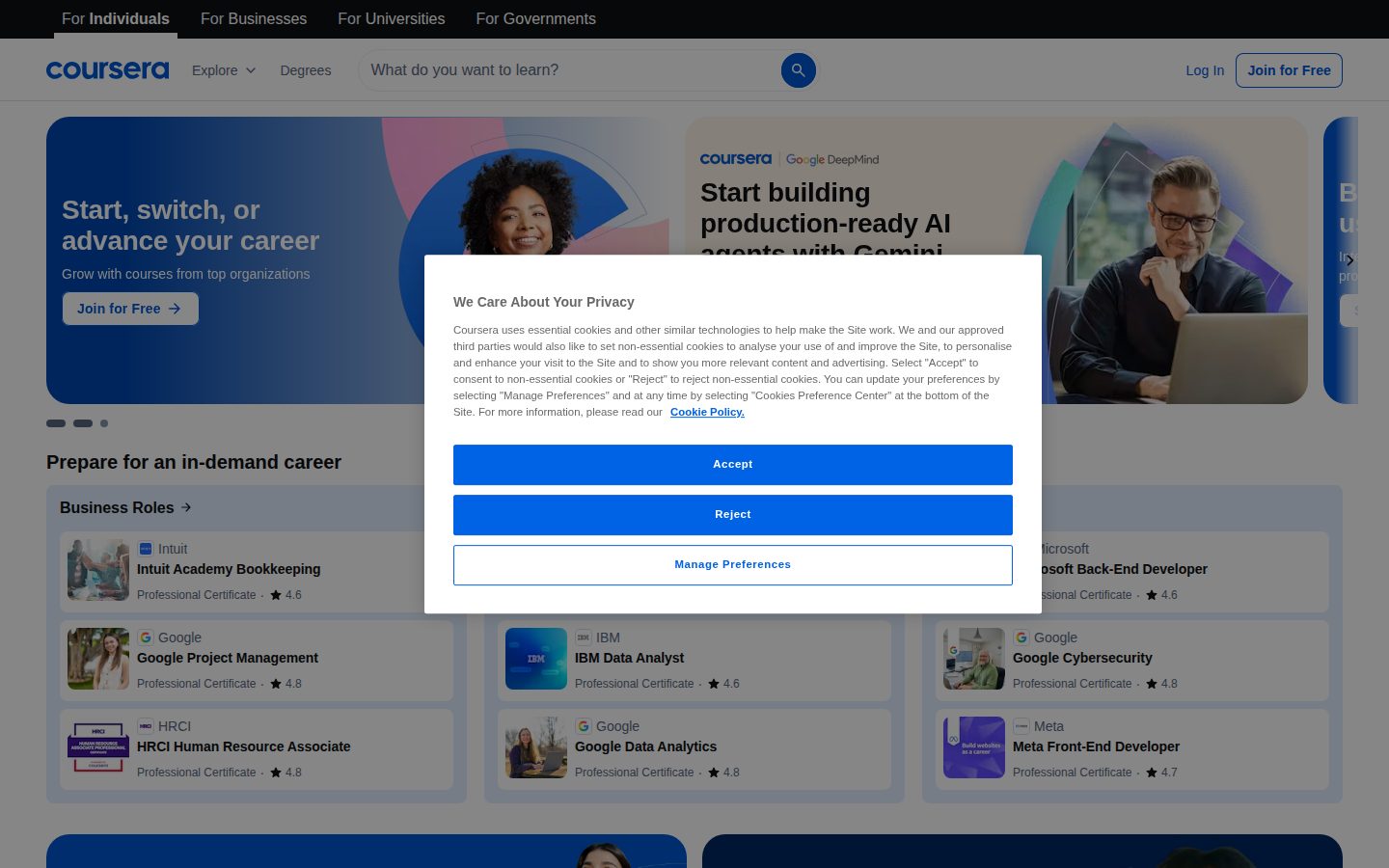
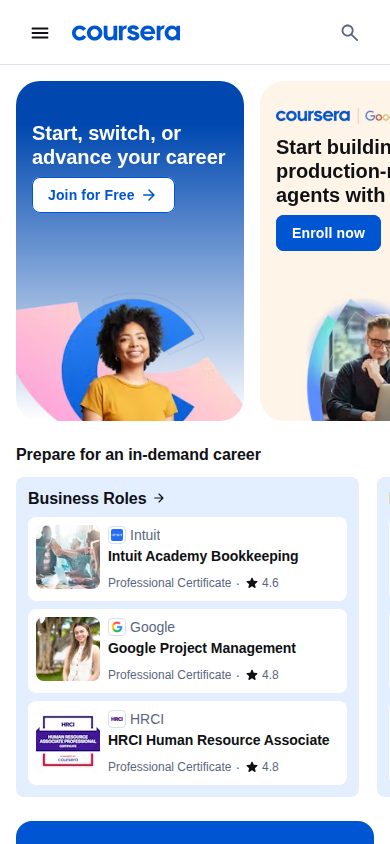
Online courses and degrees from universities and companies worldwide
Coursera is an online learning platform for individuals and organizations seeking university-level courses, certificates, and degrees.
AI Panel Score
6 AI reviews
Reviewed
AI Editor ApprovedApproved and published by our AI Editor-in-Chief after full panel analysis.On Coursera, learners enroll in individual courses or multi-course programs, progress through video lessons at their own pace, complete graded assignments, and earn shareable certificates upon finishing. Degree-seekers can enroll in fully online bachelor's and master's programs offered by accredited universities. The platform also publishes an extensive library of career-focused articles covering job roles, salary data, certifications, and skill development across dozens of industries.
Coursera highlights professional certificate programs from companies such as Google, Adobe, IBM, and Meta, as well as academic programs from institutions like Stanford, University of Michigan, and Duke. The platform includes Coursera for Business and Coursera for Campus products, which allow organizations and universities to provide access to the catalog for teams or enrolled students. Guided projects offer short, hands-on exercises in a cloud-based workspace without requiring local software installation.
Coursera serves individual learners, working professionals, university students, and enterprise teams. Many individual courses can be audited for free, though graded assignments and certificates require payment or a subscription. Coursera Plus, a paid subscription, provides unlimited access to most catalog content for a flat annual or monthly fee. Competitors in the online learning space include edX (owned by 2U), LinkedIn Learning, Udemy, and Udacity.
The platform is accessible via web browser and through mobile apps on iOS and Android, allowing learners to download content for offline viewing. Enterprise customers can integrate Coursera with HR and learning management systems through available APIs and integrations.
AI-powered learning companion that answers content questions, summarizes lectures, and offers personalized study guidance to subscribers — built on top of generative-AI models trained against Coursera's catalog and course material.
Provides access to thousands of online courses across business, computer science, data science, health, arts, and social sciences, taught by instructors from 300+ partner universities and industry organizations.
Flat-rate subscription giving unlimited access to most of the catalog — courses, specializations, and the majority of professional certificates — for a monthly or annual fee, removing per-course payment friction for frequent learners.
Short, hands-on projects (typically under 2 hours) delivered in a split-screen cloud workspace where the instructor video runs alongside a live software environment, letting learners practice without local software installs.
Fully accredited bachelor's and master's degrees from universities including University of Illinois, University of Michigan, University of London, and Imperial College London, delivered entirely online and priced well below comparable on-campus programs.
Industry-recognized credential programs from companies such as Google, IBM, Meta, Microsoft, and Adobe, designed for entry-level job preparation in roles like data analyst, IT support, UX designer, and project manager.
Multi-course series that bundle 3–10 related courses around a focused skill, ending with a hands-on capstone project so learners produce a concrete artifact rather than just consume lectures.
Enterprise tier providing curated learning paths, skill benchmarking, and analytics dashboards for teams and whole organizations, with SSO and integrations into common HR and learning-management systems.
Allows universities to license Coursera content for credit or non-credit use by their enrolled students, with administrator tools for assignment to courses and progress tracking.
iOS and Android apps that let learners stream or download video lessons for offline viewing, take quizzes on mobile, and sync progress across web and mobile so a course started on a laptop continues on a phone.
Learners who want to explore topics before committing to paid plans, with access to course videos and reading materials but no graded assignments, certificates, or instructor feedback.
Learners who need a specific skill and prefer to pay per course rather than subscribe. Prices range from $49–$99 per course with lifetime access.
Individual learners who want flexible, month-to-month unlimited access to thousands of courses — ideal for those testing the platform or with unpredictable schedules.
Dedicated learners planning to take multiple courses or specializations throughout the year — saves $309 vs. monthly billing.
Learners targeting a specific career skill or subject area through a structured multi-course program, typically taking 3–6 months to complete.
Learners seeking university-credit-bearing certificates that can apply toward a full master's degree from a partner university. Prices range from $2,000–$5,000.
Learners pursuing fully accredited online bachelor's or master's degrees from partner universities. Prices range from $9,000 to $50,000+.
Businesses and organizations with up to 499 employees seeking to train their workforce with full catalog access, skill tracking, and learning path customization.
Large organizations with 500+ users requiring advanced integrations, custom course creation, and dedicated support. Pricing requires contacting Coursera sales.
Coursera just absorbed Udemy in a $2.5B all-stock deal that reshapes who you're actually evaluating.
“The Coursera-Udemy combination closed May 11, 2026, creating a $1.5B-revenue skills platform with 290M learners and $115M in targeted synergies. Coursera (NYSE: COUR) added 7.6M learners in Q1 2026 alone and sits on $790M cash with no debt.”
The vendor-viability question got answered last Monday. Coursera closed the Udemy merger May 11 — all stock, $2.5B, 290 million learners across the combined platform. Andrew Ng and Daphne Koller's 2012 Stanford spin-out is now a public consolidator, not a target.
Q1 2026 revenue hit $196M, up 9%, with $790M cash and zero debt. Coursera Plus runs $399 annually, Professional Certificates from Google and IBM anchor the consumer flywheel, and Coursera Coach — the AI tutor — won a 2025 Newsweek AI Impact Award after 34M learner messages.
But the catch is integration risk and a stock down roughly 80% from the 2021 IPO peak. edX, LinkedIn Learning, and Pluralsight still own enterprise mindshare. Pilot Coursera for Business with one function. Defer the all-in workforce-skilling bet for 12 months.
The Udemy merger consolidates the two largest MOOC players, but LinkedIn Learning still wins the Microsoft 365 bundle.
Public NYSE listing, Stanford pedigree, and Google/IBM/Meta certificate partners make this board-defensible.
Coursera for Business needs months of curriculum design before skills programs deliver measurable outcomes.
Workforce skilling is the right thesis, but most enterprises already layered LinkedIn Learning into the stack.
Just closed the $2.5B Udemy merger with $790M cash, no debt, and 14 years under founding leadership.
Enterprises who buy workforce skills programs at scale.
Solo learners who pay per course on YouTube.
Udemy combination just closed — the strategic call is whether 290M learners offset Google Career Certificates cannibalizing the catalog.
“The May 2026 Udemy combination gives Coursera 290 million learners and 18,000 enterprise customers against LinkedIn Learning and Skillsoft. For a Head of Talent Dev sizing a 3-year skills-platform bet, the question is whether scale beats Google Career Certificates pulling employers off course-completion as a hiring signal.”
The Udemy combination closed May 2026 — $1.5 billion combined revenue, 95,000 creators, $115 million in run-rate synergies. For a CLO sizing a 3-year skills bet, that scale shifts procurement math against LinkedIn Learning bundled in M365 and Skillsoft's enterprise base.
Coursera Coach, powered by Google Gemini, reports 9.5% higher first-attempt quiz pass rates across 1M+ learners. Coursera Plus runs $399/year individual; Coursera for Teams at $399/seat under 500 users. The Google Career Certificates Employer Consortium — 150+ companies including Deloitte and Verizon — anchors a credential-to-hire pipeline Udemy's marketplace never had.
But the catch is credential gravity. Q4 2025 Enterprise grew just 5% YoY at 93% NRR — employers increasingly hire on demonstrated skill, not certificate count, and Google Career Certificates run on Coursera's own rails. The 3-year question is whether the Udemy-scaled catalog defends the moat or accelerates the commoditization.
Post-Udemy, the combined platform clears 290M learners and 18,000 enterprise customers — a category-leader perch against LinkedIn Learning.
350+ university partners plus SSO, 30+ LMS integrations, and skills benchmarking match how CLOs actually buy enterprise upskilling.
SSO, 30+ LMS connectors, APIs, and analytics dashboards make it a clean fit inside a corporate L&D stack.
The Udemy merger expands reach but the 3-year risk is credential value erosion as employers shift to skills-based hiring.
Coursera Coach on Gemini, Coursera Plus, Specializations, and degree programs give the catalog real craft depth from solo learner to enterprise.
Heads of Talent Development who need accredited university and Google certificates at enterprise scale.
Engineering managers who need short ad-hoc skill drills over structured curricula.
Coursera Plus annual at $399 beats monthly $59 by $309 — if you'll actually finish twelve months.
“Coursera Plus annual ships at $399 against $708 of monthly billing — a $309 saving if you commit. Coursera for Teams at $399/user/year scales clean to 499 seats, but Enterprise above that disappears into sales calls.”
Coursera Plus annual lands at $399 against $59 monthly — $309 in arbitrage if you'll touch the catalog twelve months running. The 7-day trial and 14-day money-back on annual let procurement size before committing. LinkedIn Learning Premium runs $39.99/month with a thinner certificate library.
Coursera for Teams sits at $399/user/year, capped at 499 seats. 50-person budget: $399 × 50 = $19,950/year for the full 8,400-course catalog plus skill benchmarking. Enterprise above 500 seats goes to sales — no published sticker.
The catch is the per-credential math. Professional Certificates and Specializations bill $49/month each outside Plus, so a single Google Data Analytics path drags two or three months. Degrees stay outside the subscription at $9K-$50K+. But 350+ partner universities and Coursera Coach inside Plus make this the cleanest learning subscription on a procurement page.
25% nonprofit discount, 54-language support, and SSO plus 30+ LMS integrations on the Enterprise tier.
7-day trial, 14-day money-back on annual, and cancel-anytime monthly billing.
Three consumer tiers visible at $0/$59/$399, but Enterprise above 499 seats is contact-sales.
Certificate completion is measurable, but the 91% career-outcome claim isn't broken down by cohort.
Plus is a clean flat fee, but degrees at $9K-$50K+ and per-credential $49/month add real line items.
Frequent learners who finish more than two certificates a year.
Buyers who need one course only.
Coursera Coach gates the AI tutor behind Plus, but Rhyme labs and certificate depth carry it.
“Coursera Coach answers content questions but only inside Coursera Plus and select Professional Certificate subscriptions, with Guided Projects running in a Rhyme cloud workspace at $399/year. The catch for L&D buyers is that degree programs and MasterTrack certificates stay outside the subscription, so the deepest credentials still bill separately.”
Coursera Coach only switches on inside Coursera Plus and select Professional Certificate subscriptions — that gating decides who actually gets the AI tutor. For an L&D lead rolling out IBM's Data Analyst certificate, it's automatic; for the audit-only learner, the help button stays grey.
Guided Projects run in a Rhyme cloud workspace — Jupyter or RStudio in a browser tab, instructor video on the left, live environment on the right. No local setup. Mobile apps download lectures for offline viewing, however peer review and interactive labs still demand a live connection.
Coursera Plus at $399/year covers 7,000+ courses; Udemy stays cheaper per-course but quality swings wildly, and LinkedIn Learning trims modules shorter than most accredited certificates need. The catch is degree programs and MasterTrack certs sit outside the subscription — the deepest credentials still bill separately.
Coursera Coach unsticks learners on dense lectures and Rhyme workspaces skip the local-setup fight that usually kills momentum.
Instructor-led courses are tight, but platform help docs read marketing-toned compared to Stanford or Michigan partner course materials.
Plus-only Coach gating and offline-mode gaps for peer review and graded labs add small daily friction for mixed-mode learners.
Specializations and Professional Certificates scale to MasterTrack and full degrees, though advanced Coursera Labs features are buried below the catalog surface.
Cross-device sync between web and mobile fits self-paced study cadence, but live cohort training still needs an LMS layer beside it.
Working professionals who pursue accredited certificates from university and industry partners.
Self-directed learners who want short modular lessons without subscription gating.
Coursera Labs nails the hands-on browser workspace, but catalog quality swings widely between Stanford and the long tail.
“The Skills Dashboard exports cleanly into Workday and Degreed, and Coursera Labs spins up Jupyter in a browser without setup. The tradeoff is uneven course freshness across 7,000+ catalog titles.”
The Skills Dashboard does the thing most learning platforms skip — it actually exports. 117+ trackable skills, dashboards that admins can pull into Workday or Degreed through 30+ LMS integrations. That's plumbing, not marketing.
Coursera Labs is the surprise. A Guided Project boots a pre-configured cloud desktop in a browser tab — Jupyter, RStudio, sometimes a full Linux machine — and the instructor video runs alongside the work. No pip install, no environment fights. Mobile parity is real here too: download a lecture, watch it on the subway, sync progress when you're back online.
But the catch is the catalog itself. Course quality swings between a Stanford specialization and a partner course that hasn't been refreshed since 2021. Udacity ships fewer programs but every Nanodegree feels maintained. Three months in, you learn which instructors care.
Skills Dashboard and Coursera Labs are sweated details, though some catalog pages feel dated.
Catalog sprawl across 7,000+ courses makes discoverability uneven by month three.
iOS and Android apps support offline lecture download and cross-device progress sync.
7-day Coursera Plus trial plus a free first-module preview keep the first ten minutes friction-light.
Public-company maturity, autosave on graded work, and stable cloud labs across web and mobile.
L&D leads who need cloud labs without local installs.
Solo learners who only want the freshest content.
Stock at $6.27, down 89% from peak, but the Udemy merger just closed at $2.5 billion.
“Coursera closed the Udemy merger May 11 at $2.5B all-stock while its own stock sits 89% below its 2021 peak. Q1 2026 revenue grew 9% to $196M and Coursera Plus drove consumer +10% — a real public company at scale with an unbelieving market.”
Merger closed Monday at $2.5B all-stock. Stock is still $6.27 — down 89% from the $58 April 2021 peak. Public markets aren't pricing the Udemy deal as a rescue. $115M run-rate synergies promised inside 24 months. That's the integration window where edtech mergers leak users.
Q1 2026 hit $196M, up 9% YoY. Coursera Plus pushed consumer to +10%; enterprise stalled at +7%. Coursera Coach is the AI tutor inside Plus. Andrew Ng's brand still anchors the catalog.
But the credential question grows. Khan Academy is free, and Google Career Certificates ride Coursera's own rails — diluting the moat from inside. Exit is clean — certificates are PDFs the learner owns. The tradeoff is real scale, just a market that doesn't believe the next chapter yet.
Google Career Certificates ride Coursera's own rails, and LinkedIn Learning bundles inside M365 — moat dilutes from inside the partnership.
Certificates are PDFs the learner owns and shares to LinkedIn — no vendor lock on the credential itself.
$790M cash, no debt, 290M combined learners post-Udemy — public and durable, but the stock signal stays weak.
Pricing tiers are published with clear exclusions — degrees and MasterTrack sit outside Coursera Plus, stated plainly.
Fourteen-year-old public company, but the chart pattern matches edtech disappointment more than durable category leadership.
Buyers who need accredited credentials at procurement-friendly prices.
Skeptics who require a turning stock chart before signing multi-year deals.
Common questions answered by our AI research team
Coursera Plus is an annual subscription offering unlimited access to thousands of courses, Specializations, and Professional Certificates. It includes a 7-day free trial and covers in-demand programs like the IBM Data Analyst Professional Certificate and Google Cybersecurity Professional Certificate.
Yes, Coursera offers a 7-day free trial through Coursera Plus or subscription-based programs. Individual courses also let you preview the first module for free before committing to full access or a certificate.
Yes, employers widely recognize Coursera certificates because they are issued directly by trusted institutions like Google and IBM. Well-known examples include the Google Data Analytics Professional Certificate and IBM Data Science Professional Certificate.
Coursera for Teams serves small teams with fixed per-user pricing and access to courses and Professional Certificates. Coursera for Enterprise targets large organizations with added analytics, integrations, skills benchmarking, and custom workforce training; pricing requires a sales consultation.
Coursera partners with 350+ universities and companies, including Google, IBM, Microsoft, OpenAI, Anthropic, DeepLearning.AI, Stanford University, University of Pennsylvania, University of Michigan, and University of Illinois.
Company
CourseraFounded
2012Pricing
From $49/moFree Trial
AvailableFree Plan
AvailableCoursera is an online learning platform based in Mountain View, CA, offering courses, professional certificates, and degrees from universities and companies including Google, IBM, and Meta.