Glass Health logo

Glass Health Review

Visit

AI-assisted clinical reasoning and documentation for physicians

Glass Health is an AI clinical decision support platform for physicians and medical providers.

AI Panel Score

7.6/10

6 AI reviews

Reviewed

AI Editor Approved

About Glass Health

Clinicians interact with Glass Health by typing or pasting a brief patient presentation — symptoms, history, and relevant context — into the interface. The platform returns a ranked differential diagnosis list along with suggested next steps such as labs, imaging, or specialist referrals. The output is structured to mirror how a clinical plan is typically organized, allowing physicians to review, edit, and copy content into their existing workflow.

Glass Health highlights its AI-generated clinical plans as the core differentiator, with the model designed specifically to handle medical reasoning tasks rather than general-purpose text generation. The platform includes a feature called Glass AI, which generates a full SOAP-style clinical plan from a problem statement, and supports physician editing of outputs before use. The website emphasizes that outputs are meant to assist, not replace, clinical judgment and that the tool is intended for use by licensed medical professionals.

The platform targets physicians, residents, medical students, and other licensed clinicians who document or reason through patient cases regularly. Glass Health offers a free tier that provides access to core features, with a paid subscription unlocking higher usage limits and additional capabilities. Competing tools in the AI clinical decision support and documentation space include Doximity's GPT, Nuance DAX, Ambience Healthcare, and general-purpose tools like ChatGPT used off-label by clinicians.

Glass Health is a web-based platform accessible through a browser, with no locally installed software required. There is no publicly documented API for third-party integration as of the available information on the website.

Features

AI

  • Ambient Scribing

    Listens to patient encounters in real time and provides diagnostic insights, suggested history questions, and recommended next steps during the encounter—not just post-visit documentation.

  • Assessment & Plan (A&P) Drafting

    Drafts evidence-based assessment and plan sections for patient cases, grounded in the latest clinical guidelines and best practices.

  • Deep Reasoning

    An advanced clinical reasoning mode (referenced by clinician testimonials and the platform) that applies deeper analytical processing for complex clinical case evaluation.

  • Differential Diagnosis (DDx) Drafting

    Generates structured differential diagnoses from patient summaries, analyzing the clinical presentation and ranking most likely diagnoses with supporting reasoning and citations.

  • Real-Time Ambient Insights

    During a live patient encounter, surfaces a live transcript alongside dynamically updating chief complaint identification, suggested history questions, and potential next steps.

Automation

  • Clinical Note Generation

    Automatically drafts a range of provider-facing documents including H&Ps, progress notes, clinic notes, discharge summaries, handoff notes, and task lists, ready for clinician review and editing.

  • Patient-Facing Documentation

    Generates patient handouts and discharge instructions as patient-facing documents alongside provider-facing clinical notes.

  • Prior Authorization Drafting

    Drafts prior authorization documentation as part of the end-to-end clinical workflow documentation suite.

Core

  • Context Addition

    Allows clinicians to add additional patient context to a session, enabling the AI to refine its diagnostic reasoning and clinical outputs based on updated information.

  • Diagnostic Support and Treatment Planning

    Analyzes complex patient presentations to develop comprehensive differential diagnoses and evidence-based treatment plans, including suggestions for relevant history questions and workup steps.

  • Evidence-Based Clinical Reference

    Answers clinical reference questions—such as drug interactions, diagnostic criteria, and treatment guidelines—with cited responses drawn from trusted medical literature.

Preview

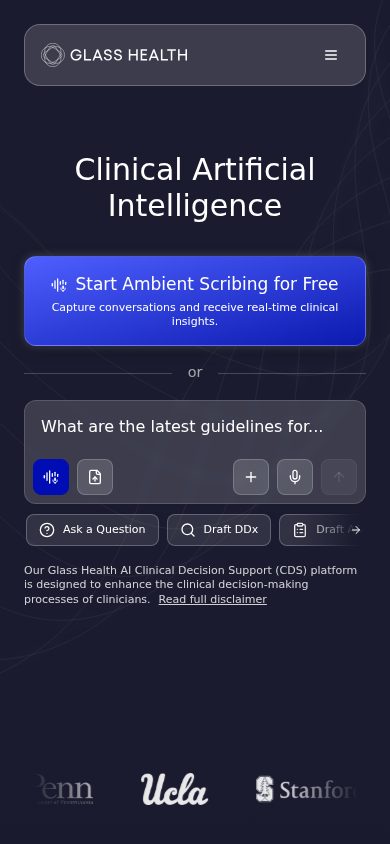
Glass Health desktop previewGlass Health mobile preview

Pricing Plans

Lite

Free

Free tier for individual clinicians and medical trainees who want to evaluate both ambient scribing and clinical decision support at no cost, with no credit card required.

  • Limited ambient scribing
  • Limited clinical decision support
  • Differential diagnosis generation
  • Assessment & plan generation
  • Clinical Q&A with literature citations
  • No credit card required

Starter

$20/monthly

Entry-level paid plan for individual clinicians who need more capacity than the free Lite tier.

  • Increased ambient scribing capacity
  • Clinical decision support
  • Differential diagnosis generation
  • Assessment & plan generation
  • Clinical Q&A with citations
Popular

Pro

$90/monthly

Full-featured plan for practicing physicians who want unlimited ambient scribing combined with the complete clinical decision support platform in one subscription.

  • Unlimited ambient scribing
  • Real-time clinical insights during encounters (DDx, suggested history questions, next steps)
  • Three-tier differential diagnosis (Most Likely, Expanded, Can't Miss)
  • Assessment & plan generation grounded in evidence-based guidelines
  • Clinical Q&A with citations to clinical guidelines and medical literature
  • Deep Reasoning mode
  • Patient context persistence
  • Six customizable documentation types (SOAP, H&P, progress notes, discharge summaries, patient handouts, and more)

Max

$200/monthly

Advanced plan for clinicians who need full Pro capabilities plus deep EHR integration with supported health systems (Epic, eClinicalWorks, Athena).

  • Everything in Pro
  • Supported Epic clinical workflow integration
  • Supported eClinicalWorks clinical workflow integration
  • Supported Athena clinical workflow integration
  • Advanced EHR-native documentation push

AI Panel Reviews

The Decision Maker

The Decision Maker

Strategic bet, vendor viability, timing, adoption approval
7.8/10

Solid clinical AI at $90/month, but EHR lock-in lives at $200.

Glass Health does real clinical work — ambient scribing, DDx ranking, prior auth drafting — at a price most physicians won't blink at. The Pro tier is the sweet spot; the Max tier is where the commitment gets serious.

The Pro plan at $90/month gets you unlimited ambient scribing, real-time encounter insights, a three-tier differential including 'Can't Miss' diagnoses, and Deep Reasoning mode. That's a complete clinical decision support stack for less than one billable hour. Nuance DAX charges enterprise rates and requires IT involvement. Glass Health doesn't.

The tradeoff is integration depth. The $200 Max tier locks in Epic, Athena, or eClinicalWorks — which is where most practicing physicians actually live. Without that, clinicians are copy-pasting into their EHR, which is friction that kills adoption. The free Lite tier exists, but no public changelog or API means we're betting on their roadmap without visibility.

No public funding data is a real flag. The product is clearly shipping — feature depth at this price says a serious team is behind it. Pilot it at the Pro tier with a few residents and attending physicians for 90 days before committing to Max.

Competitive Positioning7.8

Undercuts Nuance DAX and Ambience Healthcare on price significantly while matching ambient scribing functionality; the gap is enterprise EHR integration depth.

Reputation Risk7.5

Physician-built, evidence-cited outputs with explicit 'assists not replaces' framing makes this defensible to a medical staff committee or board.

Speed to Value8.5

Free Lite tier means zero-friction evaluation; a physician can generate a DDx in minutes with no IT involvement or credit card.

Strategic Fit8.5

Ambient scribing plus real-time DDx plus prior auth drafting advances clinical throughput — this isn't just cost savings on existing workflow.

Vendor Viability6.5

No public funding data and no changelog visibility makes a 3-year bet harder to defend, though feature breadth at this price suggests an active team.

Pros

  • Three-tier differential including 'Can't Miss' diagnoses is a meaningful clinical safety feature
  • Prior auth drafting at $90/month is a workflow accelerator most competitors charge enterprise rates for
  • Free Lite tier lets physicians evaluate without IT approval or procurement
  • EHR integration with Epic, Athena, and eClinicalWorks available at Max tier

Cons

  • No public funding data makes vendor longevity a real open question
  • No API and no public changelog limits integration visibility and roadmap confidence
  • Full EHR integration requires jumping to $200/month — that's a steep step up from $90
  • Web-only platform with no mobile app limits true point-of-care portability

Right for

Independent or group practice physicians who want clinical AI without an enterprise procurement process.

Avoid if

Your org requires EHR-native documentation and IT-governed vendor security review before any clinical AI touches workflows.

The Domain Strategist

The Domain Strategist

Craft and strategy in the product's domain — adapts identity per category, same lens
7.8/10

Serious clinical reasoning architecture, but EHR integration depth determines whether this sticks.

Glass Health has built a genuine clinical decision support layer — ambient scribing, three-tier DDx, Deep Reasoning mode, and evidence-cited Q&A in one stack. The $200/month Max tier with Epic, eClinicalWorks, and Athena integration is where the real clinical workflow bet lives.

The three-tier differential — Most Likely, Expanded, Can't Miss — tells me someone with actual diagnostic training shaped this product. That's not a GPT wrapper. The 'Can't Miss' category specifically reflects how attending physicians think about liability and patient safety, not just probability. Deep Reasoning mode for complex presentations adds another layer that Doximity's GPT doesn't offer at this structural depth.

The ambient scribing plus real-time clinical insights during the encounter is the right architectural move. Post-visit documentation tools are a crowded category; surfacing DDx and suggested history questions live, mid-encounter, is where Glass Health pulls ahead of Nuance DAX's transcription-first approach. If the real-time inference latency holds under clinical conditions, that's a durable differentiator.

The constraint I'd flag for any health system adoption: no publicly documented API means your informatics team can't build custom integrations, and the $200/month Max tier's EHR push is limited to three vendors. If your system runs Cerner or Meditech, you're on manual copy-paste workflows, which undercuts the ambient scribing value significantly.

Category Positioning8.0

Occupies the differentiated space between Nuance DAX's transcription focus and ChatGPT's off-label use, with clinical reasoning architecture neither competitor matches at this price point.

Domain Fit8.5

Ambient scribing plus real-time encounter insights mirrors actual physician workflow cadence, including prior auth drafting that solo-use tools ignore.

Integration Surface7.2

Max tier at $200/month covers Epic, eClinicalWorks, and Athena natively, but Cerner and Meditech shops have no documented pathway.

Long-term Implications7.0

No public API and a three-EHR integration ceiling create dependency risk for health systems that outgrow the supported vendor list.

Strategic Depth8.2

Three-tier DDx structure and Deep Reasoning mode reflect genuine clinical epistemology, not surface-level LLM prompting.

Pros

  • Three-tier DDx with explicit 'Can't Miss' category shows clinical safety thinking built into the model architecture
  • Real-time ambient insights during encounters, not just post-visit — architecturally ahead of most competitors
  • Evidence-cited clinical Q&A with literature references supports defensible documentation
  • Free Lite tier lowers adoption barrier for residents and trainees evaluating the platform

Cons

  • No publicly documented API limits health system customization and informatics integration
  • EHR-native push limited to three vendors at $200/month — Cerner and Meditech systems are excluded
  • No changelog or public roadmap visibility makes it hard to evaluate model update cadence and safety review processes

Right for

Attending physicians and residents in Epic, eClinicalWorks, or Athena environments who want ambient scribing and clinical decision support in one subscription.

Avoid if

Your health system runs Cerner or Meditech and requires EHR-native documentation push rather than manual copy-paste workflows.

The Finance Lead

The Finance Lead

Money, total cost of ownership, contracts, procurement math
7.2/10

$90/month Pro tier is the real product; free tier is a door opener.

Four visible tiers, no sales call required. Year-3 TCO depends heavily on EHR integration needs — Max at $200/month changes the math fast.

$0 Lite to $200 Max — all four tiers published without a sales wall. That's rare in clinical AI. Starter at $20/month is likely a stepping stone; Pro at $90 is where ambient scribing goes unlimited. $90 × 12 = $1,080/year per physician. At 10 physicians, $10,800/year. Add 20% seat creep over 3 years and you're at roughly $38,000 cumulative before touching EHR integration.

Max at $200/month exists solely for Epic, eClinicalWorks, or Athena push. That's $2,400/year per seat — 2.7× Pro. EHR integration is the upsell mechanism here. No public API means no DIY integration path; you either pay Max or stay manual.

Competitors like Nuance DAX run enterprise contracts with no public pricing. Glass publishes numbers — that's a genuine procurement advantage. The tradeoff: no documented contract terms, auto-renewal policy, or cancellation window on the pricing page. Procurement will ask. Glass won't have a fast answer.

Billing & Procurement7.0

Monthly billing on a web platform with no credit card required on Lite reduces friction; institutional procurement for Max-tier EHR integration will require vendor onboarding steps not yet documented publicly.

Contract Flexibility5.5

No public documentation of auto-renewal windows, cancellation terms, or termination clauses — standard procurement blockers that will slow institutional buying.

Pricing Transparency8.5

All four tiers and prices are publicly visible — $0, $20, $90, $200 — no sales call required, which is category-leading transparency.

ROI Clarity7.0

Ambient scribing time savings are measurable in minutes per encounter, but no published benchmark data or time-study citations to anchor an ROI model.

Total Cost of Ownership6.8

Pro at $1,080/year per seat is manageable, but Max at $2,400/year for EHR integration creates a sharp cost cliff with no documented overage or usage cap structure.

Pros

  • All four tiers priced publicly — $0 to $200 — no sales call
  • Free Lite tier requires no credit card, lowers evaluation friction
  • Pro at $90/month includes unlimited ambient scribing and Deep Reasoning
  • EHR integration with Epic, eClinicalWorks, Athena available at Max tier

Cons

  • Max at $200/month is 2.7× Pro — EHR integration is a steep upsell
  • No public API documented, eliminating custom integration paths
  • Contract terms, auto-renewal policy, and cancellation window not published
  • No published benchmark data to support time-savings ROI claims

Right for

Individual physicians or small practices wanting transparent per-seat pricing with no enterprise sales process.

Avoid if

Your institution needs formal procurement terms, SLA documentation, or a per-seat contract below $200 with native EHR push.

The Domain Practitioner

The Domain Practitioner

Daily hands-on reality in the product's domain — adapts identity per category, same lens
8.1/10

Real-Time DDx and Ambient Scribing in One Tool at $90/Month

Glass Health bundles ambient scribing, differential diagnosis generation, and A&P drafting into a single workflow. The Pro tier at $90/month is where the clinical utility actually lands — below that, usage limits will frustrate any attending seeing a full panel.

The ambient scribing with real-time clinical insights is the feature that separates this from just another documentation tool. It's surfacing suggested history questions and a live DDx during the encounter — not after. That's a different workflow posture than Nuance DAX, which is primarily post-visit dictation cleanup. The three-tier differential (Most Likely, Expanded, Can't Miss) in Pro is structured the way residents actually think on rounds.

The friction concern is the $200/month Max tier for EHR integration. Without it, you're copying outputs manually into Epic or Athena. That copy-paste gap is a daily tax on every note. For a solo hospitalist or busy outpatient internist, that overhead accumulates fast.

No public API, no changelog visible, no publicly documented integration outside the Max tier. Deep Reasoning mode sounds clinically useful, but the evidence base for its accuracy claims isn't surfaced publicly. The docs read marketing-adjacent. Clinicians need citation trails, not testimonials.

Day-3 Reality7.8

Ambient scribing plus real-time DDx is genuinely useful daily, but manual copy-paste into EHR without the $200/month Max tier creates consistent friction.

Documentation Practitioner-Fit7.0

Six customizable note types including discharge summaries and prior auth drafting show clinical workflow awareness, but public-facing docs lean on testimonials over clinical evidence citations.

Friction Surface7.2

Copy-paste to EHR on Pro tier, usage caps on Lite and Starter, and no mobile app — all small daily costs that compound across a full clinic day.

Power-User Depth8.2

Deep Reasoning mode, three-tier DDx, patient context persistence, and six documentation types give experienced clinicians meaningful depth to grow into at the Pro tier.

Workflow Integration7.5

Real-time encounter insights fit natural clinical flow, but no API and EHR push locked behind the most expensive tier limits seamless integration for most practitioners.

Pros

  • Real-time ambient insights during encounters — DDx and history suggestions live, not post-visit
  • Three-tier differential diagnosis structure mirrors actual clinical reasoning
  • Prior authorization drafting included — a genuine documentation time sink addressed
  • Free Lite tier with no credit card required lowers the evaluation barrier

Cons

  • EHR integration (Epic, Athena, eClinicalWorks) locked behind $200/month Max tier
  • No public API means no custom workflow automation
  • No publicly visible changelog or clinical validation documentation
  • Copy-paste workflow on Pro tier is a daily friction point for high-volume clinicians

Right for

Outpatient physicians or residents who want AI-assisted DDx and ambient scribing without committing to an enterprise contract.

Avoid if

You need seamless EHR push without paying $200/month or you require a documented clinical validation trail before adopting AI at point of care.

The Power User

The Power User

Daily human experience, onboarding, polish, learning curve, reliability
8.1/10

Finally, an AI that reasons like a doctor instead of autocompleting like one

Glass Health does real clinical work — differential diagnosis, ambient scribing, evidence-backed A&P drafts — at a price most physicians can actually justify. The $90/month Pro tier is where it clicks, but web-only is a real constraint for bedside use.

The feature list here is unusually honest about what clinicians actually need at the point of care. Real-time ambient insights during the encounter, not just a post-visit transcript dump. A three-tier DDx that separates 'Most Likely' from 'Can't Miss.' Prior auth drafting. These aren't checklist features — someone who's actually been in a clinical workflow designed this. Compared to Nuance DAX, which costs a small fortune and requires institutional buy-in, a $90/month individual Pro subscription that includes Epic integration at the $200 Max tier is genuinely accessible.

The tradeoff is the platform constraint. Web-only means you're either at a workstation or squinting at a phone browser mid-encounter. For ambient scribing that's supposed to run during a live patient visit, that's friction that adds up fast. No app means no real mobile parity.

Onboarding looks low-barrier — free Lite tier, no credit card, immediate access to DDx and A&P generation. That's the right instinct. Day three, you'll know if the Deep Reasoning mode earns the Pro upgrade. Most physicians probably will.

Daily Polish7.8

The structured output — SOAP notes, patient handouts, prior auth drafts — suggests real care for clinical workflow, but no changelog or public docs makes it hard to gauge how consistently the team sweats the small stuff.

Learning Curve8.2

Patient context persistence in Pro, plus a discoverable progression from free DDx generation up to Deep Reasoning mode, suggests the product rewards continued use without demanding a manual.

Mobile Parity5.5

Web-only platform with no listed mobile app is a real problem for ambient scribing during live encounters — that's the exact moment you need it to work on whatever's in your pocket.

Onboarding Experience8.5

Free Lite tier with no credit card required and immediate access to core DDx and A&P features is exactly how you remove the 'let me think about it' hesitation from busy clinicians.

Reliability Feel7.5

No public API, no changelog, and limited external documentation means reliability signals are thin — category norm for early-stage clinical AI, but still a trust gap for point-of-care use.

Pros

  • Three-tier DDx including 'Can't Miss' diagnoses shows genuine clinical design thinking
  • Real-time ambient insights during live encounters, not just post-visit cleanup
  • $90/month Pro includes unlimited scribing plus full decision support — individual-accessible pricing
  • EHR integration with Epic, Athena, eClinicalWorks at the $200 Max tier

Cons

  • Web-only with no mobile app is a real constraint for bedside or exam-room use
  • No public changelog or API makes reliability hard to assess from the outside
  • Free Lite tier has usage limits that aren't precisely specified — unclear where the wall is

Right for

Independent or employed physicians who want point-of-care AI reasoning and documentation without needing IT approval.

Avoid if

Your workflow is primarily mobile or you need guaranteed EHR push without the $200/month commitment.

The Skeptic

The Skeptic

Contrarian. Watch-outs, deal-breakers, broken promises, category patterns
6.8/10

Solid clinical AI core, but three missing signals give me pause

Glass Health does real work — ambient scribing, DDx generation, prior auth drafting, all in one $90/month Pro tier. What's missing from the public record worries me more than what's there.

Three tells before I dig in. No changelog. No blog. No API docs. The capabilities scrape came back empty on all five signals. That's not disqualifying — it's a yellow flag stack. The feature list is genuinely substantive: three-tier differential diagnosis, real-time ambient insights, six customizable note types, EHR integration at $200/month for Epic/Athena/eClinicalWorks. That's a real product, not vaporware.

The competitive picture is tricky. Nuance DAX has ambient documentation locked in at the enterprise level. Ambience is well-funded and going the same direction. Glass is priced for individual physicians — $20 Starter, $90 Pro — which is smart positioning, but solo-physician tools have a graveyard. Doximity GPT is free and already in every doctor's pocket.

Exit portability is actually decent. No proprietary format, no EHR lock at the lower tiers, outputs copy into existing workflows. If Glass goes away, you lose convenience, not data. The $200/month Max tier with EHR push is where stickiness — and lock-in risk — begins.

Competitive Differentiation6.5

Three-tier DDx and real-time ambient insights are differentiated features, but Nuance DAX and Ambience are better-resourced and targeting the same workflow.

Exit Portability7.8

Outputs are copy-paste into existing workflows with no proprietary format; EHR integration at Max tier is the only real migration friction.

Long-term Viability5.5

No public changelog, no blog, no API, no visible funding data — not enough public signal to call this a confident 3-year bet.

Marketing Honesty7.5

Messaging emphasizes 'assist, not replace' and targets licensed clinicians specifically — grounded framing, not overclaiming.

Track Record Match6.0

Individual-physician SaaS in clinical AI matches patterns from tools that got acqui-hired or quietly wound down; no public funding signals to counter that read.

Pros

  • Pro tier at $90/month bundles ambient scribing plus full DDx plus prior auth drafting — real breadth for the price
  • Three-tier differential (Most Likely, Expanded, Can't Miss) is clinically thoughtful structure
  • EHR integration at Max tier covers Epic, Athena, eClinicalWorks — the three that matter
  • Free Lite tier with no credit card lowers the evaluation barrier meaningfully

Cons

  • No public changelog or blog — shipping cadence is invisible, which is a real signal gap
  • No API means zero integration story outside the four named EHRs
  • Nuance DAX and Ambience Healthcare are better-funded competitors in the same ambient workflow lane
  • Long-term viability evidence is thin — no named investors, no funding round publicly visible

Right for

Independent physicians or residents who want AI-assisted DDx and ambient scribing without an enterprise procurement process.

Avoid if

You need an auditable shipping roadmap or are making a multi-year clinical workflow bet without fallback options.

Buyer Questions

Common questions answered by our AI research team

Features

What does Glass Health generate from a patient summary?

Glass Health generates differential diagnoses and clinical plans from patient summaries entered by clinicians.

Features

What kind of AI model powers Glass Health?

Glass Health is powered by a large language model trained on medical content.

Features

Can Glass Health suggest a diagnostic workup?

Yes, Glass Health suggests structured diagnostic reasoning and workups based on the patient summary provided.

Features

Is Glass Health designed for use at the point of care?

Yes, Glass Health is designed for point-of-care use, surfacing diagnostic reasoning when clinicians need it.

Also in AI Healthcare