Grading software for paper, digital, and code assignments
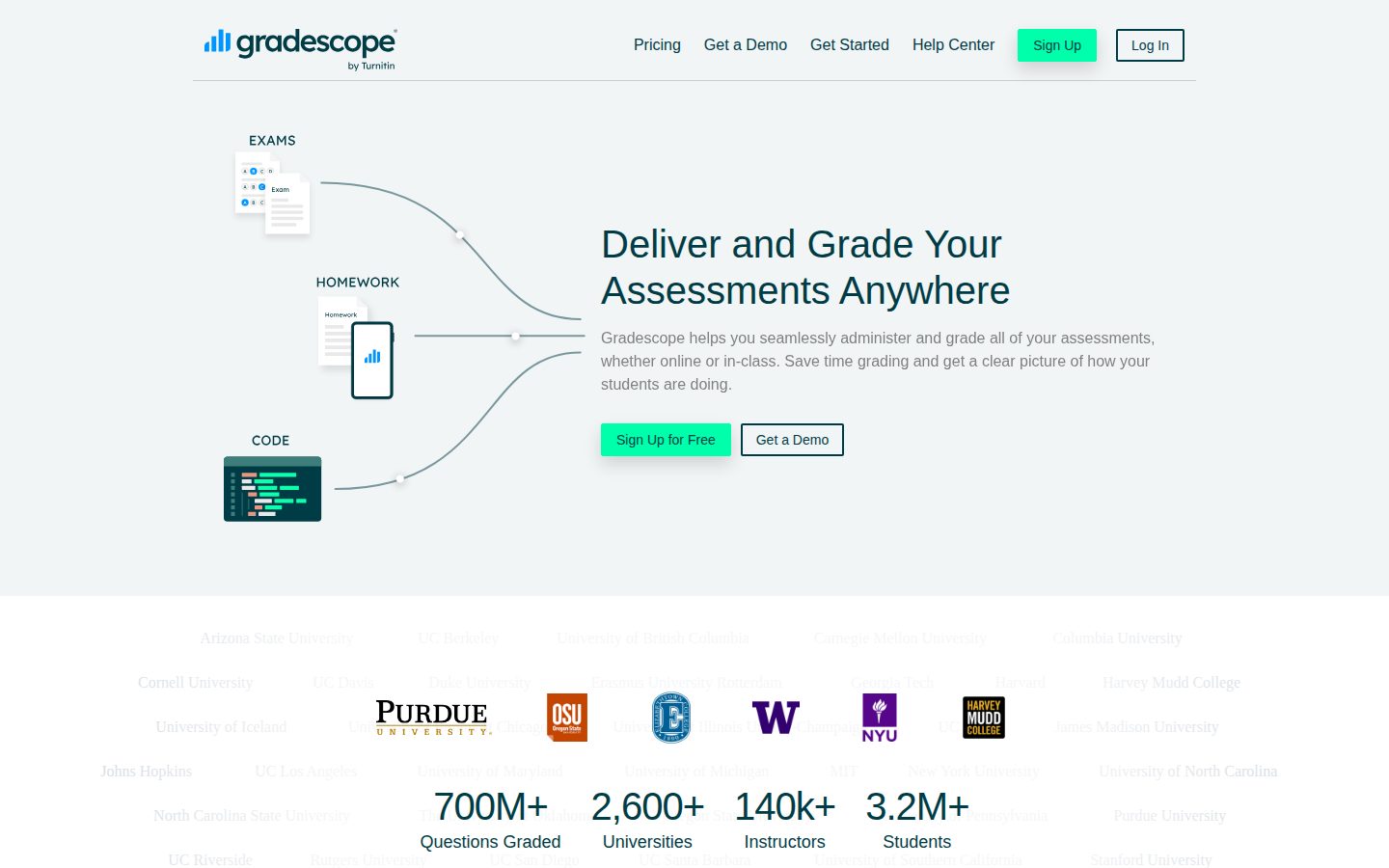
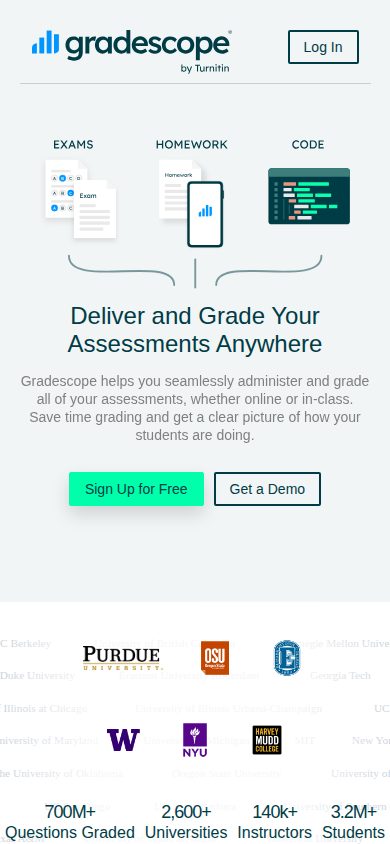
Gradescope is an online grading platform for instructors at universities and schools.
AI Panel Score
6 AI reviews
Reviewed
AI Editor ApprovedApproved and published by our AI Editor-in-Chief after full panel analysis.Gradescope is an online grading platform for instructors at universities and schools. It lets instructors grade paper-based, digital, and programming assignments through a unified interface: student submissions are scanned or uploaded, flexible rubrics are applied, and grades and feedback are distributed in one click. A distinguishing capability is AI-assisted answer grouping, which clusters similar student responses so instructors can grade an entire group at once. Other capabilities include a programming autograder with GitHub and Bitbucket integration, bubble sheet auto-grading, retroactive rubric edits that propagate across all graded submissions, and per-question analytics. Pricing starts at $1 per student per course, with institutional plans quoted by sales. TopReviewed's six-seat AI review panel scored it 7.9/10, praising retroactive rubric propagation that eliminates regrading from scratch while noting AI answer grouping is locked to institutional licenses. It best fits universities running high-enrollment STEM courses with mixed paper, digital, and code submissions.
Instructors use Gradescope by uploading or scanning student work—whether handwritten exams, PDFs, bubble sheets, or code submissions—and then defining rubrics with point values and partial credit options. Rubric changes made after grading begins automatically propagate to previously graded submissions. Once grading is complete, instructors can send grades and feedback to students in one step or export them to an external gradebook.
The platform supports several submission types: paper-based assignments scanned in batches, student-uploaded PDFs or photos, code submitted via GitHub or Bitbucket, and bubble sheets graded automatically against an answer key. For programming assignments, instructors can configure autograders that run test cases and report scores immediately. Answer Groups is a feature that clusters visually or semantically similar responses, allowing a single rubric application to grade multiple students simultaneously; the platform notes that AI assistance is available for forming these groups on certain question types under an institutional license.
Gradescope is used across more than 2,600 universities and by over 140,000 instructors in subjects including computer science, math, physics, chemistry, biology, engineering, and economics. Pricing details are not publicly listed on the homepage; institutional licensing is mentioned for AI-assisted features, suggesting a tiered or institutional contract model. Competing products in the online grading and assessment space include Canvas SpeedGrader, Turnitin, and Crowdmark.
The platform is web-based and requires no dedicated software installation. Code submission integrations with GitHub and Bitbucket are supported natively. Per-question and per-rubric analytics are available to help instructors identify where students are struggling across a class.

Gradescope AI automatically clusters similar student responses into groups so instructors can apply rubric scores to an entire group of answers at once.
Provides question-level and rubric-item-level statistics so instructors can identify which topics or concepts students struggled with most.
Batch scans bubble sheets, automatically separates them by test version, and grades them against an instructor-defined answer key with partial credit options.
Automatically runs tests against student code submissions and produces scored results, with support for additional manual inline commenting on code.
Students can submit regrade requests directly within Gradescope, allowing instructors to handle disputes online without consuming office hours.
Students can upload PDFs or photos of handwritten work, enabling remote or hybrid submission workflows without requiring physical paper collection.
Instructors can create and modify rubrics at any time, with changes automatically applying to all previously graded submissions.
Grades and assignment data can be exported to an external gradebook or downloaded for further analysis.
Instructors can send graded assignments and detailed feedback to all students simultaneously with a single click.
Instructors scan student paper submissions and grade them digitally using a flexible rubric interface, eliminating the need to alter existing assignments.
Supports assignments where each student's submission may have a different number of pages, accommodating problem sets, projects, and open-ended work.
Students can submit programming assignments directly from GitHub or Bitbucket repositories, simplifying code collection and version management.
Entry-level plan for individual instructors who want core grading tools for small to medium classes.
For courses with multiple graders or teaching assistants who need to collaborate on grading.
For individual instructors who need advanced AI and autograding features, especially in STEM or programming-heavy courses.
Custom pricing for universities and large institutions. Requires contacting Gradescope/Turnitin sales for a quote. Often bundled with existing Turnitin subscriptions.
Turnitin owns this, 2,600 universities already use it — easy institutional bet.
“Gradescope is the default grading platform for higher ed. Acquired by Turnitin in 2018, it's not going anywhere.”
2,600 universities. 140,000 instructors. That's not traction — that's infrastructure. The retroactive rubric edits alone eliminate a grading workflow problem every professor has hit. AI-assisted Answer Groups on institutional license is the real differentiator versus Canvas SpeedGrader or Crowdmark.
Two things to watch. One: AI grouping is locked behind institutional contracts, not the $3/student Solo or Team tiers. If your institution isn't already a Turnitin customer, expect a procurement conversation before you see the flagship feature. Two: Turnitin's ownership cuts both ways — survival risk is near-zero, but roadmap is no longer founder-driven.
At $3/student/course for Team, the math is trivial. Institutional tier bundles SSO and LMS integration with Canvas or Blackboard, which is what most university IT teams need to sign off. Pilot one department. Standardize on renewal.
Peers are already using it; the risk is falling behind, not getting ahead — Answer Groups is the only real differentiator over Crowdmark.
Category standard in higher ed — adopting it looks competent, not risky, to any academic board.
Retroactive rubric edits and one-click grade distribution deliver time savings from the first assignment graded.
Replaces manual paper grading workflows and adds AI grouping; this advances teaching efficiency, not just cost reduction.
Acquired by Turnitin in 2018 and embedded in 2,600 universities — zero realistic discontinuation risk.
Universities already on Turnitin contracts that want to eliminate paper grading overhead across large STEM or multi-section courses.
Your institution isn't buying institutionally — the $3/student tier lacks AI grouping and makes the per-course math awkward at scale.
Gradescope is the grading infrastructure layer that 140,000 instructors already trust.
“Retroactive rubric propagation and AI-assisted Answer Groups solve the two biggest friction points in large-course assessment workflows. At $3/student/course for the Solo or Team plan, the ROI calculus for STEM departments is straightforward.”
The retroactive rubric edit is the architectural decision that signals real practitioner thinking. When a TA misapplies a rubric item on 200 exams, Gradescope fixes it across all submissions simultaneously — that's not a feature, that's a workflow guarantee that Canvas SpeedGrader can't match. The Answer Groups clustering on institutional licenses takes that further, letting a single rubric application cover semantically similar responses at scale.
The tiered pricing structure creates a real adoption decision. AI-assisted grouping sits behind institutional licensing — individual instructors on the $3 Solo plan get autograding and code submission, but not the AI clustering that drives the biggest time savings on written exams. For a department-level rollout, that means a Turnitin contract conversation, which adds procurement friction.
If we adopt this institutionally, in 3 years we have deep grading workflow dependency inside a Turnitin-owned platform. The 2,600 university footprint shows durability, but the per-question analytics and LMS integrations with Canvas and Blackboard make exit costly. That's a reasonable tradeoff for the consistency gains — but it's a tradeoff.
140,000 instructors across 2,600 universities puts Gradescope clearly ahead of Crowdmark and well-differentiated from Canvas SpeedGrader on rubric depth.
Supports paper, PDF, bubble sheet, code, and variable-length submissions — matches actual mixed-format university course portfolios precisely.
Native LMS integration with Canvas and Blackboard plus GitHub/Bitbucket code submission covers the standard university stack cleanly.
Turnitin acquisition and institutional licensing model create platform dependency; exit costs rise as per-question analytics and rubric history accumulate.
Retroactive rubric propagation and AI Answer Groups show genuine understanding of high-enrollment assessment pain — these aren't surface features.
STEM departments and universities running high-enrollment courses with mixed paper, digital, and code submissions.
Your institution wants AI grading features without committing to an institutional Turnitin contract.
$3/student per course hides the real number: institutional SSO locks AI features behind a sales call.
“Pricing tiers are published — rare for ed-tech — but AI-assisted Answer Groups require an institutional contract. Per-course billing math depends entirely on enrollment counts your procurement team won't have until semester start.”
Three tiers published without a sales call: Basic at $1/student/course, Team and Solo at $3. That's unusually transparent for a Turnitin-owned platform. A 200-student course on the Solo plan runs $600/course. Two semesters, 5 courses — $6K/year before institutional negotiation. Year 3 with seat creep and new course sections: call it $15–18K.
The structural problem: SSO, LMS integration (Canvas, Blackboard), and AI-assisted Answer Groups are all gated behind Institutional — listed as 'free' but requiring a Turnitin sales conversation. That's the bait. No published rate, no overage structure, no term length on record.
Crowdmark publishes similar per-submission pricing and doesn't route SSO through a parent company acquisition. Gradescope's retroactive rubric propagation is a genuine time-saving feature. The tradeoff: the features worth buying are the ones you can't price without a call.
Per-student-per-course invoicing is clean for individual plans; institutional procurement adds Turnitin vendor onboarding and undisclosed LMS integration terms.
No public auto-renewal terms, no cancellation policy, and institutional pricing routes through Turnitin sales — contract terms are entirely undisclosed.
Basic and paid tiers are published at $1–$3/student/course, but institutional pricing — where AI features live — is contact-only.
Per-question analytics and Answer Groups provide measurable grading-time reduction across 140,000+ instructors — the efficiency story is concrete, not hand-wavy.
Per-course billing is predictable at small scale; institutional contract cost is opaque, and Turnitin bundling adds negotiation complexity at year 2+.
Universities already in the Turnitin ecosystem where institutional bundling makes AI features effectively included.
You need AI-assisted grading without routing a contract through Turnitin sales.
Retroactive rubrics alone make Gradescope worth the conversation for any STEM instructor
“Gradescope solves the actual daily grind of exam grading — scanning, rubric consistency, regrade request chaos — better than Canvas SpeedGrader does out of the box. The AI-assisted Answer Groups feature is locked to institutional licensing, which is the conversation every solo instructor will have to have with their admin.”
Retroactive rubric edits are the sleeper feature here. Change a rubric item after grading 60 exams, and it propagates backward automatically. Any trainer who's manually re-scored 200 papers after a rubric dispute knows exactly what that's worth. Bubble sheet auto-grading with version separation is another quiet win — batch scan, define your key, done. At $3/student/course for the Solo plan, a class of 30 runs you $90 per course, which is defensible against the hours saved.
The friction shows up around AI-assisted Answer Groups. It's the feature that moves the needle on grading velocity for open-ended questions, and it's institutional-only. Solo instructors pay Solo pricing but don't get the AI clustering that makes the platform genuinely fast at scale. That's a real gap if you're a lecturer without institutional support.
Workflow integration is strong for paper-heavy courses. GitHub and Bitbucket submission support means CS instructors aren't asking students to zip and upload. The 140,000-instructor footprint across 2,600 universities suggests real daily use, not demo adoption. Docs clarity is the unknown — no public changelog or blog in the evidence, which usually signals practitioner docs are thin.
Retroactive rubric propagation and one-click grade distribution remove the most painful recurring tasks; regrade requests handled in-platform cuts office hour drain significantly.
No public changelog, blog, or API docs visible in evidence — category norm is practitioner-facing release notes; absence here is a yellow flag for power users troubleshooting edge cases.
AI Answer Groups gated to institutional license creates a real ceiling for solo instructors who hit the grouping workflow and find it unavailable without an upgrade path they control.
Autograder configuration for programming assignments, per-question analytics, and variable-length submission support give advanced instructors real depth beyond basic grading workflows.
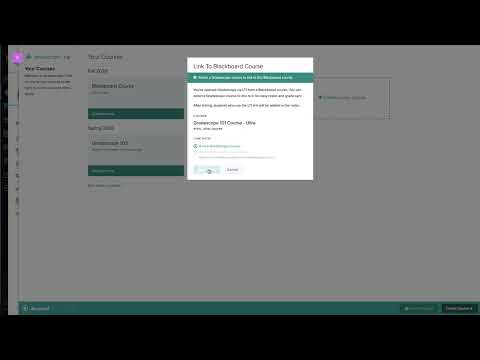
GitHub and Bitbucket native submission plus LMS integration (Canvas, Blackboard) at institutional tier means minimal workflow disruption for most university instructors.
University instructors in STEM or writing-heavy courses who grade paper or code submissions at scale and need rubric consistency across large cohorts.
You're a solo instructor without institutional backing who needs AI-assisted grouping — you'll pay Solo pricing and hit the feature wall.
Gradescope makes grading feel less like punishment — mostly.
“Over 140,000 instructors use it for good reason: it handles paper, code, and bubble sheets in one place. The retroactive rubric edits alone save hours every semester.”
The retroactive rubric feature is the one that makes instructors stop and go 'wait, really?' Change a rubric item after grading forty submissions, and it updates all of them. That's not a small thing. Canvas SpeedGrader doesn't do that. The Answer Groups clustering — where AI batches visually similar responses for one-click grading — is genuinely useful, but it's locked to institutional licenses, which means the $3/student Solo plan buyers are paying for autograding and still missing the headline AI feature.
Pricing is confusing in a way that accumulates frustration. Basic at $1/student, Solo and Team both at $3/student but for completely different use cases — that naming is lazy and will cause real purchase mistakes. Institutional is listed as 'free' but requires a Turnitin sales call, which means it's neither free nor simple.
Web-only, no mobile to speak of. For instructors that's mostly fine — nobody's grading exams on a phone. But it does mean zero flexibility for checking grade stats between classes.
One-click grade distribution and inline annotations show care, but two-tier AI availability creates daily friction for non-institutional users.
Per-question analytics and regrade request workflows are genuinely discoverable; GitHub/Bitbucket integration for code is clean once configured.
Web-only platform with no mentioned mobile app means grade-checking on the go is essentially read-only at best.
Scan-and-upload workflow is intuitive enough, and flexible rubric setup is forgiving for first-timers — no trial offered, but institutional onboarding is included.
2,600+ universities depending on it for live exam grading implies solid uptime; autosave behavior on rubric edits suggests stable infrastructure.
University instructors running STEM courses with mixed paper and code assignments who want rubric-based grading at scale.
You're an individual instructor expecting the full AI feature set without an institutional Turnitin contract.
2,600 universities in, Turnitin-owned, and the pricing page finally exists — call it settled.
“Gradescope is a genuinely differentiated grading tool with real adoption numbers and a feature set competitors like Canvas SpeedGrader can't match on paper-based workflows. The Turnitin acquisition in 2018 is the wildcard — could mean stability, could mean it gets absorbed and stripped.”
Retroactive rubric edits that propagate automatically — that's the feature Canvas SpeedGrader doesn't have and every instructor who's ever re-graded 200 exams by hand will care about. Answer Groups is real differentiation too, not marketing fluff. The AI-assisted clustering is institutional-only though, so the $3/student Solo plan buyers are paying for autograding, not the headline AI feature.
The Turnitin acquisition is where I slow down. 2018 buyout, undisclosed sum, no public changelog visible, no API docs. That's a product in maintenance orbit or quiet integration mode. Either way, the roadmap isn't yours to read.
Exit portability is modest — grades export cleanly, but rubric structures and answer group logic don't travel. Switching to Crowdmark means rebuilding workflows. Not catastrophic, but not free.
Retroactive rubric propagation and paper-scan-to-digital workflows are genuinely uncommon — Canvas SpeedGrader doesn't touch this use case.
Gradebook export exists, but rubric logic and Answer Groups workflows are platform-native with no documented import standard for competitors like Crowdmark.
Turnitin ownership since 2018 means institutional staying power but zero public shipping signals — no changelog, no API, no visible dev cadence.
The meta description still says 'for free' but there's no free plan — that's a stale claim that should've been updated years ago.
140,000 instructors and 2,600 universities is durable adoption, not hype — this matches the pattern of tools that survive category consolidation.
University instructors running high-volume paper or code-based grading who need rubric consistency across large TA teams.
You need a visible product roadmap, API access, or AI features without committing to an institutional contract.
Common questions answered by our AI research team
AI-assisted answer grouping is part of the Institutional license only, not all plans.
Yes, students can submit code directly from GitHub and Bitbucket.
Rubric changes automatically apply to all previously graded work, not just future submissions.
Gradescope supports exams, homework, code, bubble sheets, problem sets, projects, worksheets, quizzes, and fixed-template or variable-length assignments across subjects like CS, math, biology, and more.
Instructors scan paper exams and upload them to Gradescope. Students can also upload PDFs or photos of their work for digital submission workflows.
Gradescope is an AI-assisted grading platform for higher education, acquired by Turnitin in 2018 and headquartered in San Francisco.