HeartFlow logo

HeartFlow Review

Visit

AI analysis of coronary CT scans for personalized heart disease management

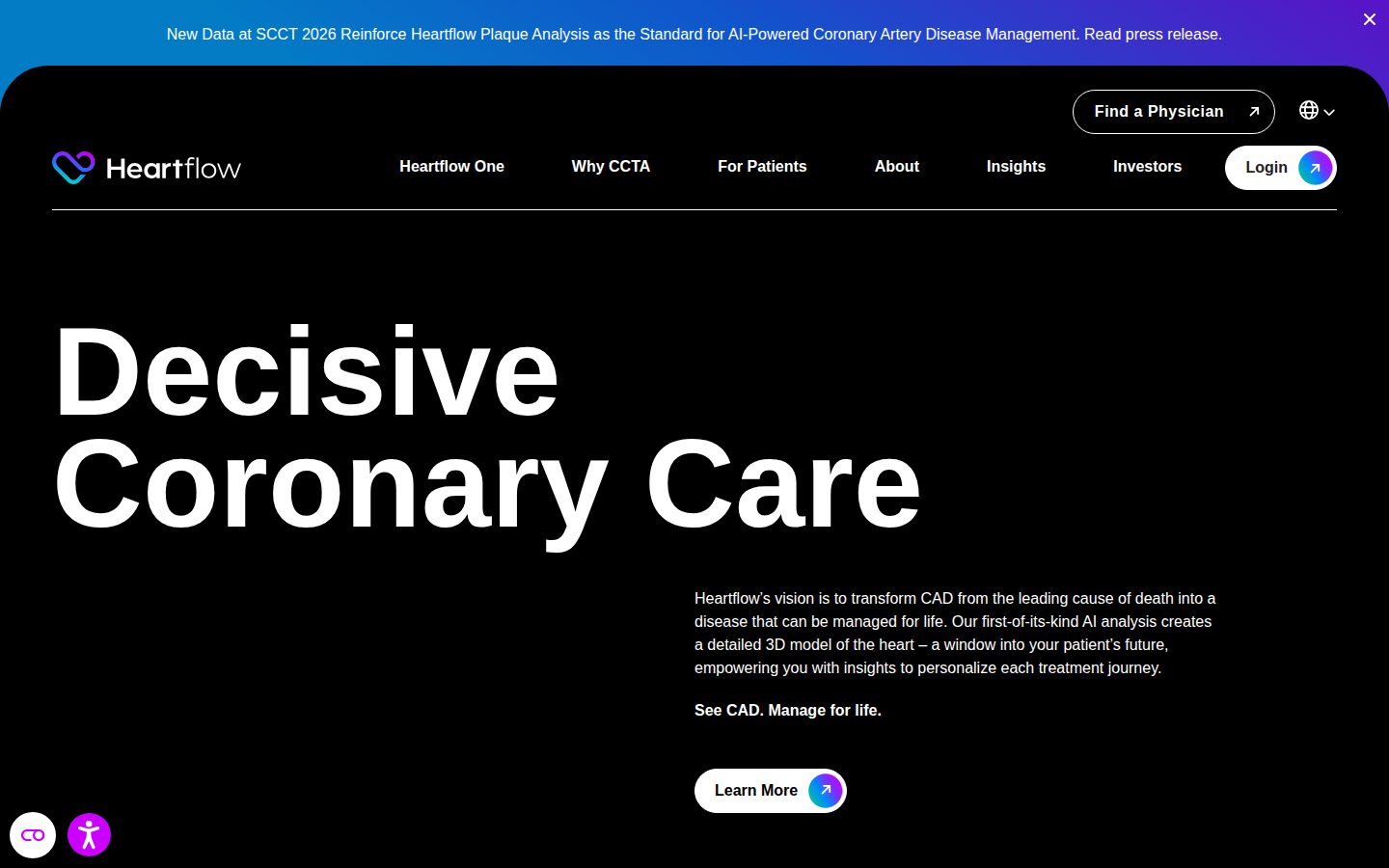
Heartflow is an AI-based analysis platform for coronary computed tomography angiography (CCTA) imaging.

AI Panel Score

7.6/10

6 AI reviews

Reviewed

AI Editor Approved

About HeartFlow

Heartflow works by taking a patient's coronary CT angiography (CCTA) scan and converting it into a dynamic 3D model of the heart. This model gives clinicians a way to assess both the anatomy of the coronary arteries and the physiology of blood flow, rather than relying solely on conventional tests such as stress EKG, stress echo, PET, calcium score, SPECT, or invasive catheterization, which the company states can produce false negatives and false positives that lead to missed diagnoses or unnecessary procedures.

The platform, marketed as Heartflow One, is built around three analysis modules. Roadmap analysis is used to read CCTA scans for early detection of coronary artery disease with consistent results across different readers. FFRct analysis evaluates blood flow at any point in the coronary tree to help determine whether a patient would benefit from revascularization. Plaque analysis quantifies and characterizes plaque buildup to inform risk assessment and ongoing disease management. Heartflow also provides clinical, operational, technical, and financial support to help institutions build and scale CCTA-based cardiology programs.

Heartflow is designed for use by cardiologists, radiologists, and other clinicians involved in diagnosing and managing coronary artery disease, as well as the hospitals and imaging centers that operate CCTA programs. The company reports the platform has been used to treat more than 650,000 patients across over 1,800 institutions, with coverage cited under 99.5% of US health insurance lives. Pricing is not publicly listed and is handled through direct contact with the company; competitors in AI-based cardiac imaging analysis include Cleerly and Elucid.

Heartflow's analysis is derived from standard coronary CTA imaging data, meaning it integrates into existing CT scanning workflows at partner institutions rather than requiring new imaging hardware. The platform is used by clinical staff through a web-based interface for reviewing scan results and 3D models, and the company cites over 625 peer-reviewed publications related to its technology and clinical validation.

Features

AI

  • AI-Powered Image Review

    Uses advanced artificial intelligence to securely review patient CT images and generate computer models of coronary anatomy.

  • Plaque Analysis

    An AI-powered, interactive tool that quantifies coronary plaque by type and volume alongside physiology to help clinicians assess a patient's cardiovascular risk.

  • Roadmap Analysis

    An AI-enabled product that assists CT readers in identifying the location and severity of coronary artery narrowings (stenoses) accurately and consistently.

Analytics

  • Clinical Evidence and Outcomes Data

    Backed by substantial clinical evidence with more than 500 peer-reviewed articles demonstrating outcomes such as reduced unnecessary angiograms and lower cost of care.

  • Quantitative Risk Assessment

    Provides quantitative measurement of plaque volume and type to help clinicians more accurately assess patient risk and develop targeted treatment plans.

Core

  • 3D Coronary Artery Modeling

    Builds a highly detailed, personalized digital 3D model of a patient's coronary arteries from CT images to visualize structure and simulate blood flow.

  • FFRct Analysis

    Computes fractional flow reserve (FFRCT), a mathematically derived quantity from simulated pressure, velocity and blood flow, from a 3D model built off static coronary CT images to support functional evaluation of coronary artery disease.

  • Non-Invasive Diagnostic Workflow

    Enables earlier detection of coronary artery disease from CT images without requiring invasive intervention or incurring adverse events associated with angiography.

Integration

  • Heartflow One Platform

    A unified platform combining FFRCT, Plaque Analysis and Roadmap Analysis so care teams can explore, evaluate and manage a patient's coronary health in one place.

Mobile

  • Mobile App Access

    Offers a dedicated mobile app (available on the App Store) that lets physicians access HeartFlow Analysis results.

Security

  • Secure Cloud-Based Image Processing

    Patient CT scan images are securely transmitted and reviewed through HeartFlow's cloud-based analysis pipeline to generate diagnostic results.

Support

  • Insurance and Reimbursement Support

    Supported by CMS-approved reimbursement in the US and recommended by NICE, with coverage giving over 235 million US patients access to the HeartFlow Analysis through their health insurance.

Preview

HeartFlow desktop previewHeartFlow mobile preview

Pricing Plans

Contact Sales

Contact sales

HeartFlow is a B2B medical technology platform sold directly to hospitals, imaging centers, and health systems rather than through a public self-serve pricing page. Pricing is negotiated per institution/contract (e.g., per-analysis or subscription arrangements) and requires contacting HeartFlow's sales team. Publicly available dollar figures relate only to U.S. Medicare/CMS reimbursement rates paid to providers for CCTA and FFRCT Analysis services, not HeartFlow's own list price.

  • FFRCT Analysis (non-invasive coronary blood flow assessment)
  • AI-Enabled Quantitative Plaque Analysis (AI-QPA)
  • Used alongside Coronary CT Angiography (CCTA) in clinical workflows
  • Supported by ACC/AHA Chest Pain Guideline and peer-reviewed validation studies

AI Panel Reviews

The Decision Maker

The Decision Maker

Strategic bet, vendor viability, timing, adoption approval
8.0/10

650,000 patients treated, 1,800 institutions live, and CMS pays for it. That's traction, not a pilot.

HeartFlow has the clinical evidence and insurance coverage most health tech vendors spend a decade chasing. The open question is whether a hospital board sees this as standard of care or a nice-to-have.

625 peer-reviewed publications. 99.5% of US insurance lives covered. 1,800 institutions already running it. That's not early-stage evidence, that's category infrastructure.

Two things stand out. One: this doesn't replace hardware, it reads CCTA scans clinicians already order, so integration risk is low. Two: FFRCT and Plaque Analysis are backed by ACC/AHA guideline language, which is about as strong as clinical validation gets in cardiology.

The tradeoff: no public pricing, so every deal is a negotiation and budgeting is a black box until legal gets involved. Cleerly and Elucid compete here, but neither has HeartFlow's scan volume or reimbursement footprint. For a hospital cardiology program, this looks less like buying software and more like joining the standard of care.

Competitive Positioning8.0

Ahead of named competitors Cleerly and Elucid on scan volume and insurance coverage breadth.

Reputation Risk8.5

ACC/AHA-backed validation and CMS reimbursement make this a safe, defensible clinical choice.

Speed to Value7.0

No free trial and contract-based pricing mean a slower procurement cycle despite fast clinical payoff once live.

Strategic Fit8.0

Improves diagnostic accuracy on existing CCTA workflows rather than just cutting cost on current tests.

Vendor Viability8.5

1,800 institutions and 650,000 patients treated signals durable scale, not a startup burning runway.

Pros

  • 625+ peer-reviewed publications backing clinical claims
  • 99.5% US insurance coverage removes a major adoption barrier
  • Integrates into existing CCTA workflows, no new imaging hardware

Cons

  • No public pricing, every deal requires direct sales negotiation
  • No free trial, so evaluation happens at contract stage
  • Mobile access exists but core workflow is web-only

Right for

Hospitals and imaging centers running or scaling CCTA-based cardiology programs.

Avoid if

Skip it if your CT volume doesn't justify negotiating a per-institution contract.

The Domain Strategist

The Domain Strategist

Craft and strategy in the product's domain — adapts identity per category, same lens
8.4/10

A validated, guideline-supported CCTA analytics platform that changes how my cath lab decides who goes to the table.

HeartFlow's FFRct and Plaque Analysis modules give me physiology and anatomy from a single non-invasive scan, backed by over 625 publications. The clinical case is strong; the governance and workflow integration questions are the ones I still have to own.

625-plus peer-reviewed publications and CMS reimbursement coverage across 99.5% of US insurance lives is not a startup's evidence base — that's the kind of validation depth I need before I put an AI tool between a CCTA scan and a revascularization decision. Roadmap, FFRct, and Plaque Analysis as one unified platform means my cardiologists and radiologists aren't juggling three vendor logins, which matters for adoption at the 1,800-institution scale HeartFlow already claims.

The three-year question is workflow lock-in versus clinical benefit. If we build our chest-pain pathway around HeartFlow One, we reduce unnecessary invasive angiograms — a real outcome — but we also tie our CCTA program's operational and financial support model to one vendor, with pricing negotiated privately rather than benchmarked against Cleerly or Elucid.

No public pricing means every CFO conversation starts from zero leverage. That's my main reservation, not the science.

Category Positioning8.5

Leads the CCTA-analytics category ahead of Cleerly and Elucid on both scale (650,000+ patients treated) and guideline citation.

Domain Fit8.6

Roadmap, FFRct, and Plaque Analysis map directly onto how cardiologists actually sequence detection, functional assessment, and risk management.

Integration Surface8.2

Runs on existing CCTA hardware and adds a web interface plus mobile app, avoiding new capital equipment spend.

Long-term Implications7.9

Reduces unnecessary angiograms per company claims, but three-year commitment ties institutional workflow and reimbursement strategy to one vendor.

Strategic Depth8.8

625+ peer-reviewed publications and AHA 2025 data position this as the deepest validated framework in coronary risk stratification I've seen.

Pros

  • Non-invasive FFRct spares patients unnecessary catheterization risk
  • Unified Heartflow One platform consolidates three analysis modules into one clinical workflow
  • Deep clinical evidence base with 625+ peer-reviewed publications and ACC/AHA guideline support

Cons

  • No public pricing forces every institution into a blind negotiation
  • Contact-only sales model slows procurement for smaller imaging centers
  • Vendor dependency risk once a chest-pain pathway is built around one platform

Right for

Hospitals and imaging centers running CCTA-based cardiology programs that want guideline-backed, non-invasive coronary risk stratification.

Avoid if

Avoid if your institution needs transparent, comparable list pricing before committing budget to a coronary imaging analytics vendor.

The Finance Lead

The Finance Lead

Money, total cost of ownership, contracts, procurement math
5.8/10

Zero dollar figures published. 1,800 institutions bought anyway — through procurement, not a pricing page.

No list price, no tiers, no self-serve anything. This is enterprise medtech procurement, priced per contract, per volume, per payer mix.

No pricing page. I couldn't find a pricing page anywhere. Everything routes through sales. That's category norm for hospital-grade AI diagnostics, but it means TCO modeling starts blind.

What's public: CMS reimbursement rates for CCTA and FFRct services. That's provider revenue, not Heartflow's fee. Two different numbers, easy to confuse in a budget meeting. Coverage under 99.5% of US insurance lives matters for adoption, not for what the hospital pays Heartflow per scan or per year.

Competitors Cleerly and Elucid face the same opacity — this whole category negotiates per institution. 625+ peer-reviewed publications support clinical ROI. Financial ROI is a different question: per-analysis fee, subscription tier, volume discounts — none of it visible pre-contract. Procurement will need a signed NDA before seeing real numbers. Budget accordingly, and expect a multi-month sales cycle before your first invoice.

Billing & Procurement5.0

650,000 patients across 1,800 institutions proves procurement works at scale, but onboarding is sales-led, not self-serve.

Contract Flexibility5.0

No public terms; institutional medtech contracts typically run multi-year with negotiated exit clauses.

Pricing Transparency2.0

No pricing page, no tiers, contact-sales only — none that I could find.

ROI Clarity7.5

625+ peer-reviewed publications and cited reductions in unnecessary angiograms give a real clinical outcomes trail.

Total Cost of Ownership4.5

Per-analysis or subscription cost unknown; CMS reimbursement figures don't reveal Heartflow's actual fee.

Pros

  • 625+ peer-reviewed publications back clinical claims
  • 99.5% US insurance coverage reduces patient-side reimbursement friction
  • Integrates into existing CCTA workflow, no new hardware

Cons

  • Zero published pricing — full sales cycle required to get a number
  • No free trial, no test-drive before institutional commitment
  • TCO impossible to model without a signed contract

Right for

Hospital systems with existing CCTA programs and a procurement team built for multi-year medtech contracts.

Avoid if

You need a comparable dollar figure before your first sales call.

The Domain Practitioner

The Domain Practitioner

Daily hands-on reality in the product's domain — adapts identity per category, same lens
8.1/10

Solid CCTA read-out tool for the cath lab conference, but the CT tech's workflow still has friction points

HeartFlow slots FFRct and Plaque Analysis into existing CCTA workflows without new hardware, which matters for adoption. Reimbursement coverage is real, but day-to-day fit for the reading radiologist and referring cardiologist is uneven.

Roadmap, FFRct, and Plaque Analysis in one platform means I'm not toggling between three vendor logins during a coronary work-up — that's a real win over stitching together calcium score, stress echo, and invasive cath data by hand. The web interface for reviewing 3D models is where clinicians actually spend time, and 625 peer-reviewed publications gives me something to cite in tumor-board-style conferences without digging.

But turnaround time and how results land in the EHR aren't spelled out anywhere in public materials — that's the daily friction that decides whether this becomes routine or gets skipped on busy clinic days. Coverage under 99.5% of US insurance lives removes the prior-auth fight, a genuine advantage over Cleerly on the reimbursement front.

No public pricing, no self-serve trial — every institution negotiates blind, which slows adoption at smaller imaging centers weighing this against Elucid.

Day-3 Reality8.0

Web-based 3D model review fits existing CCTA reading sessions without new imaging hardware, per the integration description.

Documentation Practitioner-Fit7.0

Site shows no docs, blog, or changelog that I could find, leaning on 625 publications instead of practitioner-facing guides.

Friction Surface7.5

No stated turnaround time or EHR integration detail, a real gap for referring clinicians waiting on results.

Power-User Depth8.2

Plaque Analysis quantifies by type and volume for risk stratification, validated by AHA 2025 data cited in buyer Q&A.

Workflow Integration8.3

Combines Roadmap, FFRct, and Plaque Analysis into one platform (HeartFlow One) rather than requiring three separate logins.

Pros

  • Three-in-one platform (Roadmap, FFRct, Plaque) avoids juggling separate tools
  • 99.5% US insurance coverage removes a major adoption barrier
  • 625+ peer-reviewed publications support clinical conversations with skeptical colleagues

Cons

  • No public pricing means every institution negotiates cold
  • No stated turnaround time or EHR integration workflow detail
  • Mobile app scope undocumented beyond 'access results'

Right for

Cardiology and radiology teams running active CCTA programs who want anatomy and physiology in one read.

Avoid if

You're a smaller imaging center needing transparent pricing before committing budget.

The Power User

The Power User

Daily human experience, onboarding, polish, learning curve, reliability
7.6/10

Not a consumer app, but the workflow fit for a cardiologist looks genuinely thought through.

Heartflow isn't something you sign up for on a whim, it's a hospital-level decision. But the pieces that matter daily, the 3D model, the FFRct numbers, the plaque breakdown, sound like they were built by people who sat in a reading room.

I can't tell you what the login screen feels like, there's no free trial and no pricing page, this is a call-your-sales-rep product, like Cleerly or Elucid. That's normal for hospital software, but it also means the first ten minutes isn't onboarding, it's a procurement conversation. No public docs, no changelog, nothing for a curious clinician to poke at before buying in.

What I can judge is the workflow logic, and it's solid. Roadmap, FFRct, and Plaque Analysis under one Heartflow One umbrella means a cardiologist isn't tab-switching between three different vendor tools mid-consult. It plugs into existing CCTA scans, no new hardware, which is the kind of integration decision that saves everyone a headache three months in.

The mobile app for physicians reviewing results on the go is a nice touch, though the description reads more like results-viewing than full workflow. With 650,000 patients treated across 1,800 institutions and 99.5% insurance coverage, the scale is real. The tradeoff: you're trusting an algorithm's read on plaque and flow, backed by 625+ studies, but still a black box to the patient on the table.

Daily Polish7.5

3D modeling and three integrated analysis modules suggest real workflow thought, though no UI evidence is public.

Learning Curve7.5

Three distinct modules (Roadmap, FFRct, Plaque) unify under one platform, easing the ramp from first read to ongoing management.

Mobile Parity6.5

A dedicated mobile app exists for physicians but appears read-focused, not a full clinical workflow.

Onboarding Experience6.0

Contact-sales only, no trial, no docs page, means onboarding is institutional, not self-serve.

Reliability Feel8.0

625+ peer-reviewed publications and CMS reimbursement backing signal a validated, mature clinical product.

Pros

  • Three analysis modules unified in one platform instead of separate tools
  • 650,000 patients treated across 1,800 institutions shows real-world scale
  • 99.5% US insurance coverage removes a major adoption barrier

Cons

  • No public pricing, trial, or docs makes evaluating it yourself impossible
  • Mobile app appears limited to viewing results, not full workflow
  • Requires existing CCTA imaging infrastructure at the institution

Right for

Hospitals and imaging centers already running CCTA programs that want AI-assisted plaque and flow analysis in one platform.

Avoid if

You want to self-serve trial a tool before committing an institution to a sales conversation.

The Skeptic

The Skeptic

Contrarian. Watch-outs, deal-breakers, broken promises, category patterns
7.6/10

650,000 patients treated and 625 papers cited — that's not a startup pitch deck, that's a track record.

HeartFlow has the evidence density most AI-healthcare vendors fake. Cleerly and Elucid are chasing the same CCTA workflow, but HeartFlow got there first and got paid for it.

No pricing page. Category norm for B2B medical device software — CMS reimbursement codes exist, but list price doesn't. That's fine here, not a red flag, because the reimbursement structure (99.5% of US insurance lives, 235 million patients covered per their numbers) is the actual moat, not a marketing line.

1,800 institutions. 650,000 patients. 625 peer-reviewed publications. That's a lot of receipts for a category where I'd normally expect vaporware claims about 'transforming' something. The tagline says 'decisive coronary care' — aspirational, sure, but backed by ACC/AHA guideline citations, not just adjectives.

Exit portability is the real question mark. This isn't a SaaS tool you swap out — it's embedded in a hospital's CCTA workflow, tied to reimbursement codes and clinician training. Ripping it out after 18 months means retraining readers and possibly losing the insurance pathway. Cleerly is the obvious alternative if HeartFlow's support ever slips.

Competitive Differentiation7.0

Cleerly and Elucid do similar plaque/FFR analysis; HeartFlow's edge is scale and guideline endorsement, not unique tech.

Exit Portability5.5

Deeply embedded in CCTA clinical workflow and reimbursement coding — no stated migration path off the platform.

Long-term Viability7.9

CMS-approved reimbursement and NICE recommendation signal durable institutional buy-in, though no funding figures are public.

Marketing Honesty7.8

Claims are grounded in reimbursement data and 625 cited publications, not just superlatives.

Track Record Match8.4

650,000 patients across 1,800 institutions matches a mature, adopted-category pattern, not a launch-stage one.

Pros

  • 625 peer-reviewed publications and 650,000 patients treated — rare evidence depth
  • CMS reimbursement plus NICE recommendation reduces institutional adoption risk
  • Three-module platform (Roadmap, FFRct, Plaque) covers detection through management

Cons

  • No public pricing — every deal is a sales negotiation
  • Switching cost after adoption is high; not a tool you casually replace
  • Crowded segment with Cleerly and Elucid pushing similar AI-CCTA analysis

Right for

Hospitals and imaging centers building or scaling a CCTA-based cardiology program.

Avoid if

Avoid if you need transparent self-serve pricing before engaging sales.

Buyer Questions

Common questions answered by our AI research team

Features

What does Heartflow's Roadmap Analysis do?

Roadmap Analysis efficiently reads every CCTA scan for fast, accurate, and early detection of coronary artery disease, delivering consistent results across different readers.

Features

How does FFRct analysis help with treatment decisions?

FFRCT Analysis assesses blood flow anywhere in the coronary tree, helping clinicians determine whether a patient would benefit from revascularization.

Features

What is Plaque Analysis used for?

Plaque Analysis quantifies and characterizes plaque within the coronary arteries, informing risk assessment and helping clinicians manage coronary artery disease over time.

Setup

What input scan does Heartflow require?

Heartflow requires a Coronary CT Angiography (CCTA) scan, which it processes into a dynamic, personalized 3D model of the heart assessing both anatomy and physiology.

Features

Is Heartflow Plaque Analysis clinically validated?

Yes. Heartflow Plaque Analysis is supported by scientific statements from the American College of Cardiology and American Heart Association, and late-breaking AHA 2025 data reinforced it as the most clinically validated framework for coronary risk stratification.

Product Information

  • Company

    Heartflow
  • Founded

    2007
  • Pricing

    Contact for pricing

Platforms

web

About Heartflow

HeartFlow is a medical technology company based in Mountain View, California, that develops non-invasive imaging software to diagnose coronary artery disease.

Also in AI Healthcare