Indico Data logo

Indico Data Review

Visit

Insurance-native platform for document intake, triage, and claims workflows

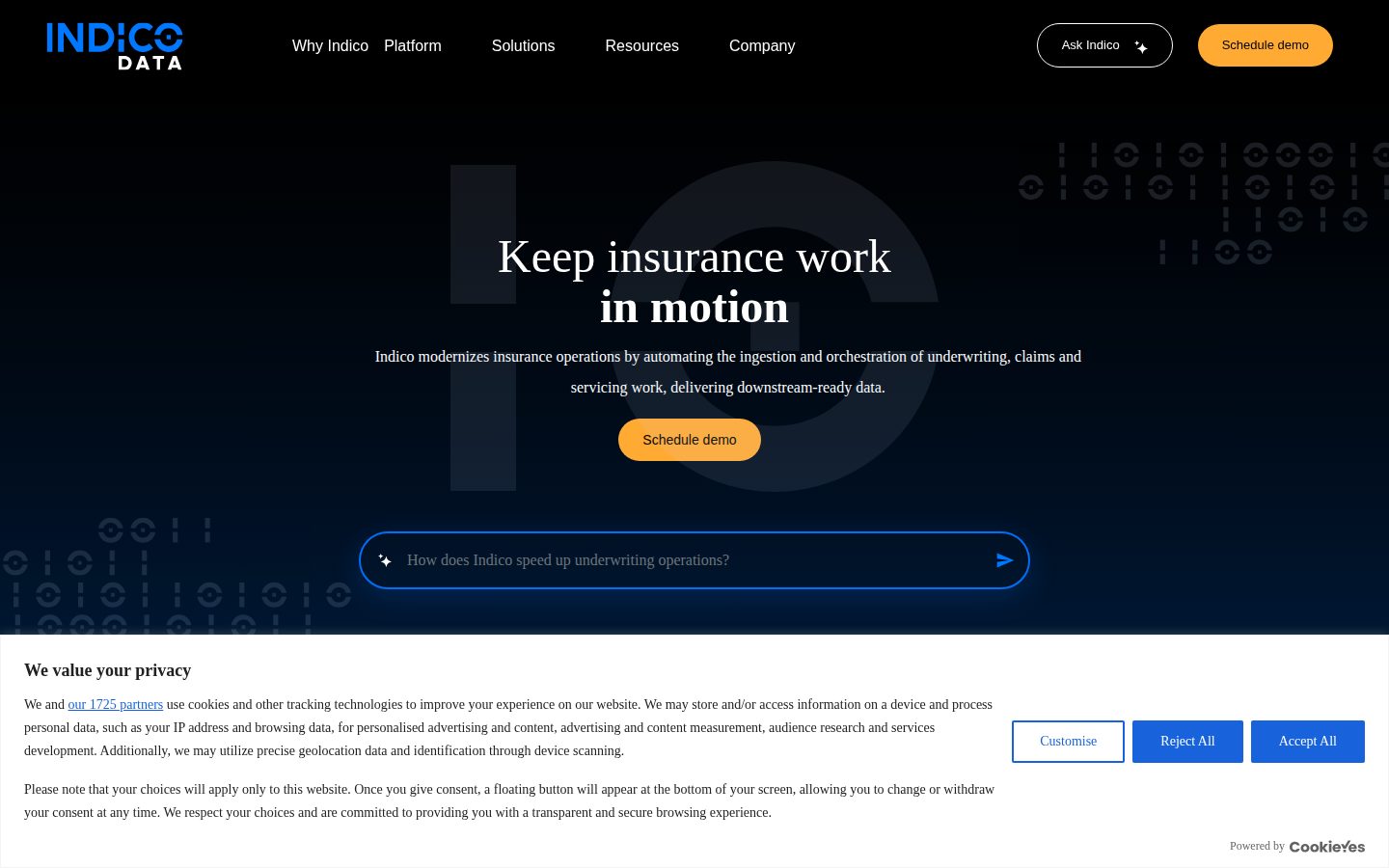
Indico Data is an intake and orchestration platform for insurance underwriting and claims operations.

AI Panel Score

7.0/10

6 AI reviews

Reviewed

AI Editor Approved

About Indico Data

Indico Data works by ingesting insurance documents from multiple sources, including email, PDFs, spreadsheets, and attachments, then extracting and classifying data from complex, multi-document submissions. The platform routes and prioritizes submissions through triage workflows, and supports claims intake including first notice of loss (FNOL) processing. Human reviewers remain in the loop to check extracted data before it moves downstream, and every step is traceable from source document to final output.

The platform is built specifically around insurance document types and workflows rather than as a general-purpose document processing tool. It does not require pre-built templates to handle varied and complex submission packages, which the company positions as a differentiator against more generic OCR or IDP tools. Indico combines document ingestion, data extraction, and workflow orchestration in a single platform, with full audit trails and data lineage tracking supporting compliance and review requirements in regulated insurance environments.

Indico Data is built for commercial insurance carriers, specialty and London market insurers, and reinsurance organizations, targeting underwriting and claims teams specifically. Pricing is not published and is handled through direct contact with the company. The product competes in the intelligent document processing and insurance workflow automation category alongside vendors such as Hyperscience, Instabase, and other insurance-focused IDP and claims automation platforms.

The platform is delivered as a web-based system, with orchestration components designed to integrate into existing underwriting and claims systems used by carriers.

Features

AI

  • Data Extraction and Classification

    Extracts and classifies data from complex, multi-document submissions without relying on predefined templates.

  • Structured, Review-Ready Data Output

    Converts unstructured insurance documents into structured data that is ready for downstream review and decisioning.

Automation

  • Claims Intake (FNOL) Automation

    Automates first notice of loss and claims intake processes to accelerate claims handling.

  • Submission Triage and Routing

    Triages, prioritizes, and routes incoming underwriting submissions to the appropriate teams or workflows.

  • Workflow Orchestration

    Orchestrates document-driven workflows across underwriting and claims operations to coordinate multi-step processes.

Collaboration

  • Human-in-the-Loop Review

    Combines automated processing with human review checkpoints to ensure accuracy and oversight.

Core

  • Claims Document Processing and Correspondence Handling

    Processes claims-related documents and correspondence as part of claims operations workflows.

  • Document Ingestion

    Ingests documents across email, PDFs, spreadsheets, and attachments as part of submission and claims intake.

  • Multi-Document Submission Handling

    Processes complex submissions composed of multiple documents and formats without requiring templates.

Security

  • Full Auditability and Traceability

    Tracks data lineage from source document to structured output to provide full auditability of processed data.

Preview

Indico Data desktop previewIndico Data mobile preview

Pricing Plans

Contact Sales

Contact sales

Indico Data does not publish list pricing; the platform is sold via custom enterprise contracts for insurance, financial services, and other document-intensive industries, and pricing requires contacting the vendor directly for a quote.

  • AI-driven document intake and orchestration for underwriting, claims, and servicing workflows
  • Intelligent document processing with OCR, machine learning, and generative AI for unstructured data extraction
  • Enterprise-scale deployment tailored to regulated, high-volume document environments
  • Custom AI workflow development and integration with existing ERP/CRM/tech stacks

AI Panel Reviews

The Decision Maker

The Decision Maker

Strategic bet, vendor viability, timing, adoption approval
7.3/10

Deep insurance-specific IDP, but you're buying blind on price and vendor scale.

Indico solves a real problem for carriers: messy multi-document submissions with no templates. No pricing page, no public funding data, no headcount — that's the risk you're underwriting alongside the claims data.

No templates required. Loss runs, SOVs, ACORD forms, email threads — that's the actual mess underwriting teams deal with, and generic OCR tools choke on it. Indico built specifically for that, not as a side use case.

Two questions I can't answer from what's here. One: who else is running this in production, and for how long? Two: contact-sales-only pricing with no free trial means you're negotiating from zero leverage on your first deal.

Competes against Hyperscience and Instabase, both better capitalized and broader in scope. Indico's bet is depth over breadth — insurance-native beats generic IDP for this workflow. If your claims and underwriting teams are drowning in unstructured submissions, that's a real advance, not just cost savings.

Pilot one line of business. Don't sign an enterprise-wide contract until you've seen their audit trail hold up in a real regulatory review.

Competitive Positioning7.5

Narrower and deeper than Hyperscience or Instabase for insurance workflows specifically, which is a real differentiator if it holds up.

Reputation Risk7.0

Insurance-native positioning reads as smart to carrier peers, but unproven public track record leaves some exposure.

Speed to Value7.0

FNOL automation and triage routing suggest fast operational wins, but no trial means no way to validate before contract.

Strategic Fit8.0

Template-free extraction for ACORD forms and loss runs targets a genuine underwriting bottleneck, not just cost-cutting on existing OCR.

Vendor Viability6.0

No public funding data, no headcount disclosed, no changelog — time-in-market unclear from evidence provided.

Pros

  • Handles multi-document submissions without pre-built templates
  • Built specifically for insurance document types: ACORD forms, SOVs, loss runs
  • Full data lineage and audit trail for regulated environments
  • Human-in-the-loop review embedded, not bolted afterward

Cons

  • No published pricing, no free trial, no way to test before committing
  • No public funding or team size data to assess vendor durability
  • Narrower market than generalist competitors like Hyperscience

Right for

Commercial carriers and specialty insurers drowning in unstructured, multi-format submission packages.

Avoid if

Skip if you need proof of vendor stability or a trial before signing an enterprise contract.

The Domain Strategist

The Domain Strategist

Craft and strategy in the product's domain — adapts identity per category, same lens
7.8/10

A vertical bet on insurance ops that trades general-purpose flexibility for deep operational fit.

Indico is narrow by design — built for underwriting and claims, not document processing in general. That narrowness is the pitch, and for the right carrier it's the right operating model.

No templates required, ingestion across email, PDFs, spreadsheets, and ACORD forms, plus FNOL automation baked in. That's not a feature list — it's an operating model for a submission desk. If I'm running underwriting ops at a specialty carrier, this maps to how the work actually flows: messy multi-document packages, triage under time pressure, human sign-off before anything moves downstream.

The tradeoff is real: this isn't a horizontal IDP tool I can redeploy against claims, HR onboarding, and vendor invoices in the same license. It's Hyperscience-and-Instabase territory, but insurance-only. If the insurance book grows, that's fine. If our document problem sprawls beyond underwriting and claims, we're running two platforms.

No published pricing, no free trial — this is a multi-year enterprise contract, evaluated like a core system, not a SaaS add-on. Audit trail and data lineage matter for regulators; that's table stakes here, not differentiation. Three years in, this becomes infrastructure, not a tool — plan the vendor relationship accordingly.

Category Positioning7.8

Sits alongside Hyperscience and Instabase as insurance-specific IDP, competing on domain depth rather than platform breadth.

Domain Fit8.5

FNOL automation, submission triage, and human-in-the-loop review mirror actual carrier workflows rather than generic document use cases.

Integration Surface7.5

Built to route into existing downstream systems, but lack of a public API listing leaves integration depth unverified.

Long-term Implications7.5

Enterprise contract with no published pricing means a multi-year commitment; insurance-only scope limits reuse beyond underwriting and claims.

Strategic Depth8.0

Template-free extraction across ACORD forms and loss runs shows real domain-specific ML investment, not generic OCR wrapped in a UI.

Pros

  • Handles complex multi-document submissions without pre-built templates
  • Human-in-the-loop review embedded directly into workflow, not bolted on after
  • Full data lineage and audit trail suited to regulated insurance environments

Cons

  • No published pricing forces a lengthy sales-cycle evaluation before ROI is clear
  • Insurance-only scope means no reuse of the platform outside underwriting and claims
  • No free trial, so proof-of-concept requires a direct vendor engagement

Right for

Commercial or specialty carriers whose underwriting and claims teams are drowning in unstructured, multi-document submissions.

Avoid if

Avoid if your document automation needs span multiple business lines beyond insurance underwriting and claims.

The Finance Lead

The Finance Lead

Money, total cost of ownership, contracts, procurement math
5.8/10

Zero published pricing. Zero trial. Full sales-cycle tax before you see a number.

No list price, no free plan, no trial. Every dollar figure comes from a sales call, which means your first real data point is the invoice.

No pricing page. Contact-sales only, like Hyperscience and Instabase in this category. That's category norm for enterprise IDP, but it means procurement starts blind.

TCO math is a guess here. Enterprise contracts in this space typically run six figures annually once you add implementation, ERP/CRM integration work, and custom workflow development — all called out explicitly in their one published tier. No stated per-document or per-seat rate. No overage terms visible. Year 3 cost depends entirely on volume growth and how many lines of business you bolt on.

ROI story leans on FNOL automation and template-free extraction — real capabilities, hard to benchmark without a pilot. No free trial means no cheap way to test claims before signing. Audit trail and data lineage help justify spend to compliance, less so to finance.

Billing & Procurement5.0

Enterprise sales-cycle onboarding; no self-serve path, no stated payment terms.

Contract Flexibility4.0

No term length or renewal terms published; enterprise custom contracts imply limited standard flexibility.

Pricing Transparency2.5

No pricing page, no published tiers, contact-sales only.

ROI Clarity5.5

FNOL and triage automation are measurable in theory, but no benchmarks or case metrics provided.

Total Cost of Ownership4.5

Custom AI workflow development and integration costs are explicitly bundled but unquantified.

Pros

  • Template-free extraction handles messy multi-document submissions
  • Built specifically for ACORD forms, loss runs, SOVs
  • Full data lineage supports insurance compliance audits

Cons

  • Zero published pricing anywhere
  • No free trial to validate claims pre-contract
  • No stated overage or per-volume rate

Right for

Commercial or specialty carriers with enterprise procurement teams and six-figure automation budgets.

Avoid if

You need a quotable number before your first meeting.

The Domain Practitioner

The Domain Practitioner

Daily hands-on reality in the product's domain — adapts identity per category, same lens
7.4/10

Solves the loss-run and ACORD chaos, but you're queuing for a demo before you learn anything

Indico is built for the actual mess of underwriting inboxes, not a generic OCR demo. The tradeoff is that you can't touch it, price it, or read a real API doc before sales gets involved.

No templates required is the pitch that matters here. Anyone who's fought a rigid IDP tool over a loss run that doesn't match the expected layout knows why that's the daily fight worth solving. FNOL automation and submission triage map to real desk work, not abstract 'document processing' — that's a good sign someone actually mapped an underwriter's week.

But there's no docs page, no changelog, no API surface listed, and pricing is 'contact sales' only. For a knowledge worker trying to evaluate whether this fits alongside existing systems, that's a wall before you even get to day three. Human-in-the-loop review is embedded, which matters for exception handling, but I can't tell from public material how configurable those checkpoints are for a power user.

Competes with Hyperscience and Instabase, both of which have clearer public trails. Indico's insurance-specific depth (ACORD forms, SOVs) is real differentiation, but you're taking that on faith until the demo.

Day-3 Reality7.2

Insurance-specific document types (ACORD, SOVs, loss runs) suggest real workflow fit, but no trial means day-3 friction is untested publicly.

Documentation Practitioner-Fit6.5

Docs exist per capabilities table but no changelog or API reference visible, reading more marketing than practitioner reference.

Friction Surface6.8

No pricing page, no free trial, and no API listed means friction starts before onboarding even begins.

Power-User Depth7.0

Human-in-the-loop review and audit lineage suggest depth, but advanced configuration options aren't discoverable pre-sale.

Workflow Integration7.8

Triage, routing, and FNOL intake map directly onto underwriting and claims desk work rather than generic document upload.

Pros

  • Template-free extraction built specifically for messy multi-document insurance submissions
  • FNOL and claims intake automation maps to real desk workflows, not generic use cases
  • Full audit trail and data lineage supports regulated carrier compliance needs

Cons

  • No published pricing or free trial forces a sales call before any hands-on evaluation
  • No visible API docs or changelog for practitioners vetting integration depth
  • Enterprise-only positioning means smaller MGAs or TPAs may not fit the target buyer

Right for

Underwriting and claims teams at commercial or specialty carriers drowning in unstructured loss runs and ACORD submissions.

Avoid if

Avoid if you need to test-drive extraction accuracy on your own documents before committing to a sales cycle.

The Power User

The Power User

Daily human experience, onboarding, polish, learning curve, reliability
6.9/10

Solid bones for insurance ops, but you'll never see the inside until legal signs off.

Indico bets everything on messy, template-free insurance documents and human review. Fair bet, but there's zero public evidence of what using it actually feels like day to day.

No pricing page, no free trial, no demo you can just click into. That's category norm for enterprise insurance software, but it means my usual gut-check — open it, poke around for ten minutes — isn't possible here. Everything I've got is a marketing site and an FAQ.

What's real: it ingests loss runs, SOVs, ACORD forms, email attachments, no templates required, which is the actual hard problem in this space. Human-in-the-loop review is built into the workflow instead of tacked on as an afterthought, and there's audit trail and data lineage tracking, which regulated shops need. Competes with Hyperscience and Instabase, both of which have similar template-free pitches, so Indico's edge is being insurance-only rather than general-purpose.

The tradeoff: you're trusting a vendor's own FAQ for reliability and security claims because there's no changelog, no public API docs, no user reviews to check it against. Three months in could be great. Could also be a integration slog. No way to know from here.

Daily Polish5.5

No screenshots, no demo, no changelog — nothing to judge the actual UI feel against.

Learning Curve6.5

Template-free extraction cuts setup pain, but workflow orchestration across underwriting and claims implies real ramp-up time.

Mobile Parity3.0

Web-only platform, no mobile mentioned anywhere, and insurance back-office work rarely needs it anyway.

Onboarding Experience5.0

Contact-sales-only with no free trial means onboarding is a sales cycle before it's a product experience.

Reliability Feel7.0

Confidence scoring, data lineage, and audit trails suggest solid engineering, per their own claims.

Pros

  • Handles template-free, multi-document submissions like loss runs and ACORD forms
  • Human-in-the-loop review baked into the workflow, not bolted on after
  • Full audit trail and data lineage for compliance-heavy insurance environments

Cons

  • No published pricing, no free trial, no way to self-evaluate before a sales call
  • Zero public evidence of onboarding time or day-to-day UI feel
  • Web-only, no mobile story at all

Right for

Commercial carriers and specialty insurers drowning in messy multi-document submissions who need underwriting and claims triage in one platform.

Avoid if

You want to try before you buy or need anything approaching a self-serve trial.

The Skeptic

The Skeptic

Contrarian. Watch-outs, deal-breakers, broken promises, category patterns
6.9/10

Insurance IDP, no pricing, no changelog. Familiar shape.

Narrow vertical focus is the real differentiator here, not the AI. But there's nothing public to check the shipping-cadence claim against.

Three tells before the demo request. One: no pricing page — 'contact sales' only. Two: no changelog listed, so no way to gauge shipping cadence. Three: meta description leans on 'Agentic Decisioning Platform,' the kind of label every IDP vendor slaps on post-2023.

The vertical specificity is real, though. ACORD forms, SOVs, loss runs, FNOL — that's not generic OCR marketing, that's someone who's read an actual submission packet. Hyperscience and Instabase both play here too, and Indico's pitch is narrower: insurance-only, not general document AI stretched thin.

Exit portability is the open question. Workflow orchestration plus human-in-the-loop review means your review logic lives inside their system — pull out in 18 months and you're rebuilding triage rules from scratch. No API listed publicly either. Fair pricing model for enterprise insurance. Thin public proof it survives three years.

Competitive Differentiation7.5

Insurance-only focus vs. generic IDP tools and Instabase is a real, named-market wedge.

Exit Portability5.5

Orchestration plus workflow logic embedded means migration likely means rebuilding triage rules elsewhere.

Long-term Viability6.5

No changelog, no public funding figures, no team page in evidence — can't verify shipping cadence.

Marketing Honesty6.5

'Agentic Decisioning Platform' is aspirational; the FNOL/ACORD specifics in buyer Q&A are grounded.

Track Record Match7.0

Vertical-specific IDP has surviving precedent (Hyperscience); no visible customer logos here to confirm traction.

Pros

  • Deep insurance-specific document coverage: loss runs, SOVs, ACORD forms
  • No-template extraction claim is a genuine differentiator vs. legacy OCR
  • Human-in-the-loop and audit trail features fit regulated-industry buyers

Cons

  • No public pricing, funding, or changelog to verify momentum
  • No API listed — integration story is asserted, not demonstrated
  • Workflow lock-in risk if orchestration logic isn't portable

Right for

Commercial or specialty insurance carriers with high-volume, messy submission intake and a compliance mandate for audit trails.

Avoid if

You want transparent pricing or public proof of shipping velocity before committing to an enterprise contract.

Buyer Questions

Common questions answered by our AI research team

Features

Does Indico require templates for document extraction?

No. Indico handles complex, multi-document submissions without relying on templates, extracting data from messy, inconsistent documents that break generic OCR, IDP, and template-based tools.

Features

What document types can Indico ingest?

Indico ingests emails, PDFs, spreadsheets, and attachments, including insurance-specific documents like loss runs, SOVs (statements of values), and ACORD forms across underwriting, claims, and servicing work.

Features

Does Indico support human-in-the-loop review?

Yes. Human review, validation, and exception handling are embedded directly into Indico's workflows, combining automation with human-in-the-loop review so processes scale without sacrificing control.

Security

Is Indico secure enough for enterprise insurance data?

Yes. Indico operates inside enterprise insurance environments, meeting strict security, compliance, and governance requirements, with built-in data lineage, confidence scoring, and explainability for auditable outputs.

Integration

Can Indico integrate with existing insurance systems?

Yes. Indico integrates with existing systems and scales reliably across volumes, use cases, regions, and lines of business, routing validated work to the right downstream systems and teams.

Also in AI Document Processing