ABBYY Vantage logo

ABBYY Vantage Review

Visit

Intelligent document processing powered by AI and machine learning

ABBYY Vantage is a cloud-based intelligent document processing platform for automating data extraction from business documents.

AI Panel Score

7.8/10

6 AI reviews

Reviewed

Facts checked against abbyy.com

AI Editor Approved

What is ABBYY Vantage?

ABBYY Vantage is a cloud-based intelligent document processing platform that automates data extraction from business documents such as invoices, contracts, and forms. The low-code platform lets organizations train AI models to read and understand documents, then plugs into existing RPA, BPM, and ERP systems as a processing layer to accelerate straight-through processing. Pricing is quote-based, with a free trial but no free plan. Capabilities include pre-trained document skills covering invoices, purchase orders, tax forms, and identity documents, 90-percent-plus out-of-the-box recognition accuracy, multi-language and multi-format support, and a Vantage 3.0 prompt-based activity that wires Azure OpenAI into document skills for unstructured content. TopReviewed's six-seat AI review panel scored it 7.8/10, praising the pre-trained skills that shortcut long enterprise training cycles while noting the public pricing page returns a 404 and every tier requires a sales conversation. It best fits mid-to-large enterprises processing invoices and forms at high volume.

About ABBYY Vantage

ABBYY Vantage is an intelligent document processing (IDP) platform developed by ABBYY, a company specializing in AI-based document and language processing technology. The platform allows businesses to automate the extraction of information from a wide variety of document types, including structured forms, semi-structured documents like invoices and purchase orders, and unstructured content such as contracts and correspondence.

At its core, Vantage uses pre-trained AI document skills that can be deployed quickly without extensive configuration. Users can also train custom skills using their own document samples, allowing the platform to adapt to organization-specific formats. The low-code design means that business analysts and automation developers can configure and deploy document processing workflows without deep machine learning expertise.

Vantage is built to integrate with enterprise automation ecosystems. It offers connectors and APIs compatible with major robotic process automation (RPA) platforms, business process management (BPM) tools, and content management systems. This positions it as a processing layer within broader automation pipelines rather than a standalone workflow tool.

The platform targets mid-to-large enterprises in industries such as financial services, insurance, healthcare, logistics, and manufacturing, where high volumes of documents need to be processed accurately and at scale. Common use cases include accounts payable automation, loan origination, claims processing, and onboarding document handling.

In the intelligent document processing market, ABBYY names Kofax and Hyperscience among the competitors it is regularly positioned against in Gartner, IDC, and Everest Group assessments. ABBYY's long history in OCR and document recognition technology underpins the accuracy capabilities of the platform.
Features

AI

  • 90%+ Out-of-the-Box Recognition Accuracy

    Delivers over 90% recognition accuracy right out of the box for every type of document, from invoices to identity documents.

  • Agentic Automation Support

    Powers scalable, secure, and compliant agentic automation through the combination of Document AI and generative AI in Vantage 3.0.

  • Purpose-Built Document AI with Generative AI

    Vantage 3.0 combines purpose-built Document AI with generative AI to power scalable, secure, and compliant agentic automation.

Automation

  • Accounts Payable Automation

    Expedites invoice processing with better visibility and control, handling invoices of any language, format, or structure.

  • Enterprise Process Automation

    Automates document-heavy business processes to find improvement opportunities and enhance customer experience across the enterprise.

  • Straight-Through Processing

    Automates document-heavy workflows to achieve touchless processing, as demonstrated by 92% touchless order processing for Carlsberg.

Core

  • Low-Code AI Document Processing

    A pre-trained low-code platform that reads and extracts data from documents in seconds without requiring extensive coding.

  • Multi-Language and Multi-Format Support

    Processes documents in any language, format, or structure, including invoices and identity documents.

  • Pre-Trained Document Models

    Comes with pre-trained AI models that extract actionable data from any document regardless of format or language without manual configuration.

Mobile

  • Customer Onboarding Automation

    Enables customers to submit personal data by taking a photo of their documents to simplify mobile registration and reduce customer churn.

Preview

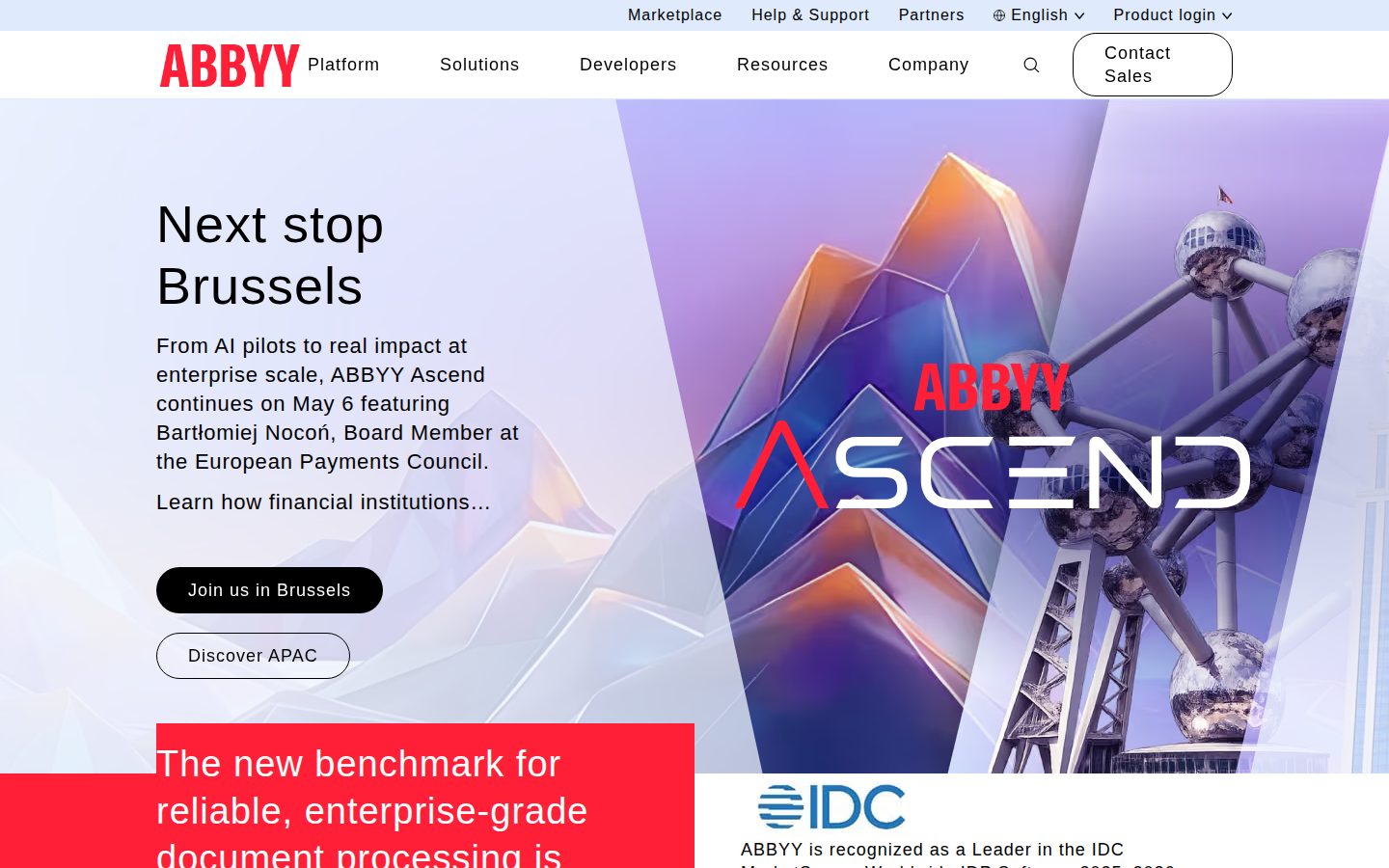
ABBYY Vantage desktop previewABBYY Vantage mobile preview

Pricing Plans

Contact Sales

Contact sales

ABBYY publishes no list price for Vantage. Subscriptions are sold by written quote for a set volume of documents, pages or transactions, default to a 12-month term, and renew automatically unless notice is given 45 days before the term ends.

  • Quote-based pricing on processing volume
  • 12-month default subscription term
  • Free evaluation trial via the ABBYY Marketplace

AI Panel Reviews

The Decision Maker

The Decision Maker

Strategic bet, vendor viability, timing, adoption approval
8.1/10

Thirty-seven years in business, three decades in OCR, now selling agentic IDP against UiPath's land grab.

“ABBYY Vantage is a low-code intelligent document processing platform from a 1989-era OCR specialist now backed by Marlin Equity. Vantage 3.0, shipped January 2026, layers generative AI on top of purpose-built Document AI to chase the agentic-automation budget line.”

Thirty-seven years in business is the unfashionable answer to the vendor-viability question. ABBYY was founded in 1989, shipped its first OCR (FineReader) in 1993, relocated HQ from Milpitas to Austin in October 2024, and took growth equity from Marlin Equity in May 2021. Durable, not flashy.

Vantage 3.0 launched January 2026 and layers generative AI on top of purpose-built Document AI that posts 90%+ out-of-the-box accuracy on invoices and IDs. Carlsberg reportedly hit 92% touchless order processing. The honest competitive set is UiPath Document Understanding and Hyperscience, both louder in the agentic-IDP pitch.

However, pricing sits behind a sales call and ABBYY publishes no price list — enterprise-only motion, long procurement cycles. Hyperscience will undercut on time-to-value for a single use case. Run a 90-day accounts-payable pilot, then make the standardize call.

Competitive Positioning7.8

Credible peer-set default alongside UiPath Document Understanding and Hyperscience, slower on the agentic-IDP narrative.

Reputation Risk8.2

Established brand with Carlsberg and large-enterprise references — board-defensible without explanation.

Speed to Value7.5

Pre-trained skills and 90%+ OOTB accuracy accelerate AP and onboarding, but enterprise sales cycle adds months before pilot.

Strategic Fit7.8

IDP advances document-heavy automation programs but sits as a processing layer inside larger RPA and ERP stacks.

Vendor Viability8.7

Founded 1989, Marlin Equity growth investment May 2021, 10,000+ enterprise customers — survival math is settled.

Pros

  • Three-decade OCR pedigree (FineReader since 1993) underpins the 90%+ out-of-the-box accuracy on invoices and identity documents.
  • Marlin Equity growth investment in May 2021 underwrites the three-year vendor-survival question.
  • Vantage 3.0 (January 2026) layers generative AI on top of purpose-built Document AI for agentic workflows.
  • Carlsberg case study shows 92% touchless order processing in production at enterprise scale.

Cons

  • Custom-quote pricing with no published rate card signals long enterprise procurement cycles.
  • Hyperscience and UiPath Document Understanding are louder in the agentic-IDP narrative right now.
  • Web-only platform with no published self-serve tier rules out lightweight team-led adoption.

Right for

Mid-to-large enterprises who process high volumes of invoices and forms.

Avoid if

Solo teams or SMBs who want self-serve pricing and quick procurement.

The Domain Strategist

The Domain Strategist

Craft and strategy in the product's domain — adapts identity per category, same lens
8.2/10

ABBYY Vantage is a 35-year survivor's bet on pre-trained Document Skills for the agentic IDP era.

“ABBYY's three-decade OCR heritage and Vantage 3.0's January 2026 LLM integration make it a credible IDP substrate against UiPath Document Understanding. But contact-only pricing locks procurement leverage on the Marlin Equity-backed vendor side for any three-year rollout.”

For a Head of Intelligent Automation scoring an IDP substrate through 2028, the bet ABBYY asks you to make is on pre-trained Document Skills rather than a model fine-tune workflow. ABBYY was founded in 1989, has shipped OCR since FineReader in 1993, and took a growth investment from Marlin Equity Partners in 2021 that made Marlin its largest shareholder. Few competitors in this lane can show three decades of recognition R&D.

Vantage 3.0, launched January 2026, wires LLMs directly into the deterministic extraction pipeline and adds built-in redaction for regulated workloads. The 90%+ out-of-box accuracy claim is honest given the pre-trained skill library, and the platform sits cleanly behind UiPath Document Understanding or any RPA orchestrator rather than competing with it.

But the catch is procurement gravity. Pricing is contact-sales only with no published floor, which means a three-year accounts-payable rollout binds you to negotiated renewals against a Marlin-backed vendor whose roadmap answers to PE return horizons.

Category Positioning8.0

Credible head-to-head against UiPath Document Understanding, Microsoft Azure Document Intelligence, and Hyperscience.

Domain Fit8.3

Purpose-built for AP, claims, loan origination, and onboarding where enterprises actually buy IDP.

Integration Surface8.2

Connectors and APIs for major RPA, BPM, and ERP platforms position it as a processing layer behind existing orchestration.

Long-term Implications7.6

PE ownership since 2021 plus contact-only pricing creates renewal-cycle exposure over 3 years.

Strategic Depth8.2

35 years of OCR R&D plus Document AI fused with generative AI in Vantage 3.0.

Pros

  • Pre-trained Document Skills deliver 90%+ out-of-box recognition accuracy across formats and languages.
  • Vantage 3.0 wires LLMs into the deterministic extraction pipeline for agentic automation workloads.
  • Built-in redaction and compliance controls suit regulated workloads in financial services, insurance, and healthcare.
  • Sits cleanly behind UiPath, Microsoft, or ERP automation layers rather than competing with them.

Cons

  • Contact-sales-only pricing with no published floor obscures total cost of ownership before pilot.
  • Marlin Equity ownership since 2021 raises PE renewal-cycle questions over a 3-year horizon.
  • Custom skill training still requires document samples and tuning effort despite the low-code framing.

Right for

Mid-to-large enterprises who automate document-heavy back-office workflows.

Avoid if

Teams who need transparent published pricing before piloting.

The Finance Lead

The Finance Lead

Money, total cost of ownership, contracts, procurement math
7.0/10

Miss a 45-day notice window and Vantage renews for 12 months at up to 7% more.

“ABBYY publishes no Vantage list price, but its public cloud terms let you model the contract before the first quote. Budget for per-period overage, re-pricing if volume drops, and a separately licensed Phoenix Plus.”

Put a reminder on day 320. ABBYY's cloud terms renew Vantage for another 12 months unless you send written notice 45 days before term end. Email counts. Miss it and that's another non-refundable year.

ABBYY publishes no list price; the quote sets volume, price and payment terms. Fees can rise up to 7% before each renewal. Call year one Q: three years at the cap is 3.21Q. Overage bills each billing period at a quoted rate. Renew smaller and the old per-unit rate no longer applies. Phoenix Plus, the GenAI add-on, is licensed separately.

The value side is measurable. Vantage 3.0's dashboard tracks touchless rates; Carlsberg reports 92% touchless order processing. The catch is the paper, not the product. The quote overrides these terms, so cap renewals and overage there. Run Kofax quotes through the same test.

Billing & Procurement6.0

Quote-only, paid by electronic transfer, prepayment possible, late interest up to 1.5% a month; trials are form-requested.

Contract Flexibility6.5

12-month auto-renewal with 45-day email notice and non-cancellable fees, but the quote can override the 7% cap.

Pricing Transparency5.0

ABBYY publishes no list price, but its cloud terms disclose renewal, overage and payment rules up front.

ROI Clarity8.0

Carlsberg reports 92% touchless order processing and 140+ hours saved monthly; Vantage 3.0's dashboard tracks touchless rates.

Total Cost of Ownership6.5

Unit cost is quote-only; at the 7% renewal cap three years cost 3.21x year one, before overage and separately priced Phoenix Plus.

Pros

  • Cloud terms are public, so the 45-day notice, 7% renewal cap and overage rule can be modeled before any quote.
  • Pre-trained skills reach 90% accuracy at the start, per ABBYY's Vantage page.
  • Counterparty is clear: privately held ABBYY, with Marlin Equity Partners its largest shareholder since 2021.
  • Pre-trained skills can be tested in a form-requested ABBYY Marketplace trial before a quote is signed.

Cons

  • No list price for any volume; every figure lives in a written quote.
  • Overage is billed at the end of each billing period, at a rate only your quote sets.
  • A renewal at lower volume is re-priced without regard to the old per-unit rate, and fees are non-refundable.

Right for

Finance teams who can commit to a steady annual document volume.

Avoid if

Teams who expect document volume to shrink at renewal.

The Domain Practitioner

The Domain Practitioner

Daily hands-on reality in the product's domain — adapts identity per category, same lens
7.9/10

ABBYY Vantage's pre-trained skills shortcut IDP setup, but custom skill training still wants a labeling budget.

“Pre-trained Document AI skills for invoices, purchase orders, and identity docs cover the common AP and onboarding cases without a labeling project. The catch is anything outside the catalog still needs annotated samples and an iteration loop.”

IDP platforms live or die in the long tail. Vantage ships pre-trained skills for invoices, purchase orders, tax forms, and identity docs — straight-through for the AP queues that look the same everywhere. ABBYY cites 90%+ recognition out of the box; Carlsberg ran 92% touchless order processing on the platform.

Vantage 3.0 landed January 2026 with a prompt-based activity calling Azure OpenAI inside a Document skill, useful for the unstructured tail (contract clauses, correspondence) where regex extraction gives up. UiPath Document Understanding offers a similar generative path; Hyperscience leans on its own stack, Essentials at $50K on AWS Marketplace.

Friction is anything off-catalog. Custom skills still want labeled samples and a training loop — not a weekend job, however the low-code Skill Designer keeps it out of pure ML hands. Pricing routes through sales (ABBYY publishes no price list), the daily friction for budget owners scoping a pilot.

Day-3 Reality7.8

Pre-trained skills handle the catalog cleanly; off-catalog formats add a training loop.

Documentation Practitioner-Fit7.8

docs.abbyy.com publishes versioned release notes for 3.0 with skill-level guidance.

Friction Surface7.4

Custom skill iteration and opaque pricing are the recurring daily fights.

Power-User Depth8.0

Custom skills, prompt-based activity, and Skill Designer scale from analyst to ML-adjacent.

Workflow Integration8.2

Connectors and APIs slot into UiPath, Power Automate, and BPM tools as a processing layer.

Pros

  • Pre-trained skills cover invoices, purchase orders, tax forms, and identity docs out of the box.
  • Vantage 3.0 prompt-based activity wires Azure OpenAI into Document skills for the unstructured tail.
  • Connectors and APIs slot cleanly into UiPath, Power Automate, and existing BPM stacks.
  • 90%+ out-of-the-box recognition accuracy with case evidence like Carlsberg's 92% touchless processing.

Cons

  • No published pricing — every conversation routes through sales.
  • Custom skills still need labeled samples and an iteration loop, not a weekend job.
  • Mid-to-large enterprise focus makes a small SMB pilot awkward.

Right for

Enterprises automating high-volume invoice and onboarding document workflows.

Avoid if

Teams needing transparent self-serve pricing for a small pilot.

The Power User

The Power User

Daily human experience, onboarding, polish, learning curve, reliability
7.6/10

ABBYY Vantage brings 1989-era OCR pedigree to modern IDP, but every pricing tier hides behind a sales call

“Pre-trained Document Skills and 90%+ out-of-the-box accuracy, now with Azure OpenAI wired in via Vantage 3.0. The catch is there's no published pricing and every quote sits behind a sales conversation.”

Document AI tools mostly fall into two camps: cheap OCR wrappers and consultant-priced enterprise platforms. ABBYY Vantage sits firmly in camp two, and it earned that spot — the company has been recognizing characters in low-quality scans since FineReader shipped in 1993, and that pedigree shows up in the 90%+ out-of-the-box accuracy on invoices and IDs.

Vantage 3.0 shipped January 2026 with direct Azure OpenAI hookups for prompt-based extraction. Purpose-built Document AI for the structured stuff, generative AI for the messy paragraphs — that's the right call. Pre-Trained Document Skills cut the cold-start problem that makes Hyperscience and UiPath Document Understanding feel like six-month projects.

But ABBYY publishes no pricing and every quote is contact-sales — you cannot kick the tires on a Tuesday afternoon. Mobile is a customer photo-capture flow, not an operator console. Carlsberg hit 92% touchless order processing on it. That kind of number gets procurement on a call.

Daily Polish7.5

Enterprise-grade UI that competently surfaces the Document Skills library but feels engineered for procurement, not delight.

Learning Curve7.4

Low-code Document Skills shorten the ramp, but real custom-skill training still wants automation-developer skills.

Mobile Parity7.5

Mobile is intentionally a customer photo-capture surface for onboarding, not an operator console — fair for enterprise IDP.

Onboarding Experience6.8

Has a free trial but every pricing tier is a sales call, so the first ten minutes is a contact form, not a workspace.

Reliability Feel8.2

Thirty-five years of OCR R&D and a 90%+ accuracy claim backed by named deployments like Carlsberg at 92% touchless.

Pros

  • 90%+ recognition accuracy out of the box on invoices, IDs, and semi-structured forms.
  • Vantage 3.0 wires Azure OpenAI for prompt-based extraction without custom ML code.
  • Pre-Trained Document Skills shortcut the long training cycles typical of enterprise IDP rollouts.
  • Plugs into RPA, BPM, and ERP stacks as a processing layer rather than a closed workflow tool.

Cons

  • No published pricing — every quote is a sales conversation.
  • No free plan — only a trial — so solo evaluation is hard.
  • Mobile is customer photo capture only, not an operator workspace.

Right for

Mid-to-large enterprises who process invoices and contracts at high volume.

Avoid if

Solo operators who want to sandbox a tool before talking to sales.

The Skeptic

The Skeptic

Contrarian. Watch-outs, deal-breakers, broken promises, category patterns
7.8/10

1989 founder, Gartner Leader, opaque pricing — durable on fundamentals, frustrating on procurement.

“ABBYY has been in business since 1989, shipping OCR since 1993, and lands in the Gartner Magic Quadrant Leader bucket for IDP, which earns the benefit of the doubt. The catch is contact-only pricing on a contact-only contract — buyers can't pre-validate ROI before sales gets involved.”

There's no published pricing. That's the first thing I noticed. Everything routes through 'contact us' — category norm for enterprise IDP, but it still buries ROI math before sales gets involved.

But the receipts are real. ABBYY shipped FineReader in 1993 from Moscow, moved headquarters to Austin in 2024, and lands in the Gartner Magic Quadrant Leader band for IDP. Vantage 3.0 fuses Document AI with generative AI; Pre-Trained Document Models claim 90%+ out-of-the-box accuracy. Carlsberg gets cited at 92% touchless order processing.

Against UiPath Document Understanding and Hyperscience, that accuracy bar is competitive — not a leap. ABBYY's cloud terms bill any volume above the quoted subscription as overage and let fees rise up to 7% at each renewal. Exit is decent: extracted JSON travels, and Vantage sits as a layer in your RPA stack, not the workflow owner itself.

Competitive Differentiation7.0

Competitive on accuracy versus Hyperscience and UiPath Document Understanding, but not a meaningful leap.

Exit Portability7.5

Sits as a processing layer beside RPA/BPM tools, and extracted JSON travels cleanly out.

Long-term Viability8.5

35-plus year privately held company headquartered in Austin, with 10,000+ enterprise customers.

Marketing Honesty7.3

Accuracy claims are specific and customer-cited, but publishing no pricing at all keeps buyers guessing.

Track Record Match8.5

FineReader shipped 1993, Gartner Magic Quadrant Leader for IDP in 2025 and 2026, reported 60% growth in new Vantage ARR in 2023.

Pros

  • Founded 1989 with continuous OCR shipping — rare survival pattern in the IDP category.
  • Gartner Magic Quadrant Leader for IDP in 2025 and 2026 — independent third-party validation.
  • Pre-Trained Document Models hit a 90%+ out-of-the-box accuracy claim with named customer proof.
  • Sits as a layer inside RPA and BPM stacks rather than locking the workflow itself.

Cons

  • No published pricing, forcing every evaluation through sales conversations.
  • Accuracy claims look competitive but not differentiated against Hyperscience on long-form documents.
  • Enterprise-only positioning leaves no self-serve path for smaller teams to pilot.

Right for

Mid-to-large enterprises who need analyst-validated document automation at high volumes.

Avoid if

Small teams who need transparent self-serve pricing to evaluate quickly.

Buyer Questions

Common questions answered by our AI research team

Features

How accurate is ABBYY Vantage out of the box?

ABBYY Vantage's pre-trained skills reach 90% accuracy from the start on structured, semi-structured and unstructured documents. Accuracy keeps improving as skills learn from new document variations and human-in-the-loop review.

Integration

Which RPA platforms does ABBYY Vantage integrate with?

Vantage has out-of-the-box integrations with UiPath, Microsoft Power Automate, Blue Prism and Automation Anywhere, which make its skills auto-discoverable from RPA, BPM and chatbots. Other applications connect through the Vantage REST API.

Setup

Can ABBYY Vantage be deployed on premises?

Yes. Vantage is cloud-first, hosted in SOC2-certified ABBYY Cloud instances in Europe, the USA or Australia, and it can also run on premises or in your private cloud on Microsoft Azure using Docker and Kubernetes.

Pricing

How much does ABBYY Vantage cost?

ABBYY publishes no list price for Vantage. Subscriptions are sold by quote for a set volume of pages, documents or transactions, default to a 12-month term, and renew automatically unless either side gives notice 45 days before the end.

Pricing

Does ABBYY Vantage offer a free trial?

Yes. You request a Vantage trial through a form on the ABBYY Marketplace. The trial is for internal evaluation only, is limited in duration or processing volume, and stops working at expiry until you buy a subscription.

Alternatives to ABBYY Vantage

Who ABBYY Vantage competes with, and how each one differs

Also in AI Document Processing