AI-powered contract analysis for legal and business teams
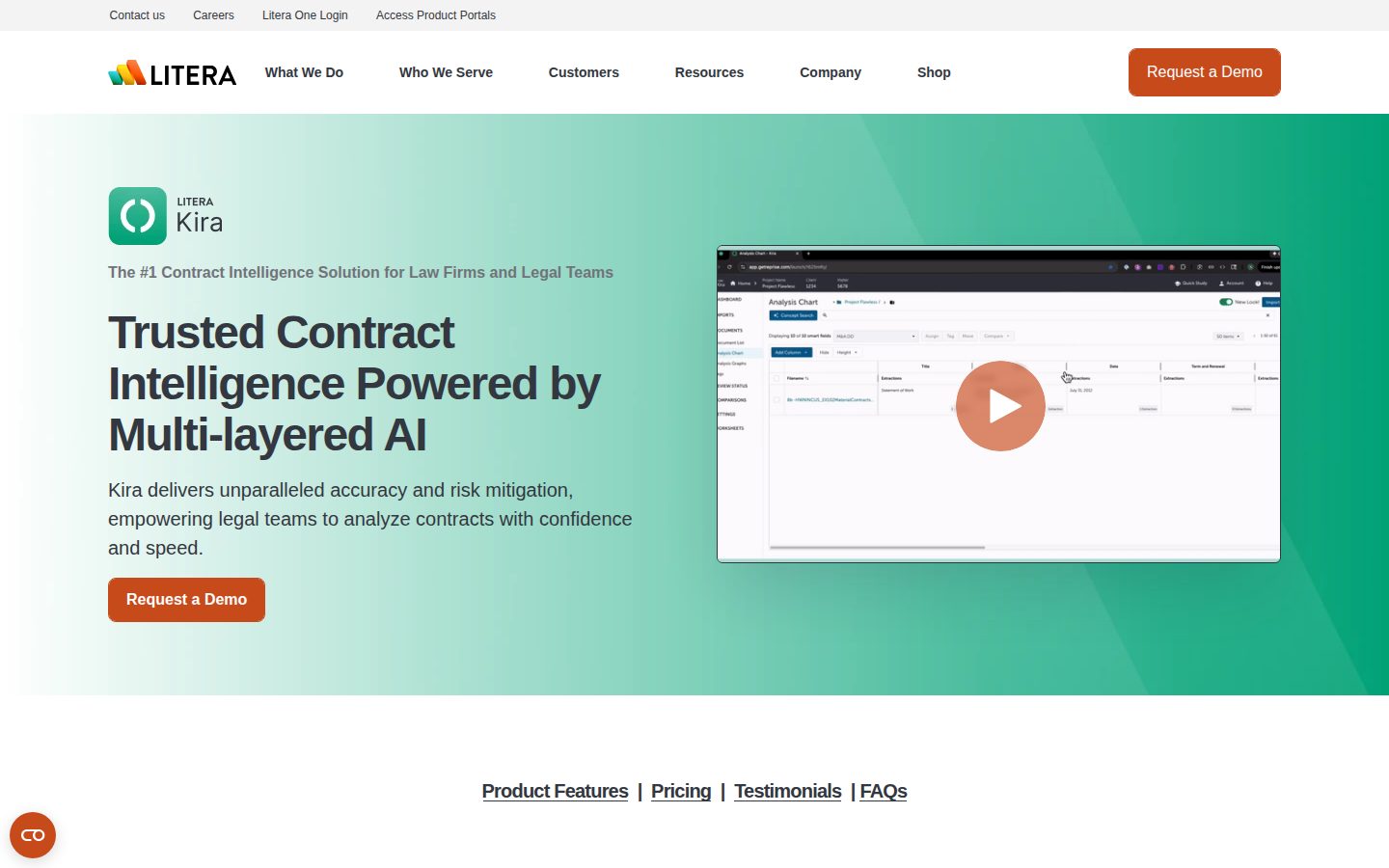
Kira Systems is an AI-powered contract analysis and due diligence software platform.
AI Panel Score
6 AI reviews
Reviewed
Kira Systems is a contract analysis platform that applies machine learning to help legal and business professionals review large volumes of contracts more efficiently. The software can automatically locate and extract specific clauses, provisions, and data points from uploaded documents, reducing the manual time required during due diligence, lease abstraction, regulatory compliance reviews, and other document-intensive processes.
The platform is designed for law firms, Big Four accounting and consulting firms, and in-house legal departments. It is commonly deployed during mergers and acquisitions, where legal teams must review hundreds or thousands of contracts under tight deadlines. Kira's trained machine learning models can recognize a wide range of standard contract provisions out of the box, and users can also build custom models to identify organization-specific or deal-specific language.
Kira includes tools for document uploading, clause highlighting, side-by-side document comparison, and exporting extracted data to spreadsheets or reports. Teams can work collaboratively within the platform, assigning documents and tracking review progress. The extracted information can be used to populate deal summaries or flag provisions that require attorney attention.
In terms of market positioning, Kira competes with other AI-driven contract review tools such as Luminance and Loio. It is considered an enterprise-grade solution and is typically sold to organizations that handle significant contract volumes. Kira Systems was acquired by Litera in 2021, integrating it into a broader suite of legal workflow and document management tools.
Provides instant, citation-linked answers from contracts via natural language prompts, and generates clause and document summaries for rapid diligence reporting.
Allows users to ask natural language questions to instantly extract answers across documents without requiring labeled training data, supporting creation in any language.
Combines GenAI and proprietary AI models trained on 45,000+ lawyer hours to deliver 90%+ accuracy in contract clause extraction with fewer hallucinations.
Supports bulk import with keep-awake, deduplication, data room integrations, and triage tools including classification, tagging, grouping, assignment, and language/jurisdiction detection.
An AI Legal Agent embedded in Outlook, Word, and the web that automates structured reviews such as NDA playbook checks, risk analysis, and agentic redlines, included at no additional charge for Kira customers.
Enables teams to review, analyze, flag, tag, assign, and collaborate on contract documents within a single platform without switching systems.
Provides a structured review interface with comparison and redline outputs, flags, and export options to Word, Excel, and PDF for client deliverables.
Enables legal teams to find any concept across all documents in a project using an example phrase or clause, with no training, prompting, or setup required, including in any language.
Allows organizations to train their own AI models on their own data without Kira using firm data to train its shared models.
Connects with HighQ, Intralinks, and Litera Transact for data room access and transactional matter progress tracking, plus an Open API for additional custom integrations.
Offers flexible hosting and data residency in the US, Canada, Europe, and Asia Pacific to meet data sovereignty requirements, with SOC 2 Type II, GDPR, DORA, and NIS2 alignment.
Allows administrators to toggle GenAI on or off per project to meet firm or client compliance requirements without affecting non-GenAI features.
Kira does not list public pricing. All plans require contacting sales or requesting a demo to get pricing tailored to your organization. Serves enterprise law firms, corporate legal departments, and small law firms.
A board-safe contract-review bet inside Litera, gated only by quote-only enterprise pricing.
“Kira has run since 2011 and now sits inside Hg-backed Litera, so vendor survival is not the question. The catch is opaque pricing that forces procurement to negotiate blind.”
Kira has been in the contract-analysis market since 2011 and now sits inside Litera, the Hg-backed legal-tech roll-up. No board asks whether this vendor lasts three years.
The real call is whether Kira advances the firm or just speeds up diligence work associates already grind through. Generative Smart Fields let a reviewer ask a plain-language question across thousands of contracts without labeled training data, and the proprietary models claim 90%+ extraction accuracy from 45,000+ lawyer hours. Luminance pushes harder on autonomous review, but Kira's draw is the governance toggle that switches GenAI off per project when a client demands it.
However, there is no public price, so procurement walks into the demo with no number to anchor against. Reputation risk is low given adoption across half the Am Law 100. Pilot it on one M&A deal team for 90 days, confirm the accuracy on your own contracts, then negotiate the seat math.
Peers use Kira widely; the GenAI governance toggle differentiates it from Luminance.
Adoption across roughly half the Am Law 100 makes this a defensible board choice.
Strong out-of-box models, but quote-only pricing and enterprise rollout slow first payback.
Advances diligence throughput for firms with real M&A contract volume, less so for light reviewers.
In market since 2011 and owned by Hg-backed Litera, a durable legal-tech roll-up.
Law firms and corporate legal teams who review high contract volumes during M&A diligence.
Small teams who need transparent per-seat pricing before committing.
Kira separates deterministic extraction from generative AI, but adopting it pulls in the whole Litera suite.
“Kira pairs lawyer-trained proprietary models with a toggleable GenAI layer, a genuinely sound architecture for high-volume diligence. The strategic cost is consolidation into Litera's transaction-management stack and fully opaque pricing.”
Kira's architectural call is the hybrid: proprietary models trained on 45,000+ lawyer hours sit underneath, and GenAI Governance Controls let an admin toggle the generative layer off per project. For a legal-tech lead defending a multi-year stack choice, that separation is the real craft — the deterministic extraction layer keeps working even when a client bars GenAI on a matter.
The three-year question is consolidation. Kira, founded in 2011 by Noah Waisberg and Alexander Hudek, was acquired by Litera in 2021 and now lives inside HighQ, Intralinks, and Litera Transact integrations. Adopting Kira increasingly means adopting the Litera transaction-management suite.
Concept Search and Generative Smart Fields are best-in-class for high-volume diligence, and 90%+ extraction accuracy is a credible number. But the catch is pricing opacity — no public tiers, contact-sales only — and against Luminance, that makes a clean bake-off harder to scope before commitment.
A market-defining contract-analysis platform now backed by Litera's legal-workflow portfolio.
Bulk import, Analysis Grid, redlines, and Word/Excel/PDF export map directly to how diligence teams actually work.
HighQ, Intralinks, Litera Transact, and an Open API cover the transactional stack well.
Adoption deepens dependence on the broader Litera suite rather than a standalone tool.
A decade of proprietary models plus 45,000+ lawyer hours gives a craft ceiling few rivals match.
Legal-tech leads who run high-volume M&A diligence and want governed AI extraction.
Small firms who need transparent self-serve pricing before committing.
No published price, a sales-only quote, and a 2021 acquisition that removed the startup risk.
“Kira lists nothing — every number comes from a Litera sales call. The acquisition makes the vendor durable, but the blind quote stays.”
No sticker on the page. Kira sells through Litera as an enterprise quote, priced per organization on firm size and contract volume. Three named segments — enterprise, corporate legal, small law firm — but no tier breakdown. Procurement starts blind. No free plan, demo-gated trial.
The vendor risk is low. Litera acquired Kira in 2021, so this isn't a startup that disappears at renewal. Lito, the AI Legal Agent, is bundled at no extra charge — rare in this category, where add-ons usually pad the invoice. The catch is the opaque quote: with no list price, two firms of the same size can pay very different numbers.
ROI is legible. The site claims 90%+ extraction accuracy and up to 50% review-time savings, both auditable against billable hours. Luminance competes on the same opaque, sales-led model. Negotiate term length and confirm Word and Excel export before signing.
Litera-issued enterprise invoicing is standard; sales-only access adds quote-cycle friction.
Enterprise legal-tech norm of annual terms; acquisition by Litera in 2021 lowers renewal risk.
No public price anywhere; three segments named but no tiers, every quote is demo-gated.
Claimed 90%+ accuracy and up to 50% review-time savings are measurable against billable hours.
Lito AI Legal Agent bundled free, but the opaque quote makes the 3-year all-in hard to model.
Law firms who run high-volume M&A due diligence.
Solo practitioners who need transparent published pricing.
Kira pulls clause extraction out of the manual diligence grind, but pricing stays behind a sales call.
“Concept Search and Generative Smart Fields cut the slow part of a diligence review without a training queue. There is no public pricing, so a small firm cannot scope a pilot alone.”
A transactional lawyer judges a contract tool on the third day of a 600-document data room, not the demo. Kira earns its keep there. Concept Search finds a clause across every document from one example phrase, no labeling and no prompting. Generative Smart Fields take a plain-language question and return answers across the set, so you skip the old chore of training a model before review one.
The daily win is the Analysis Grid. Extractions land in a structured grid you can flag, compare, and redline, then export to Word, Excel, or PDF as a client deliverable instead of a screenshot. GenAI toggles off per project, which matters when a client restricts it. Luminance covers similar ground, but Kira's grid feels built around how diligence findings actually get reported.
The catch is the buying path. There is no public pricing and no free plan, so a small firm cannot scope a pilot solo. Founded in 2011 and acquired by Litera in 2021, this is sold to firms with real contract volume.
Concept Search and the Analysis Grid hold up across a multi-hundred-document data room, the actual day-3 test.
The site Q&A is detailed and lawyer-aware, but there is no public docs or changelog to gauge depth.
Per-project GenAI toggles and no-training Smart Fields cut setup friction, though contact-sales access adds an upfront wall.
Custom model training plus 1,400+ lawyer-trained smart fields and an Open API scale from first review to bespoke deal language.
Bulk import, HighQ and Intralinks data-room links, and Word/Excel/PDF export fit diligence as it already runs.
Transactional lawyers who review large contract sets under deadline.
Solo practitioners who need to scope a tool without sales contact.
Kira has a decade of polish behind it, but the door only opens after a sales call
“The hybrid AI and the GenAI on-off toggle feel built by people who know how cautious legal teams really are. The catch is no public price and no self-serve trial, so you cannot judge the day-three feel yourself.”
A contract tool only earns its keep when the diligence pile stops eating your week. Kira, founded in 2010 and acquired by Litera in 2021, has had a long time to sweat that grind. It shows in the small choices.
Concept Search is the part that feels considered. Hand it an example clause and it finds the same idea across every document, no training or prompting setup. Generative Smart Fields skip the labeled-data homework entirely, and the GenAI Governance Controls let an admin flip GenAI off per project when a client is touchy about it. The 90%+ extraction accuracy comes from 45,000+ lawyer hours, not a marketing slide. Citations link back to the source text, so you are not babysitting guesses.
Luminance is the obvious rival here. But Kira lists no public pricing and offers no real trial, so the first ten minutes are a demo form, and month-three feel stays a guess until you have signed.
Concept Search needing no setup and citation-linked answers show details sweated over a decade.
Generative Smart Fields remove labeled-data work, easing the path from first project to month three.
Web-only with the bundled Lito agent reaching Outlook and Word; mobile is not the use case.
No trial or public pricing means the first ten minutes are a sales form, not the product.
90%+ accuracy from 45,000+ lawyer hours plus SOC 2 Type II and flexible data residency.
Legal and accounting teams who review large contract volumes under deadline
Small firms who want to try a tool before talking to sales
A bootstrapped survivor now folded into Litera, but the buying process stays a black box.
“Kira ran seven years without outside money before a $50M raise and a 2021 acquisition. The catch is contact-only pricing and a roadmap now set by a parent company.”
Kira did something rare in legal AI. Founded 2011 in Toronto by Noah Waisberg and Alexander Hudek, it bootstrapped for seven years before taking $50M from Insight Partners in 2018. Most of its 2011 cohort never got that far.
The product reads as mature, not hype. Concept Search finds a clause across a project with no training or prompting, and the GenAI Governance Controls let admins toggle generative features off per project — a real concern for firms with client-data rules. The vendor cites 90%+ extraction accuracy from 45,000+ lawyer hours. Luminance leans harder on pure GenAI; Kira hedges with proprietary models, which is the safer bet here.
However, Kira was acquired by Litera in 2021, so the roadmap is no longer Kira's. Pricing is contact-only, no trial, no public tiers. You cannot benchmark cost before signing.
Proprietary lawyer-trained models plus toggleable GenAI separate it from pure-GenAI rivals like Luminance and Loio.
Exports to Word, Excel, and PDF exist, but custom-trained models and review workflows do not travel.
Backed by Litera since 2021 with active GenAI shipping, though the roadmap is now a parent company's call.
The 90%+ accuracy and 45,000+ lawyer-hours claims are specific, but "leading" and Fortune 500 framing run hot.
Seven bootstrapped years plus a 2018 Insight Partners raise fit the survivor pattern, not the graveyard one.
Large legal teams who run high-volume due diligence under deadline.
Small firms who need transparent pricing before committing.
Common questions answered by our AI research team
Kira's content mentions three customer segments — Enterprise and Large Law Firms, Corporate Legal Departments, and Small Law Firms — but does not specify different pricing tiers for each. To get a quote, you must request a demo through the website, as pricing is provided per organization upon request.
Yes. Kira explicitly states it offers 'Governance-first AI, with GenAI controls you can toggle on or off,' allowing firms to apply GenAI only where appropriate while maintaining oversight and compliance independently of the core proprietary AI extractions.
A testimonial from Bill Garcia, Chief Practice Innovation Officer, references 'the integration of Kira Smart Summaries with an OpenAI model' as enabling cost-effective contract review while 'maintaining enhanced data security.' However, the content does not provide specific technical details about how the integration works or what particular data security controls are in place.
Generative Smart Fields do not require labeled training data — the content explicitly states 'They remove the need for labeled training data.' They can be created using natural language questions, and can be 'edited, previewed and refined before publishing,' though no specific setup time is mentioned.
Kira Systems is a Toronto-based AI contract review platform used by law firms and corporate legal teams, now part of Litera.