Langchain logo

Langchain Review

Visit

Open-source framework for building applications with large language models

LangChain is an open-source framework for developing applications powered by large language models.

AI Panel Score

8.0/10

6 AI reviews

Reviewed

AI Editor Approved

About Langchain

LangChain is an open-source framework designed to help developers build applications that leverage large language models (LLMs). The framework provides a standardized interface for working with various LLM providers, including OpenAI, Anthropic, and others, allowing developers to switch between models or use multiple models within the same application.

The framework is built around several core concepts including chains, agents, memory, and retrievers. Chains allow developers to combine multiple components into sequential workflows, while agents can make decisions about which tools to use based on user input. Memory components enable applications to maintain context across interactions, and retrievers help connect LLMs to external data sources.

LangChain targets software developers, data scientists, and AI researchers who want to build production-ready applications with LLMs. Common use cases include chatbots, question-answering systems, document analysis tools, and automated content generation applications. The framework includes pre-built components for common tasks while remaining flexible enough for custom implementations.

As an open-source project, LangChain has gained significant adoption in the AI development community. It competes with other LLM application frameworks and provides both Python and JavaScript implementations. The project is actively maintained and has extensive documentation and community support.
Features

AI

  • LLM-as-Judge Evaluation

    Offers reusable LLM-as-judge and multi-turn evals to score agents automatically, with calibration via human feedback.

Analytics

  • AI-Driven Analytics

    Provides AI-driven insights to uncover patterns across traces from agent runs.

  • Agent Tracing

    Breaks each agent run into a structured timeline of steps so developers can see exactly what happened, in what order, and why.

  • Online and Offline Scoring

    Supports both online and offline scoring modes to evaluate agent performance in production and pre-deployment.

Automation

  • Fleet Autonomous Agents

    Allows users to describe tasks in plain language and turn them into recurring autonomous agents that act across daily tools and improve with feedback.

Collaboration

  • Human Feedback Annotations

    Allows human reviewers to annotate agent outputs and provide feedback used for eval calibration and iterative improvement.

  • Human-in-the-Loop Interactions

    Supports human-in-the-loop interactions, input concurrency, and background agents in the deployment layer.

Core

  • Durable Checkpointing

    Provides durable checkpointing on fault-tolerant infrastructure so long-running agents can handle failures and resume execution.

  • Multi-turn Chat Threading

    Supports message threading for multi-turn chat interactions within agent traces.

  • Scalable Distributed Runtime

    Provides a scalable, distributed runtime designed to handle agent swarms and any production workload.

Integration

  • A2A and MCP Protocol Support

    Provides native protocol support for Agent-to-Agent (A2A) communication and Model Context Protocol (MCP) for extending agent capabilities.

  • Native Framework Tracing

    Provides native tracing support for popular agent frameworks and OpenTelemetry, with SDKs for Python, TypeScript, Go, and Java.

Preview

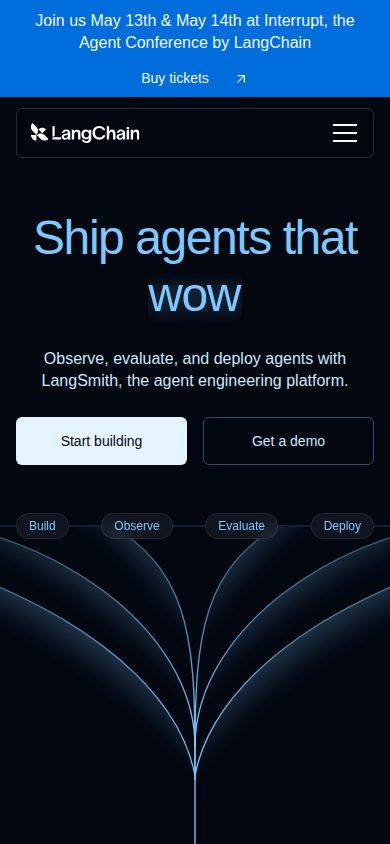
Langchain mobile preview

Pricing Plans

Developer

Free

Free tier with 5K base traces/month then pay-as-you-go. 1 seat. Up to 50 Fleet runs/mo. Community support.

  • 5K base traces/month
  • 1 seat
  • Tracing to debug agent execution
  • Online and offline evals
  • Prompt Hub, Playground, Canvas
  • Annotation queues
  • Monitoring and alerting
  • Up to 50 Fleet runs/month
Popular

Plus

$39/monthly

Per seat/month, then pay-as-you-go. 10K base traces, unlimited seats, 1 dev-sized agent deployment included.

  • Everything in Developer
  • 10K base traces/month
  • Unlimited seats
  • 1 dev-sized agent deployment
  • Email support
  • Unlimited Fleet agents
  • Up to 500 Fleet runs/month
  • Up to 3 workspaces
  • Deployment + Sandboxes access

Enterprise

Contact sales

Custom annual contract with hybrid/self-hosted options, SSO/RBAC, support SLA, dedicated engineering access.

  • Everything in Plus
  • Hybrid + self-hosted deployment
  • Custom SSO and RBAC
  • Deployed engineering team access
  • Support SLA
  • Team trainings and architectural guidance
  • Custom Fleet packages

AI Panel Reviews

The Decision Maker

The Decision Maker

Strategic bet, vendor viability, timing, adoption approval
8.3/10

Side project to unicorn in three years — IVP, Sequoia, and Benchmark back the agent orchestration thesis.

LangChain closed a $125 million Series B in October 2025 at a $1.25 billion valuation, led by IVP with Sequoia and Benchmark following on. LangSmith is the commercial wedge — tracing, evals, and OpenTelemetry support that close the agent observability gap.

Harrison Chase shipped a Python side project in October 2022 and got it to a $1.25 billion valuation by October 2025. IVP led the $125 million Series B with Sequoia, Benchmark, CapitalG, and Workday Ventures back in. That's a defensible bet through 2028.

LangSmith is the commercial wedge. Native tracing for OpenTelemetry plus SDKs for Python, TypeScript, Go, and Java cover the four languages enterprises actually deploy. Plus runs $39 per seat per month with 10K base traces. Datadog has tracing too, but it doesn't speak LLM-as-Judge evaluation the way LangSmith does.

The catch is platform risk. LangChain the open-source framework gets criticized for over-abstraction, and a competitor stack like LlamaIndex plus OpenLLMetry could erode the moat. Pilot LangSmith on one agent team for 60 days, watch trace volume against the 10K cap, then negotiate Enterprise.

Competitive Positioning8.3

LangChain is the default reference in agent orchestration conversations, with LlamaIndex the only serious alternative.

Reputation Risk8.2

Tier-one investor syndicate and three years of GitHub mindshare make this an easy defense to the board.

Speed to Value7.8

Tracing and eval payback is fast once instrumented, but agent development itself carries a real ramp.

Strategic Fit8.0

LangSmith fits any company building agentic workflows, with native OpenTelemetry support that slots into existing observability.

Vendor Viability8.5

IVP-led $125M Series B in October 2025 at a $1.25B valuation, with Sequoia, Benchmark, CapitalG, and Workday following on.

Pros

  • Top-tier investor syndicate (IVP, Sequoia, Benchmark, CapitalG) makes the 36-month bet defensible.
  • LangSmith covers tracing, LLM-as-Judge evals, and Human Feedback Annotations in one platform.
  • SDKs for Python, TypeScript, Go, and Java match the languages real enterprises ship.
  • Hybrid and self-hosted deployment on Enterprise keeps trace data inside the VPC.

Cons

  • Open-source framework has a real reputation for over-abstraction that adds maintenance cost.
  • Plus tier at $39 per seat with only 10K base traces gets expensive on production agent volume.
  • LlamaIndex plus OpenLLMetry is a viable competitor stack if LangChain raises prices post-unicorn.

Right for

Engineering leaders who are already shipping LLM agents into production.

Avoid if

Teams who only need one-off LLM calls without orchestration or observability.

The Domain Strategist

The Domain Strategist

Craft and strategy in the product's domain — adapts identity per category, same lens
8.3/10

LangSmith plus Durable Checkpointing makes LangChain the default agent-engineering substrate for teams shipping past prototypes.

Harrison Chase open-sourced LangChain in October 2022, then layered LangSmith observability on top and closed a $125M Series B led by IVP at a $1.25B valuation in October 2025. For a Head of AI Platform Engineering picking a stack through 2029, the call is whether framework-plus-platform beats stitching LlamaIndex with self-hosted Langfuse.

Harrison Chase open-sourced the framework in October 2022, then layered LangSmith observability on top and closed a $125M Series B led by IVP in October 2025 at a $1.25B valuation. Native SDKs cover Python, TypeScript, Go, and Java, and OpenTelemetry support means tracing isn't a walled garden.

Durable Checkpointing keeps long-running agents alive through failures, and A2A and MCP Protocol Support lets the agent layer compose with external tools instead of forcing rewrites. The Plus tier at $39 per seat per month bundles 10K base traces, unlimited seats, and one dev-sized deployment — platform-shape pricing, not a seat tax.

However, the abstraction surface is the constraint as much as the wedge. LangChain churned its core interfaces enough times that some production teams migrated off; LlamaIndex still owns the retrieval-heavy lane more cleanly. The 3-year ceiling is agent-engineering platform, not universal LLM toolkit.

Category Positioning8.5

A $1.25B Series B valuation in October 2025 and broad open-source mindshare make this the default agent-engineering brand.

Domain Fit8.4

Tracing, LLM-as-Judge Evaluation, and Durable Checkpointing match how senior AI platform leaders actually scope agent reliability work.

Integration Surface8.5

OpenTelemetry, A2A, MCP, and SDKs in Python, TypeScript, Go, and Java cover the senior stack cleanly.

Long-term Implications7.8

LangChain has a public history of churning core abstractions, which raises migration cost over a 3-year horizon.

Strategic Depth8.3

Framework, observability via LangSmith, evals, and deployment together signal platform-grade craft rather than a single-feature tool.

Pros

  • LangSmith bundles tracing, online and offline evals, and human-feedback annotations into one observability layer for agents.
  • Native OpenTelemetry support and SDKs in Python, TypeScript, Go, and Java cover the senior engineering stack without lock-in to a single language.
  • Durable Checkpointing and Scalable Distributed Runtime push the platform into production-shape territory, not just notebook prototyping.
  • Plus at $39 per seat per month with unlimited seats is platform-shape pricing for growing teams, not a per-seat tax.

Cons

  • LangChain has a public reputation for abstraction churn, which creates real migration cost for teams that build deeply against its primitives.
  • For retrieval-heavy applications, LlamaIndex offers a more focused and cleaner mental model than LangChain's broader surface area.
  • The free Developer tier caps Fleet at 50 runs per month, which makes evaluation of the autonomous-agent feature artificially thin.

Right for

Platform engineering leads standardizing how their org ships and observes LLM agents.

Avoid if

Solo developers who only need a retrieval-augmented chatbot without operational scaffolding.

The Finance Lead

The Finance Lead

Money, total cost of ownership, contracts, procurement math
7.8/10

$125M at $1.25B in October 2025; LangSmith overage math is where the real invoice lives.

Plus runs $39 per seat monthly with 10K base traces included; overage is $2.50 per 1K base, $5 extended. Free tier disarms procurement, but the Enterprise gate behind SSO and self-hosted has no published floor.

$125M Series B at $1.25B closed October 2025. IVP led, with Sequoia and Benchmark back in. LangChain is a unicorn now, monetizing LangSmith — observability on top of an open-source framework you can self-host for free.

Plus runs $39 per seat monthly, 10K base traces included. 15 engineers × $39 × 12 = $7,020/year on seats alone. Base trace overage is $2.50 per 1K, extended 400-day retention $5 per 1K. Compare Langfuse open-core — cheaper sticker, less polish on Agent Tracing.

The catch is the Enterprise gate. SSO, RBAC, and self-hosted deployment sit behind a sales call with no published floor. The free tier lets procurement say yes early. But model the trace overage before signing — that's where invoices get loud.

Billing & Procurement7.5

Free tier and self-serve Plus reduce onboarding friction; SSO behind Enterprise adds a sales cycle.

Contract Flexibility7.5

Plus is monthly with pro-rated mid-month adds; Enterprise terms not published.

Pricing Transparency7.5

Developer and Plus tiers list seats, traces, and overage rates publicly; Enterprise is gated.

ROI Clarity8.0

Agent Tracing plus LLM-as-Judge evals give measurable observability signal pre-deploy and in production.

Total Cost of Ownership7.0

Seat math is clean at $39, but trace overage at $2.50-$5 per 1K makes volume the swing variable.

Pros

  • Plus tier is $39 per seat monthly with 10K base traces and unlimited seats — published, no sales call.
  • Open-source framework is free and self-hostable, so the commercial product is opt-in for observability not core function.
  • Native OpenTelemetry tracing with SDKs for Python, TypeScript, Go, and Java keeps it portable.
  • $125M Series B at $1.25B valuation in October 2025 signals durability — IVP led with Sequoia and Benchmark.

Cons

  • Trace overage at $2.50-$5 per 1K makes monthly invoices hard to forecast without volume modeling.
  • SSO, RBAC, and self-hosted deployment all gate behind Enterprise with no published floor.
  • Plus includes only 1 dev-sized agent deployment and 500 Fleet runs — production scale pushes upgrade conversations fast.

Right for

Engineering teams already building LangChain agents who need observability.

Avoid if

Procurement leads who need SSO without a sales call.

The Domain Practitioner

The Domain Practitioner

Daily hands-on reality in the product's domain — adapts identity per category, same lens
7.9/10

LangSmith makes agent tracing legible the way Sentry made exceptions legible, but the eval loop adds discipline.

LangSmith's Agent Tracing turns an agent run into a step-by-step timeline with LLM-as-Judge evals layered on top, and SDKs cover Python, TypeScript, Go, and Java. The catch is framework gravity — it shines with LangChain and LangGraph, less so for raw OpenAI SDK builds wiring OpenTelemetry by hand.

Agent Tracing breaks an agent run into a step-by-step timeline you can scrub through — the kind of view Langfuse ships and Datadog APM still doesn't quite render natively for LLM calls. SDKs cover Python, TypeScript, Go, and Java, so the language you already ship in is one of them.

The eval loop is where this stops being a tracer. LLM-as-Judge Evaluation runs reusable judges with human-feedback calibration, and Annotation Queues route outputs to reviewers without standing up a separate labeling tool. The tradeoff is framework gravity — LangSmith plays cleanly with LangChain or LangGraph, but raw OpenAI SDK users wire OpenTelemetry themselves.

Plus is $39/seat/month with 10K base traces. Overage runs $2.50 per 1,000 on the 14-day tier — fine for prototypes, sharp at scale. Self-hosted only opens at Enterprise. Docs link from error states to the relevant section, which says the team uses the product.

Day-3 Reality7.8

Tracing and evals are genuinely usable once integrated; framework gravity is the constraint.

Documentation Practitioner-Fit8.0

Error states link to relevant docs; SDK examples are runnable rather than aspirational.

Friction Surface7.4

Trace overage math and per-seat billing require active monitoring on growing teams.

Power-User Depth8.0

Annotation Queues, online/offline scoring, and durable checkpointing scale from prototype to production.

Workflow Integration8.2

OpenTelemetry support and four-language SDK coverage fit existing observability stacks cleanly.

Pros

  • Agent Tracing gives a scrubable step-by-step timeline that Datadog APM still doesn't render natively for LLM calls.
  • SDKs for Python, TypeScript, Go, and Java cover the languages most production stacks already ship in.
  • LLM-as-Judge Evaluation with human-feedback calibration replaces standing up a separate labeling tool.
  • $39/seat/month Plus tier with 10K base traces is honest entry pricing for a team of three to ten.

Cons

  • Self-hosted deployment only opens at Enterprise, locking VPC-only shops out of Plus.
  • Trace overage at $2.50 per 1,000 on the 14-day retention tier gets sharp at agent-scale volume.
  • Framework gravity favors LangChain and LangGraph users — raw OpenAI SDK builds carry OpenTelemetry wiring themselves.

Right for

Engineering teams who ship LLM agents on LangChain or LangGraph.

Avoid if

Solo developers who run a few OpenAI calls a day.

The Power User

The Power User

Daily human experience, onboarding, polish, learning curve, reliability
7.9/10

Durable Checkpointing and OpenTelemetry-native tracing make LangSmith the agent debugger you stop fighting.

Durable Checkpointing keeps long agent runs alive through failures, and the SDK ships in Python, TypeScript, Go, and Java. Plus is $39 per seat with 10K traces, but per-seat plus overage means the bill grows with the team.

An open-source framework that grew up into an observability platform. That's the arc. LangChain shipped the abstractions in 2022, then watched everyone struggle to debug what they built. LangSmith is the answer to that mess.

Agent Tracing breaks every run into a timeline you can actually read. Durable Checkpointing means a 40-minute agent run doesn't lose its place when something flakes. The SDKs cover Python, TypeScript, Go, and Java — a real choice, not a Python-and-a-half story. OpenTelemetry support means you don't have to throw out your existing stack to use it.

The catch is per-seat plus traces. Plus at $39 per seat with 10K base traces sounds reasonable, but Langfuse charges $29 flat for 100K units with no seat multiplier, and Helicone has a free tier that goes further. The $125M Series B at $1.25B in October 2025 says they have runway to keep shipping.

Daily Polish7.8

AI-Driven Analytics and multi-turn chat threading suggest a team that watched developers actually use it.

Learning Curve7.4

LangChain abstractions get easier at month three but the framework's surface area is real.

Mobile Parity7.5

Dev infra is not a mobile product; neutral score per category norm.

Onboarding Experience7.6

Free Developer tier with 5K traces and SDKs in four languages lets you wire it up in an afternoon.

Reliability Feel8.2

Durable Checkpointing on fault-tolerant infrastructure is the whole pitch — long-running agents survive failures.

Pros

  • Durable Checkpointing keeps long agent runs alive through transient failures.
  • SDKs ship in Python, TypeScript, Go, and Java — rare for AI tooling.
  • Native OpenTelemetry support means it slots into your existing observability stack.
  • Free Developer tier with 5K traces is enough to actually feel the product.

Cons

  • Per-seat pricing at $39 plus trace overage compounds as the team grows.
  • Langfuse and Helicone offer more generous open-source alternatives at the model layer.

Right for

Developers who build production LLM agents and need observability.

Avoid if

Solo builders who prefer self-hosted open-source observability.

The Skeptic

The Skeptic

Contrarian. Watch-outs, deal-breakers, broken promises, category patterns
7.7/10

The framework had the mindshare — the test is whether LangSmith at $39 per seat builds a moat.

Harrison Chase founded LangChain in 2022 and pulled a $125M Series B at a $1.25B valuation in October 2025, led by IVP. The catch is converting open-source mindshare to ARR with Helicone, Arize Phoenix, LlamaIndex, and Vercel AI SDK all circling adjacent lanes.

The framework-to-platform pivot is the whole question. Harrison Chase shipped LangChain in 2022. Now the revenue play is LangSmith at $39 per seat on the Plus tier. Open-source distribution converting to ARR — the model that worked for HashiCorp, the model that strained Heroku.

IVP led a $125M Series B in October 2025 at a $1.25B valuation. Sequoia and Benchmark already on the cap table. Durable Checkpointing and Agent Tracing are the real engineering wedges, with native OpenTelemetry hooks across Python, TypeScript, Go, and Java SDKs.

But the catch is the moat. Helicone and Arize Phoenix circle the observability lane. Vercel AI SDK and LlamaIndex circle the framework lane. LangChain has the mindshare, not the lock-in. Exit is portable — OpenTelemetry traces go anywhere. The bet is on Fleet and Deployment, both early.

Competitive Differentiation6.8

Helicone, Arize Phoenix, LlamaIndex, and Vercel AI SDK each circle a lane; LangChain has mindshare but not lock-in.

Exit Portability8.2

Native OpenTelemetry across Python, TypeScript, Go, and Java SDKs means traces follow you out if direction shifts.

Long-term Viability7.8

A $125M Series B at a $1.25B valuation in October 2025 buys runway, but framework-to-platform pivots are the category test.

Marketing Honesty7.5

The "Ship agents that work" headline is concrete and the pricing page publishes per-seat plus usage rates without hand-waving.

Track Record Match7.8

Three years shipping, IVP-led Series B, and Sequoia plus Benchmark already on the cap table beat the typical AI-infra pattern.

Pros

  • IVP-led $125M Series B in October 2025 at a $1.25B valuation buys real runway.
  • Native OpenTelemetry tracing across Python, TypeScript, Go, and Java SDKs keeps the exit clean.
  • Durable Checkpointing on fault-tolerant infrastructure is rare in the agent-platform category.
  • Free Developer tier with 5K base traces lets teams pilot without procurement.

Cons

  • Helicone and Arize Phoenix have deeper observability roots in production LLM teams.
  • Framework-to-platform pivots strain mindshare more often than they consolidate it.
  • Plus tier is $39 per seat with usage-based traces on top — the bill compounds fast.

Right for

Teams who need agent tracing with native OpenTelemetry support.

Avoid if

Solo developers who only need a simple LLM SDK.

Buyer Questions

Common questions answered by our AI research team

Pricing

How much does the Plus plan cost per seat?

The Plus plan costs $39 per seat per month, then pay as you go for additional usage.

Security

Does LangSmith train models on my trace data?

No. LangSmith does not use your data to train models. Your traces, prompts, and outputs remain private to your organization.

Setup

Which programming languages does the LangSmith SDK support?

LangSmith SDKs support Python, TypeScript, Go, and Java.

Features

Does LangSmith support self-hosted deployment?

Yes. Enterprise plans support hybrid and self-hosted deployment options so data doesn't leave your VPC.

Integration

Does LangSmith integrate with OpenTelemetry?

Yes. LangSmith includes native tracing for popular agent frameworks and OpenTelemetry.

Also in LLM Platforms