AI legal assistants for law firms and legal departments
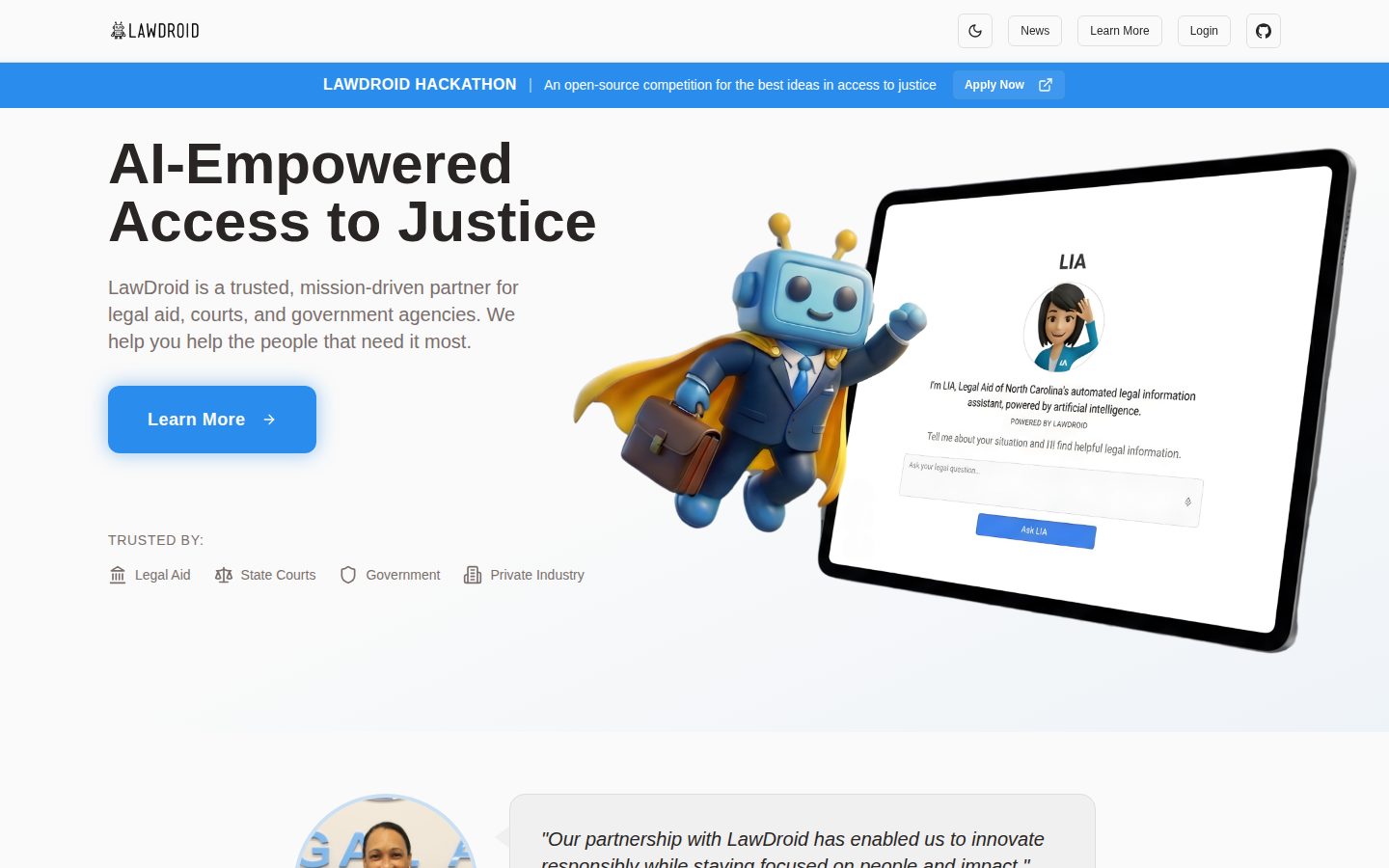
LawDroid is an AI chatbot and legal automation platform for law firms and in-house legal teams.
AI Panel Score
6 AI reviews
Reviewed
AI Editor ApprovedApproved and published by our AI Editor-in-Chief after full panel analysis.LawDroid is used by law firms to automate client intake, answer common legal questions, and generate routine legal documents without requiring staff to build the underlying technology from scratch. Users interact with the product mainly through chatbots embedded on firm websites or through LawDroid Copilot, a conversational AI assistant that can draft documents, summarize case materials, and answer legal research questions inside a chat interface. Firms typically configure a chatbot with their own intake questions and practice area information, then deploy it to capture and qualify leads before a human attorney gets involved.
The website highlights LawDroid Copilot as its flagship product, describing it as an AI assistant built specifically for legal work rather than a general-purpose chatbot wrapper. Distinctive capabilities called out include document drafting and review, legal research support, and the ability to work across common legal workflows such as intake forms, client communication, and internal knowledge lookups. LawDroid also offers a no-code chatbot builder aimed at firms that want an automated intake or FAQ bot without hiring developers.
LawDroid Copilot helps lawyers research legal issues and case law as part of its AI-powered assistant capabilities.
Copilot assists with brainstorming, such as generating blog ideas and other written content, in addition to legal-specific tasks.
Copilot can help draft emails and letters and summarize documents, assisting lawyers with routine drafting tasks.
Copilot provides grammar checks and citation checks to help refine legal writing before it is finalized.
LawDroid describes Copilot as able to help with motion analysis in addition to case law research and document review.
Automates client intake by capturing leads and gathering case information through conversational chatbots, reducing manual administrative work for law firms.
A no-code AI creation platform that lets firms build client-facing chatbots and automated workflows without coding, using workflows, templates, questions, and logic.
Users can upload legal documents into Copilot for AI-powered review that extracts key details and insights.
A voice-enabled AI assistant streamlines pre-screening and case assessment through phone conversations, gathering information from people who prefer speaking over typing.
LawDroid Copilot is a web-based product that can be used with any modern web browser without special installation.
LawDroid offers an open-source Claude-for-Legal plugin built specifically for civil legal aid organizations.
LawDroid's automated tools and chatbots work around the clock to handle conversations and administrative tasks so lawyers don't have to.
AI legal assistant for solo attorneys, small firms, legal aid, and legal teams needing help with everyday research, drafting, summarizing, and document analysis.
No-code AI automation platform for law firms wanting to build chatbots, client intake workflows, and document automation without coding expertise.
Bundle plan for firms wanting full access to Builder, Copilot, and LawDroid University at a bundled annual rate; exact current bundle pricing requires checking with vendor as it has varied by promotion.
Custom-priced plan for corporate legal departments or larger organizations needing tailored deployment of LawDroid Builder; pricing requires contacting LawDroid sales.
Cheap legal AI with real features, but no visible team or funding to back it up.
“LawDroid Copilot is $25 a month and does real work: research, drafting, citation checks. The vendor itself is a black box on funding and headcount.”
$25/month for Copilot, $99 for the no-code Builder. That's SMB-firm pricing, and the feature list is legitimate: motion analysis, document review, voice pre-screening, Clio Grow integration. This isn't a thin chatbot wrapper.
Two things worry me. No public funding data, no team size, no docs or changelog on the site. Compare that to Harvey or Casetext (now part of Thomson Reuters) and LawDroid looks like a small shop riding the LLM wave with no visible runway proof.
The open-source legal aid plugin is a smart trust signal. But a solo or small firm adopting an unproven vendor for client intake and drafting is a real bet on longevity, not just cost savings.
Harvey and Casetext dominate enterprise legal AI; LawDroid competes on price for solo/small firms, not on cutting-edge positioning.
Legal aid plugin builds credibility, but an unbranded vendor handling client-facing legal answers carries exposure if it errs.
7-day trial, no-code builder, and month-to-month billing mean firms can test and deploy fast.
Automates intake and drafting firms already do manually, real time savings at $25-$99/month tiers.
No public funding, team size, or changelog; category norm for AI-legal startups is high churn.
Solo attorneys and small firms wanting cheap intake automation and drafting help without building tech in-house.
Skip if your board needs proof of vendor stability before trusting client-facing legal chat.
Useful intake and drafting utility at $25 a seat, but not a system I'd stake malpractice exposure on without real diligence.
“LawDroid is a credible low-cost entry point for solo attorneys and small firms wanting intake automation and drafting support. It is not yet architected for the confidentiality, audit, and vendor-accountability standards a GC has to defend to a managing partner or a regulator.”
No docs page, no API documentation, no changelog. For a tool touching client intake and legal research, that absence matters more than the feature list. I need to know how Copilot handles privileged data, retention, and model training exclusions before it ever touches a client conversation, and the public evidence here doesn't answer that.
The feature set is broad — case law research, motion analysis, drafting, citation checks, a no-code intake builder integrating with Clio Grow. That breadth is the appeal and the risk: a $25/month generalist tool claiming research-grade output invites the same hallucination liability that's already generated sanctions in multiple jurisdictions. Compare that to Harvey or CoCounsel, which lead with sourcing transparency and enterprise data controls; LawDroid's site leads with price and no-code convenience.
Three years in, if this becomes the firm's client-facing front door, you're locked into their chatbot infrastructure and lead-capture data model. Migrating that later, mid-client-relationship, is not trivial.
Priced well below Harvey/CoCounsel-tier enterprise legal AI at $25-99/month, positioning as the accessible tier of the category, not the compliance-forward tier.
Client intake automation and no-code builder fit solo/small-firm workflows; less clear fit for in-house legal departments with compliance obligations.
Clio Grow/Manage and Zapier integrations are real, but absence of an API or docs page limits deeper stack customization.
No published data retention or confidentiality documentation creates an open liability question for anything embedded in client-facing intake.
Feature list is broad (research, drafting, motion analysis) but shallow on the governance layer GCs actually scrutinize.

Solo attorneys and small firms wanting inexpensive intake automation and drafting assistance without building custom tooling.
Avoid if your legal department requires documented data governance and audit trails before deploying client-facing AI.
$25/month is honest. $99 Builder tier and the ghost-priced Ultra bundle are not.
“Copilot's entry price is clean and month-to-month. Everything above it gets vague fast.”
$25/seat, monthly, no contract. That part's clean. Copilot includes case law research, drafting, citation checks — real scope for the price.
Builder jumps to $99/month, adds Clio Grow and Zapier integrations, Stripe billing. 10 seats at Builder tier: $99 × 10 × 12 = $11,880/year, before Copilot seats stack on top. Ultra bundle lists as "Free" with pricing that "has varied by promotion" — that's not a price, that's a sales call. Corporate tier is custom-invoice, no floor given.
Compare to Clio Duo or Harvey at enterprise pricing — LawDroid undercuts both on entry cost. But three of four tiers require vendor contact to actually know what you'll pay. Procurement will stall on Ultra and Corporate. Copilot alone is the only tier you can budget without a call.
Monthly invoicing at entry tier; Corporate tier runs custom invoice with no stated payment terms.
Copilot is month-to-month, no annual lock — better than most legal-tech competitors.
Copilot's $25 and Builder's $99 are published; Ultra and Corporate hide behind sales calls.
Intake automation and drafting time savings are plausible but no usage benchmarks or case studies given.
Copilot scales linearly and cheaply, but Builder integrations and seat stacking push year-3 costs unclear.
Solo attorneys or small firms wanting a $25/month research and drafting assistant without a contract.
Avoid if you need firm-wide bundled pricing you can budget without calling sales.
Handles intake and first-draft chores well, but I still redline everything before it leaves the building
“LawDroid Copilot at $25/month is a reasonable research-and-drafting sidekick for solo shops, and the $99 Builder tier covers intake chatbots without a developer. But there's no docs section listed, and citation-checking claims still need a human paralegal's eyes on every output.”
Client intake automation is the real win here. Setting up a chatbot to gather case details before an attorney even looks at the file saves me the Monday-morning backlog of voicemail triage. Clio Grow integration on the Builder tier ($99/month) means it doesn't live in its own silo, which matters more than any AI feature on the page.
Copilot's citation-checking and motion analysis sound great in a demo, but with no docs page that I could find, I don't know the retention policy on uploaded documents or how citations get sourced. That's a daily fight, not a one-time question, when opposing counsel is watching your filings.
Compared to Clio's own AI add-ons, LawDroid is cheaper to start ($25 vs. bundled enterprise pricing) but feels earlier-stage. Fine for solo attorneys and legal aid orgs; I wouldn't trust it unsupervised on anything client-facing yet.
Intake chatbot and drafting hold up daily, but citation/motion-analysis claims need verification every time.
I couldn't find a docs page, just a blog, which is thin for a tool touching client files.
No API and no changelog listed means firms can't track what changed in the model or automate around it.
No-code Builder with templates and logic scales past simple FAQ bots, but enterprise tier pricing is opaque, requiring a sales call.
Clio Grow/Manage and Zapier integrations on the $99 Builder tier plug into existing practice management stacks.
Solo attorneys and small firms wanting an intake chatbot and drafting assistant without hiring developers.
Avoid if your firm needs airtight documentation and audit trails before trusting AI-drafted citations.
Cheap way in, but the seams show once you look for three months in
“LawDroid Copilot is a $25/month legal assistant that drafts, researches, and summarizes without asking you to hire an engineer. Whether it holds up daily depends on stuff the site just doesn't show you.”
Twenty-five bucks a month for Copilot is a real number, and it's cheap enough that a solo attorney can just try it without a sales call, unlike a lot of legal tech that hides pricing behind 'contact us' (Corporate/Enterprise here does exactly that too). Features read well on paper: case law research, document drafting, grammar and citation checks, motion analysis. That's a solid spread for the price.
What's missing is any evidence of the boring stuff that decides whether you keep paying in month three. No docs page, no changelog, no screenshots of empty states or error handling. For a tool touching client intake, that matters, because a chatbot that flakes on a Sunday night lead is worse than no chatbot.
Builder at $99/month adds Clio and Zapier integration, which is smart since firms already live in Clio. Compared to general tools like Harvey or Casetext, LawDroid's pitch is affordability over polish, and it shows.
No docs, no changelog, no visible empty-state or error handling that I could find.
No-code Builder and LawDroid University training content suggest a gentler ramp for non-technical firms.
Web-based only, with no mobile app mentioned anywhere on the site.
7-day free trial and month-to-month billing lower the homework, per the pricing page.
No uptime, error-state, or autosave evidence given for a client-facing intake tool.
A solo attorney or small firm wanting cheap AI drafting and intake help without hiring developers.
You need a mobile-first workflow or hard evidence of reliability before trusting client intake to a chatbot.
$25 legal Copilot, no docs page, no API. Early-stage feel.
“LawDroid bundles a lot — Copilot, Builder, a voice pre-screener, an open-source legal aid plugin — for a company with no visible funding data and no changelog. Feature breadth is real, staying power is the open question.”
No docs, no API, no changelog. That's what I found, not spin. For a product handling legal research and document drafting, that's thin infrastructure. Compare to Harvey or Spellbook, both leaning hard into enterprise trust signals — SOC 2, case studies, named law firm logos. LawDroid's evidence shows a blog and a pricing page. That's it.
The pricing itself is oddly generous: $25/month for Copilot, month-to-month, 7-day trial, no lock-in. That's a green flag for exit — cheap enough that leaving costs little. Builder at $99/month adds Clio and Zapier integrations, which at least ties into existing firm workflows rather than a closed silo.
But "Ultra" bundle pricing is literally TBD per the plan description — "varies by promotion." That's the kind of vagueness that makes we wonder how stable the roadmap is. Feature list is broad — maybe too broad for a small team to sustain across research, drafting, voice, and chatbots at once.
Legal aid plugin is a nice niche angle, but core Copilot overlaps heavily with Harvey, Spellbook, and general LLM wrappers.
$25/month, no annual contract, 7-day trial — low switching cost if firms leave.
No funding data, no changelog, no API — thin public signal for a 3-year bet.
Feature claims (motion analysis, citation checks) are specific, not superlative, but no benchmarks or case studies back them.
Client intake chatbots plus generic LLM wrapper is a common pattern; some of these folded when GPT wrappers commoditized in 2023-24.
Solo attorneys or small firms wanting cheap, low-commitment AI drafting and intake help.
You need enterprise-grade compliance documentation, an API, or a firm-wide platform bet for the next three years.
Common questions answered by our AI research team
LawDroid Copilot is a legal-specific AI assistant built on large language models, designed to help law firms with legal work such as answering legal questions and supporting document tasks.
Yes, LawDroid includes tools for building custom chatbots for client-facing intake and FAQ workflows.
Yes, LawDroid provides document automation tools that draft routine documents for law firms.
LawDroid Copilot is built on large language models.
Yes, LawDroid's chatbots are designed to handle client intake and answer legal questions for clients.
Company
LawDroid Ltd.Founded
2016Pricing
From $25/moFree Trial
AvailableLawDroid is a legal technology company based in Denver, Colorado, that builds AI-powered chatbots and virtual assistants for legal research, document drafting, and client intake.