Contract workflow software for operations teams
Lexion is a contract lifecycle management platform for legal, sales, procurement, HR, and finance teams.
AI Panel Score
6 AI reviews
Reviewed
AI Editor ApprovedApproved and published by our AI Editor-in-Chief after full panel analysis.Lexion is a contract lifecycle management platform for legal, sales, procurement, HR, and finance teams. It centralizes contract intake, routing, approvals, and storage in a single dashboard, and its defining capability is email-driven intake: stakeholders submit contract requests directly from their inbox without logging into a new tool, while legal and operations teams manage the full workflow centrally. Other capabilities include an AI-powered contract repository, no-code workflow automation, templated document generation, e-signature sending, key date and term tracking, and a Salesforce integration. Pricing is quote-based on annual contracts, with no free plan or trial. TopReviewed's six-seat AI review panel scored it 7.5/10, praising email-driven intake for removing the adoption barrier that kills most CLM rollouts while noting reported annual contracts starting around $15,000 rule out small teams. It best fits mid-market companies whose small legal teams face high contract volume from sales, procurement, or HR.
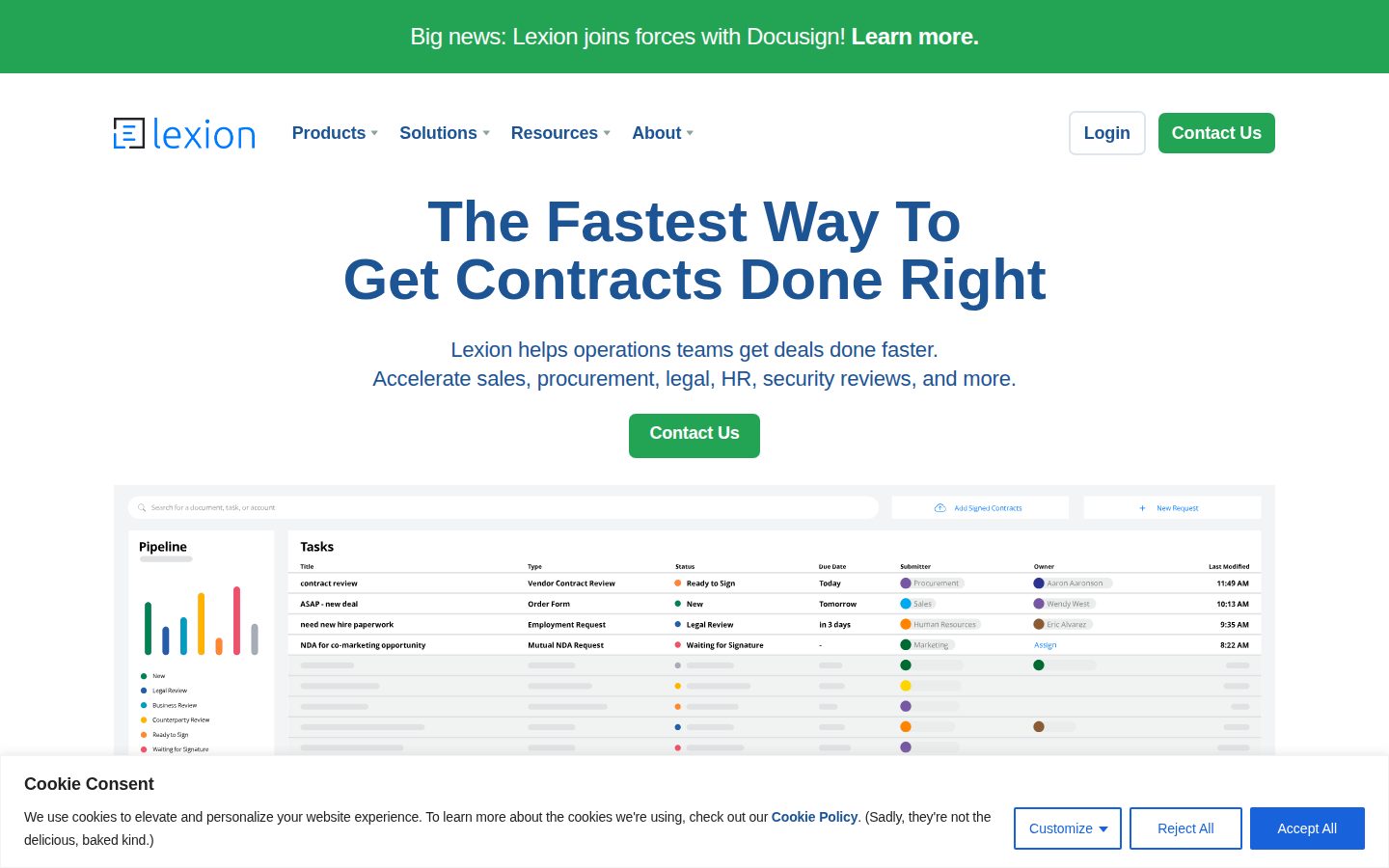
Users interact with Lexion primarily through a centralized dashboard where all active contracts and tasks are visible across teams. Contracts can be submitted via email, routed automatically for approval, assigned to owners, and tracked through to signature — without requiring non-legal stakeholders to learn a new system. The platform supports document generation from templates and sends documents for e-signature as part of the same workflow.
Lexion's no-code workflow automation lets teams configure approval routing, notifications, and task assignments without IT involvement. Its AI-powered contract repository automatically extracts and tracks key dates and terms from uploaded contracts. Integrations include Slack, Salesforce, and email, with additional ready-made connectors listed on the integrations page. Status updates and alerts can be pushed automatically to keep cross-functional teams informed.
Lexion is positioned for mid-market companies where legal teams are small relative to the volume of contracts generated by sales, procurement, HR, and IT. The website does not publicly list pricing; all plans appear to require contacting sales. Competitors in the contract lifecycle management category include Ironclad, ContractPodAi, Conga, and DocuSign CLM — notably, Lexion announced a merger with DocuSign.
Lexion is a web-based platform. Integrations with Slack, Salesforce, and email clients allow work to surface inside tools teams already use, reducing the need to context-switch into the Lexion interface directly.

Uses AI built at Allen Institute for AI (AI2) to centralize all contracts, automatically track key dates and terms, and enable bulk analysis and reporting across the contract portfolio.
Automatically extracts and tracks key contract dates and obligations so teams can stay on top of renewals, deadlines, and compliance requirements.
Routes contracts to the appropriate stakeholders for approval as part of configurable workflow automation, keeping deal momentum without manual handoffs.
Allows users to automate approvals, assign owners and followers, route contracts, generate templated documents, and send documents for signature without coding or IT assistance.
Proactively sends status updates and alerts to keep every team automatically informed on where their deals stand without manual follow-up.
Enables seamless collaboration on contracts via email and Slack both inside and outside of Lexion, so internal and external parties can communicate without switching tools.
Manages the complete contract lifecycle for all teams from a single platform, providing status visibility and proactive alerts to keep every team informed on deal progress.
Sends documents for signature directly from within the Lexion workflow, supporting the full contract execution cycle in one place.
Stakeholders can submit contract requests and initiate tasks directly from their email inbox without logging into Lexion, automatically turning emails into tracked tasks on the dashboard.
Generates contract documents from pre-built templates as part of the automated workflow, reducing manual drafting for repeat agreements.
Offers a library of pre-built integrations with popular business platforms beyond email, Slack, and Salesforce to connect contract workflows with existing systems.
Integrates with Salesforce alongside other platforms to connect contract workflows with sales processes and cross-functional tools, increasing transparency across teams.
Lexion does not publish list pricing publicly. Pricing is quote-based and tailored to each organization's requirements, structured as an annual per-user subscription. Based on third-party transaction data (Vendr), typical annual contract values range from ~$15,000 to $150,000+ depending on user count, contract volume, and feature set. Lexion was acquired by DocuSign in May 2024 for $165M and continues to operate as a sales-led product. Prospective buyers should contact Lexion directly at lexion.ai/request-demo for a customized proposal.
DocuSign acquired this in 2024 — that's either a safety net or a slow fade.
“Lexion solves the real problem: non-legal people hate logging into new tools. The DocuSign acquisition at $165M gives it runway, but also raises the question of where the roadmap goes from here.”
Founded at Allen Institute for AI in 2019, acquired by DocuSign in May 2024 for $165M. That's not a distressed exit — that's a strategic buy. The vendor viability question isn't solvency, it's absorption. Will this stay a standalone product in 36 months, or get folded into DocuSign CLM?
The email-driven intake feature is the real differentiator. Non-legal stakeholders submit contracts from their inbox — no login, no training, no helpdesk tickets. That's a genuine adoption unlock versus Ironclad or Conga, where rollout almost always stalls on change management. The no-code workflow automation and AI extraction from the AI2 research lineage are solid additions, not window dressing.
Tradeoff worth naming: no public pricing, $15K–$150K+ annual range per Vendr, and no free trial. That's a significant commitment ask before you've seen the renewal math. Pilot with legal and one cross-functional team before you standardize.
Edges out Ironclad on SMB ease-of-use, but the DocuSign acquisition muddies the differentiation story as both products increasingly overlap.
DocuSign-backed, AI2 research pedigree, SOC 2 Type 2 — the board won't wince at this vendor name.
The Implementation Guarantee and zero-training email intake mean cross-functional adoption can happen fast, unlike competitors that require weeks of change management.
Email-driven intake and no-code workflow automation genuinely change how non-legal teams engage with contracts, not just digitize what's already happening.
DocuSign acquisition removes bankruptcy risk but introduces roadmap uncertainty — standalone product or absorbed platform in 3 years is the open question.
Mid-market companies with small legal teams drowning in contract volume from sales, procurement, or HR.
You need pricing transparency before engaging sales, or you're already deep in the DocuSign CLM ecosystem.
DocuSign's 2024 acquisition makes Lexion a safer mid-market CLM bet than it was 18 months ago.
“Lexion solves the actual adoption problem in CLM: non-legal stakeholders won't learn a new tool, and email-driven intake routes around that resistance entirely. The DocuSign acquisition, closed May 2024 for $165M, creates both a distribution advantage and a strategic dependency worth scrutinizing.”
Email-driven intake isn't a UX nicety — it's a compliance architecture decision. When sales and procurement submit contracts without touching Lexion, legal retains control of routing, approval, and repository without fighting adoption battles. The no-code workflow automation and AI extraction, built on Allen Institute for AI research, show genuine engineering investment rather than a GPT wrapper on top of a folder structure. For a lean legal team covering high contract volume across sales, HR, and procurement, that's the right load-bearing feature.
The DocuSign merger is the defining variable for a 3-year horizon. If integration deepens, Lexion buyers get native e-signature, expanded distribution, and a more defensible stack. If DocuSign treats it as a feature acquisition, roadmap velocity slows and migration risk rises — and CLM migrations are expensive. Ironclad and ContractPodAi both have independent roadmaps; that independence has real option value right now.
ACV range of $15,000–$150,000+ with no published pricing means every renewal is a negotiation. SOC 2 Type 2 and AES-256 encryption meet baseline enterprise security requirements. Dedicated customer success is included, which matters during the DocuSign integration period when product uncertainty is highest.
Acquired into the DocuSign ecosystem for $165M, Lexion sits above point solutions but below enterprise CLM players like Conga; the merger is a positioning bet that hasn't fully resolved.
Email-driven intake and cross-functional routing match exactly how mid-market legal teams actually operate when headcount is low and contract volume is high.
Salesforce, Slack, Microsoft Teams, SharePoint, HubSpot, Coupa, and native e-sign cover the stack of virtually every mid-market legal and ops team.
DocuSign ownership cuts both ways — distribution upside is real, but CLM migrations are costly if product direction shifts, and Ironclad offers a cleaner independent path.
AI2-backed extraction and no-code workflow automation show real depth; the ceiling depends entirely on how DocuSign stewards the roadmap post-acquisition.
Mid-market legal teams with high cross-functional contract volume who need non-legal stakeholders to participate without onboarding.
You need a fully independent vendor roadmap and aren't already in the DocuSign ecosystem.
$15K–$150K annual range, zero public pricing, and now DocuSign owns it.
“Lexion is a capable mid-market CLM with strong email-driven intake and no-code automation. The acquisition by DocuSign in May 2024 for $165M introduces real roadmap and pricing uncertainty.”
No public pricing. Vendr transaction data puts annual contracts at $15K–$150K+. That's a 10x range — procurement can't benchmark without a sales call. SSO is included per the feature list, which is rare in this category. Credit that.
TCO math is hard here. Call it $40K/year for a 50-person mid-market deployment at mid-range. Year 3 with seat creep and post-acquisition repricing: model $60K conservatively. Compare to Ironclad, which also hides pricing but has deeper enterprise penetration. Lexion's edge is the email-driven intake — non-legal stakeholders need zero training, which cuts change management cost.
DocuSign acquired Lexion in May 2024. That means contract terms, renewal clauses, and roadmap now flow through DocuSign's commercial org. Auto-renewal windows and termination rights need legal review before signing. No free trial, no published overage rates. The invoice you can't predict is still the real risk.
Quote-only, sales-led, no free trial — procurement friction is high; dedicated customer success manager is included, which offsets onboarding cost somewhat.
No public terms on auto-renewal windows or termination for convenience; DocuSign ownership adds enterprise contract complexity.
Zero published pricing; Vendr data suggests $15K–$150K+ annual range requiring a full sales cycle to confirm.
Email-driven intake and no-code automation reduce change management cost measurably, but no published time-savings benchmarks.
No overage rates, no tier structure, and post-DocuSign acquisition repricing risk makes 3-year TCO modeling speculative.
Mid-market legal and ops teams at 50–500 employees who need cross-functional CLM without requiring non-legal users to adopt new software.
Your procurement team needs transparent pricing to get budget approved without a sales cycle.
Email-driven intake is the real win — paralegal teams stop chasing stakeholders on day one.
“Lexion's email intake model solves the adoption problem that kills most CLM rollouts: non-legal people never log in. The AI extraction and no-code routing are solid mid-market tools, but quote-only pricing starting around $15K/year means budget conversations happen before you can even test the workflow.”
The email-driven contract intake is genuinely smart. Sales reps and HR managers submit requests from their inbox, and the task surfaces in the dashboard without anyone logging into Lexion. That's the daily fight with Ironclad — getting stakeholders to actually use the intake portal. Lexion sidesteps it. Key dates and terms extraction means less manual tickler file maintenance, which is real paralegal time back.
Day three looks functional. Approval routing is no-code, so configuring a standard NDA workflow doesn't require opening a ticket with IT. The Salesforce integration means sales-side contract status lives where reps already live. The DocuSign acquisition (May 2024, $165M) is a double-edged signal — roadmap continuity is plausible, but enterprise absorption often slows iteration on the features paralegals actually use.
The gap: no public docs, no changelog, and no free trial. You're committing to a sales cycle before validating fit. For a small legal team with high contract volume, the workflow depth looks right — but you're buying on demo, not on day-three evidence.
Email intake removes the stakeholder adoption fight, but no changelog or public docs makes it hard to know what breaks quietly post-implementation.
No public docs page and no changelog listed in site capabilities — the docs indicator is N, which means practitioner guidance lives behind a sales call.
No-code workflow automation and automated status alerts reduce the manual follow-up loop that eats paralegal hours every week.
Bulk analysis, reporting on contract KPIs, and configurable approval routing suggest real depth, but discoverability is opaque without a trial or public documentation.
Slack, Salesforce, email, and Microsoft Word integrations cover the tools paralegals and their cross-functional partners actually live in.
Mid-market legal or operations teams managing high contract volume with non-legal stakeholders who won't adopt a new tool.
You need transparent pricing or a trial period before committing budget to a CLM platform.
Email-driven intake is genuinely clever — DocuSign's $165M bet makes sense
“Lexion solves the real CLM problem: non-legal people hate logging into legal tools. The email intake alone probably cut contract turnaround time for mid-market ops teams in half.”
The email-driven intake isn't a gimmick. Most CLM platforms die because sales and HR won't adopt them — too many logins, too much training, too much friction. Lexion flips that. Stakeholders submit from their inbox, legal manages from the dashboard, and nobody has to beg a salesperson to learn new software. That's the actual insight, and it's worth the $165M DocuSign paid in 2024.
No-code workflow automation plus Salesforce, Slack, and Teams integrations means the contract lives where the work already happens. Key dates auto-extracted, renewal alerts pushed automatically. Compared to something like Ironclad, Lexion feels built for teams where legal is two people managing a hundred contracts, not the other way around.
The tradeoff: zero public pricing, no free trial, and web-only. You're going in blind on cost — Vendr data suggests $15,000 to $150,000+ annually. Mobile is an afterthought. And post-DocuSign acquisition, the roadmap is a question mark worth asking about before you sign.
Centralized dashboard with proactive alerts and automated status updates suggests someone thought through the daily repetition, though no changelog is public to verify ongoing iteration.
No-code automation and email-native workflows mean non-legal stakeholders barely need to learn anything, and legal power users get configurability without IT.
Web-only platform with no native mobile app — for a tool that sells on 'always staying informed,' that's a gap that'll annoy people by month two.
Email-driven intake plus an Implementation Guarantee means most stakeholders need zero training — that's a genuinely low friction first day.
SOC 2 Type 2, AES 256-bit encryption, and SSO support signal infrastructure seriousness, though no public changelog makes it hard to gauge how fast bugs get fixed.
Mid-market companies where a small legal team is drowning in contract requests from sales, procurement, and HR.
You need mobile access on the go or want transparent pricing before talking to sales.
DocuSign acquired it for $165M — viability question answered, independence question opened
“Lexion's email-driven intake is a real differentiator in a space where Ironclad and Conga demand everyone learns a new tool. The DocuSign acquisition in May 2024 solves the funding question but raises the roadmap question.”
Three tells worth watching. One: no public pricing — $15K to $150K+ range from Vendr data suggests wide variance, and that spread usually means negotiation theater. Two: no changelog visible on the site. For a 2024 acquisition, I'd want to see active shipping. Three: 'Fastest Way' is the kind of superlative that ages poorly. Still — the AI2 research origin is a credible foundation for the extraction claims, not just marketing decoration.
The email-driven intake is the real differentiator. Non-legal stakeholders submit contracts from their inbox without logins. Ironclad doesn't do this cleanly. That's a concrete workflow moat for mid-market legal teams stretched thin.
Exit portability is the flag. DocuSign owns the roadmap now. If they absorb Lexion's features into DocuSign CLM and deprecate the standalone product, migration gets messy fast. No free trial, no self-serve, no pricing page — hard to evaluate escape velocity before you're committed.
Email-driven intake without requiring stakeholder logins is a genuine gap vs. Ironclad and ContractPodAi, which both assume more tool adoption.
No free trial, sales-only entry, and DocuSign ownership means switching costs could rise fast if roadmap shifts post-acquisition.
DocuSign backing solves the funding risk, but no changelog and unclear post-acquisition product independence are real unknowns.
'Fastest Way' headline plus zero public pricing is a combination that erodes trust before the demo call.
Founded 2019 at AI2, acquired by DocuSign for $165M in 2024 — matches the pattern of a real product finding a strategic home, not a shutdown.
Mid-market companies with a small legal team drowning in cross-functional contract volume who want email-native intake without retraining their whole organization.
You need transparent pricing, a self-serve trial, or confidence that the standalone product won't get absorbed into DocuSign CLM within 24 months.
Common questions answered by our AI research team
Yes. Stakeholders submit contract requests directly from their inbox via email without logging into Lexion. Legal and operations teams then manage the full workflow from a centralized dashboard.
Lexion integrates with Email, Salesforce, HubSpot, Microsoft Word, Coupa, Slack, Microsoft Teams, DocuSign, and an API.
Yes. Lexion's No-Code Workflow Automation lets teams assign owners, route contracts for approval, generate templated documents, and send for signature — no training or IT help required.
Adoption is designed to be near-instant. Email-driven workflows mean stakeholders need no training, and the Implementation Guarantee supports quick onboarding across the entire company.
Yes. Lexion has a dedicated Security page, listed in the site navigation and footer.
Lexion is an AI-powered contract management platform founded in Seattle in 2019, acquired by DocuSign in May 2024 for $165 million.