LinkedIn Learning logo

LinkedIn Learning Review

Visit

Online courses and skill-building informed by LinkedIn's talent marketplace

LinkedIn Learning is an online learning platform for professionals seeking to develop business, technology, and creative skills.

AI Panel Score

7.6/10

6 AI reviews

Reviewed

AI Editor Approved

About LinkedIn Learning

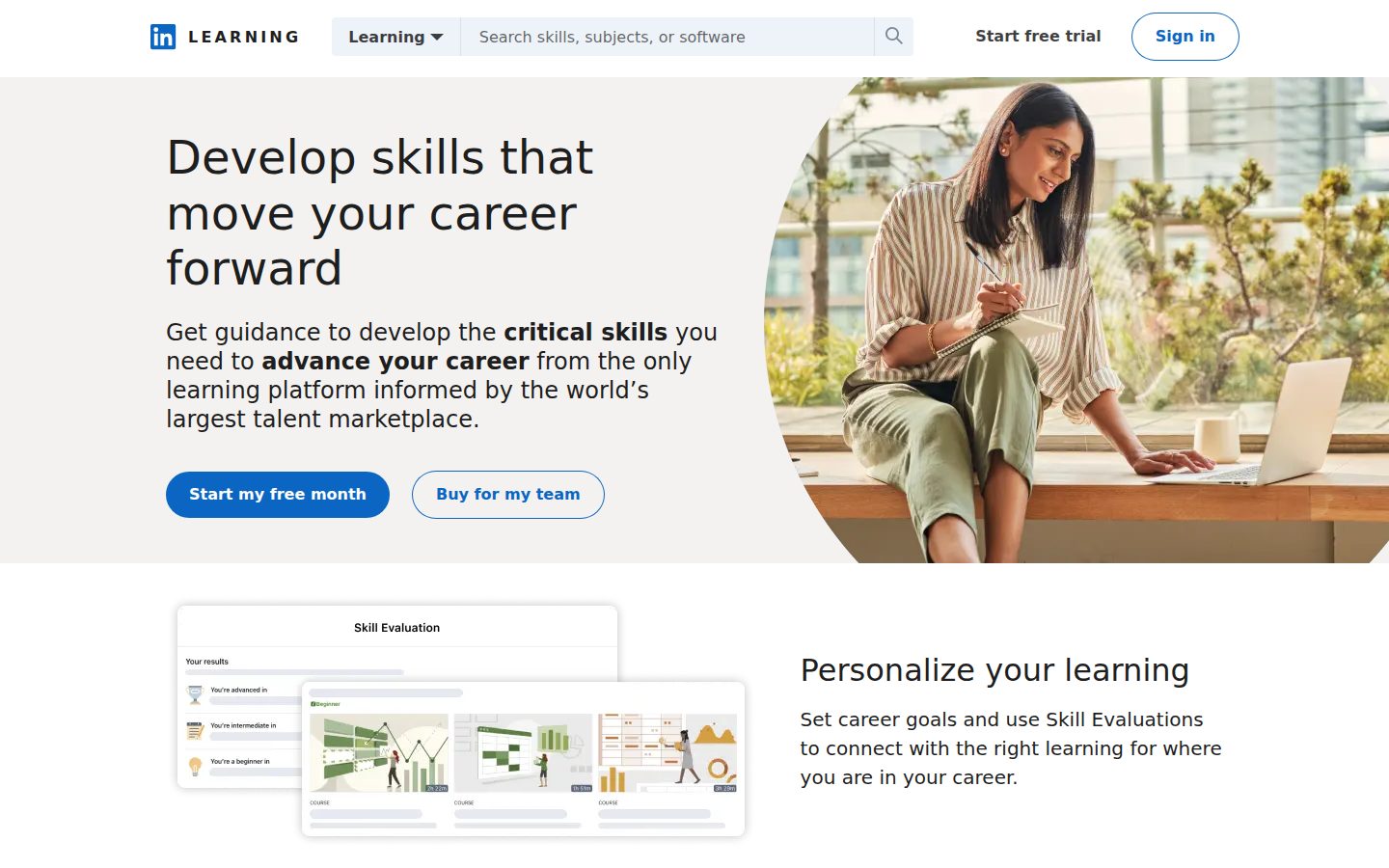
Users access LinkedIn Learning through a web browser or mobile app, where they can browse courses, follow guided Role Guides for over 35 career paths, or work through 1,300+ curated Learning Paths. Courses are delivered primarily as video, with supplementary formats including audio, text, and Nano Tips—short-form videos under a few minutes. Learners can set career goals and complete Skill Evaluations to receive tailored course recommendations aligned to where they are in their career progression.

The platform includes over 300,000 quiz questions and 10,000 exercise files to reinforce learning, plus virtual coding environments via GitHub Codespaces for technical courses. Subtitles are available in 20+ languages, and the platform offers seven native language course libraries. LinkedIn Learning also supports credential preparation, with over 2,000 courses covering more than 120 off-platform certifications, continuing education units, and academic credits. Professional Certificates from providers including Microsoft, Zendesk, LambdaTest, and Blue Prism are available directly on the platform.

LinkedIn Learning is used by individuals seeking personal career development and by organizations managing workforce training, with the platform reporting adoption by over 78% of Fortune 100 companies. Pricing includes individual subscriptions with a free trial month and team or enterprise plans available for purchase. Competing platforms in the online learning category include Coursera, Udemy Business, Skillsoft, and Pluralsight.

The platform is accessible via web browser and has dedicated iOS and Android mobile apps. Team and enterprise plans include administrative tools for assigning and tracking learning across an organization. Content is added on a weekly basis, with dozens of new courses added each week.

Features

AI

  • Personalized Learning Recommendations

    Uses career goals and Skill Evaluation results to surface course recommendations tailored to a learner's current role and career trajectory on the world's largest talent marketplace.

Collaboration

  • Team/Business Learning Plans

    Allows organizations to purchase and manage access to the LinkedIn Learning course library for business, higher education, or government teams.

Core

  • Credentials & Professional Certificates

    Offers Professional Certificates from providers like Microsoft, Zendesk, LambdaTest, and BluePrism, plus over 2,000 courses that prepare learners for 120+ off-platform credentials, certifications, continuing education units, and academic credits.

  • Hands-on Practice

    Provides over 300,000 quiz questions, 10,000 exercise files, and virtual coding environments via GitHub Codespaces to reinforce learning alongside course content.

  • Learning Paths

    Offers curated sequences of courses across business, technology, and creative topics, with dozens of new paths added each week, enabling guided and deeper skill development.

  • Multilingual Course Library

    Makes courses available with subtitles in 20+ languages and provides 7 native language libraries for global skill development.

  • Multiple Learning Formats

    Supports long-form video, audio, and text-based learning formats in addition to short Nano Tips videos, accommodating different learner preferences.

  • Nano Tips Videos

    Delivers 450+ short-form videos offering quick, actionable learning tips as an alternative to long-form course content.

  • Role Guides

    Provides structured learning paths supporting career advancement for over 35 different roles, with 1,300+ hand-curated pathways for guided skill acquisition.

  • Skill Evaluations

    Assesses a learner's current skill level to connect them with the right courses based on where they are in their career.

Customization

  • Course Library Browse by Topic

    Enables learners to browse and filter 25,600+ courses across Business, Technology, and Creative categories with granular topic sub-categories such as AI, Cybersecurity, DEI, and more.

Integration

  • GitHub Codespaces Integration

    Integrates with GitHub Codespaces to provide virtual coding environments so learners can practice programming skills directly alongside course content.

Preview

LinkedIn Learning desktop previewLinkedIn Learning mobile preview

Pricing Plans

Individual (Monthly)

$40/monthly

Full catalog access for individual learners on a month-to-month subscription.

  • 21,000+ courses
  • Certificates of completion
  • Mobile + offline access
  • Learning paths
  • 30-day free trial
Popular

Individual (Annual)

$20/monthly

Annual billing ($239.88/year) — saves roughly $120 vs monthly.

  • Same as Individual Monthly
  • Annual prepayment
  • Lower effective monthly rate

Premium Student

$15/monthly

Discounted Premium-with-Learning subscription for students.

  • Full LinkedIn Premium
  • Full Learning catalog
  • Verified student eligibility

Business / Teams

Contact sales

Per-license team pricing (~$379.88/user/year published); seat-based with volume discounts and regional adjustment. Contact sales for a quote.

  • Admin controls and analytics
  • Bulk seat licensing
  • Skills tracking
  • Custom learning paths
  • SSO and SCIM (higher tiers)

AI Panel Reviews

The Decision Maker

The Decision Maker

Strategic bet, vendor viability, timing, adoption approval
7.8/10

LinkedIn Learning is the safe enterprise bet that won't embarrass anyone.

78% of Fortune 100 companies already use it. That's not a selling point — that's a reminder you're buying infrastructure, not advantage.

This is a Microsoft-backed platform sitting inside the world's largest professional network. Vendor viability is a non-issue. The 25,500-course library with GitHub Codespaces integration and Skill Evaluations tied to LinkedIn career data is genuinely differentiated versus Coursera or Udemy Business — nobody else closes the loop between skill gaps and labor market signals. At $379.88/user/year for teams, the pricing page suggests it's positioned mid-market, not cheap.

The tradeoff is real: breadth over depth. You're getting video courses across everything, not deep technical mastery. Pluralsight still wins for serious engineering teams who need hands-on rigor. LinkedIn Learning wins when you're training a broad workforce across business, tech, and creative skills simultaneously.

For org-wide L&D with admin tracking and SSO, this is the default choice right now. Individual contributors get the annual plan at $19.99/month. That's a defensible line item.

Competitive Positioning7.5

The LinkedIn network data powering personalized recommendations is a moat no Coursera or Udemy Business can replicate.

Reputation Risk9.0

78% of Fortune 100 adoption means zero board eyebrows raised.

Speed to Value7.5

Role Guides and Skill Evaluations get learners into relevant content fast, but behavior change still takes months.

Strategic Fit7.0

Strong for broad workforce upskilling, but won't accelerate a specialized technical team the way Pluralsight would.

Vendor Viability9.5

Microsoft owns LinkedIn — this platform isn't going anywhere.

Pros

  • Microsoft backing makes vendor risk essentially zero
  • Skill Evaluations tied to LinkedIn career data beat generic recommendations
  • 25,500+ courses with weekly additions keeps content fresh
  • Admin controls and SSO for enterprise teams are table stakes covered

Cons

  • Breadth over depth — serious engineering teams will outgrow it fast
  • $379.88/user/year for teams isn't cheap at scale without volume negotiation
  • No public changelog makes it hard to track platform investment pace
  • Microsoft Professional Certificates are useful; others like LambdaTest carry less weight

Right for

Organizations training a broad, mixed-role workforce who want L&D tied to real labor market data.

Avoid if

Your training need is deep technical specialization where Pluralsight or hands-on bootcamp formats win.

The Domain Strategist

The Domain Strategist

Craft and strategy in the product's domain — adapts identity per category, same lens
7.8/10

25,500 courses and LinkedIn's career graph make this the default enterprise L&D catalog.

LinkedIn Learning's integration of Skill Evaluations and career-graph data gives it a personalization layer no standalone LMS competitor can replicate. The catalog breadth is real, but the learning architecture skews consumption over capability-building.

The 1,300+ curated Learning Paths and Role Guides for 35+ career tracks show someone thought about learning design, not just content acquisition. GitHub Codespaces integration for technical courses signals hands-on practice intent, and 300,000 quiz questions give assessors something to anchor to. At $379.88/user/year for teams, the per-seat cost is defensible if utilization holds — which is the real governance question for any L&D lead.

The strategic moat is the LinkedIn career graph. Personalized recommendations drawing from a learner's actual professional profile and Skill Evaluations is a dataset Coursera and Skillsoft can't match. That's a durable structural advantage for workforce skills mapping, not just course browsing.

The ceiling is completion architecture. Video-forward delivery with Nano Tips as the short-form play won't close skills gaps that need practice loops, cohort accountability, or manager reinforcement. If your learning strategy requires behavior change, not just awareness, you'll need a second layer alongside this platform.

Category Positioning8.5

78% Fortune 100 adoption and the LinkedIn career graph create a network-effects moat that Udemy Business and Skillsoft don't structurally have.

Domain Fit8.2

Skill Evaluations plus LinkedIn profile-driven recommendations match how L&D practitioners actually diagnose gaps and assign learning at the workforce level.

Integration Surface7.0

SSO and SCIM at higher tiers are table stakes met, but no public API and no changelog visibility makes custom workflow integration a black box.

Long-term Implications7.8

If we adopt this, in 3 years we have strong catalog coverage and skills data tied to LinkedIn profiles, but likely dependency on Microsoft's ecosystem roadmap.

Strategic Depth7.5

Learning Paths and Role Guides show genuine instructional design thinking, but the video-dominant format caps the ceiling for deep skill transfer.

Pros

  • Career-graph personalization via Skill Evaluations is architecturally unique in the category
  • 25,500-course library with weekly additions covers virtually any workforce topic
  • 120+ off-platform credential prep plus Microsoft and Zendesk certificates supports formal learning programs
  • GitHub Codespaces integration shows genuine hands-on practice intent for technical tracks

Cons

  • Video-first delivery without cohort or accountability structures limits behavior-change outcomes
  • No public API limits integration into custom LMS or HCM workflows
  • Completion and utilization data quality depends entirely on learner self-motivation
  • At $379.88/user/year, ROI is hard to defend without strong admin-driven assignment discipline

Right for

Enterprise L&D teams that need broad catalog coverage, skills gap diagnostics, and LinkedIn-native career pathing in one platform.

Avoid if

Your learning strategy requires cohort accountability, manager-in-the-loop reinforcement, or deep custom content integration.

The Finance Lead

The Finance Lead

Money, total cost of ownership, contracts, procurement math
7.2/10

$239.88/year individual — but team pricing vanishes behind a sales call

Individual pricing is clean and published. Business tier requires a quote, and that's where 78% of Fortune 100 deployments actually live.

Individual math is simple. Annual plan: $19.99/month × 12 = $239.88/year. Monthly option runs $39.99 — that's $480/year for the same catalog. The annual discount is real: roughly $240 saved. Student tier at $14.99/month bundles full LinkedIn Premium, which is actually the better value story here.

Team pricing is a different contract. Published rate is ~$379.88/user/year, but that number requires verification — no pricing page confirmed, based on extracted plan data only. 50 seats × $380 = $19,000/year. Add 30% seat creep by year 3: ~$24,700. SSO and SCIM are listed as higher-tier features, so budget for that unlock. Compare Udemy Business at ~$360/user/year — comparable sticker, weaker LinkedIn network integration.

The ROI story leans on completion tracking and Skills Evaluations, which are measurable. But no published API means no clean LMS data export without manual work. Auto-renewal terms and cancellation windows aren't publicly documented — that's a procurement flag before you sign anything.

Billing & Procurement6.5

Individual billing is self-serve and frictionless; enterprise requires sales contact, and no API means procurement integrations need manual configuration.

Contract Flexibility5.5

Auto-renewal windows and cancellation terms aren't publicly documented — category norm is 30-60 day notice, but nothing confirmed in evidence.

Pricing Transparency6.0

Individual tiers are published; Business/Teams pricing requires a sales call with only a rough $379.88/user/year reference visible.

ROI Clarity7.0

Skill Evaluations and admin completion tracking provide measurable outputs; 300,000+ quiz questions and 120+ cert pathways give concrete progress signals.

Total Cost of Ownership6.5

50-seat team at $380/user = $19K year 1; seat creep and SSO tier unlock push year 3 closer to $25K with no API for self-serve data extraction.

Pros

  • $239.88/year individual annual plan — transparent, no sales call required
  • 25,500+ courses with weekly additions keeps catalog ROI defensible over a 3-year term
  • Skill Evaluations and admin analytics give measurable learning progress — not just seat counts
  • SSO and SCIM available at higher tiers — enterprise checklist item covered

Cons

  • Business tier pricing requires a quote — no published page confirmed
  • No public API means no clean data pipeline to external LMS or HR systems
  • Auto-renewal and cancellation terms aren't publicly documented — procurement risk
  • SSO gated to higher tiers — adds cost for teams that require it on day one

Right for

Mid-size organizations already on LinkedIn Premium who want admin-tracked workforce training without a custom LMS build.

Avoid if

Your procurement team requires fully published pricing and contract terms before engaging a vendor.

The Domain Practitioner

The Domain Practitioner

Daily hands-on reality in the product's domain — adapts identity per category, same lens
7.8/10

25,500 courses and LinkedIn's network make this the default corporate training shelf

LinkedIn Learning is the safe, broad choice for workforce L&D—deep catalog, solid admin controls, and credential pathways that learners actually care about. The friction lives in content depth, not breadth.

The Role Guides and 1,300+ curated Learning Paths are where the platform earns its keep. As a trainer assigning curricula, having pre-built sequences for 35+ career paths means less time stitching content together manually. Skill Evaluations feeding directly into recommendations is the kind of workflow shortcut that survives past the demo. The $379.88/user/year enterprise price is defensible when 78% of Fortune 100 companies are already running it—procurement conversations are easier.

Day three looks like this: learners drift. 25,500 courses is a catalog problem as much as a catalog feature. Without an admin pushing assigned paths, self-directed learners scatter. Nano Tips are genuinely useful for quick reinforcement, but long-form video is still the dominant format—and passive video learning completion rates are a known problem across every platform, Coursera and Udemy Business included.

The GitHub Codespaces integration for technical courses is the standout power-user feature—hands-on practice inside the platform beats linking out to a sandbox. Admin analytics and custom learning paths on the team tier give L&D enough control. The tradeoff: deep technical depth lags behind Pluralsight, and creative depth lags behind Skillshare. LinkedIn Learning is a mile wide and consistently competent.

Day-3 Reality7.5

Personalized recommendations and Skill Evaluations reduce cold-start friction, but a 25,500-course catalog creates decision fatigue without active admin curation.

Documentation Practitioner-Fit6.8

Blog exists but no changelog and docs flag is N—hard to tell if admin guides are written for L&D practitioners or for IT buyers signing the contract.

Friction Surface7.0

No changelog published and no API listed means L&D admins can't automate reporting pipelines or get ahead of content changes—manual admin overhead adds up weekly.

Power-User Depth8.0

GitHub Codespaces integration, 300,000+ quiz questions, 10,000 exercise files, and SSO/SCIM on higher tiers give serious L&D teams real infrastructure to build on.

Workflow Integration8.2

LinkedIn profile integration means recommendations pull from real career context, and mobile offline access keeps learning from requiring a dedicated desk session.

Pros

  • Role Guides and 1,300+ curated Learning Paths reduce curriculum-building time significantly
  • GitHub Codespaces integration makes technical practice hands-on, not passive
  • 2,000+ courses covering 120+ off-platform certifications gives learners visible career ROI
  • Admin analytics and custom learning paths on team tier support real L&D program management

Cons

  • 25,500-course breadth creates learner drift without active admin curation
  • No API means reporting pipelines require manual work—friction that compounds weekly
  • Deep technical content doesn't match Pluralsight's specialization for engineering-heavy teams
  • No public changelog makes it hard to track what content or features actually changed

Right for

Corporate L&D teams running broad skills programs who need defensible catalog coverage and executive-recognizable credentials.

Avoid if

Your learners need deep technical specialization—Pluralsight will serve an engineering org better than this.

The Power User

The Power User

Daily human experience, onboarding, polish, learning curve, reliability
7.8/10

25,500 courses, LinkedIn's network behind it — that's a real moat

LinkedIn Learning is a mature, well-stocked platform that uses your actual career profile to surface relevant content. The network integration is the thing competitors like Coursera and Udemy Business genuinely can't copy.

The Skill Evaluations feature is legitimately useful — it's not just a quiz, it's the platform checking where you actually are and routing you accordingly. Pair that with 1,300+ curated Learning Paths and Role Guides for 35+ careers, and the first week doesn't feel like drowning in a 25,500-course catalog. That's a real design win.

The tradeoff is video-heaviness. Almost everything is video. Long-form video. The 450+ Nano Tips are a nice escape hatch, but if you're a read-and-skim learner, you'll feel it by month two. And at $39.99 a month on the monthly plan — dropping to $19.99 annual — that's real money if you're not in a course consistently.

Mobile has offline access, which matters. It's not an afterthought. The GitHub Codespaces integration for technical courses is a detail that tells you someone on the team actually thought about day-three learners, not just demo-day learners.

Daily Polish7.5

Personalized recommendations and Skill Evaluations show real craft, but the changelog is absent publicly, which makes it hard to know how fast rough edges get fixed.

Learning Curve8.0

Role Guides and 1,300+ curated Learning Paths do the navigation work so you're not lost in 25,500 courses after the first week.

Mobile Parity7.9

Dedicated iOS and Android apps with offline access is genuine parity — not a shrunken web view.

Onboarding Experience8.2

Career goal-setting and Skill Evaluations at entry point make the first 10 minutes feel purposeful rather than like browsing a warehouse.

Reliability Feel7.8

A platform used by 78% of Fortune 100 companies has to be solid infrastructure-wise; no public signals of persistent outages or data loss concerns.

Pros

  • LinkedIn network data makes personalization actually relevant to your real career, not just your interests
  • 25,500+ courses with new content added weekly — catalog depth beats most competitors
  • GitHub Codespaces integration for hands-on coding practice is a thoughtful technical detail
  • Offline mobile access on iOS and Android — works when you're on a plane

Cons

  • Almost entirely video-format — read-first learners will feel underserved by month two
  • $39.99/month on monthly billing is hard to justify if your usage is sporadic
  • No free plan, only a 30-day trial — you're on the clock from day one
  • Business tier pricing requires a sales call; no self-serve transparency

Right for

Professionals who want career-path-specific learning and the credibility of LinkedIn's network baked into their recommendations.

Avoid if

You learn best by reading, or you only need a handful of courses a year and can't commit to annual billing.

The Skeptic

The Skeptic

Contrarian. Watch-outs, deal-breakers, broken promises, category patterns
7.2/10

25,500 courses, Fortune 100 credibility, but the moat is LinkedIn — not the learning

Solid catalog. The real product is the LinkedIn integration, not the courses. Without that network layer, it's Udemy Business with a Microsoft parent.

Three tells. One: no changelog listed. Two: no public pricing page scraped — team pricing is 'contact sales.' Three: the tagline leans on 'world's largest talent marketplace,' which is LinkedIn, not Learning. That's borrowed moat.

What's real: 25,500 courses, GitHub Codespaces for hands-on coding practice, Skill Evaluations that actually feed recommendations from profile data. The Microsoft/Zendesk Professional Certificates are a genuine differentiator vs. Coursera's academic tilt. The $19.99/month annual plan is competitive. 78% Fortune 100 adoption isn't a made-up number.

The exit story is ugly. Completions certificates live on LinkedIn profiles. Skills tracking hooks into LinkedIn data. You leave, you lose the graph. Pluralsight handles tech depth better. Coursera handles credentials better. LinkedIn Learning handles career-signal-to-course matching better than both — if you're already in the ecosystem. That 'if' is the whole bet.

Competitive Differentiation7.5

Career-signal-to-course matching via LinkedIn profile data is a real gap vs. Coursera and Udemy Business, which lack that professional network layer.

Exit Portability4.5

Completion certificates, skills data, and recommendations are LinkedIn-profile-native — leaving means losing the graph, not just the courses.

Long-term Viability9.0

Owned by Microsoft, weekly content additions, enterprise SSO/SCIM tiers, and Fortune 100 adoption — this isn't going away.

Marketing Honesty7.0

Tagline anchors on LinkedIn's talent marketplace rather than the learning product itself — accurate but strategically convenient framing.

Track Record Match8.5

LinkedIn Learning survived the Lynda.com acquisition, Microsoft integration, and 78% Fortune 100 reported adoption — this is a category survivor, not a hopeful entrant.

Pros

  • Career-graph personalization via Skill Evaluations is genuinely differentiated
  • GitHub Codespaces integration for hands-on technical practice — not just video
  • $19.99/month annual tier is competitive vs. Pluralsight's $33+
  • Microsoft/Zendesk Professional Certificates add credential weight

Cons

  • Exit portability is poor — skills and certificates are LinkedIn-profile-locked
  • No public pricing page for teams; 'contact sales' at ~$380/user/year is opaque
  • Tech depth still lags Pluralsight for senior engineers
  • No changelog visible — hard to assess shipping cadence

Right for

Professionals already active on LinkedIn who want career-aligned learning tied to their profile.

Avoid if

Your team wants portable credentials or deep technical depth without the LinkedIn ecosystem dependency.

Buyer Questions

Common questions answered by our AI research team

Features

How does LinkedIn Learning personalize course recommendations?

LinkedIn Learning personalizes recommendations by letting users set career goals and complete Skill Evaluations to identify skill gaps. It also uses LinkedIn's professional network data to surface courses aligned with a user's current role and career objectives.

Pricing

Does LinkedIn Learning offer a free trial?

LinkedIn Learning offers a free month trial, as indicated by the "Start my free month" option on the homepage.

Features

How many courses does LinkedIn Learning have?

LinkedIn Learning offers over 25,500 courses and Learning Paths, with dozens added each week, spanning business, technology, and creative topics.

Features

Can LinkedIn Learning issue professional certifications?

LinkedIn Learning offers Professional Certificates from providers like Microsoft, Zendesk, LambdaTest, and BluePrism, plus 2,000+ courses to prep for 120+ off-platform credentials including certifications, continuing education units, and academic credits.

Features

Does LinkedIn Learning support learning in multiple languages?

LinkedIn Learning supports 20+ languages for subtitles and offers 7 native language course libraries.

Product Information

  • Pricing

    From $15/mo
  • Free Trial

    Available

Platforms

webiosandroid

Connect

Resources

Blog

Also in AI Education & Training