Employer-sponsored mental health care with therapy, coaching, and psychiatry
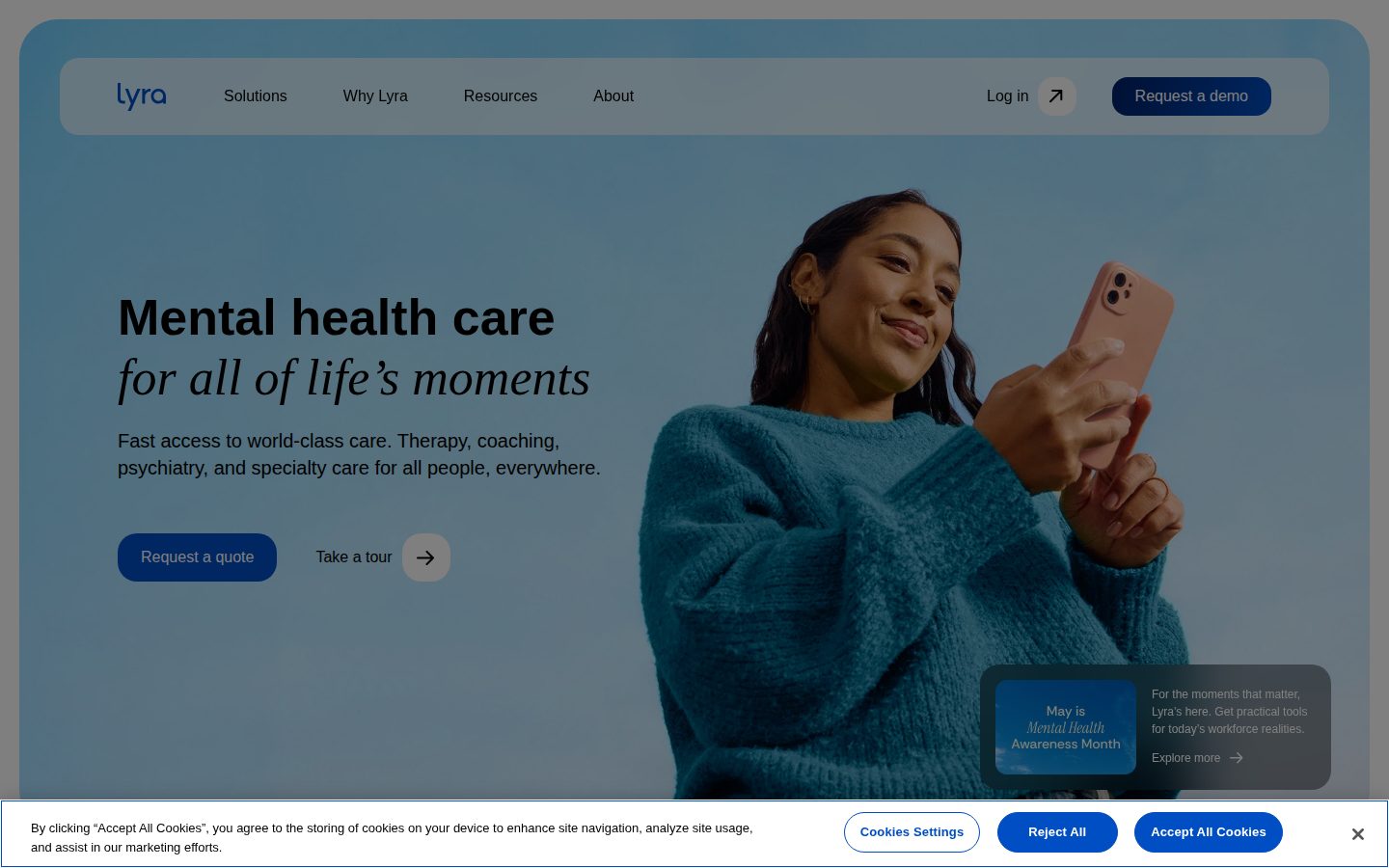
Lyra Health is a mental health benefits platform for employers, health plans, and health systems seeking to provide workforce mental health support.
AI Panel Score
6 AI reviews
Reviewed
Members access Lyra through their employer or health plan by answering intake questions or describing their needs via the platform. An AI-powered matching system then surfaces appropriate providers from Lyra's global network, and members can book appointments for themselves or family members directly. The platform supports care across the full spectrum—from self-paced digital programs and coaching for preventive needs, to clinical therapy, medication management, and intensive programs for complex or acute conditions.
Distinctive capabilities include in-house Centers of Excellence that handle specialized needs such as children and teen mental health and neurodiversity support without third-party referrals, and more than 100,000 hours of annual clinical oversight across its provider network. Lyra also offers coordinated medical-behavioral care through partnerships with health systems, enabling closed-loop referrals. For employers, the platform includes organizational tools such as workforce assessments, crisis support, learning and development resources, and data insights to support benefits strategy execution.
Lyra is primarily sold to mid-to-large employers as a replacement or supplement to traditional Employee Assistance Programs (EAPs), and also partners with health plans, health systems, and benefits consultants. Pricing is not publicly listed and is custom-quoted based on organizational size and configuration. Competitors in the employer mental health benefits space include Spring Health, Calm Health, Modern Health, and Headspace Health. Lyra reports serving more than 20 million people globally through direct employer contracts.
The platform is accessible via web and mobile (iOS and Android). Lyra publishes peer-reviewed research supporting its outcomes model, including a claimed 26% reduction in overall healthcare claims costs for participants and recovery rates approximately twice as fast as traditional care.

Uses clinically-rigorous AI to triage members and match them to the right therapist, coach, or psychiatrist based on their needs, preferences, and schedule—typically enabling a first appointment within one day.
A predictive insights engine that gives benefits leaders an anonymized, aggregated, real-time view of employee mental well-being trends, engagement, and ROI, while recommending tailored campaigns and organizational solutions.
Offers the industry's first outcomes-based pricing model, tying care fees to measurable clinical and financial benchmarks—such as clinical improvement, member satisfaction, and ROI—rather than a flat per-employee rate.
Extends mental health support to the entire family—children, teens, adults, couples, and families—with access to over 6,500 children's mental health specialists and dedicated care pathways for each age group.
A specialized program for members with high-acuity needs such as severe depression, substance use disorders, suicidality, and PTSD, providing access to over 250 facility locations and a multidisciplinary team of in-house clinical experts.
An AI-enhanced care delivery system that equips network providers with integrated scheduling, documentation, and outcomes tracking in one system to deliver consistent, high-quality care at scale.
Connects members with specialized mental health physicians for in-depth consultations and ongoing treatment check-ins for conditions including severe depression, bipolar disorder, and other psychiatric needs.
Delivers culturally responsive mental health care in 65+ languages across 200+ countries and territories, with locally provided resources and on-the-ground account management tailored to regional customs and health care systems.
A behavioral health ecosystem that enables seamless client data sharing across diverse benefit platforms—including Workday Wellness, Alight, Hinge Health, Cleo, and Collective Health—to support whole-person, coordinated care.
A rich mobile and web library of research-based activities, meditations, videos, courses, and skill-building programs accessible anytime, including a dedicated coach-designed six-week digital care plan members complete at their own pace.
A live team of clinical specialists available around the clock via phone or chat to help members start care, assess higher-level needs, provide safety planning for crises, and coordinate referrals to intensive outpatient or residential programs.
Provides benefits leaders with manager consultations, learning and development resources, crisis support, well-being strategy tools, and organizational assessments to build mentally healthy workplaces.
Lyra's pricing is tailored to each organization's needs. No public list prices are available; employers must contact the partnerships team for a personalized quote.
Lyra is the EAP replacement boards actually respect, if the price holds.
“30,000+ providers, outcomes-based pricing, and a 97% first-match retention rate puts Lyra ahead of Spring Health and Modern Health on clinical credibility. No public pricing is the friction point every procurement team will feel.”
Lyra claims a 26% reduction in overall healthcare claims costs and recovery rates twice as fast as traditional care. Those are peer-reviewed numbers, not marketing copy. That's what makes this defensible to a CFO in 18 months.

Two things differentiate it from competitors. One: the outcomes-based pricing model ties fees to actual clinical benchmarks, not a flat per-employee rate. Two: the Lyra Complex Care program handles high-acuity cases—suicidality, PTSD, substance use—in-house, across 250+ facility locations. Spring Health doesn't match that depth.
The tradeoff is opacity. No pricing page, no published tiers, custom quotes only. That's a real procurement drag for mid-market buyers. But if you're running a 5,000-person workforce and your current EAP has 3% utilization, Lyra's network breadth and AI-Powered Provider Matching make this worth the sales conversation.
In-house complex care and 65+ language global network meaningfully outpaces Modern Health and Headspace Health for multinational employers.
Published clinical research, 100,000+ hours of annual clinical oversight, and health system partnerships make this an easy boardroom defense.
First appointment typically within days is credible, but custom procurement cycles with no public pricing will slow enterprise rollout.
Lyra Connect's predictive workforce insights and outcomes-based pricing move this beyond cost savings into workforce strategy territory.
20 million members served globally and peer-reviewed outcomes research signal a mature, established platform—not a startup that folds in 18 months.
Mid-to-large employers ready to replace a low-utilization EAP with a clinically credible, outcomes-measured mental health platform.
You need transparent per-seat pricing or a fast procurement cycle without a sales process.
Lyra's clinical infrastructure is serious enough to replace your EAP and mean it.
“30,000+ providers, outcomes-based pricing tied to measurable benchmarks, and 100,000+ hours of annual clinical oversight — this isn't a wellness app with therapy bolted on. For mid-to-large employers, Lyra is the most credible full-spectrum mental health benefit on the market.”
The clinical architecture here is what separates Lyra from competitors like Modern Health or Headspace Health. Lyra Complex Care handles suicidality, PTSD, and substance use disorders through 250+ facility locations with in-house multidisciplinary teams — that's not a referral hand-off, that's a continuum. The 97% first-match retention rate, if it holds under independent audit, is a meaningful signal about triage quality. The peer-reviewed outcomes data, including claimed 26% reduction in overall healthcare claims costs, gives a CMO something to take to the CFO.
The outcomes-based pricing model is architecturally sound for a benefits strategy — you're tying cost to clinical and financial benchmarks rather than covered lives. The tradeoff is opacity: no public pricing means you're negotiating blind, and contract terms will determine whether those outcome benchmarks actually have teeth. Lyra Link's integrations with Workday Wellness, Hinge Health, and Collective Health suggest genuine ecosystem thinking, not checkbox interoperability.
If we adopt Lyra, in three years we have a behavioral health infrastructure that handles population-level risk, not just individual episodic care. The risk is vendor dependency — 20 million members served means Lyra has leverage at renewal. Validate the clinical oversight model and audit the provider credentialing rigor before signing.
Lyra sits above EAP-replacement competitors like Spring Health by combining a global 65-language network with in-house Centers of Excellence and outcomes-tied contracts.
Outcomes-based pricing, 24/7 Care Navigator Team with safety planning capability, and closed-loop medical-behavioral referrals match how serious CMOs actually structure mental health benefits.
Named integrations with Workday Wellness, Alight, Hinge Health, Cleo, and Collective Health suggest a mature integration strategy, not a single-point connection.
Deep platform integration via Lyra Link and custom contracting creates real switching costs by year two — beneficial if outcomes hold, constraining if they don't.
Full spectrum from digital self-paced programs through Complex Care's 250+ facility network, with measurement-based care and published peer-reviewed outcomes research — genuine clinical depth.
Mid-to-large employers ready to move beyond a basic EAP and invest in a clinically rigorous, outcomes-accountable mental health benefit.
Your organization needs transparent per-employee pricing or lacks the procurement bandwidth to negotiate a custom clinical contract.
30,000+ providers, zero published prices — outcomes-based model needs scrutiny
“Lyra is a credible EAP replacement with real clinical depth and a 30,000+ provider network. No public pricing makes TCO modeling impossible without a sales cycle.”
No pricing page. Custom quotes only. For a procurement team, that means three weeks of sales calls before you can build a spreadsheet. Spring Health and Modern Health operate the same way — category norm, not a Lyra-specific sin. But it is a real friction cost.
The outcomes-based pricing model is the standout number: fees tied to clinical improvement and ROI benchmarks, not a flat PEPM rate. Lyra claims 26% reduction in overall healthcare claims costs for participants. If the methodology holds under audit, that's a credible offset against whatever the per-employee fee lands at. Year 3 TCO depends entirely on utilization rates and whether complex care escalations carry separate fees — neither is published.
Tradeoff worth flagging: Lyra Connect's predictive workforce insights dashboard is a genuine differentiator over legacy EAPs, but integration complexity with Workday, Alight, and others via Lyra Link adds implementation cost. No public API docs. Assume non-trivial onboarding budget.
Custom quoting, no self-serve trial, and multi-system integration via Lyra Link suggest a long procurement cycle with real onboarding cost.
No public auto-renewal or termination terms — category standard is annual contracts with 60-90 day renewal windows, but nothing confirmed for Lyra.
No pricing page, no tiers, no PEPM range — 100% gated behind a sales call.
26% healthcare claims cost reduction and peer-reviewed outcomes research are specific, auditable claims — stronger than most EAP competitors.
Outcomes-based model is novel but unpublished; complex care escalations and Lyra Link integrations likely carry undisclosed costs.
Mid-to-large employers replacing a legacy EAP who can absorb a custom procurement cycle and want outcomes-tied billing.
Your finance team needs published pricing to build a budget before engaging sales.
30,000+ providers, AI matching in days — finally an EAP worth replacing your EAP with
“Lyra Health is a clinically serious mental health benefits platform that matches the scope traditional EAPs promised but never delivered. The 97% first-match retention stat and outcomes-based pricing model signal a platform built around clinical accountability, not utilization theater.”
The AI-powered matching claim — first appointment within one day, 97% first-match retention — is the number that matters clinically. Traditional EAPs routinely push 3-6 week wait times and mismatched referrals. If Lyra's matching actually holds at scale across 20 million covered lives, that's a meaningfully different access model. The 100,000+ annual clinical oversight hours and peer-reviewed outcomes data (26% healthcare claims reduction) are the kinds of anchors that survive a benefits committee review.
Lyra Engage giving providers integrated scheduling, documentation, and outcomes tracking in one system is the right instinct. Provider-side friction is where most digital mental health platforms quietly collapse. No changelog is public, and docs accessibility is thin from the outside — so how the provider-facing tools actually perform day-to-day stays opaque.
The opaque pricing is the real practitioner friction. Custom-quoted, no published tiers, no free trial. Compared to Spring Health or Modern Health, benchmarking cost-per-seat before a contract negotiation requires a sales call. For benefits teams already drowning in vendor demos, that's a process tax before the product even proves itself.
97% first-match retention and same-day access suggest low early abandonment, but no changelog or public user feedback makes ongoing workflow assumptions speculative.
Blog exists but no API docs, no changelog, no public clinical protocol documentation — evidence points to marketing-first, not practitioner-first, information architecture.
24/7 Care Navigator team and direct booking reduce member-side friction, but the absence of public documentation means administrators are navigating via sales reps, not self-serve.
Lyra Connect predictive workforce insights and Lyra Complex Care for high-acuity conditions (250+ facility locations) give benefits leaders and clinical coordinators real depth beyond basic EAP replacement.
Lyra Link integrates with Workday Wellness, Alight, Hinge Health, and Collective Health — the actual benefits stack most mid-to-large employers already run.
Mid-to-large employers replacing a legacy EAP who need clinical credibility, family coverage, and measurable ROI to survive a CFO review.
Organizations needing transparent per-seat pricing or a self-serve evaluation path before committing to a sales process.
30,000 providers, real outcomes data, zero public pricing — classic enterprise move
“Lyra is a serious mental health benefits platform with actual clinical depth, not just an app with a meditation library. The no-public-pricing thing is a friction point, but everything behind that wall looks built to last.”
The 97% first-match retention stat is the number that stops me. That's not a vanity metric — that's someone actually engineering the intake experience to surface the right provider, not just the nearest available one. The AI-powered matching feeding into Lyra Engage, their provider-side care delivery system, suggests both ends of the connection got attention. Spring Health and Modern Health are playing the same field, but Lyra's 30,000-plus global network and 65+ language support gives it real reach that competitors haven't fully matched.
The family coverage is genuinely underrated. Most EAP replacements wave vaguely at dependents. Lyra has 6,500 children's specialists and dedicated pathways for teens, couples, and families. That matters to employees who aren't going to use a benefit that ignores their actual household.
The tradeoff is real though: no pricing page, contact-only sales, custom quotes. If you're a mid-size benefits team without an established broker relationship, the buying process adds friction before a single employee gets help.
The Lyra Library and self-paced digital care suggest someone thought about the between-session experience, but no changelog means we can't see how quickly rough edges get addressed.
The stepped care model — from self-paced digital up through Lyra Complex Care for high-acuity needs — means members naturally find their level without having to figure out the whole system on day one.
iOS and Android apps support the full Lyra Library and booking flow, not just notifications — that's actual mobile parity, not a read-only wrapper.
Answering intake questions to trigger AI matching, with appointments available within days, is about as low-friction an entry as mental health benefits gets.
24/7 Care Navigator team via phone and chat is a solid reliability signal — there's a human backstop when the tech hiccups or the need is urgent.
Mid-to-large employers who want to replace a legacy EAP with something that has measurable clinical outcomes and real family coverage.
You need transparent per-employee pricing upfront or you're a small business without a benefits broker relationship.
30,000 providers, zero public pricing — classic enterprise mental health play
“Lyra is one of the two or three serious players left standing in employer mental health benefits after the 2022-2023 EAP-replacement shakeout. Feature breadth is real. The opacity is also real.”
Three tells upfront. One: no pricing page, no changelog, no API docs. Enterprise moat or information embargo — hard to say which. Two: '97% of members stick with their first matched provider' is the kind of stat that needs a denominator I can't find. Three: 'industry's first outcomes-based pricing' is a claim Spring Health and Modern Health would contest loudly.
What's actually solid: 30,000+ providers across 200+ countries, 65+ languages, and the Lyra Complex Care program covering suicidality and substance use — that's not copycat territory. The 6,500 children's specialists figure is specific enough to be verifiable. The Lyra Link integrations with Workday and Hinge Health suggest real enterprise infrastructure, not vapor.
Exit portability is where I'd worry. Zero standard data export story visible. Provider relationships live inside Lyra's network. If your employer switches vendors, your care continuity is at their discretion. That's a real tradeoff, and most EAP-category vendors bury it.
Lyra Complex Care for high-acuity conditions and 6,500+ children's specialists are concrete differentiators vs. Spring Health and Modern Health, which lean lighter on specialty care depth.
No public data portability policy, no API, and provider relationships are network-locked — switching costs are high by design.
No public funding page found, but enterprise contracts at scale, named health system partnerships, and 100,000+ hours of annual clinical oversight suggest an organization with real infrastructure behind it.
'97% stick with first match' and 'industry's first outcomes-based pricing' are superlatives without visible methodology — the blog exists but no public clinical methodology page found.
Lyra has survived the employer mental health consolidation wave that took out smaller players; 20 million reported members and peer-reviewed outcomes research suggest durable traction, not vaporware.
Mid-to-large employers replacing a legacy EAP who need full-spectrum care including high-acuity and family coverage.
You need pricing transparency before procurement, or your workforce is primarily small-employer or individual-subscriber.
Common questions answered by our AI research team
Appointments are available in days, not weeks or months. The AI-powered matching system connects members to a provider typically within days.
Yes. Lyra offers family support including children, teens, adults, couples, and families, with access to over 6,500 children's mental health specialists through in-house Centers of Excellence.
Yes. Lyra is designed to replace an existing EAP, offering a comprehensive solution that supports teams at scale with measurable impact and ROI.
Lyra uses a clinically-rigorous AI-powered matching system. Members share their story or answer a few quick questions, and the system connects them to the right provider. 97% of members stick with their first matched provider.
Contact Lyra's partnerships team at +1(800) 505-5972 or complete the form on their website to explore options and get a personalized quote.
Lyra Health is a Burlingame-based employer mental health benefits platform that connects employees to therapists, coaches, and mental health tools through employer-sponsored plans.