
Manufact Review
VisitThe fullstack SDK and cloud platform for building and deploying MCP Apps and Servers
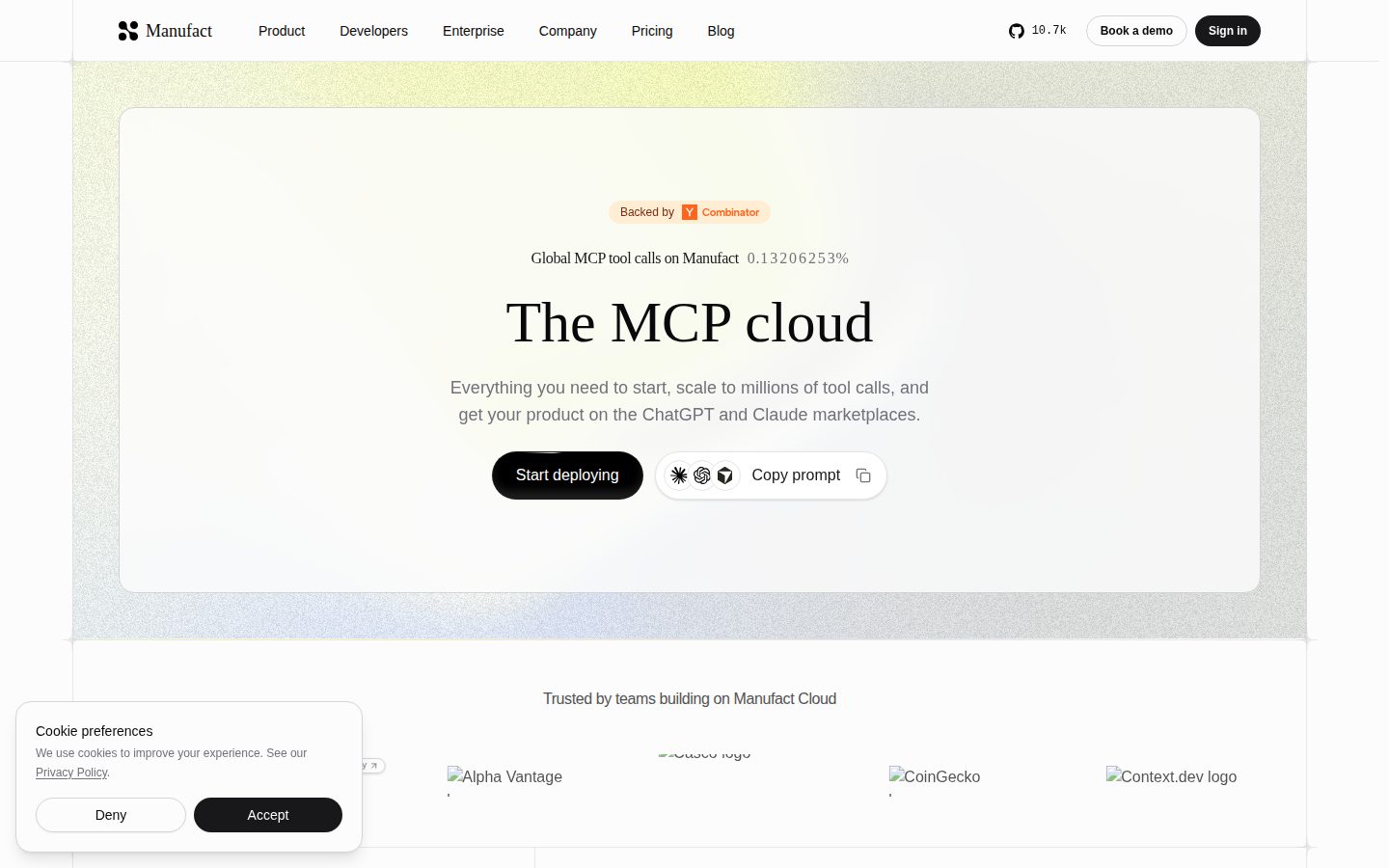
Manufact is a software development platform for building and hosting MCP servers and MCP Apps.
AI Panel Score
7.5/10
6 AI reviews
Reviewed
The fullstack SDK and cloud platform for building and deploying MCP Apps and Servers
Manufact is a software development platform for building and hosting MCP servers and MCP Apps.
AI Panel Score
6 AI reviews
Reviewed
Developers scaffold a project with `npx create-mcp-use-app@latest` (TypeScript) or `pip install mcp-use` (Python), building either MCP Apps (React widgets that render inside ChatGPT, Claude, Gemini, and other AI chat clients) or MCP Servers (spec-compliant tool servers usable by Claude, ChatGPT, Cursor, VS Code, Codex, and agent frameworks). The bundled MCP Inspector lets developers debug tools, resources, prompts, and RPC logs locally without needing a live LLM. Once code is pushed to a connected GitHub repository, Manufact Cloud auto-deploys it with no Dockerfiles or YAML configuration required.
Manufact Cloud adds platform features specific to MCP: preview deploy URLs for every pull request, custom domains with SSL, a Cloud Inspector for debugging deployed servers from a browser while switching between GPT, Claude, and Gemini models mid-session, and a checklist-driven path to submitting apps to the ChatGPT Apps Store or Claude Connectors marketplace, including auto-generated submission assets. Other platform capabilities include an embeddable public chat UI for a deployed MCP server, analytics covering traffic, tool-call volume, latency, session replay, and error rates, multi-user organizations with role-based access control and API keys, and a 'vibe coding' feature that scaffolds an MCP App from a text prompt.
The platform targets developers building MCP servers or AI-powered apps for ChatGPT, Claude, Gemini, or coding agents, teams aiming to publish to the ChatGPT Apps Store or Claude Connectors, AI engineers integrating MCP tool-calling into agent frameworks, and enterprises needing managed, observable MCP infrastructure. Pricing is usage-based with a monthly credit pool (1 credit = $0.01): a Free plan includes $5 in credits, Hobby is $25/month ($300 billed yearly) with $30 in credits plus pay-as-you-go, Startup is $250/month ($3,000 billed yearly) with $300 in credits plus pay-as-you-go, and Enterprise pricing is custom. All plans include the full platform feature set.
The mcp-use SDK is open source, with repos for TypeScript and Python, runnable examples, and starter templates (Chart Builder, Maps Explorer, Diagram Builder) on GitHub. Manufact also exposes MCP endpoints of its own: an authenticated Manufact Cloud MCP server for managing deployments, organizations, and logs, and a public mcp-use Docs MCP server for accessing documentation through MCP without authentication.
Scaffolds an MCP App automatically from a natural-language prompt describing what the user wants to build.
Tracks traffic, tool-call volume, latency, session replay, error rates, and sends alerts for deployed MCP servers.
Connects a GitHub repo once so every push automatically deploys the MCP server or App with no YAML or Dockerfiles required.
Generates a live, unique URL for every pull request to preview changes before merging.
A shareable chat UI for an MCP server that can be embedded anywhere for others to interact with.
Supports multi-user workspaces with role-based access control (RBAC) and API key management.
Debugs a deployed MCP server from any browser and allows swapping models (GPT, Claude, Gemini) mid-session.
Runs evaluation suites for an MCP server across multiple AI clients such as ChatGPT, Claude, and Cursor.
Exports React components as widgets that render natively inside ChatGPT, Claude, Gemini, and other AI chat clients, with typed props, theming, and a useWidget hook.
A visual debugger for inspecting tools, resources, prompts, and real-time RPC logs on MCP servers, including MCP-UI and MCP App widgets, without needing a live LLM.
Exposes spec-compliant tools that any AI agent or client (Claude, ChatGPT, Cursor, VS Code, Codex, Mastra, LangChain, Vercel AI SDK, OpenAI Agents) can call, with edge-runtime support.
An open-source, fullstack SDK in TypeScript and Python for building MCP servers and MCP Apps from a single codebase.
Lets teams ship their MCP server or App under their own domain with SSL handled automatically.
An official CLI and authenticated MCP endpoint for managing deployments, organizations, runtime logs, build logs, and observability directly from the command line or agent workflows.
Provides a checklist-driven path to submit MCP Apps to the ChatGPT Apps Store and Claude Connectors, with submission assets generated automatically.
Explore MCP and ship your first server
Everything you need to launch
For teams scaling their product
For organization requirements; custom volume pricing starting at $1,000/month, contact sales

A real bet on MCP becoming the default way agents talk to apps, priced to try cheap.
“Manufact bundles an open-source SDK with a deploy platform built specifically for MCP servers and ChatGPT-style widgets. Free tier and $25/month Hobby plan make it easy to test before committing.”
MCP is still young infrastructure. Betting on it means betting Anthropic's protocol becomes the standard agents call tools through — that's not settled, but Manufact isn't waiting around. The mcp-use SDK is open source, in both TypeScript and Python, and the Cloud Inspector lets you debug a deployed server across GPT, Claude, and Gemini mid-session. That's a real capability, not a wrapper.
Pricing is usage-based and transparent: $5 free credits, $25/month Hobby with $30 in credits, $250/month Startup with 3M requests. No Dockerfiles, no YAML — push to GitHub and it deploys.
The tradeoff: you're building on a protocol spec that could shift, and switching off Manufact Cloud later means re-hosting servers elsewhere. Fine for a pilot, riskier for mission-critical infrastructure today.
Combining widget rendering across ChatGPT, Claude, and Gemini with marketplace submission checklists is a specific capability most generic hosting platforms don't offer.
No compliance or SOC2 detail surfaced, and MCP's spec is still evolving, which adds adoption risk for regulated teams.
Auto-deploy from GitHub pushes and a $5 free credit tier let a developer ship and test an MCP server within a day.
Directly advances teams building for ChatGPT Apps Store and Claude Connectors rather than just cutting hosting cost on existing infrastructure.
Open-source SDK with repos, starter templates, and a documented API reference suggest active building, though I couldn't find a changelog to confirm release cadence.
Developers and small teams building MCP servers or chat-client widgets who want to ship fast without managing infrastructure.
Skip it if your organization needs documented compliance certifications before adopting new infrastructure.

Solid infra bet for MCP-native teams, but your org adopts the protocol's growing pains too.
“Manufact wraps a real open-source SDK with the kind of cloud tooling I'd expect a mature CI/CD platform to have. The question for me isn't feature count, it's whether I want my deploy pipeline wired to a protocol spec that's still settling.”
The architecture decision here is actually sound: mcp-use is open source, so I'm not fully hostage to Manufact Cloud if I want to self-host the SDK output elsewhere. That matters for a VP signing off on a 3-year bet — the exit ramp exists even if it's not comfortable. Cloud Inspector and the auto-deploy-from-GitHub flow are the kind of operational maturity I want to see before I let a team ship production tool servers.
What gives me pause is the credit-based pricing model layered onto usage I can't fully predict yet — 300k requests/month on Hobby sounds fine until a widget goes viral inside ChatGPT and burns through pay-as-you-go fast. Cross-client eval suites across ChatGPT, Claude, and Cursor are the right instinct for regression testing against a moving spec.
Organizations with RBAC at the Startup tier (10 members, $250/month) is table stakes, not differentiation. I'd run this for a pilot team building Apps Store submissions before I'd trust it as core infra.
Few platforms combine SDK, hosting, and Apps Store submission checklists into one pipeline today.
GitHub-push auto-deploy with no Dockerfiles matches how engineering teams already ship, not how MCP tooling wishes they shipped.
Works with LangChain, Mastra, and Vercel AI SDK per the docs, which covers most agent stacks I'd actually run.
Open-source mcp-use SDK gives an exit path, but Manufact Cloud itself is a 2026-era bet on a protocol spec still in motion.
MCP Inspector plus Cloud Inspector gives real debugging depth most competitors in this lane don't surface.
A team already committed to shipping MCP Apps or servers that wants deploy and debug tooling without building it in-house.
You need predictable fixed infra costs or can't accept dependency on a protocol spec that's still evolving.

Credits, not seats, drive the bill here. That cuts both ways.
“Pricing is public down to the dollar, which procurement will like. The credit model makes forecasting a math problem, not a lookup.”
$0.01 per credit. Free gives $5/month, Hobby $25 for $30 in credits plus overage, Startup $250 for $300 plus overage. That's a usage meter, not a seat count. Team of 50 doesn't map cleanly to this pricing — it maps to request volume, tool-call volume, session replay volume. Harder to budget, easier to pay for only what you use.
Annual billing saves relative to monthly: Hobby at $300/year versus $25×12=$300 — no discount there actually, same number. Startup is $3,000/year versus $250×12=$3,000. Flat either way, so annual just locks the commitment, doesn't buy a discount. Worth asking before signing yearly.
Enterprise starts "custom, from $1,000/month" per their pricing page — a real floor, not just "contact sales" fog. That's useful. No invoicing terms, payment net-days, or cancellation window listed for the paid tiers. Auto-renewal behavior on annual plans isn't stated either. Fine for a $25 card swipe. Worth a contract read before $3,000/year.
Self-serve signup with a $5 free credit pool keeps procurement light until Enterprise, where it's sales-only.
No cancellation terms or auto-renewal window listed for Hobby or Startup annual billing.
All four tiers show numbers, including an Enterprise floor of $1,000/month — rare for that tier.
Analytics covering tool-call volume and latency gives a usage trail, but no stated benchmark ties spend to output.
Credit-based overage on top of $25-$250/month base makes 3-year cost dependent on traffic, not a fixed line item.
Teams who'd rather pay a usage meter than guess at seat counts.
Avoid if your finance team needs a fixed line item, not a variable one.

Analytics and a Cloud Inspector give you oncall signal most MCP shops are flying without today.
“Latency, error rate, and session replay are the metrics I'd actually page on, and Manufact ships them natively for MCP servers. The gap is everything downstream of a page — no incident tooling surfaced beyond alerts.”
Analytics covering traffic, tool-call volume, latency, session replay, and error rates is the right instrumentation set for a protocol with almost no observability tooling of its own. That's the part I'd actually care about at 2am. Alerts are mentioned but I couldn't find detail on routing, escalation policies, or whether they integrate with PagerDuty or Opsgenie — for an SRE that's the gap between 'we have metrics' and 'we have an oncall workflow.'
Edge-runtime support plus multi-region on the Startup tier ($250/month) suggests they've thought about blast radius, but unlimited requests only show up on Enterprise, meaning capacity planning under real load means a sales call.
The mcp-use SDK being open source is good for postmortems — I can read the actual RPC handling instead of trusting a black box when debugging a cross-model failure between GPT and Claude mid-incident.
Cloud Inspector debugging live deployments across models is a real day-3 win, but alerting depth is unclear from what I could find.
Runnable examples and starter templates on GitHub read like docs written by people who ship, not marketing copy.
Credits-plus-pay-as-you-go billing adds a mental tax during an incident when you're already tracking latency, not spend.
The authenticated Manufact Cloud MCP endpoint for managing deployments and logs from agent workflows is a genuine power-user path beyond the dashboard.
Auto-deploy from GitHub pushes with no Dockerfiles fits existing CI habits without forcing a new deploy mental model.
Teams running MCP servers in production who need latency and error visibility without building it themselves.
Avoid if you need a documented incident-response and alert-escalation chain before you'll put something on an oncall rotation.

Dev tool that knows what it's building for, even if the whole category is still wet paint.
“Manufact feels like it was built by people who've actually debugged an MCP server at 11pm. The rough edges that remain are mostly the protocol's fault, not theirs.”
The thing I keep coming back to is the MCP Inspector working without a live LLM. That's the kind of feature only someone who's been burned by flaky model calls during debugging would bother shipping. Same instinct behind the 'vibe coding' scaffold — it's a nice-to-have on the surface, but it tells you the team is thinking about the first ten minutes, not just the demo.
First hour is npx create-mcp-use-app and you're looking at a widget in a local inspector. That's a real 'wow, okay' moment, not homework. Where it gets murkier is month three: this is a brand-new protocol ecosystem, and discoverability past the starter templates (Chart Builder, Maps Explorer) depends on docs I can't fully audit from here.
Embedded chat UI as a shareable artifact is a nice daily-use touch — lets you show a non-technical teammate the server without a client install. Free tier's $5 credits versus the jump to Startup is the kind of thing you'll feel on a Tuesday, not launch day.
MCP Inspector working offline from a live LLM and the embeddable chat UI both show attention to actual daily debugging, not demo polish.
Starting a project is simple, but scaling to cross-client eval suites and RBAC means climbing through pricing tiers as much as through the docs.
Platform is listed as web only, and the whole product is a developer tool, so mobile isn't really the point, but it's also not addressed anywhere.
One CLI command (npx create-mcp-use-app) to a running local widget is a genuinely fast first hour, backed by runnable starter templates on GitHub.
Latency and error-rate tracking is built in, but I couldn't find details on uptime history or incident response for the hosting side itself.
A developer who wants to go from prompt to a working ChatGPT widget in an afternoon.
You need a mobile-first workflow or a long operational track record before you trust a hosting platform.

A protocol bet dressed up as a platform — mcp-use is the real asset here.
“Manufact is betting its cloud business on MCP staying the standard agents and chat clients converge on. The SDK is a solid hedge against that bet going wrong; the cloud pricing isn't.”
MCP is still a young spec. Betting a hosting business on it is the same move Heroku made on buildpacks before Docker ate the category — worked out fine for Heroku, less fine for a dozen clones nobody remembers. Manufact's answer is to open-source the SDK and sell the convenience layer on top. Smart hedge.
The credit-based pricing is where I'd slow down. $25 a month buys $30 in credits at Hobby, then pay-as-you-go kicks in with no visible per-unit rate in what I could find. That's a meter you can't read until you're already paying it.
Marketing calls itself 'the MCP cloud' — fine, grounded, not 'the future of agents' or similar superlative. Submission checklist to the ChatGPT Apps Store and Claude Connectors is a concrete, checkable claim, not vapor. Enterprise floor starts at $1,000/month, custom above that — normal, not hidden.
Single-codebase widgets for ChatGPT, Claude, and Gemini are distinctive, but the category itself is still forming so 'differentiated' is a moving target.
mcp-use is open source in TypeScript and Python, so the build artifact survives even if Manufact Cloud doesn't.
Docs, API reference, and a blog are visible; I couldn't find a changelog, which may just be a surfacing gap rather than an absence.
Tagline and H1 ('the MCP cloud') stay close to what's actually shipped — no inflated category claims found.
Named capabilities like the Cloud Inspector and submission checklist are specific enough to check, not vague promises.
Developers who want to build on MCP now but need the SDK to stay usable if the cloud product doesn't pan out.
You need predictable monthly costs rather than a credit meter with unclear overage pricing.
Common questions answered by our AI research team
mcp-use supports building MCP servers and MCP Apps in TypeScript or Python.
Yes, Manufact lets you ship React-based widgets from a single codebase that render inside ChatGPT, as well as Claude and Gemini.
Yes, Manufact's MCP tool servers are usable by agent frameworks including LangChain.
Manufact Cloud auto-deploys your app from GitHub pushes.
Yes, Manufact's MCP tool servers are usable by the Vercel AI SDK, along with agent frameworks like LangChain and Mastra.


Manufact develops mcp-use and Manufact Cloud, open-source and cloud infrastructure for building and deploying applications on the Model Context Protocol.