Anthropic's agentic coding tool for your terminal, IDE, and codebase
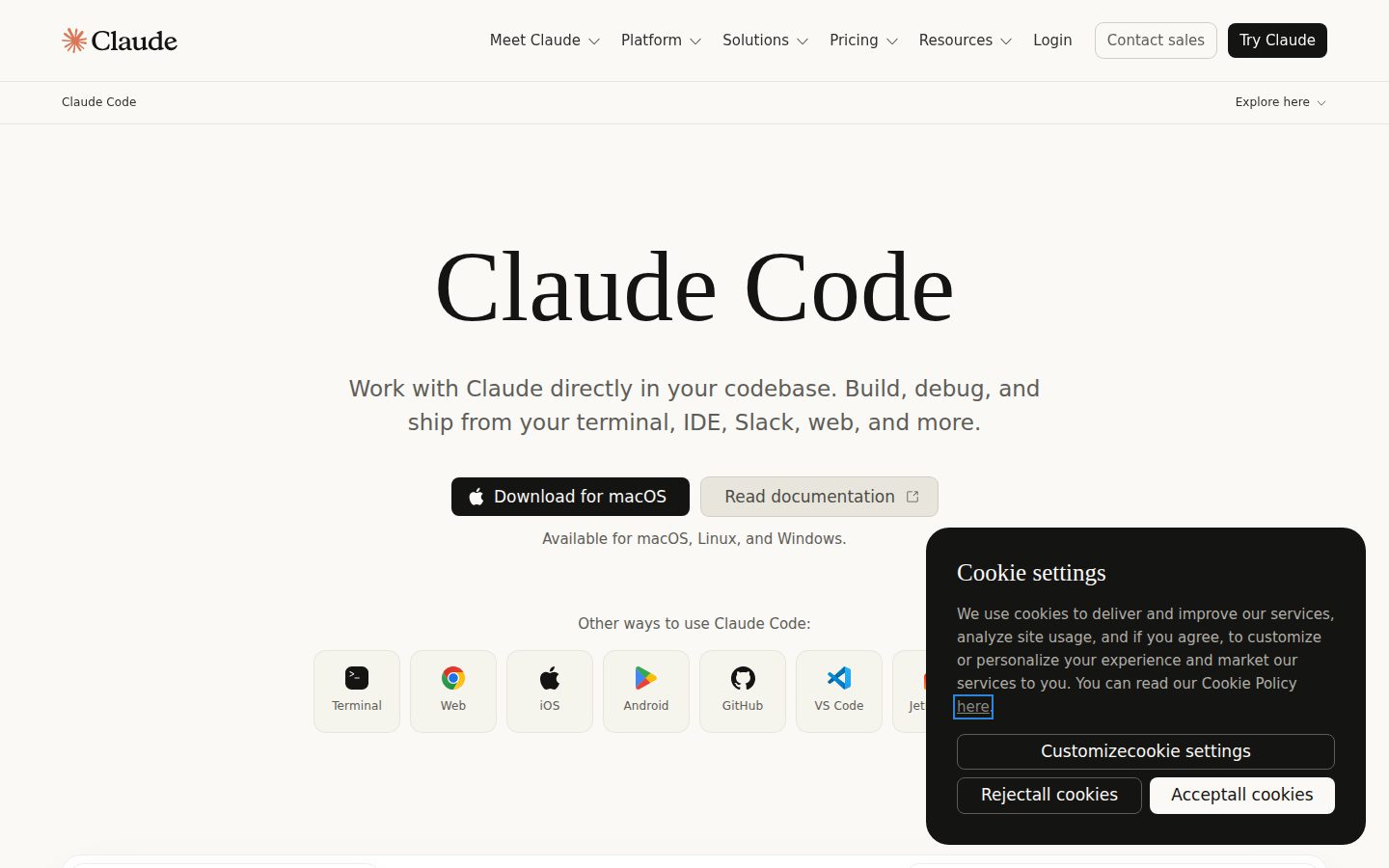
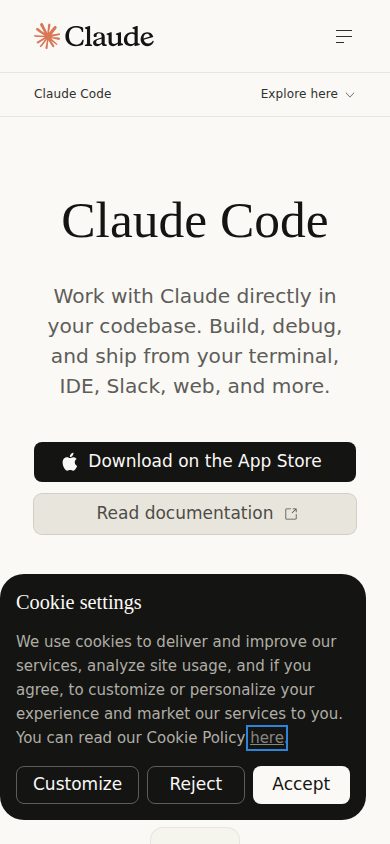
Claude Code is an agentic coding tool for developers, run from the terminal, IDE, web, or desktop.
AI Panel Score
6 AI reviews
Reviewed
AI Editor ApprovedApproved and published by our AI Editor-in-Chief after full panel analysis.Claude Code is Anthropic's agentic coding tool, available as a terminal CLI, desktop and mobile app, web session, Slack integration, and IDE extensions for VS Code and JetBrains. It is built for professional developers who want an AI agent working directly inside their codebase rather than in a separate editor. There is no free tier: access is included with Claude Pro subscriptions starting at $17 per month billed annually ($20 monthly), Max plans from $100 per month, Team and Enterprise premium seats, or usage-based API billing through a Claude Console account. The agent maps codebases with agentic search, makes coordinated multi-file edits, runs commands and tests, and turns GitHub or GitLab issues into submitted pull requests. It runs locally, connects directly to the model API without a remote code index, and asks permission before changing files. Alternatives include Cursor, Windsurf, Cline, Aider, and Devin.
Claude Code installs with a single shell command or ships inside the Claude desktop app, and it is driven conversationally: you describe a task in plain language, and the agent searches the repository, reads the relevant files, proposes edits, and runs commands such as tests and git operations, asking permission before it changes files or executes anything. Sessions can start in the terminal, in the Claude desktop or mobile apps, on the web, from Slack, or inside an IDE, and an Agent view collects every running session in one place so parallel tasks stay manageable.
Agentic search lets it map an unfamiliar codebase without manually selecting context files, which the website presents as the basis for multi-file edits that stay consistent across a project. It integrates with GitHub and GitLab to carry an issue through code, tests, and a submitted pull request, and it can call command-line tools and MCP servers to extend its own capabilities. Recent additions include dynamic workflows that fan a task out across tens to hundreds of parallel subagents and check the results before they reach the user, routines that run on a schedule, from an API call, or in response to an event, and computer use, which lets the agent open applications, navigate a browser, and operate dev tools.
It is aimed at professional developers and engineering teams. Access is bundled with Claude subscriptions rather than sold separately: the Pro plan starts at $17 per month billed annually ($20 monthly), Max plans from $100 per month add 5x or 20x Pro usage, and Team and Enterprise premium seats include it; developers can instead pay usage-based API rates through a Claude Console account. In the agentic coding category it competes with Cursor, Windsurf, Cline, Aider, and Devin, differing mainly in being terminal-first rather than built around an IDE or a standalone editor.
The CLI runs on macOS, Linux, and Windows, with native IDE extensions for VS Code (also usable in Cursor) and JetBrains IDEs, a Slack integration, and web and mobile access for starting or reviewing sessions away from a workstation. It runs locally and talks directly to the model API, with no backend server or remote code index holding a copy of the codebase.

Spawns multiple agents that work on different parts of a task simultaneously while a lead agent coordinates subtasks and merges results, with Agent view managing background sessions from one screen.
Maps and explains entire codebases quickly using agentic search, and traces bugs through the codebase to identify the root cause.
Plans an approach from a plain-language request, writes code across multiple files using whole-codebase understanding, and verifies that it works.
Reads a project-root CLAUDE.md file at the start of every session for coding standards and architecture decisions, and automatically saves learnings like build commands across sessions.
Runs user-defined shell commands before or after Claude Code actions, such as auto-formatting after every file edit or running lint before a commit.
Packages repeatable workflows into shareable team commands like /review-pr or /deploy-staging.
Stages changes, writes commit messages, creates branches, and opens pull requests from issues, with GitHub Actions and GitLab CI/CD automating code review and issue triage in CI.
Connects to external tools and data through the Model Context Protocol open standard, such as reading design docs in Google Drive, updating tickets in Jira, or pulling data from Slack.
Runs in the browser at claude.ai/code with no local setup for long-running or parallel tasks on repos you do not have locally, and sessions can be pulled into the terminal with claude --teleport.
Standalone macOS and Windows app that reviews diffs visually, runs multiple sessions side by side, schedules recurring tasks, and kicks off cloud sessions.
VS Code extension (also installable in Cursor) with inline diffs, @-mentions, plan review, and conversation history, plus a JetBrains plugin with interactive diff viewing for IntelliJ IDEA, PyCharm, and WebStorm.
Full-featured CLI that runs in any project and follows the Unix philosophy: pipe logs into it, run it in CI with claude -p prompts, or chain it with other tools.
Individual plan that includes Claude Code; $17/mo billed annually or $20 month-to-month.
Power-user plan with 5x Pro usage for heavier Claude Code sessions; monthly billing only.
Top individual plan with 20x Pro usage for near-daily heavy Claude Code work; monthly billing only.
Per-user team seat (teams of 5-150); $20/user/mo billed annually or $25 month-to-month. Includes Claude Code.
Per-user team seat with 5x standard-seat usage; $100/user/mo billed annually or $125 month-to-month.
Sales-assisted plan: seat price ($20/seat self-serve component) plus usage billed at API rates; pricing requires contacting the vendor.
Claude Code via an Anthropic Console account: pay-per-token API billing that varies by model (e.g. Opus, Sonnet, Haiku) instead of a subscription.
A best-in-class coding agent from a bulletproof vendor whose meter, not runway, deserves your diligence.
“Claude Code is the reference product in agentic coding, bundled with Claude subscriptions from $17 a month and backed by one of the best-capitalized private companies in software. The diligence item isn't survival; it's usage-limit volatility and single-model lock-in.”
In July 2025, Claude Code users found out usage limits had tightened only when they hit them. Anthropic formalized weekly caps weeks later. That meter volatility is the one line item here that should slow a buyer down.
Because everything else is unusually strong. Agentic search maps a repo without hand-fed context, Agent view keeps parallel sessions manageable, and CLAUDE.md carries team standards into every run — bundled into subscriptions from $17 a month. Cursor offers model choice; Claude Code is Anthropic-only, and the tradeoff is coupling your workflow to one company's roadmap and one meter.
Vendor viability isn't the question — a $13B Series F at a $183B valuation closed in September 2025. Pilot Max seats with the engineers who'll live in it; expand to Team seats after a month of real usage data. If the meter moves again, that's your renewal conversation.
Peers already run it against Cursor and Windsurf, and the terminal-first position is the one rivals copy.
Adopting the category's reference tool reads as smart to any board, though the July 2025 limits episode left a mark.
One-line install into existing repos and subscriptions puts merged pull requests inside the first week.
Multi-file agentic edits and CI automation change how teams ship, not just the cost of the old workflow.
A $13B Series F at a $183B post-money valuation in September 2025 settles the three-year question.
Engineering teams who want an agentic coder inside the tools they already use.
Teams who need model choice across multiple AI vendors in one tool.
Claude Code sets the bar for agentic coding, but adopting it means marrying Anthropic's models.
“Claude Code's local-first CLI, MCP integration surface, and repo-native customization match how senior engineering teams operate. The strategic caveat is that harness and model come from one vendor, unlike model-agnostic Cursor.”
There's no backend server here — the CLI runs locally and talks straight to the model API, no remote index holding a copy of the repo. Add headless claude -p runs in CI and Hooks gating commits on lint, and it fits how platform teams already operate.
Integration surface is where the strategy shows. Anthropic authored the Model Context Protocol in late 2024, and once OpenAI and Google adopted it, the connector ecosystem accrued to this tool first. CLAUDE.md, Skills, and Hooks live as plain text in the repo, so the workflow layer your team builds stays portable.
The catch is model coupling. Cursor lets a team re-point at whichever frontier model leads the quarter; here harness and model are one vendor — the moat and the three-year constraint at once. At $17 a month on Pro to $200 on Max, the entry price isn't the commitment — the model dependency is.
It defined the terminal-agent category that Cursor, Windsurf, and OpenAI's Codex CLI now chase.
Terminal-first with VS Code and JetBrains extensions matches how senior platform engineers already work.
MCP, GitHub and GitLab issue-to-PR, Slack, and CI hooks cover the whole delivery pipeline.
Plain-text CLAUDE.md and Skills stay portable, but the model layer is single-vendor by design.
Parallel subagents, Hooks, and headless claude -p runs put the craft ceiling above chat-in-editor tools.
Platform and engineering teams who standardize on a scriptable terminal-first coding agent.
Teams who need to swap between frontier model vendors inside one coding harness.
Claude Code rides inside $17-and-up Claude plans, but the usage quota is a multiplier, not a number.
“Every Claude Code tier is public, from the $17 annual Pro rate to $200 Max, and SSO comes standard on the $20 Team seat. The unpublished token quota behind the 5x and 20x multipliers is the cost you can't model up front.”
Claude Code has no price of its own. It ships inside every Claude subscription — $17 a month on annual Pro, $20 month-to-month. Team seats are $20 with SSO included. Most vendors gate that behind enterprise.
A 50-dev team on standard seats: 50 × $20 × 12 = $12K a year. But usage is sold in multipliers — Max 5x, Max 20x — against a base quota Anthropic never states in tokens. Five-hour windows plus weekly caps. That's the yellow flag: heavy agentic weeks are the one line procurement can't forecast. Budget $100 Premium seats for the top users.
GitHub Copilot Business is $19 a seat — dollar-equivalent, and now metered in credits too. Exit cost stays low here: CLAUDE.md memory is plain Markdown in the repo, and monthly billing cancels clean. Strong math for the mid-band. Price the heaviest decile separately.
Central billing, self-serve seats, and SSO at $20 keep procurement friction low, though Enterprise stays quote-only.
Monthly billing is available on every self-serve tier, and annual is optional for the 15% discount.
Seven tiers are public without a sales call, but usage quotas are stated as multipliers rather than token counts.
Claude Code shares one usage pool with chat, which muddies per-tool cost attribution.
$12K a year covers a 50-dev team on standard seats, with chat and agentic coding in one subscription.
Teams who want agentic coding bundled into an existing Claude subscription.
Buyers who need a predictable per-developer invoice under heavy usage.
CLAUDE.md memory and headless CI piping make Claude Code the rare agent with real Unix manners.
“Claude Code treats the coding agent as a Unix tool: scriptable, hookable, and at home in CI, with CLAUDE.md carrying project context between sessions. The main daily friction is usage allowance on the $17 Pro tier, which pushes heavy users toward Max plans.”
Headless claude -p takes a prompt from stdin and runs in CI like any Unix tool — the agent as plumbing, not a chat window. The deeper hook is CLAUDE.md, a project-root file read at every session start, so build commands and house style stop being re-explained each morning.
Reach is unusual for a terminal-first tool. The VS Code extension installs inside Cursor, JetBrains gets interactive diffs, Hooks run lint after every edit unprompted, and a web session pulls down to the terminal with --teleport. Skills turn team rituals into shared commands like /review-pr.
The catch is the usage ceiling. Pro at $17/month runs thin on heavy refactor days — the $100 and $200 Max tiers exist for that reason — and permission prompts interrupt flow until tuned. Cursor bundles a full IDE for similar money, but for engineers who live in a shell, nothing else in the category goes this deep.
CLAUDE.md and auto memory mean day three starts with build commands and house rules already loaded.
Docs and a maintained changelog cover headless flags, hooks, and MCP setup at engineer level.
Usage allowances on Pro and untuned permission prompts are the recurring fights; both are tunable or buyable away.
Hooks, Skills, MCP servers, parallel subagents, and headless mode give a ceiling far past the chat loop.
Terminal, VS Code, Cursor, JetBrains, Slack, web, and CI coverage meets engineers where they already work.
Terminal-native engineers who want a deep coding agent inside their existing shell workflow.
Developers who want an IDE-first visual experience rather than a terminal-driven agent.
A coding agent that feels like a colleague in the terminal, not a chatbot in a sidebar.
“Claude Code turns plain-language requests into multi-file edits and pull requests from the terminal, and CLAUDE.md memory makes it smarter about your project each session. No free tier and multiplier-based plans make a heavy month hard to budget.”
Plain language in, pull request out — from a terminal. Claude Code maps the repo, edits across files, runs tests, and asks before touching anything. The daily detail is CLAUDE.md: your project's rules read at every session start, plus it saves what it learns. Tools that remember are tools you stop babysitting.
Getting in is one shell command, then claude in any repo. No config wizard. The catch is pricing: no free tier, and the plans sell multipliers of a number nobody prints — Pro at $17 a month billed annually, Max at 5x or 20x the usage for $100 or $200.
Cursor wraps this in a familiar editor with a free tier to poke at; here you're trusting a chat box in a terminal. But starting a task from your phone and pulling it into the terminal later is a mobile story most dev tools don't attempt.
Inline diffs in the IDE extensions and an Agent view collecting parallel sessions show the daily details got attention.
Plain-language first session, with Hooks, Skills, and CLAUDE.md giving month-three depth to grow into.
Web and iOS session access with --teleport into the terminal beats the category norm for dev tools.
One-line install, then running claude in any repo and logging in — the docs show no setup slog.
Permission prompts before every file change and test runs to verify edits build trust, though output still needs review.
Developers who want whole coding tasks handled from the terminal.
Developers who want a point-and-click editor instead of a terminal workflow.
Cleanest exit in the category, but the $17 subscription marries you to exactly one model vendor.
“The checkable claims hold up — local execution, no remote code index, and a shipping pace that outran the category's 2025 casualties. The lock is the model, not the tool, since walking away is cheap but staying means Anthropic-only.”
Rare setup where the vendor risk runs backwards. Anthropic isn't going to kill Claude Code — reporting put it at a $1B annualized run-rate within months of going GA. Survival isn't the worry. The marriage is: one company's models, full stop.
The copy is unusually checkable. Runs locally, no remote code index, asks permission before touching files — specific claims, not vibes. Launched February 2025; in the year Windsurf got carved up between Google and Cognition, this thing shipped constantly. Yellow flag: usage is sold in multiples — '5x Pro' on the $100 Max plan, no absolute quotas published.
Exit is about as clean as this category gets. Your code stays plain files, CLAUDE.md is just markdown, and moving to Cursor or Aider costs an afternoon. But if the model race flips next year, you can't swap the brain. You switch tools.
Terminal-first agent with no remote code index is a real gap versus IDE forks like Cursor.
Output is plain files and git with a markdown CLAUDE.md, so migration off is nearly free.
A reported $1B run-rate within months of GA makes shutdown risk about as low as it gets.
Local-run and no-remote-index claims are specific and checkable, but usage tiers hide behind relative multiples.
Shipped continuously since the February 2025 preview while category rival Windsurf was dismembered.
Developers who want an agentic coder inside their existing terminal workflow.
Teams who need to swap between multiple model vendors.
Common questions answered by our AI research team
Claude Code is included with the Claude Pro plan at $17 per month billed annually ($200 up front) or $20 month-to-month. Max plans run $100 or $200 per month for 5x or 20x more usage, and Team seats start at $20 per seat per month.
Claude Code ships a VS Code extension with inline diffs, @-mentions, and plan review that also installs in Cursor, plus a JetBrains plugin with interactive diff viewing for IntelliJ IDEA, PyCharm, WebStorm, and other JetBrains IDEs.
Yes. Through the Model Context Protocol, an open standard for connecting AI tools to external data, Claude Code can read design docs in Google Drive, update tickets in Jira, pull data from Slack, or use your own custom tooling.
Install the CLI with a one-line curl script on macOS, Linux, or WSL, or use Homebrew, WinGet, or the PowerShell installer on Windows. Then run claude in any project directory and log in on first use; native installs auto-update in the background.
No. Claude Code runs locally and connects directly to the model API, with no backend server and no remote code index. It also asks permission before making changes or running commands.
Company
AnthropicFounded
2021Location
San Francisco, CAPricing
From $17/mo


Anthropic is an AI safety company based in San Francisco that develops Claude, a family of large language models, and publishes AI alignment research.